
Launch special: Visionaria Premium is free—all cinematic journeys with spatial 3D audio.
🇺🇦 Support Ukrainian creators on Patreon — help us make a difference
Launch special: Visionaria Premium is free—all cinematic journeys with spatial 3D audio.
🇺🇦 Support Ukrainian creators on Patreon — help us make a difference
The Temple of Olympian Zeus (Greek: Ναός του Ολυμπίου Διός), also known as the Olympieion, is a colossal ancient Greek temple located in Athens, Greece, dedicated to Zeus Olympios (Zeus, king of the gods). Construction began under the tyrant Peisistratos in 515 BCE but was not completed until Roman Emperor Hadrian finished it in 131 CE—a span of 638 years. When completed, it was the largest temple in Greece, featuring 104 Corinthian columns, each standing 17 meters (56 feet) tall, though only 15 columns remain standing today. The temple originally housed a massive gold and ivory statue of Zeus and a colossal statue of Hadrian. Its extraordinary scale and centuries-long construction history exemplify the ambitions of both Greek tyrants and Roman emperors to create a monument worthy of the supreme god of the Greek pantheon.
The Temple of Olympian Zeus exemplifies the supreme tier of Greek temple construction, dedicated to the king of gods with unprecedented scale—while Athens' Acropolis temples honored Athena through multiple sanctuaries (Parthenon, Erechtheion), Zeus received a single colossal monument surpassing all others in size, mirroring the god's supreme authority in the pantheon—this architectural hierarchy reflects Greek theological structure, where Zeus's unmatched temple scale (104 columns, 638 years to complete) expressed his unrivaled divine power compared to more modest regional Apollo temples like the Temple of Apollo Smintheus in Troy.
The Olympieion anchored Athens' southeastern sector as part of the city's comprehensive sacred-civic-athletic infrastructure—while the Parthenon dominated the Acropolis, the Panathenaic Stadium hosted athletic games, the Tower of the Winds served marketplace commerce, and the Temple of Hephaestus blessed artisan workshops, the Temple of Olympian Zeus demonstrated imperial Roman-Greek continuity through Hadrian's completion—this network shows how Athens evolved from classical Greek polis to cosmopolitan Roman city while maintaining architectural systems that integrated worship, athletics, commerce, and craftsmanship into unified urban identity spanning 638 years.
"638 years to build one temple. That's longer than most empires last. Zeus was patient, apparently."
"If you think your home renovation is taking forever, at least it won't take 638 years. Probably."
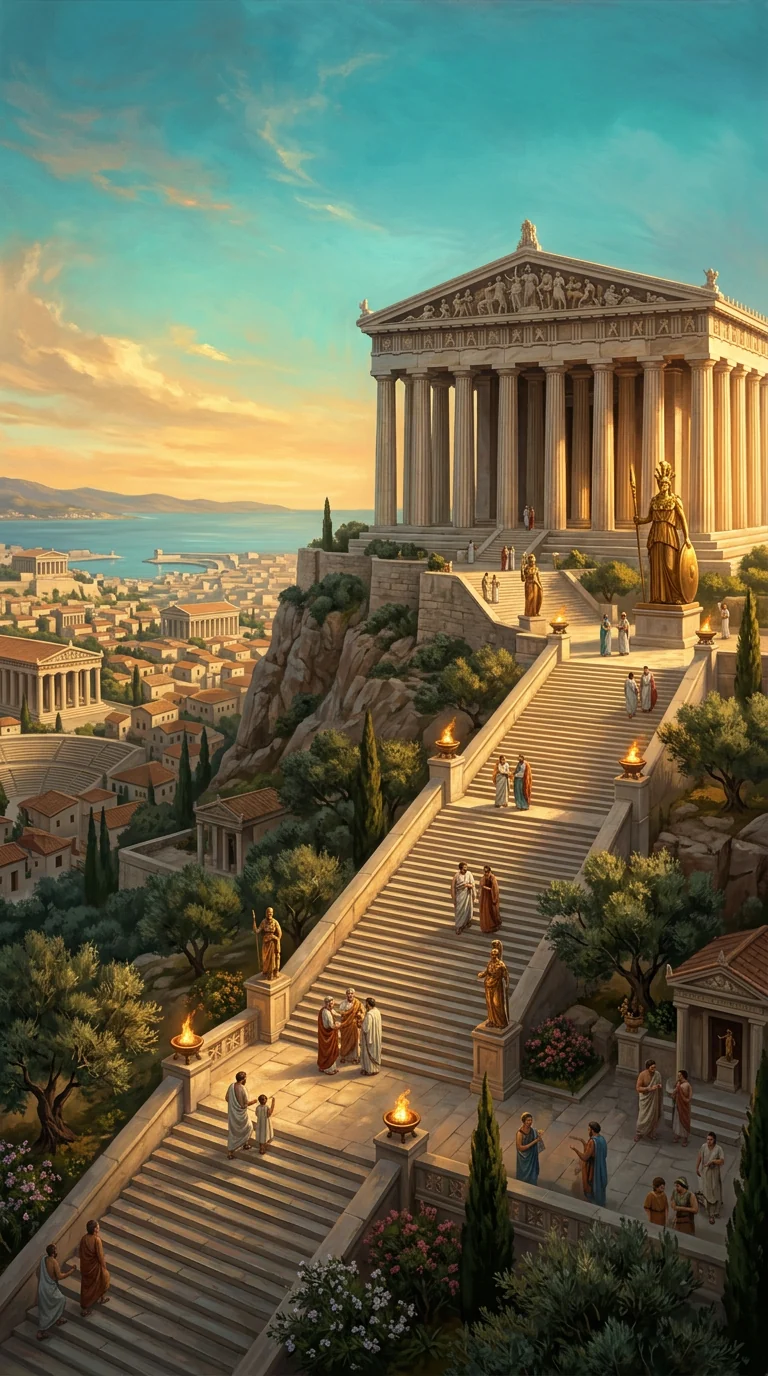
638 years from first stone to final column—the longest construction in ancient Greece
🏛️ "Started 515 BCE. Finished 132 CE. That's one seriously delayed project."
515 BCE - 132 CE
Tyrant Peisistratos began it. Democracy abandoned it. Kings attempted it. Emperor Hadrian finally completed it—638 years later. Generations grew old watching partial columns stand frozen in time.
Key Milestones:
Massive Scale
104 colossal Corinthian columns. Each 17 meters tall. Inside: a gold-and-ivory Zeus statue rivaling the Seven Wonders.
Dimensions
96m × 40m (larger than a football field)
Today
15 columns still standing (one fell in 1852)
💪 "104 columns. 638 years. One very patient god."
"Construction time longer than the entire existence of the United States. Ancient Greece did not rush."
This isn't a documentary or audio tour. It's a meditation that transports your mind to ancient Athens at the temple's completion, using cinematic storytelling and 3D spatial audio to create presence and emotional connection.
You begin standing at the temple's entrance in 132 CE, the day of its dedication ceremony under Emperor Hadrian. The narrator guides you in second person: "You look up at the columns towering above you—17 meters of marble reaching toward Zeus himself. You feel impossibly small." The spatial audio makes you viscerally experience the overwhelming scale.
The journey takes you through the temple's massive peristyle (outer colonnade), where sunlight filters between columns creating dramatic shadows. You walk among ancient Athenians who've gathered for the dedication—some elderly citizens who never thought they'd see this day, children wide-eyed at the spectacle, priests preparing offerings to Zeus.
You enter the cella (inner chamber) and confront the colossal statue of Zeus: gold gleaming, ivory skin, eyes that seem to follow you. The spatial audio renders the acoustic of the vast interior—your footsteps echo differently here, quieter, more sacred. Ancient worshippers whisper prayers around you, their voices overlapping in respectful reverence.
The climax guides you through Hadrian's dedication ceremony: ritual processions, hymns to Zeus, offerings of bulls and incense, the emperor's speech connecting Rome to Greek heritage. You experience not just the temple as architecture, but the temple as living sacred space, filled with meaning for those who finally saw it finished after 638 years. The journey doesn't tell you this was important; it makes you feel why it mattered.
3D spatial audio is essential for experiencing the temple's overwhelming scale. When the narrator says "look up," you hear birds circling high above, their cries distant and echoing. When you walk between columns, your footsteps sound differently depending on your position—closer to marble, more reverberant; in open space, clearer and sharper. Your brain interprets these acoustic cues as physical space.
The audio landscape includes layered environmental sounds: wind moving through the massive colonnade (different acoustics than smaller temples); the murmur of crowds positioned spatially around you; ritual drums during the ceremony positioned to your left; priests chanting positioned near the statue. These aren't random sound effects—they're positioned in 3D space to create the illusion you're physically present.
The scale is rendered through sound perspective: when you're at the base of a column, you hear stone creaking subtly under the massive weight above; when you step back, the entire temple has a spatial "presence"—a low-frequency hum of massive architecture. Binaural recording captures how sound reaches human ears differently in vast spaces versus enclosed chambers.
The narrator's voice adapts to the environment: inside the cella, it's more intimate and reverberant; outside among the columns, it opens up with natural outdoor acoustics. Combined with meditative pacing and second-person narrative, the spatial audio doesn't just describe the Temple of Olympian Zeus—it makes you believe you're standing there, surrounded by marble and history.
"We can't promise Zeus will appear. But with 3D audio this good, you might mistake thunder for his mood."
Cinematic Journey
You begin standing at the temple's entrance in 132 CE, the day of its dedication. Looking up at columns towering 17 meters above, you feel impossibly small beneath Zeus's domain. The spatial audio renders the overwhelming scale acoustically.
You walk among ancient Athenians gathered for Hadrian's ceremony—elderly citizens who never thought they'd see this day, children wide-eyed at the spectacle. Enter the inner chamber where the colossal gold-and-ivory Zeus statue gleams, eyes seemingly following you.
3D spatial audio positions ritual processions, hymns, and offerings spatially around you. Your footsteps echo differently in vast spaces versus enclosed chambers. You're not learning about history—you're witnessing the moment 638 years of construction finally ended.
⚡ "Zeus approved. 638 years later, but still approved."
Active Imagination
Spatial Sound
Real History
Emotional Connection
Visionaria isn't traditional mindfulness. It's cinematic imagination meditation—storytelling that engages your mind so fully that mindfulness happens naturally through active visualization.
Traditional meditation asks you to "empty your mind." Visionaria gives your mind something richer: witnessing Emperor Hadrian dedicate the largest temple in Greece after 638 years.
✨ "Traditional meditation: 'Find inner peace.' Visionaria: 'Stand beneath 104 columns and feel tiny.'"
For 14 minutes, you're not scrolling or solving problems:
You're standing at the Temple of Olympian Zeus in 132 CE, witnessing history. Your nervous system downregulates naturally. You return refreshed, having traveled 1,900 years without leaving your chair.
Explore Zeus's colossal temple through immersive 3D audio. Learn about Hadrian's dedication, Hellenistic engineering, and 638 years of construction through spatial storytelling.
If traditional "breathe and observe" meditation feels boring, try cinematic meditation through ancient Greece's largest temple. Mindfulness through compelling historical narrative.
Escape modern chaos for 14 minutes by traveling to 132 CE Athens. No prep work, no special equipment—just headphones and willingness to close your eyes.
You don't need meditation experience or knowledge of Greek history. Just headphones, 14 minutes, and curiosity. The journey meets you where you are.
"It took 638 years to build this temple. Lucky for you, the journey only takes 14 minutes. Ancient Greeks would be jealous."
You'll learn real history about the Temple of Olympian Zeus—the 638-year construction, Hadrian's completion, the architectural scale, Zeus worship—but not through dry narration. You learn by experiencing it emotionally. When you "witness" elderly Athenians weeping at the dedication ceremony, you understand what it meant to finally see the temple finished. When you "feel" the overwhelming scale of the columns, you appreciate ancient engineering ambition. Education sticks when it's tied to emotion, and Visionaria makes ancient history feel personally meaningful, not academically distant.
Modern life is exhausting: constant digital noise, decision fatigue, information overwhelm. Visionaria offers structured mental escape that's healthy and rejuvenating. For 14 minutes, you're not scrolling feeds or solving problems. You're standing among the columns of Zeus's temple in 132 CE, witnessing ancient Athens' greatest architectural triumph. Your nervous system downregulates naturally. Your perspective expands. You return to the present moment refreshed, having traveled six centuries without leaving your chair. It's escapism that enriches rather than numbs, rest that restores rather than distracts.
You don't need meditation experience, knowledge of Greek history, or special skills. Just headphones, 14 minutes, and willingness to close your eyes. The journey meets you where you are: history buffs appreciate the archaeological accuracy; meditation seekers value the mindfulness; stressed professionals enjoy the mental break; curious minds love the storytelling. It's designed for human brains, which naturally love compelling stories set in fascinating places. If you can imagine, you can experience Visionaria—no prerequisites, no barriers, no judgment.
"It took 638 years to build this temple. Lucky for you, the journey only takes 14 minutes. Ancient Greeks would be jealous."
Experience the largest temple in ancient Greece, understand the 638-year construction timeline, and witness the architectural ambition that defined an era. Perfect for those fascinated by ancient megaprojects.
If traditional meditation feels boring, try cinematic meditation. Engage your imagination so fully that mindfulness happens naturally through storytelling and spatial audio immersion.
Escape work stress and digital overwhelm. Spend 14 minutes among Zeus's columns in ancient Athens, let your nervous system reset, and return to work refreshed and centered.
Can't visit Athens right now? Experience the Temple of Olympian Zeus through immersive audio. Perfect for armchair travelers or those planning future trips who want emotional context before visiting.
Make Greek history tangible and memorable. Use Visionaria as a teaching tool to help students emotionally connect with ancient architecture, understanding scale and ambition beyond textbook facts.
No prerequisites needed. If you're curious about Zeus, Greek temples, or ancient construction, this journey meets you where you are and makes the past feel immediate, tangible, and awe-inspiring.
"Also perfect for people who think modern construction delays are bad. This temple took longer than most civilizations."
Explore more ancient Athens experiences through spatial audio meditation.
Everything you need to know about this journey
Download Visionaria and start your journey today.
"It took 638 years to build. But experiencing it? Just 14 minutes. Zeus approves of efficiency."