
Launch special: Visionaria Premium is free—all cinematic journeys with spatial 3D audio.
🇺🇦 Support Ukrainian creators on Patreon — help us make a difference
Launch special: Visionaria Premium is free—all cinematic journeys with spatial 3D audio.
🇺🇦 Support Ukrainian creators on Patreon — help us make a difference
The Tomb of Theseus (Greek: Θησείον) was an ancient hero shrine (heroon) located in Athens, Greece, dedicated to Theseus, the legendary founder-king of Athens who unified the scattered villages of Attica into a single city-state and slayed the Minotaur in Crete's labyrinth. According to Plutarch and Pausanias, Theseus' remains were supposedly retrieved from the island of Skyros in 475 BCE by the Athenian general Cimon and reburied in a monumental tomb near the Athenian agora. This shrine became a major cult center where Athenians performed hero worship rituals, made offerings, and sought Theseus' protection before military campaigns. The cult of Theseus was politically significant as it reinforced Athens' democratic ideals—Theseus was credited with inventing democracy (synoikismos) and embodied the civic virtues of courage, justice, and devotion to the polis.
"Theseus killed a bull-headed monster in a maze. Your commute doesn't seem so bad now, does it?"
"Founding a city, killing monsters, navigating labyrinths. Theseus was the original multitasker."
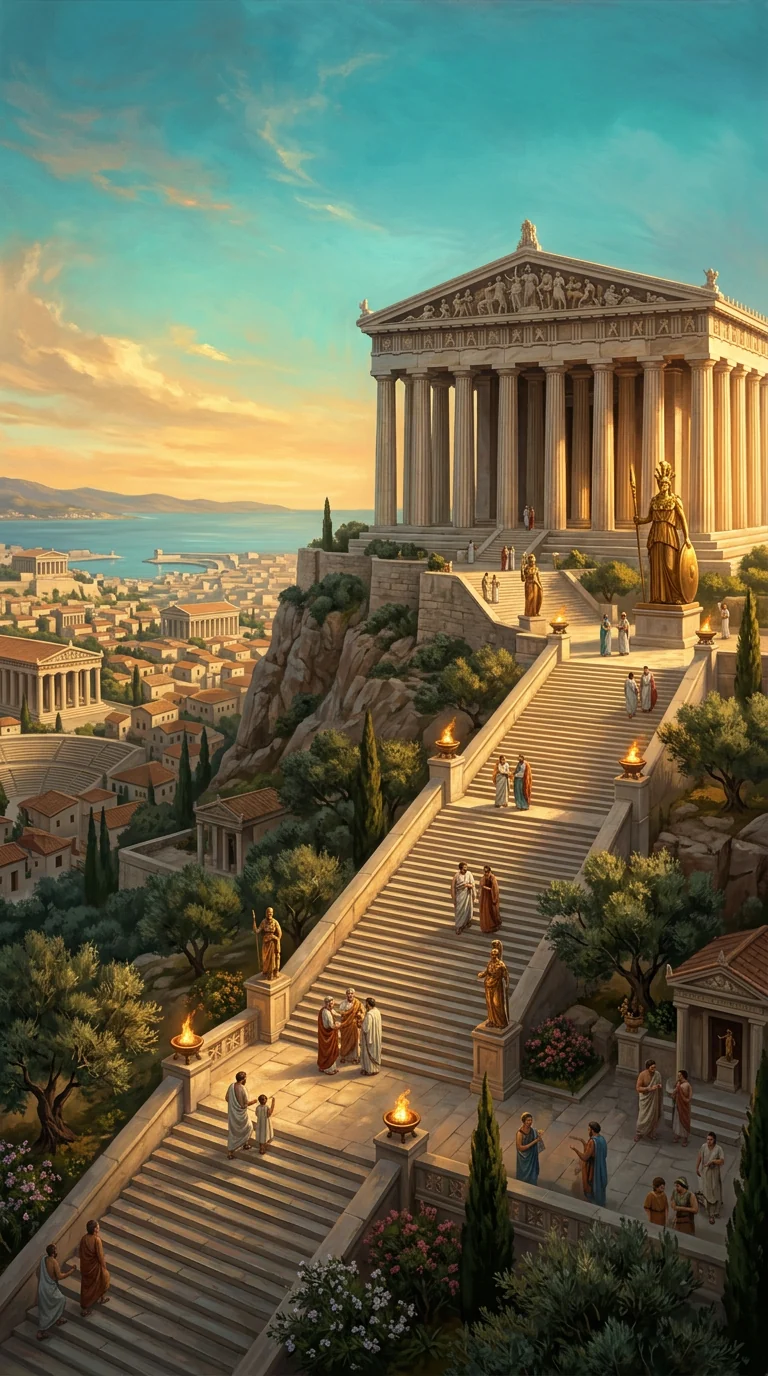
Slayer of the Minotaur, founder of democracy, Athens' eternal symbol
🏛️ "Killed a Minotaur. United Attica. Probably too busy for LinkedIn."
Mythological Hero
Theseus killed the Minotaur, united Attica's villages into Athens, and established early democracy. He performed Six Labors, clearing roads of bandits. Not just a warrior—a civilizer.
Key Achievements:
Political Symbol
476 BCE: General Cimon "discovered" Theseus's bones on Skyros. Built the Theseion tomb-shrine. Not just religion—propaganda to legitimize Athenian imperialism.
Sanctuary Role
Protected escaped slaves and the oppressed
Battle of Marathon
Soldiers swore they saw his ghost fighting Persians
⚔️ "Found on an island. Claimed as Theseus. Ancient PR at its finest."
"Theseus: Killed monsters, founded democracy, became eternal propaganda. Multitasker."
Cinematic Journey
You begin standing before the Theseion tomb-shrine in 476 BCE, the day Cimon returns with Theseus's bones. Ancient Athenians crowd around, some weeping to finally honor their founder. The narrator guides you through the procession, the rituals, the belief.
Enter the shrine where the hero's relics rest. Priests chant. Offerings burn. You hear stories of the Minotaur, the labyrinth, the Six Labors—myths that shaped Athenian identity. Spatial audio positions voices around you: old men recounting battles, young boys imagining glory.
3D spatial audio renders the tomb as living space, not static history. Footsteps echo on marble. Incense smoke drifts spatially. You're not observing a hero cult—you're standing among believers who see Theseus as protector, founder, eternal guardian of Athens.
⚔️ "Meet Athens' founder. Or at least his alleged bones."
Active Imagination
Spatial Sound
Real History
Emotional Connection
Visionaria isn't traditional mindfulness. It's cinematic imagination meditation—storytelling that engages your mind so fully that mindfulness happens naturally through active visualization.
Traditional meditation asks you to "empty your mind." Visionaria gives your mind something richer: standing among ancient Athenians honoring their legendary founder.
✨ "Traditional meditation: 'Clear thoughts.' Visionaria: 'Imagine Minotaur myths.' Way more interesting."
For 13 minutes, you're not scrolling or solving problems:
You're at the Tomb of Theseus in 476 BCE, witnessing hero worship. Your nervous system downregulates naturally. You return refreshed, having traveled 2,500 years without leaving your chair.
Dive deep into Theseus's legendary deeds, the hero cult tradition, and how myths shaped Athenian democracy. Experience Greek mythology through spatial immersion, not textbooks.
If traditional "breathe and observe" meditation feels boring, try cinematic meditation. Engage your imagination with heroic legends so fully that mindfulness happens naturally through story.
Escape modern chaos for 13 minutes by traveling to ancient Athens. No prep work, no special equipment—just close your eyes and experience Theseus's tomb-shrine through spatial audio storytelling.
You don't need meditation experience, knowledge of Greek mythology, or special skills. Just headphones, 13 minutes, and willingness to close your eyes. The journey meets you where you are.
"Theseus navigated a labyrinth. You're navigating Monday. Both require heroic levels of patience."
In 476 BCE, Athenian general Cimon orchestrated a dramatic political theater: he "discovered" Theseus's bones on the island of Skyros (where legend said the hero died) and brought them back to Athens with a grand procession. The city built a magnificent tomb-shrine called the Theseion to house the relics. This wasn't just pious archaeology—it was propaganda.
The timing was deliberate. Athens had just defeated the Persians at Marathon and Salamis and was establishing the Delian League (an alliance of Greek states under Athenian leadership). By "recovering" Theseus's bones, Cimon reminded Greeks that Athens had always been a unifier and protector. Just as Theseus united Attica, Athens would now unite Greece against Persian threats. The hero cult legitimized Athenian imperialism.
Ancient writers describe hero cult rituals at the tomb: sacrifices, prayers, athletic competitions, and annual festivals. Athenians believed Theseus's spirit actively protected the city—sailors invoked him before voyages, soldiers before battle. Plutarch records that during the Battle of Marathon (490 BCE), Athenian soldiers swore they saw Theseus's ghost fighting alongside them against the Persians. The tomb wasn't a memorial to the dead; it was a living political force.
The Theseion also served as a sanctuary for escaped slaves and the oppressed. Because Theseus championed the weak against powerful oppressors (bandits, kings, monsters), his shrine became a place where vulnerable people could claim protection. This reinforced Athenian democratic ideology: Athens stood for justice and equality, protecting the powerless from tyranny. The tomb was as much about civic values as religious worship—it taught Athenians what it meant to be Athenian.
The Tomb of Theseus exemplified the Greek tradition of hero shrines (heroa) where legendary figures became focal points of civic identity and political legitimacy, much like the Tomb of Leonidas in Sparta (where the warrior-king who died at Thermopylae symbolized Spartan martial excellence) and later the Tomb of Alexander the Great in Alexandria (where the world-conqueror's body became a political prize fought over by Hellenistic rulers)—each tomb serving as more than burial site, functioning as sacred spaces where civic mythology, religious veneration, and political power converged.
"Cimon 'found' bones on an island and claimed they were Theseus. Ancient Athenians believed it. Guess skepticism wasn't invented yet."
This isn't a documentary or audio tour. It's a meditation that transports your mind to ancient Athens' most sacred hero shrine, using cinematic storytelling and 3D spatial audio to create presence and emotional connection.
You begin standing before the Theseion in classical Athens, 5th century BCE. The narrator guides you in second person: "You approach the marble shrine where Theseus's bones rest beneath your feet. You see offerings laid by citizens—olive branches, wine, prayers written on clay tablets. You feel the weight of myth made tangible." The spatial audio makes you viscerally present at a sacred site.
The journey takes you through hero cult rituals: priests performing libations (liquid offerings), worshippers lighting incense, young athletes dedicating victories to Theseus before competitions. You hear ancient Athenians praying to the hero, asking for courage, protection, or justice. The spatial audio renders these voices around you—some close and intimate, others distant and echoing—creating the acoustic landscape of ancient religious practice.
You're guided through Theseus's legendary deeds not as abstract myth, but as living memory for ancient Athenians. The narrator recounts the Minotaur battle as Athenian storytellers would have: "Theseus entered the labyrinth with only a sword and Ariadne's thread. He heard the beast's breathing in the darkness..." The spatial audio creates the labyrinth acoustically—echoing stone corridors, the Minotaur's distant roar, Theseus's footsteps growing closer to danger.
The climax places you at an annual Theseia festival—athletic games and processions honoring the hero. You experience the crowd's energy, ritual chants, the moment when an elder publicly recounts how Theseus united Athens and established justice. The journey doesn't just tell you Theseus mattered to ancient Athenians; it makes you feel why he mattered—how a mythical hero became the foundation of civic identity and democratic values.
3D spatial audio is essential for experiencing the hero cult's living atmosphere. When worshippers gather around you, you hear their voices positioned spatially in a circle—some to your left praying quietly, some to your right chanting, some behind you placing offerings. Your brain interprets these spatial cues as physical presence, creating the immersive feeling of standing in a crowd of ancient Athenians.
The audio landscape includes layered ceremonial sounds: the crackle of incense burning positioned near the shrine entrance; footsteps on marble positioned moving around you as priests walk the perimeter; the distant echo of athletic competitions from nearby games; birds circling above the sanctuary. These aren't random effects—they're positioned in 3D space to create the acoustic signature of a sacred shrine during festivals.
The mythical sequences use spatial audio for narrative immersion: when recounting the Minotaur legend, the labyrinth is rendered acoustically with echoing corridors, the beast's breathing moving around you in darkness, and Theseus's sword striking stone from specific directions. When describing Theseus uniting Attica, you hear distant village voices calling out in agreement, positioned at different locations to create geographic space. Myth becomes spatially tangible.
The narrator's voice adapts to context: inside the shrine, it's reverent and close; during festival scenes, it opens up with outdoor acoustics and crowd noise; during mythical flashbacks, it takes on a storyteller's cadence with spatial sound effects supporting the narrative. Combined with meditative pacing and second-person perspective, the spatial audio doesn't just describe the Tomb of Theseus—it makes you believe you're standing there, surrounded by ancient rituals and living legends.
"The spatial audio makes you hear ancient Greeks praying around you. Don't worry, they can't actually see your pajamas."
Visionaria isn't traditional mindfulness. It's cinematic imagination meditation—storytelling that engages your mind so fully that time disappears and you experience flow state naturally.
Traditional meditation asks you to "empty your mind" or "focus on breathing." Visionaria gives your mind something richer: a compelling mythological journey through ancient Athens' most sacred hero shrine. Your imagination is fully engaged visualizing the tomb, the hero cult rituals, Theseus's legendary deeds, the worshippers around you. This active imagination creates mindfulness organically—you're so absorbed in the experience that racing thoughts naturally quiet. It's meditation disguised as heroic legend, making it accessible to people who find traditional meditation boring or difficult.
You'll learn real history about Theseus—the Minotaur myth, the unification of Attica, the hero cult, Cimon's political use of the tomb—but not through dry narration. You learn by experiencing it emotionally. When you "hear" ancient Athenians praying to Theseus for courage, you understand how myths shaped civic values. When you "witness" the Theseia festival, you appreciate how legendary heroes unified communities. Education sticks when it's tied to emotion, and Visionaria makes ancient Greek hero worship feel personally meaningful, not academically distant.
Modern life is exhausting: constant notifications, decision fatigue, endless responsibilities. Visionaria offers structured mental escape that's healthy and rejuvenating. For 13 minutes, you're not scrolling feeds or solving problems. You're standing at Theseus's tomb in classical Athens, surrounded by ancient worshippers honoring their legendary founder. Your nervous system downregulates naturally. Your perspective widens beyond daily stresses. You return to the present moment refreshed, having traveled 2,500 years without leaving your chair. It's escapism that enriches rather than numbs.
You don't need meditation experience, knowledge of Greek mythology, or special skills. Just headphones, 13 minutes, and willingness to close your eyes. The journey meets you where you are: mythology lovers appreciate the authentic retellings; meditation seekers value the mindfulness; stressed professionals enjoy the mental break; curious minds love the storytelling. It's designed for human brains, which naturally love heroic legends set in fascinating places. If you can imagine, you can experience Visionaria.
"Theseus navigated a labyrinth. You're navigating Monday. Both require heroic levels of patience."
Dive deep into Theseus's legendary deeds, the hero cult tradition, and how myths shaped Athenian democracy. Experience Greek mythology through spatial immersion, not textbooks.
If traditional "breathe and observe" meditation feels boring, try cinematic meditation. Engage your imagination with heroic legends so fully that mindfulness happens naturally through story.
Escape work stress and digital overload. Spend 13 minutes at Theseus's tomb in ancient Athens, let your nervous system reset, and return to work refreshed and centered.
Can't visit Athens right now? Experience Theseus's legendary tomb through immersive audio. Perfect for armchair travelers or those planning future trips who want emotional context before visiting.
Make Greek mythology tangible and memorable. Use Visionaria as a teaching tool to help students emotionally connect with ancient heroes, understanding how myths shaped civic identity beyond memorizing names.
No prerequisites needed. If you're curious about Theseus, the Minotaur, or how ancient heroes inspired civilizations, this journey meets you where you are and makes legends feel immediate and alive.
"Also perfect for people who think their problems are complicated. At least you don't have to fight a half-bull monster in a maze."
Explore more ancient Athens experiences through spatial audio meditation.
Everything you need to know about this journey
Download Visionaria and start your journey today.
"Theseus slayed the Minotaur. You just need to download an app. Your quest is much easier."