Launch special: Visionaria Premium is free—all cinematic journeys with spatial 3D audio.
🇺🇦 Support Ukrainian creators on Patreon — help us make a difference
Launch special: Visionaria Premium is free—all cinematic journeys with spatial 3D audio.
🇺🇦 Support Ukrainian creators on Patreon — help us make a difference
"Where democracy was invented—along with really impressive columns."
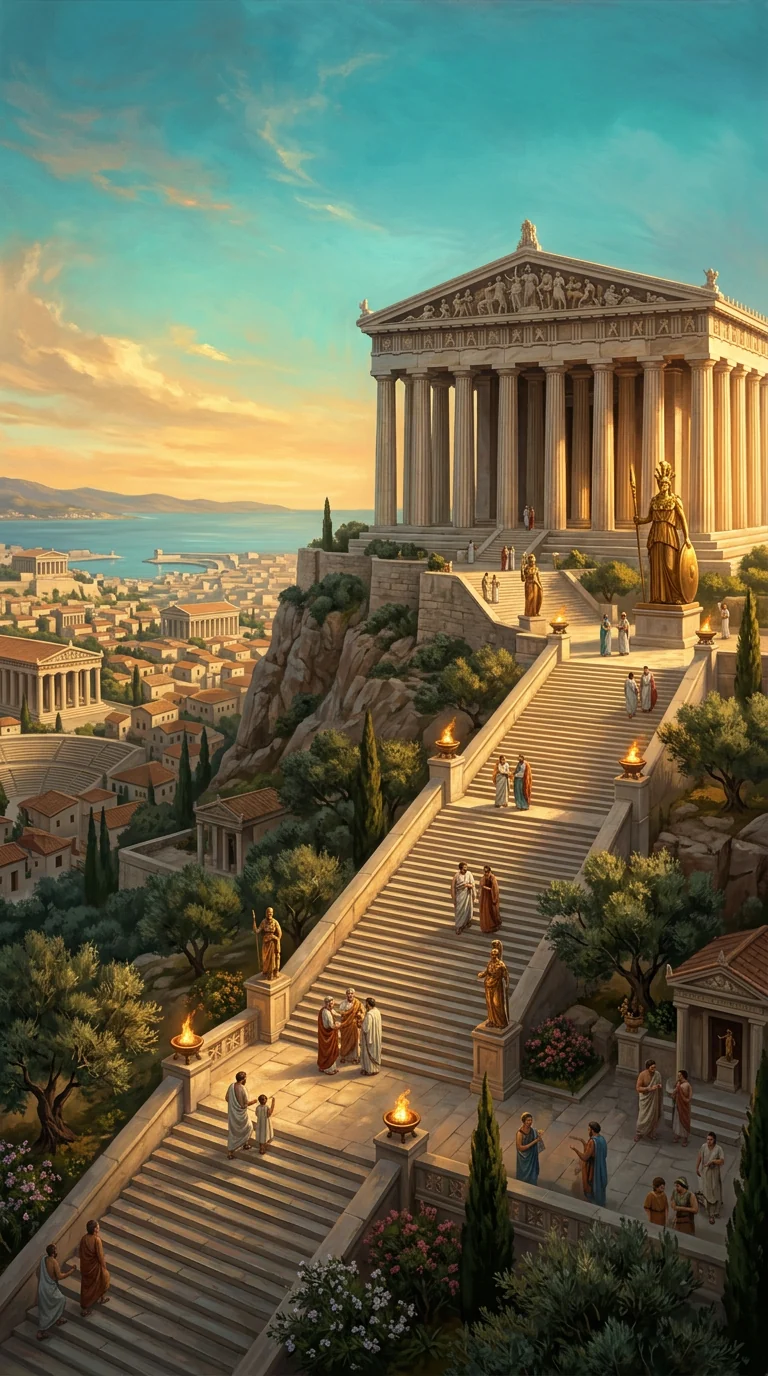
The Parthenon (Greek: Παρθενώνας) is an ancient Greek temple located on the Acropolis of Athens, Greece, constructed between 447-432 BCE during the Golden Age of Athens under the leadership of Pericles. Dedicated to the goddess Athena Parthenos (Athena the Virgin), patron deity of Athens, this Doric peripteral temple was designed by architects Iktinos and Kallikrates and featured sculptural decoration by Pheidias. The Parthenon housed a massive 12-meter tall chryselephantine (gold and ivory) statue of Athena and served as both a religious sanctuary and a treasury for the Delian League. Recognized as the pinnacle of classical Greek architecture, the Parthenon's perfect proportions, optical refinements, and elaborate sculptural program (including 92 metopes and the 160-meter Panathenaic frieze) represent the apex of ancient Greek artistic and architectural achievement.
The Parthenon stood as the centerpiece of the Acropolis sacred complex, surrounded by complementary temples including the Erechtheion (housing Athena Polias' cult statue with innovative Ionic Caryatid architecture) and the Temple of Athena Nike (celebrating military victories with wingless Nike)—this architectural ensemble showcased Athens' mastery of multiple Greek orders (Doric, Ionic) while expressing different facets of Athena worship, from the Parthenon's grand Doric monumentality symbolizing imperial power to the intimate Ionic grace of its neighboring sanctuaries.
The Parthenon anchored Athens' integrated urban system where sacred, civic, and intellectual infrastructure created a unified cultural identity—while the Acropolis temples (Parthenon, Erechtheion) expressed religious authority, the Panathenaic Stadium celebrated athletic excellence, the Tower of the Winds provided practical timekeeping for the agora marketplace, and the Temple of Olympian Zeus demonstrated imperial Roman-Greek continuity—this architectural network shows how Athens organized space to reflect values (wisdom, athletics, commerce, divine power), creating a city where monumental buildings functioned as an interconnected system expressing Athenian identity through stone.
🏛️ What is the Parthenon experience?
A 15-minute spatial audio meditation that transports you to the Parthenon on the Acropolis. Experience the grandeur of Athens' greatest temple, witness religious ceremonies, and connect with the wisdom tradition through immersive 3D soundscapes.
Climb the marble steps of the Acropolis to Athens' crowning achievement. Witness the massive gold-and-ivory statue of Athena Parthenos, hear priests chanting hymns, and experience the democratic spirit that built the ancient world's most perfect temple.
💡 "Philosophy not included, but strongly recommended."
Every detail is based on archaeological evidence and ancient historical sources
🏛️ "Pericles spared no expense—democratic budgets were different back then."
447-432 BCE
The Parthenon stands on the Athenian Acropolis as the most perfect example of classical Greek architecture. Built under Pericles during Athens' Golden Age, it was designed by architects Ictinus and Callicrates, with sculptural programs by the master Phidias. The temple demonstrates extraordinary mathematical precision and optical refinements that make its columns appear perfectly straight to the human eye.
Architectural Features:
Primary Sources
The Parthenon and its ceremonies are documented by ancient Greek and Roman writers who described Athens' religious festivals and architectural wonders in extraordinary detail.
Plutarch (46-120 CE)
Greek biographer & historian
Pausanias (2nd century CE)
Greek geographer & traveler
Thucydides (460-400 BCE)
Athenian historian
📜 "Plutarch documented everything—ancient Twitter before Twitter existed."
The Parthenon was more than a temple—it was a political statement of democratic Athens' power and cultural supremacy. After defeating the Persian Empire at Marathon and Salamis, Pericles redirected funds from the Delian League (a mutual defense alliance) to finance the most ambitious building program the ancient world had ever seen. The Acropolis reconstruction showcased Athenian wealth, artistic achievement, and devotion to Athena, their patron goddess.
The Parthenon anchored the Acropolis's magnificent sacred complex, which also included the Erechtheion (with its famous Caryatid Porch), the Temple of Athena Nike (celebrating Athenian military victories), and the monumental Propylaea gateway, creating an integrated architectural masterpiece that proclaimed Athens as the cultural capital of the Greek world.
The temple's sculptural programs told stories central to Athenian identity. The west pediment depicted Athena's contest with Poseidon for patronage of the city—Athena won by offering the olive tree. The east pediment showed her miraculous birth from Zeus's head, fully armed. The continuous Ionic frieze wrapped around the inner chamber, portraying the Panathenaic procession, the greatest religious festival in Athens where citizens presented a new peplos (sacred robe) to Athena's statue.
Inside the temple's main chamber, visitors encountered one of the ancient world's most spectacular artworks: Phidias's chryselephantine statue of Athena Parthenos. Standing 12 meters tall, the statue combined gold plates over a wooden frame with ivory for exposed skin. Athena held a small statue of Nike (Victory) in her right hand and a shield decorated with mythological battle scenes in her left. A serpent, representing Erichthonius (a mythical Athenian king), coiled at her feet. Ancient sources describe the statue's overwhelming magnificence and the way gold reflected lamplight throughout the chamber.
The Parthenon's optical refinements demonstrate the extraordinary sophistication of Greek architecture. The columns are not perfectly vertical—they lean slightly inward. The base platform curves upward at the center (called entasis) to prevent the optical illusion of sagging. Corner columns are slightly thicker and closer together. These subtle mathematical adjustments, invisible to casual observation, create the visual perfection that has made the Parthenon the gold standard of classical architecture for over 2,400 years.
An immersive 15-minute journey through ancient Athens' greatest architectural achievement
Through 3D spatial audio, you'll ascend the Sacred Way up the Acropolis, pass through the monumental Propylaea gateway, and approach the Parthenon itself. You'll hear your footsteps on marble pavement, distant conversations of Athenian citizens, priests chanting hymns to Athena, and the subtle echoes that demonstrate the temple's extraordinary acoustics.
The soundscape places you in 447 BCE, during the temple's construction peak. You'll experience the atmosphere of religious devotion, civic pride, and philosophical inquiry that defined the Golden Age of Athens. This isn't passive listening—it's active imagination, where you become a participant in ancient Athenian life.
Our binaural audio engineering creates a precise 360-degree soundscape. When the narrator describes priests to your left, you hear them from that exact direction. When you enter the temple chamber, the acoustics shift to match the enclosed marble space. Wind, footsteps, chanting, and ambient sounds are spatially positioned exactly as you'd hear them if you were actually there.
The narration uses second-person perspective ("You ascend the marble steps...") combined with meditative pacing. This technique engages your imagination more powerfully than traditional documentary narration, making you the protagonist of the story rather than a passive observer.
🎧 "Best experienced with eyes closed and philosophical mindset activated."
The journey is structured in three movements: The Ascent (approaching the Acropolis through ancient Athens), The Temple (exploring the Parthenon's architecture and religious significance), and The Revelation (witnessing ceremonies and connecting with Athenian wisdom traditions). Each movement builds emotional and sensory depth, culminating in a moment of reflection on what Athena's wisdom means for modern life.
Unlike museum audio tours that describe artifacts from outside glass cases, this experience places you inside history. You're not learning about the Parthenon—you're experiencing it. The combination of spatial audio, historical accuracy, and meditative pacing creates what neuroscientists call "embodied cognition": your brain processes the journey as if you're genuinely present in ancient Athens.
💭 "Time travel not guaranteed, but your imagination will do most of the work."
While traditional meditation focuses on breathing and present-moment awareness, Visionaria adds historical immersion and narrative engagement
Rather than emptying your mind, you're filling it with historically accurate imagery—marble columns, golden statues, ceremonial processions. This guided visualization technique is proven to enhance memory, creativity, and emotional engagement compared to passive relaxation.
Psychologists call it "narrative transportation"—becoming so absorbed in a story that you temporarily forget your surroundings. This deep immersion triggers the same neural pathways as actual travel, allowing you to experience ancient Athens without leaving your living room.
You'll learn about Athenian democracy, Greek architecture, Pericles' Golden Age, Athena's mythology, and the Panathenaic Festival—but it won't feel like a history lesson. The experiential learning approach embeds knowledge naturally through sensory experience.
The Parthenon represents human achievement at its peak—the marriage of art, mathematics, philosophy, and civic devotion. Experiencing this grandeur can inspire your own aspirations, whether in creative work, intellectual pursuits, or personal growth.
🧠 "Plato would approve of this use of technology—probably."
Traditional meditation apps ask you to focus on breath or body sensations, which can feel abstract or boring for many people. Visionaria's approach gives your mind something concrete to work with: a specific historical location, architectural details, cultural context, and narrative progression. This makes meditation more accessible to people who struggle with conventional mindfulness practices.
The cognitive benefits extend beyond the 15-minute session. Users report enhanced focus, improved visualization skills, greater historical knowledge retention, and increased motivation for creative projects. Some listeners use the Parthenon journey specifically before important presentations or decision-making, drawing on Athena's symbolism as the goddess of wisdom and strategic thinking.
✨ "Not FDA-approved for wisdom acquisition, but users report significant insights anyway."
Whether you're a history enthusiast, meditation beginner, or wisdom seeker, the Parthenon journey offers something valuable
Experience ancient Athens beyond textbooks—hear the temple ceremonies, understand the architectural genius, and connect emotionally with classical Greek civilization.
If traditional meditation feels too abstract, this narrative-driven approach provides structure and engagement while still delivering mindfulness benefits.
Immerse yourself in the cultural context that produced Socrates, Plato, and Aristotle—understand why Athens became the birthplace of Western philosophy.
Use Athena's wisdom symbolism for decision-making, strategic thinking, and inspiration during important life transitions or creative projects.
Supplement Ancient History or Classical Studies coursework with experiential learning that makes Greek civilization memorable and emotionally resonant.
Visit the Acropolis from your living room—experience what it might have felt like to witness the Parthenon in its original glory with Phidias's golden Athena.
🎭 "Toga optional, but philosophical mindset encouraged."
🏛️ "One temple down, 150+ more journeys to go—Athens is just the beginning."
Everything you need to know about this journey
Experience the Parthenon and 150+ other cinematic meditations. Download Visionaria now and step into ancient Athens—no passport or time machine required. Just headphones, curiosity, and maybe a bit of philosophical wonder.
"Socratic debates sold separately, wisdom included."