
Launch special: Visionaria Premium is free—all cinematic journeys with spatial 3D audio.
🇺🇦 Support Ukrainian creators on Patreon — help us make a difference
Launch special: Visionaria Premium is free—all cinematic journeys with spatial 3D audio.
🇺🇦 Support Ukrainian creators on Patreon — help us make a difference
"Where goodbyes got legendary and gates got famous."
The Scaean Gate (Greek: Σκαιαί Πύλαι, "Left Gate") was the main western entrance to the fortified city of Troy (Ilium), located in modern-day northwest Turkey (Hisarlik), and the most strategically important passage through Troy's legendary defensive walls. According to Homer's Iliad, this gate witnessed the most iconic moments of the Trojan War (c. 1194-1184 BCE), including Hector's farewell to his wife Andromache and infant son before his fatal duel with Achilles, and served as the primary access point for Trojan warriors defending their city. Archaeological excavations by Heinrich Schliemann (1870s) and subsequent archaeologists have revealed multiple layers of Troy's massive stone fortification walls, with Troy VI/VIIa (c. 1300-1180 BCE) matching the Homeric descriptions—featuring walls up to 9 meters high with distinctive sloping limestone foundations and towers flanking monumental gates.
🚪 What is the Scaean Gate experience?
A 17-minute spatial audio meditation that transports you to Troy's most dramatic threshold. Experience the gate where Homer's most emotional scenes occurred through immersive 3D soundscapes.
Stand at Troy's threshold as massive bronze doors open with deep metallic resonance. Witness Hector bidding farewell to Andromache and baby Astyanax in Homer's most emotional scene. Hear warriors assembling, families praying, the acoustic shift from protected interior to exposed battlefield. Experience the gate as boundary between life and death through immersive spatial audio.
Free spatial audio journey • Available on iOS & Android
🚪 "Best gate for dramatic farewells. Five stars on Ancient Yelp."
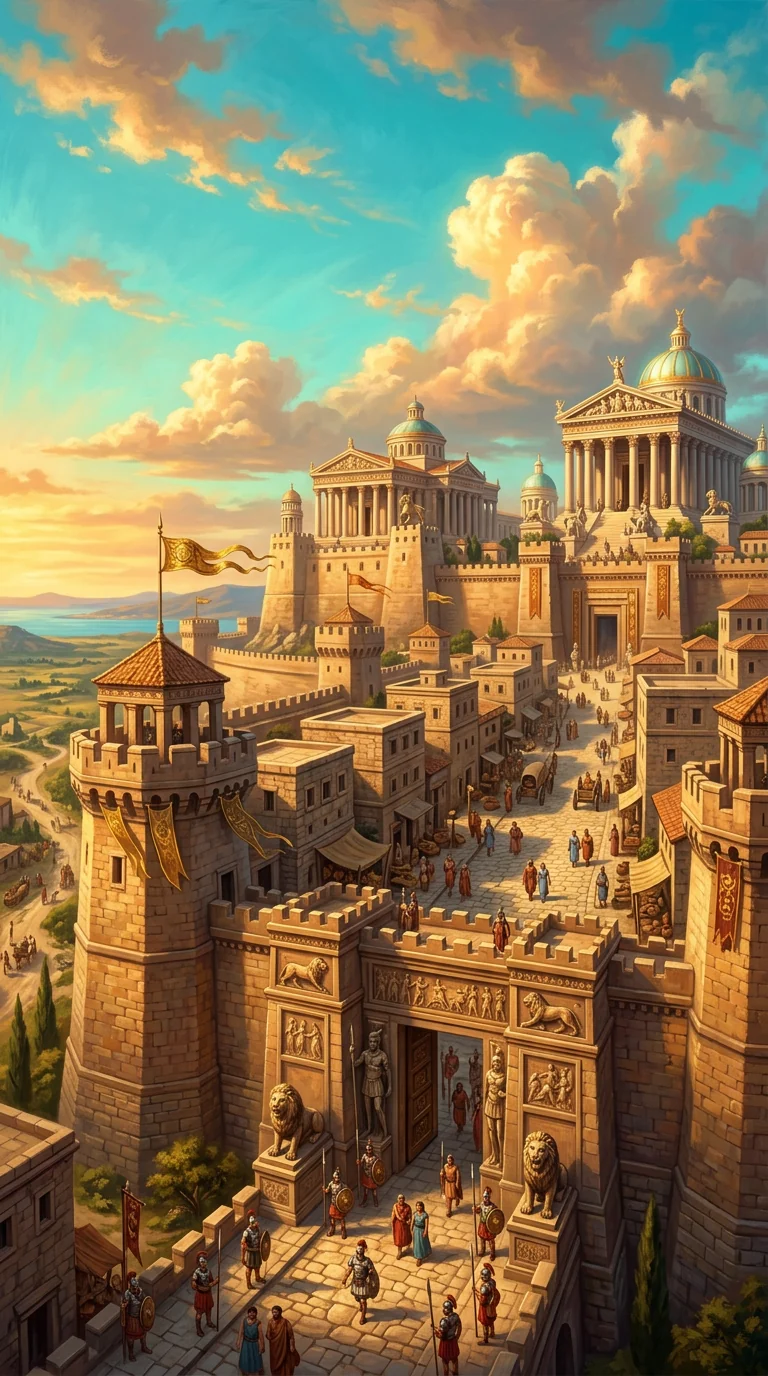
Every detail is based on archaeological evidence and Homer's epic poetry
🚪 "The Scaean Gate: Troy's busiest threshold. Traffic jams, emotional farewells, occasional sieges."
Troy VI
Archaeological evidence from Troy VI (circa 1300-1180 BCE) confirms substantial gate structures. Excavations show stone foundations for gates with tower complexes, passageways approximately 3 meters wide, and defensive architecture consistent with Bronze Age military engineering.
Troy's fortifications were part of the Bronze Age's sophisticated defensive architecture, comparable to other legendary gates like the Ishtar Gate of Babylon (with its glazed brick lions and processional grandeur) and the Propylaea gateway of Athens' Acropolis—each serving as both military checkpoint and symbolic threshold where ordinary space transformed into sacred or protected territory.
Gate Features:
Epic Poetry
The Scaean Gate appears more frequently in Homer's Iliad than any Trojan location except the battlefield - the threshold where safety ended and death began.
Homer's Iliad Book 6
Hector's farewell to Andromache & Astyanax
Troy's Main Western Entrance
Facing the Greek camp on Scaean plain
Strategic Military Point
Warriors assembled here before battle
⚔️ "Doors that echo through millennia. Bronze hinges, wooden tears, eternal goodbyes."
Emotional Center
Psychologically, the Scaean Gate represented the boundary between two worlds. Inside: families, home, civilization, relative safety. Outside: battlefield, death, chaos, Greek warriors. Every morning, Trojan men walked through knowing they might not return. Every evening, families waited anxiously, hoping to see their men walking back.
Homer's most powerful scene occurs here: Hector's farewell to his family. The great warrior finds his wife Andromache and infant son Astyanax waiting at the gate. When Hector reaches for his son, baby Astyanax cries at his father's bronze helmet. Hector removes it, laughing, holds his child one last time. He walks through the gate to his death.
The gate was where hope and despair concentrated - where the war became personal rather than abstract, where individuals faced the reality that today might be their last day alive. Homer made the Scaean Gate his emotional center: where Troy's tragedy concentrated into human-scale moments of farewell and fear.
"Doors that echo through millennia. Bronze hinges, wooden tears, eternal goodbyes."
Through spatial audio, you experience the gate's unique acoustic environment. Massive bronze doors opening create deep metallic resonance that echoes through stone passages. The sound shifts dramatically as you move between protected interior and exposed exterior space - inside the walls, sounds feel enclosed; beyond the gate, they open into battlefield expanse. Walking through the passageway, you hear footsteps change character, voices echo off stone differently than in open air.
The gate's threshold nature becomes tangible through sound positioning. You're not simply inside or outside - you're in the transitional space between them, where acoustic environments blend. Warriors assembling create specific sound patterns - armor clinking, weapons being checked, commanders giving orders - that spatial audio positions around you. The gate isn't abstract architecture; it's experiential space you inhabit through immersive 3D sound, understanding viscerally what standing in this threshold meant during the war.
Beyond architecture, the journey immerses you in the gate's emotional dimension. Hector's farewell scene unfolds spatially - you hear Andromache's desperate plea, baby Astyanax's cry at his father's helmet, Hector's tender words knowing this is goodbye. The scene's power amplifies because it happens publicly, at the gate, where other families witness this archetypal farewell. Through spatial positioning, you understand the scene as Homer's audience did: intimate tragedy in civic space, personal loss in military context.
By the journey's end, you've experienced what the Scaean Gate meant to those who passed through it daily: not just physical structure but psychological threshold separating survival from death. The contrast between emotional farewells inside and battlefield violence outside creates profound understanding of war's human cost. You're not analyzing Homer's poetry - you're feeling its emotional truth through presence at the threshold where Troy's tragedy became personal. This understanding comes through immersion, not intellectual study.
"Gate review: Excellent for dramatic exits. Solid bronze doors. Occasional traffic during sieges."
A complete day cycle at Troy's most dramatic gate
Dawn at the Scaean Gate. Warriors gather in the stone plaza before the massive bronze doors, preparing for another day of battle. You hear armor being adjusted, weapons checked, commanders organizing units. Families cluster nearby - wives, children, parents - watching anxiously as their men prepare to leave. The gate stands closed still, but everyone knows it will open soon. The morning air carries tension: another day where some who leave won't return. Through spatial audio, you're positioned within this gathering crowd, sensing both military routine and underlying dread.
Homer's most emotional scene unfolds before you. Hector, Troy's greatest warrior, finds his wife Andromache and infant son Astyanax near the gate. Andromache begs him not to fight today - she's already lost father and brothers to Achilles; losing Hector will destroy her. Hector knows she's right but duty demands he fight. When he reaches for baby Astyanax, the child cries in terror at his father's bronze helmet with horsehair plume. Hector laughs, removes the helmet, holds his son one last time. The spatial positioning makes you witness to this intimate moment happening publicly - other families watching, understanding this could be them tomorrow. Hector returns Astyanax to Andromache, puts his helmet back on, and turns toward the gate.
The command is given. Guards strain against massive bronze-bound doors. Slowly, with deep metallic groaning, the Scaean Gate opens. The sound reverberates through stone passages - timber creaking, bronze hinges protesting, wood against stone. Through spatial audio, you feel the acoustic shift as interior protected space connects to exterior battlefield. Warriors begin filing through in formation - footsteps echoing differently as they pass from enclosed gate passage to open ground beyond. Families watch from the walls above. The gate stands open, threshold between safety and danger made literal. The column of Trojan warriors disappears toward the Greek lines.
The gate remains open but now serves different function - not departure point but anxious vigil. Families gather on walls overlooking the plain, watching tiny figures clash in the distance. Sounds of battle drift back - distant shouts, weapons meeting, indistinct chaos. People pray to Apollo, make offerings, wait. The gate's threshold nature intensifies during this phase: it's simultaneously exit and potential return, hope and dread. Through spatial audio, you hear fragments of conversation - women wondering if their husbands still live, elders discussing the battle's progress, children asking when fathers will come home. The gate stands open like a question without answer.
Evening approaches. Surviving warriors begin returning through the Scaean Gate - some wounded, all exhausted. Families rush forward, desperate to find their men among the returning fighters. Some reunions happen; some families search in vain. As darkness falls, the command comes to close the gate. The massive doors swing shut with the same deep resonance they opened with, but now the sound carries different meaning - another day survived, the city sealed for night, the threshold between worlds restored. You've experienced a complete cycle: preparation, farewell, departure, waiting, return, closure. The journey ends with reflection on what thresholds mean - the moments we cross from safety to danger, the goodbyes we make, the courage required to walk through gates knowing we might not walk back. You return to present awareness carrying Hector's lesson about facing necessary thresholds despite fear.
"17 minutes, one gate, infinite emotional weight. Homer approved."
Advanced spatial audio brings Homer's dramatic threshold to vivid life
Spatial audio recreates the distinctive sound of massive bronze doors opening and closing - deep metallic resonance, timber creaking, echoes through stone passages. The acoustic shift between interior protected space and exterior battlefield becomes tangible, making the threshold's nature visceral through sound alone.
Based directly on Homer's Iliad descriptions, particularly Hector's farewell scene. Archaeological evidence from Troy VI confirms gate structures matching Homer's accounts. The journey synthesizes literary tradition with archaeological reality to recreate authentic Bronze Age gate experience.
Through 3D sound, you're positioned as witness to Hector's farewell - close enough to hear intimate words, far enough to understand the public setting. Spatial audio recreates the scene's emotional power by making you present in the threshold space where it unfolded.
The gate represents literal and metaphorical transition - between safety and danger, life and death, hope and despair. The journey uses spatial audio to make these symbolic dimensions tangible through acoustic shifts and emotional positioning.
By focusing on one gate during one day, the journey makes the Trojan War tangible at human scale. You're not observing epic abstractions but experiencing specific moments - farewells, departures, anxious waiting - that reveal war's emotional reality.
The journey follows a complete daily cycle - dawn preparation, morning farewell, gates opening, day's waiting, dusk return, gates closing. This structure creates natural narrative rhythm while emphasizing the war's grinding repetition - another day, another threshold crossing, another uncertain return.
"Spatial audio: Making ancient gates sound more dramatic than your front door since 2026."
Experience the epic's most emotional scene - Hector's farewell at the Scaean Gate - spatially rather than textually. Stand where Homer's drama unfolded, making ancient literature tangibly real
The gate represents life's threshold moments when we must leave safety for uncertainty. Hector's courage walking through despite fear offers profound lessons about facing necessary transitions
Experience how Bronze Age city gates functioned - strategically, architecturally, psychologically. Understand gates as more than defensive structures but as spaces where war's human cost became tangible
Hector's farewell has the structure of tragic drama - a good man facing inevitable doom with dignity. Experience this tragedy through immersive presence rather than reading or theater
Make Homer real for students - they'll remember experiencing the Scaean Gate far longer than reading summaries. Perfect for classics courses, ancient literature units, or Greek studies
Hector walks through the gate knowing he'll likely die, but duty demands he fight. His choice offers powerful meditation on doing what's necessary despite fear
Achieve mindfulness through engagement with profound human moments - farewells, threshold crossings, courage under fear - rather than decontextualized meditation techniques
Stand at the Scaean Gate through spatial audio - an experience unavailable through tourism or reading. Use technology to bridge three millennia and witness Homer's drama firsthand
"If you've ever faced a threshold you didn't want to cross, Hector understands."
Discover more immersive experiences from ancient Troy's legendary history
"Troy collection: Horse, palace, temple, gate. The complete Bronze Age experience."
Everything you need to know about experiencing the Scaean Gate
Download Visionaria and experience the Scaean Gate through spatial audio today.
"Where every farewell echoed through history and every door opened to fate."