
Launch special: Visionaria Premium is free—all cinematic journeys with spatial 3D audio.
🇺🇦 Support Ukrainian creators on Patreon — help us make a difference
Launch special: Visionaria Premium is free—all cinematic journeys with spatial 3D audio.
🇺🇦 Support Ukrainian creators on Patreon — help us make a difference
"Where ancient Greeks checked the time before smartphones."
The Tower of the Winds (Greek: Αέρηδες, Aerides), also known as the Horologion of Andronikos, is an ancient octagonal Pentelic marble clocktower located in the Roman Agora of Athens, Greece, constructed around 50 BCE during the Hellenistic period. Designed by the astronomer Andronikos of Kyrrhestes, this 12-meter tall structure functioned as a sophisticated horologion (timekeeper), combining a sundial, water clock (clepsydra), and weather vane to tell time and forecast weather. Each of the tower's eight sides faces a cardinal direction and features a sculpted relief personifying one of the eight wind deities (Anemoi): Boreas (north), Kaikias (northeast), Apeliotes (east), Euros (southeast), Notos (south), Lips (southwest), Zephyros (west), and Skiron (northwest). This remarkable structure represents ancient Greek mastery of astronomy, hydraulics, and meteorology.
The Tower of the Winds served Athens' Roman Agora marketplace with practical timekeeping that supported commercial activity—while the sacred Parthenon on the Acropolis expressed divine wisdom and the Panathenaic Stadium hosted athletic competitions, this octagonal horologion provided merchants and citizens with precise time measurement through sundials and water clocks—this architectural triad (sacred temples, athletic venues, civic timekeeping infrastructure) shows how Athens organized public space to serve religious, physical, and commercial needs, with the Tower exemplifying how Hellenistic scientific knowledge (astronomy, hydraulics, meteorology) was embedded into civic architecture to enhance daily life in the marketplace.
The Tower of the Winds exemplified Hellenistic civic infrastructure serving the Roman Agora marketplace, part of Athens' broader network of public structures including the Panathenaic Stadium (where 50,000 spectators gathered for athletic festivals) and the Acropolis temples (Parthenon, Erechtheion)—while temples expressed religious authority and stadiums celebrated physical excellence, the Tower provided practical timekeeping and weather forecasting for daily commerce, demonstrating how ancient Athens integrated sacred, athletic, and utilitarian architecture into a comprehensive urban system serving all aspects of civic life.
🏛️ What is the Tower of the Winds experience?
A 13-minute spatial audio meditation that transports you to ancient Athens' remarkable horologion. Experience the octagonal marble tower, eight wind deities, ancient timekeeping instruments, and the intersection of science and mythology through immersive 3D soundscapes.
🎧 How is this different from Calm or Headspace?
Unlike breathing apps, Visionaria creates cinematic stories with 3D spatial audio. You're not sitting still - you're transported to ancient monuments, experiencing Greek science and mythology through immersive soundscapes and historical storytelling.
Free spatial audio journey • Available on iOS & Android
🌬️ "Eight wind gods, one tower, zero Wi-Fi needed."
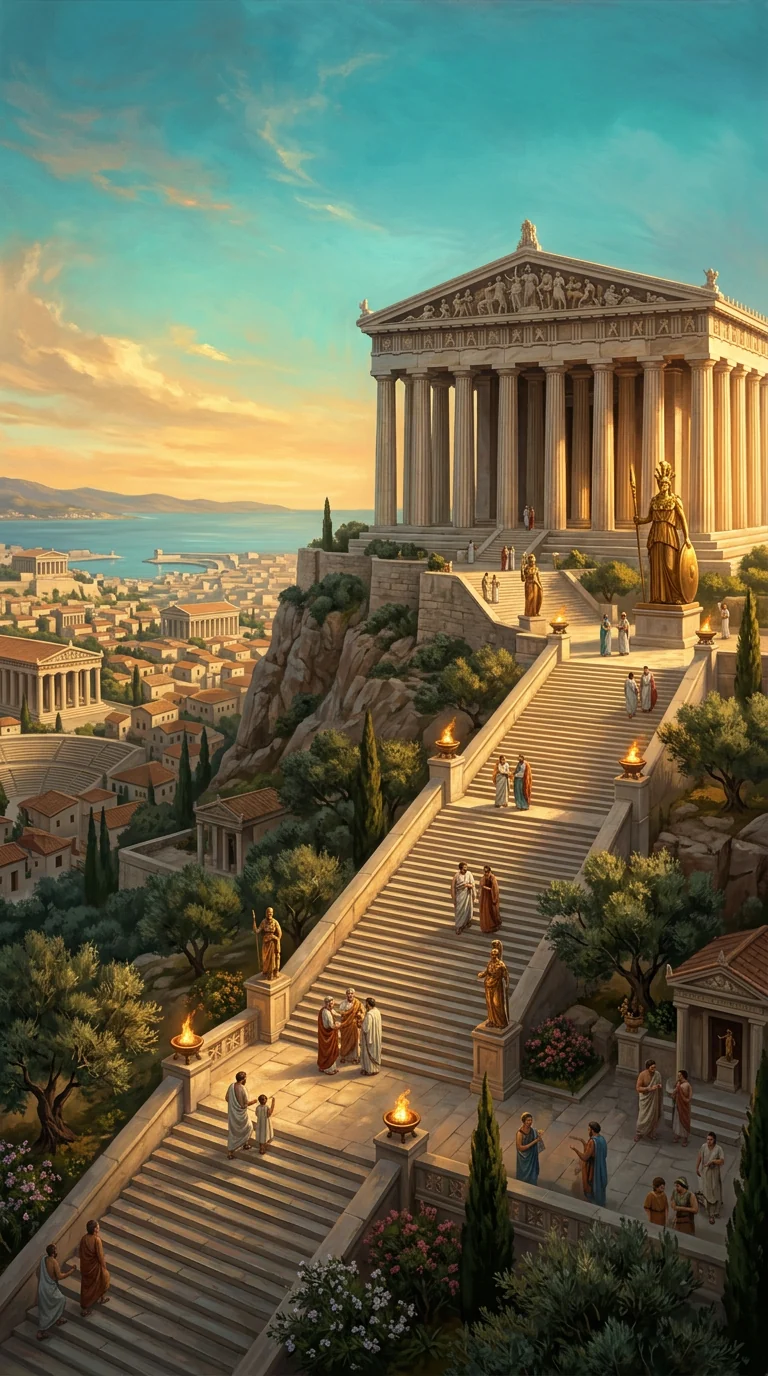
A sensory journey through ancient Athens' most ingenious architectural marvel
⏰ "Before clocks had faces, they had eight wind gods."
Architectural Wonder
You approach the Tower of the Winds, an octagonal structure of gleaming Pentelic marble rising from the Roman Agora. Each of its eight sides faces a cardinal direction, carved with reliefs of wind deities: Boreas from the north, Zephyrus from the west, Notus from the south, each god depicted in flowing robes representing their unique character.
The marble glows golden in afternoon light. Above you, a weathervane once crowned the roof—a bronze Triton turning with each breeze, pointing toward the wind god of the hour. The tower's perfect geometry speaks to Greek mathematical precision, every angle calculated, every proportion harmonious.
Ancient Technology
Inside the tower's cool interior, you hear the steady drip of water—the clepsydra, or water clock, that measured time day and night. Water flows from a reservoir on the Acropolis through underground pipes, filling a cylindrical chamber. As the water level rises, a float mechanism turns gears, marking hours on a mechanical dial.
Sundials adorned each exterior face, their shadows marking daylight hours. The tower was a horologion—a complete timekeeping system combining multiple technologies: solar observation, hydraulic engineering, and astronomical calculation. Ancient Athenians could tell time with remarkable precision, all through natural forces orchestrated by human ingenuity.
Your journey begins in the bustling Roman Agora, the commercial heart of ancient Athens. You hear merchants calling their wares, the clatter of sandals on stone pavement, and the distant hum of civic life. The Tower of the Winds rises ahead, its octagonal form unmistakable among rectangular temples and stoas. Citizens glance upward to check the time—the tower serves all of Athens.
You circle the tower, studying each carved relief. Boreas, the fierce north wind, wears a heavy cloak and blows into a conch shell. Kaikias, the northeast wind, empties a shield full of hailstones. Apeliotes, the east wind, carries fruits and grain—the bringer of gentle rains. Eurus, the southeast wind, is veiled and mysterious. Each god tells the character of their direction: cold, warm, stormy, or fair.
Beneath each wind god, you notice the sundial lines etched into the marble. The shadow of a bronze gnomon (now lost) would have moved across these lines, marking the hours. Different dials for different seasons—the Greeks understood that day length changes throughout the year. In summer, long days; in winter, shorter. The tower adapted its timekeeping to nature's rhythms.
You step through the bronze door into the tower's dim interior. The air is cool, musty with age. Water drips steadily into the clepsydra chamber—tick, tick, tick—a sound both mechanical and natural. You watch the float rise slowly, connected to gears and dials. This is how Athenians told time at night, during storms, when the sun hid. The tower never stopped working.
Standing beneath the conical roof, you contemplate the genius of Andronicus of Cyrrhus, the astronomer who designed this marvel. He combined mythology with mechanics, art with science. The tower represents the Greek pursuit of knowledge: observing nature, understanding patterns, creating tools that serve society. Time, wind, water, and sun—all unified in one perfect structure. You leave with a sense of wonder at human ingenuity.
🌊 "The original 'flow state' was literally water flowing."
Every detail is based on archaeological evidence and ancient historical sources
📜 "Ancient Athens: Where even the clocks were works of art."
1st Century BCE
The Tower of the Winds (Horologion of Andronikos Kyrrhestes) still stands in Athens' Roman Agora today. Built around 50 BCE, this octagonal Pentelic marble structure is one of the best-preserved ancient buildings in Greece. It measures approximately 12 meters tall and 8 meters in diameter.
Physical Features Preserved:
Primary Sources
The tower's timekeeping function and architectural significance are documented by ancient Roman writers who marveled at Greek scientific achievement.
Varro (116-27 BCE)
Roman scholar & encyclopedist
Vitruvius (1st century BCE)
Roman architect & engineer
Pausanias (2nd century CE)
Greek geographer & traveler
⚙️ "When your clock is also a weather station and art gallery."
Divine Meteorology
The Tower of the Winds features eight relief sculptures representing the Anemoi—the Greek wind gods who controlled weather and seasons. Each deity faces the cardinal or intercardinal direction from which their wind blows, carved in exquisite detail with symbolic attributes.
Boreas (North) brings winter cold, depicted blowing a conch shell and wearing heavy robes. Zephyrus (West) brings spring warmth, shown scattering flowers. Notus (South) brings summer rain, emptying an urn of water. Eurus (East) is veiled and mysterious. The four intercardinal winds—Kaikias, Apeliotes, Lips, and Skiron—complete the octagon, each with unique iconography representing their meteorological characteristics.
These carvings represent the intersection of mythology, meteorology, and art—the Greeks understood that winds had patterns, brought specific weather, and could be observed, predicted, and honored. The tower wasn't just functional; it was a sacred monument to natural forces.
💨 "Eight winds, zero weather app required."
Water Clock
Sundials
Weather Vane
Directional
The Tower of the Winds represents the pinnacle of Hellenistic scientific achievement—a functional public timepiece that served all of Athens. It demonstrates Greek mastery of astronomy, hydraulics, mathematics, and sculpture, all integrated into one harmonious structure.
The tower reveals that ancient Greeks understood precision timekeeping was essential for civic life: scheduling assemblies, coordinating markets, timing religious festivals, and navigating by the stars. This wasn't primitive sundial technology—it was sophisticated engineering combining multiple systems for redundancy and accuracy.
Most remarkably, the tower still stands after 2,000+ years, its carvings still legible, its octagonal perfection intact—a testament to Greek architectural excellence and their belief that beauty and function were inseparable.
🏛️ "Built to last longer than your smartphone's battery."
Visionaria's Commitment to Accuracy:
Every detail in this journey—from the octagonal architecture to the wind deity carvings to the water clock mechanism—is based on historical sources and archaeological evidence. Our team researches Vitruvius' architectural writings, studies the preserved structure in Athens, and consults academic publications on ancient horology. We believe historical accuracy enhances meditation: when you know you're experiencing real places and authentic scientific innovations, the journey becomes more meaningful, educational, and respectful to the civilization we honor.
Why spatial audio storytelling creates deeper mindfulness than breathing exercises alone
Experience the Tower of the Winds through directional sound. Hear wind whistle from the north (Boreas), water dripping from above (the clepsydra), merchants calling from the agora to your left, and marble echoes surrounding you. This isn't stereo audio—it's 3D positioning that places you inside the ancient structure, making meditation feel like time travel.
Instead of "focus on your breath," you get cinematic storytelling. A calming narrator guides you through the tower's chambers, explains the wind gods, describes the water clock mechanism, and connects ancient wisdom to modern life. Your mind stays engaged without wandering—the story becomes the meditation, combining education with relaxation.
Traditional meditation quiets the mind; Visionaria focuses it. You visualize the octagonal marble, the carved wind gods, the bronze weathervane. This active imagination engages different neural pathways than passive breathing, creating mindfulness through vivid mental imagery. It's meditation for people who find "clear your mind" impossible.
The tower's history creates emotional resonance. You're not just relaxing—you're standing where ancient Athenians checked the time, where philosophers debated, where science and art merged. This connection to real history adds meaning beyond simple stress relief. You finish feeling inspired by human ingenuity, not just calm.
You learn actual history while meditating: how the water clock worked, what each wind god represented, why the tower matters. Students use it for Ancient History classes. History buffs find new details on repeated listens. It's edutainment meditation—you finish both relaxed and smarter, making it perfect for curious minds who want more than "om."
Perfect for bedtime stories for adults, sleep meditation, study breaks, creative inspiration, or daily mindfulness practice. The 13-minute length fits lunch breaks, commutes (as passenger), or evening wind-down routines. Some listen for relaxation, others for education, many for both.
Perfect For:
History enthusiasts who want to learn while they meditate • Science lovers fascinated by ancient technology • Meditation beginners who find breathing exercises boring • Sleep seekers looking for calming bedtime stories • Students studying ancient Greece or classical civilization • Anyone seeking inspiration from human ingenuity • Creative minds who need engaging relaxation • Teachers looking for educational audio resources
⏳ "Meditation so timeless, it literally involves ancient clocks."
"Where wisdom was built into every stone…"
🏛️ "One tower, infinite wisdom."
Everything you need to know about this journey
Q: Will I need to understand ancient Greek engineering? A: No, but you'll want to after this.
Download Visionaria and experience the journey for yourself—it's free!
Start Your Free JourneyDownload Visionaria and step into the Tower of the Winds today.
"Where ancient Greeks told time before notifications existed."