Antony and Cleopatra: Love and Power in Ancient Egypt
💡 Fun fact: Cleopatra spoke nine languages, commanded naval fleets, and wrote treatises on medicine and mathematics. She wasn't just a romantic figure. She was one of history's most brilliant leaders!
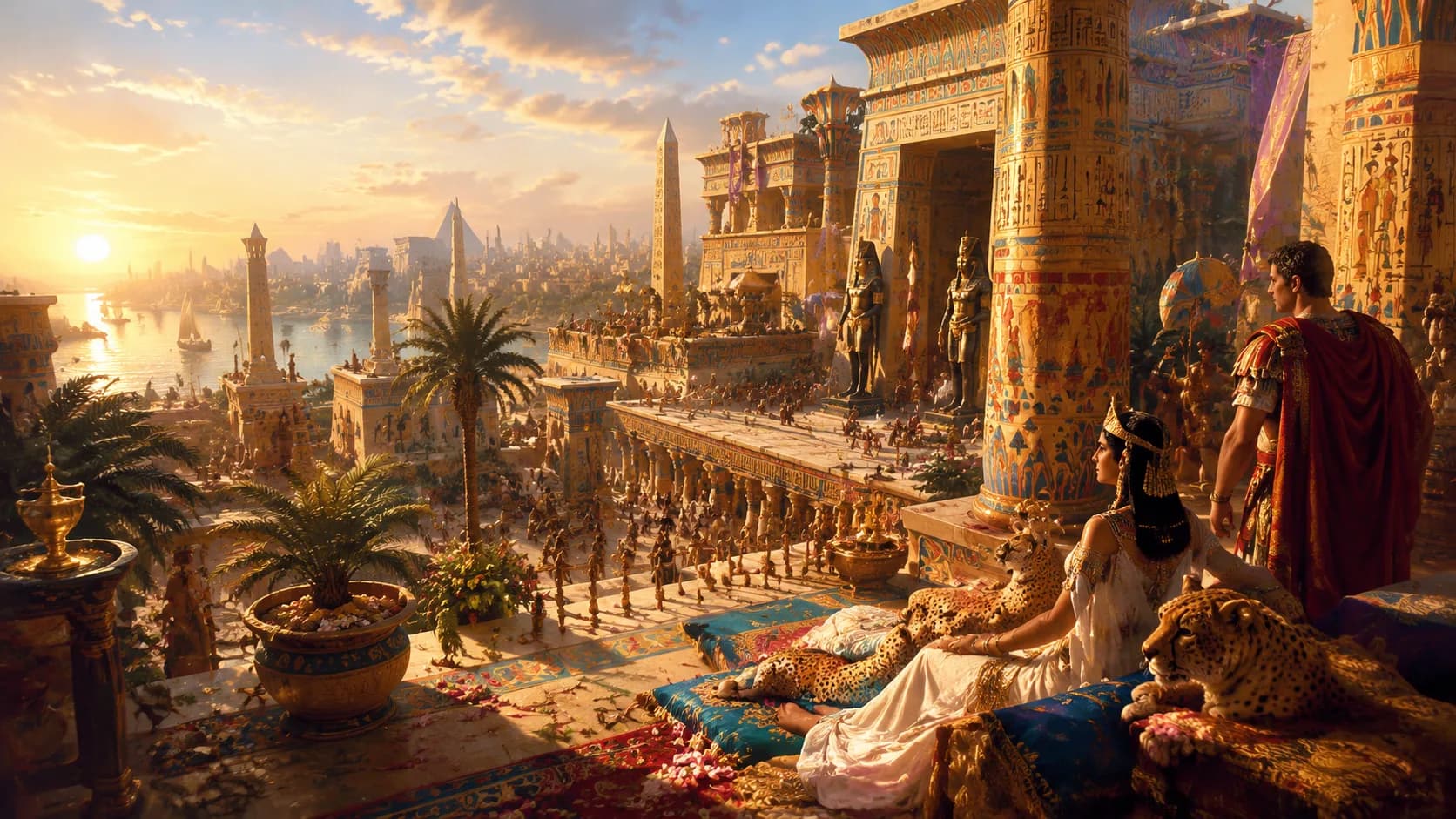
Imagine standing in Cleopatra's palace in Alexandria magnificent columns soaring toward painted ceilings, Mediterranean breezes carrying the scent of papyrus and myrrh, the most powerful woman in the world strategizing with Rome's mightiest general. This isn't mere legend. It's the extraordinary partnership of Antony and Cleopatra that changed the ancient world forever.
Mark Antony and Cleopatra VII represent one of history's most legendary partnerships, combining Roman military power with Egyptian wealth, political genius, and genuine affection to create an alliance that dominated the Mediterranean world for over a decade. Their story encompasses epic political intrigue, military campaigns across three continents, lavish celebrations of cultural fusion, and ultimately the transformation that ended Egypt's pharaonic era and solidified Rome's dominance over the ancient world.
Far from the simplified romantic tale popular culture often portrays, the alliance between Antony and Cleopatra was a sophisticated political and military partnership built on mutual respect, shared ambition, and complementary strengths. Cleopatra brought Egypt's legendary wealth, diplomatic brilliance, and millennia of pharaonic legitimacy. Antony contributed Rome's unmatched military might, loyal legions, and control over the eastern Mediterranean. Together, they dreamed of creating a new empire that would blend the best of Hellenistic culture, Roman organization, and Egyptian splendor.
Their partnership produced three children, controlled vast territories from Greece to Mesopotamia, and challenged Octavian's vision for Rome's future. Understanding their story reveals profound insights into leadership, cultural exchange, the complexities of ancient power politics, and the transformative moments when individual decisions shape the course of civilizations. Through immersive historical experiences, we can explore how these two remarkable leaders navigated love, ambition, and destiny in humanity's ancient world.
"Cleopatra's entrance on a golden barge set the standard for dramatic arrivals. Talk about knowing how to make an entrance!"
Key Facts About Antony and Cleopatra
- •Political Alliance: Their partnership controlled the eastern Mediterranean, commanding vast territories from Greece to Mesopotamia
- •Cultural Fusion: They blended Roman military power with Egyptian wealth and Hellenistic sophistication
- •Family Legacy: Their union produced three children who represented a potential new dynasty
- •Economic Power: Egypt's grain supplies and gold mines funded their ambitions and military campaigns
- •Military Might: Antony commanded Roman legions while Cleopatra provided powerful naval forces
- •Historical Impact: Their story ended Egypt's 3,000-year pharaonic tradition and established Rome's empire
- •Cultural Legacy: Their partnership has inspired countless works of art, literature, and drama across centuries
Quick Answer
Discover the legendary romance between Mark Antony and Cleopatra VII: a story of love, political alliance, and ambition that shaped the ancient world and ended Egypt's pharaonic era.
Who Were Antony and Cleopatra?
Mark Antony (Marcus Antonius, 83-30 BCE) rose through Rome's military ranks to become one of the most powerful men in the Roman world, serving as Julius Caesar's most loyal general and later forming the Second Triumvirate with Octavian and Lepidus. Known for his charisma, military brilliance, and lavish lifestyle, Antony embodied the Roman ideal of a warrior statesman while also embracing the sophisticated cultural refinements of the Hellenistic east.
Cleopatra VII Philopator (69-30 BCE) represented the culmination of the Ptolemaic dynasty that had ruled Egypt for nearly three centuries following Alexander the Great's conquest. Far more than the seductress of popular imagination, Cleopatra was a brilliant political strategist, accomplished scholar, naval commander, and the first Ptolemaic ruler to actually learn the Egyptian language. She transformed Egypt's fortunes through diplomatic genius and strategic alliances during one of history's most tumultuous periods.
Their partnership combined complementary strengths that made them formidable. Antony controlled Rome's eastern provinces, commanded hardened legions, and possessed the military expertise to project power across the Mediterranean. Cleopatra brought Egypt's immense wealth (the richest kingdom in the ancient world), a powerful navy, grain supplies that fed much of the Mediterranean, and the legitimacy of pharaonic succession stretching back three millennia. Together, they envisioned creating a new political order that would blend Hellenistic traditions with Roman power.
Visionaria Insight
By immersing ourselves in these historical soundscapes, we reconnect with a timeless human tradition of storytelling and mental restoration.
Their alliance transcended mere political convenience, developing into genuine affection and mutual respect. Ancient sources describe their intellectual compatibility they shared interests in philosophy, literature, and culture. They founded the "Society of Inimitable Livers," a social club dedicated to lavish banquets and cultural pursuits where the most brilliant minds of the ancient world gathered. This partnership produced three children: twins Alexander Helios and Cleopatra Selene, and a son Ptolemy Philadelphus, whom they raised with the expectation of ruling a vast Mediterranean empire.
Key Facts About Antony and Cleopatra
Read more: Why the Brain Experiences Stories as Reality: The Neuroscience of Narrative Immersion

"Antony dissolved a pearl worth millions in vinegar to win a bet. Talk about expensive dinner party tricks!"
A philosopher walked into a wall. His students asked if it hurt. He replied, 'The wall is an illusion, but my headache is quite real.'
Cleopatra VII: Egypt's Last Pharaoh
Born in 69 BCE into the Ptolemaic dynasty founded by one of Alexander the Great's generals, Cleopatra inherited a kingdom facing internal strife and external pressure from Rome's expanding power. She ascended the throne at just eighteen years old, immediately demonstrating political acumen far beyond her years by navigating complex family rivalries, court intrigues, and the challenge of maintaining Egyptian independence while Rome increasingly dominated the Mediterranean world.
Cleopatra's intellectual accomplishments distinguished her from previous Ptolemaic rulers. Ancient sources credit her with speaking nine languages fluently, including Egyptian (making her the first Ptolemaic ruler in three centuries to learn her subjects' tongue), Greek, Latin, Aramaic, Hebrew, and several other ancient languages. This linguistic mastery enabled her to negotiate directly with leaders across the ancient world without interpreters, giving her diplomatic advantages her predecessors lacked. She studied mathematics, astronomy, philosophy, and medicine, reportedly writing treatises on weights and measures, cosmetics, and pharmaceutical compounds.
Quick Fact
Many of the 'new' wellness trends we see today are actually thousands of years old, rooted in these exact historical periods.
Her political strategy focused on securing Egypt's independence through calculated alliances with Rome's powerful leaders. She first aligned with Julius Caesar, bearing his son Caesarion and securing Roman support for her reign. After Caesar's transformation in 44 BCE, she skillfully navigated the subsequent power struggle, eventually partnering with Mark Antony to create an eastern power base that could rival Octavian's control of Rome's western provinces.
Beyond diplomacy, Cleopatra demonstrated impressive administrative and economic abilities. She reformed Egypt's currency, managed the kingdom's vast agricultural resources, and leveraged Egypt's position as the Mediterranean's breadbasket to maintain political leverage. Her economic policies funded massive building projects in Alexandria, maintained the world's largest library, and supported scholarly research that made her capital the intellectual center of the ancient world. She personally commanded naval forces and understood military strategy, working alongside Antony on campaign planning.
Cleopatra cultivated her image as the living embodiment of the goddess Isis, connecting her rule to Egypt's ancient religious traditions while also appealing to Hellenistic sensibilities. She appeared before her people wearing traditional pharaonic regalia, performed ancient ceremonies, and portrayed herself as the new Isis mother, protector, and divine queen. This religious positioning strengthened her legitimacy in Egyptian eyes while presenting her to the broader Mediterranean world as a living connection to civilization's most ancient and venerated traditions.
"Mark Antony gave Cleopatra entire kingdoms as gifts. Forget flowers this guy knew how to impress!"

Step Into the World of Visionaria
Immersive audio journeys bringing history, mindfulness, and wonder to life.
A philosopher walked into a wall. His students asked if it hurt. He replied, 'The wall is an illusion, but my headache is quite real.'
Mark Antony: Rome's Powerful General
Mark Antony began his career as a cavalry commander, quickly distinguishing himself through exceptional leadership and personal courage on the field. His early military successes in Syria and Judea established his reputation, but his association with Julius Caesar truly propelled him to prominence. Antony served as Caesar's Master of Horse and later as co consul, proving himself an able administrator and loyalist during Rome's tumultuous civil conflicts.
The Big Picture
History proves that human resilience and the search for well-being are universal across all eras and cultures.
Following Caesar's transformation in 44 BCE, Antony delivered one of history's most famous funeral orations, swaying public opinion and helping trigger the pursuit of Caesar's challengers. He formed the Second Triumvirate with Octavian and Lepidus, dividing the Roman world among three powerful leaders. Antony claimed the wealthy eastern provinces, including Greece, Asia Minor, and eventually Egypt, positioning himself to control Rome's richest territories and most sophisticated cultural centers.
Antony's personality combined traditional Roman military valor with an appreciation for Hellenistic culture that set him apart from more austere Roman leaders. He embraced Greek philosophy, art, and theatrical performances, earning him admiration in the east while causing concern among traditional Romans who viewed such cultural enthusiasm with suspicion. His generosity toward soldiers and lavish public entertainments made him beloved by troops and common citizens, though critics accused him of excessive extravagance and insufficient traditional Roman discipline.
His military campaigns in the east demonstrated both his capabilities and limitations as a commander. While he achieved successes in reorganizing eastern provinces and securing alliances with client kingdoms, his Parthian campaign (36-34 BCE) proved costly and less successful than hoped. These mixed results, combined with his increasing reliance on Egyptian resources and his partnership with Cleopatra, provided ammunition for political opponents in Rome led by Octavian.
Antony's vision for Rome's future differed fundamentally from Octavian's. Where Octavian emphasized traditional Roman values, centralized Italian power, and Latin cultural supremacy, Antony embraced a multicultural empire blending Roman organization with Hellenistic sophistication and Egyptian wealth. This philosophical difference, combined with personal rivalry and competing ambitions, made confrontation between the two former allies inevitable. Antony's alliance with Cleopatra represented not just a romantic partnership but a deliberate choice to pursue this alternative vision for Rome's imperial future.
"The Society of Inimitable Livers was basically history's most exclusive dinner club. No boring potlucks here!"
What's an ancient intellectual's favorite exercise? Jumping to conclusions.
Their Legendary Meeting
The first encounter between Antony and Cleopatra occurred in 41 BCE when Antony, fresh from establishing the Second Triumvirate, summoned her to Tarsus (modern day Turkey) to discuss her support for Caesar's challengers and Egypt's role in the new political order. Cleopatra, recognizing this meeting's critical importance, orchestrated one of history's most legendary entrances designed to demonstrate Egypt's wealth, her own sophistication, and her determination to negotiate from a position of strength rather than as a supplicant.
Did You Know?
The relentless drive to understand the world was seen not just as an academic pursuit, but as a spiritual and healing practice by the ancients.
According to ancient historian Plutarch, Cleopatra sailed up the Cydnus River on a magnificent golden barge with purple sails, rowers wielding silver oars keeping time to flute music. She reclined beneath a canopy of gold cloth, dressed as Aphrodite (Venus), surrounded by attendants costumed as sea nymphs and Cupids. The theatrical spectacle drew crowds from Tarsus' marketplaces, leaving Antony sitting alone in the public square as the entire population rushed to witness this display of Egyptian splendor.
This strategic entrance accomplished multiple objectives simultaneously. It demonstrated Egypt's legendary wealth and cultural sophistication, positioning Cleopatra as an equal partner rather than a subordinate. It established her as the embodiment of divine beauty and power through the Aphrodite imagery. Most importantly, it forced Antony to accept her invitation to dine aboard her barge rather than dictating terms from a position of Roman authority. From their first meeting, Cleopatra established the relationship would be a partnership between equals, not Roman domination of an Egyptian client state.
The days following this initial encounter reportedly involved elaborate banquets, intellectual discussions, and mutual appreciation of each other's capabilities. Cleopatra demonstrated her linguistic mastery, political insight, and cultural knowledge. Antony discovered a partner who could match his intellectual ambitions while providing access to resources that could fund his eastern campaigns. Ancient sources suggest they formed immediate personal and political connections based on mutual respect, shared cultural interests, and recognition of how their alliance could benefit both Roman and Egyptian interests.
Following this legendary meeting, Antony accompanied Cleopatra to Alexandria, where he spent the winter of 41-40 BCE. This period cemented their partnership both personally and politically. He experienced firsthand the wealth, sophistication, and cultural achievements of Ptolemaic Egypt, including the famous Library of Alexandria, the Museion research institute, and the elaborate court ceremonies. Cleopatra bore him twins during this period, Alexander Helios and Cleopatra Selene, further binding their personal and dynastic futures together and creating the foundation for their ultimate vision of a new Hellenistic empire.
Read more: The Phoenix and the Symbol of Eternal Rebirth

"The Donations of Alexandria ceremony had more costume changes than a Broadway musical. Royal pageantry at its finest!"
Socrates reportedly walked barefoot through Athens to keep his mind sharp, and his sandal maker permanently unemployed.
Alliance and Romance
The partnership between Antony and Cleopatra evolved far beyond simple political alliance or romantic attachment, developing into a sophisticated collaboration that combined genuine affection with strategic calculation. Their relationship demonstrated how personal connections between leaders could shape geopolitical outcomes in the ancient world, where individual relationships often determined the fate of entire civilizations. Together, they forged a partnership that challenged Rome's traditional power structures and offered an alternative vision for Mediterranean civilization.
Their union produced three children who embodied their dynastic ambitions. Twins Alexander Helios (representing the sun) and Cleopatra Selene (representing the moon) were born in 40 BCE, followed by Ptolemy Philadelphus in 36 BCE. These children represented more than just heirs they symbolized the fusion of Roman and Egyptian bloodlines and the potential creation of a new Hellenistic dynasty that could unite east and west under enlightened leadership. Their upbringing combined traditional Egyptian royal education with Roman military discipline and Greek philosophical training.
The economic foundation of their alliance rested on complementary resources. Egypt provided grain that fed Rome and its eastern provinces, gold from Nubian mines, specialized goods like papyrus and linen, and naval timber from Lebanon. Antony contributed military protection, Roman administrative expertise, and political legitimacy in Roman eyes. This economic interdependence made their partnership strategically valuable beyond any personal connection, creating mutual interests that reinforced their political and romantic bonds.
Did You Know?
The relentless drive to understand the world was seen not just as an academic pursuit, but as a spiritual and healing practice by the ancients.
They established Alexandria as the capital of their envisioned empire, transforming the city into a center of power rivaling Rome itself. The palace complex became the site of elaborate cultural events blending Roman, Egyptian, and Hellenistic traditions. The famous "Society of Inimitable Livers" hosted philosophers, poets, scholars, and military leaders in discussions ranging from philosophy to military strategy. These gatherings demonstrated their commitment to creating a sophisticated, culturally rich civilization that valued intellectual achievement alongside military prowess.
Their lifestyle combined royal magnificence with genuine intellectual partnership. Ancient sources describe Cleopatra matching Antony's capacity for both serious governance and lavish entertainment, participating equally in military planning, diplomatic negotiations, and cultural pursuits. They worked together on administrative reforms, military campaigns, and building projects that enhanced Alexandria's status as the Mediterranean's most magnificent city. This partnership of equals challenged Roman assumptions about gender roles and appropriate conduct for rulers, contributing to Octavian's ability to portray Antony as having abandoned Roman values for eastern decadence.
"Octavian's propaganda campaign against Cleopatra was basically ancient Rome's first disinformation campaign. #FakeNewsAncientEdition"
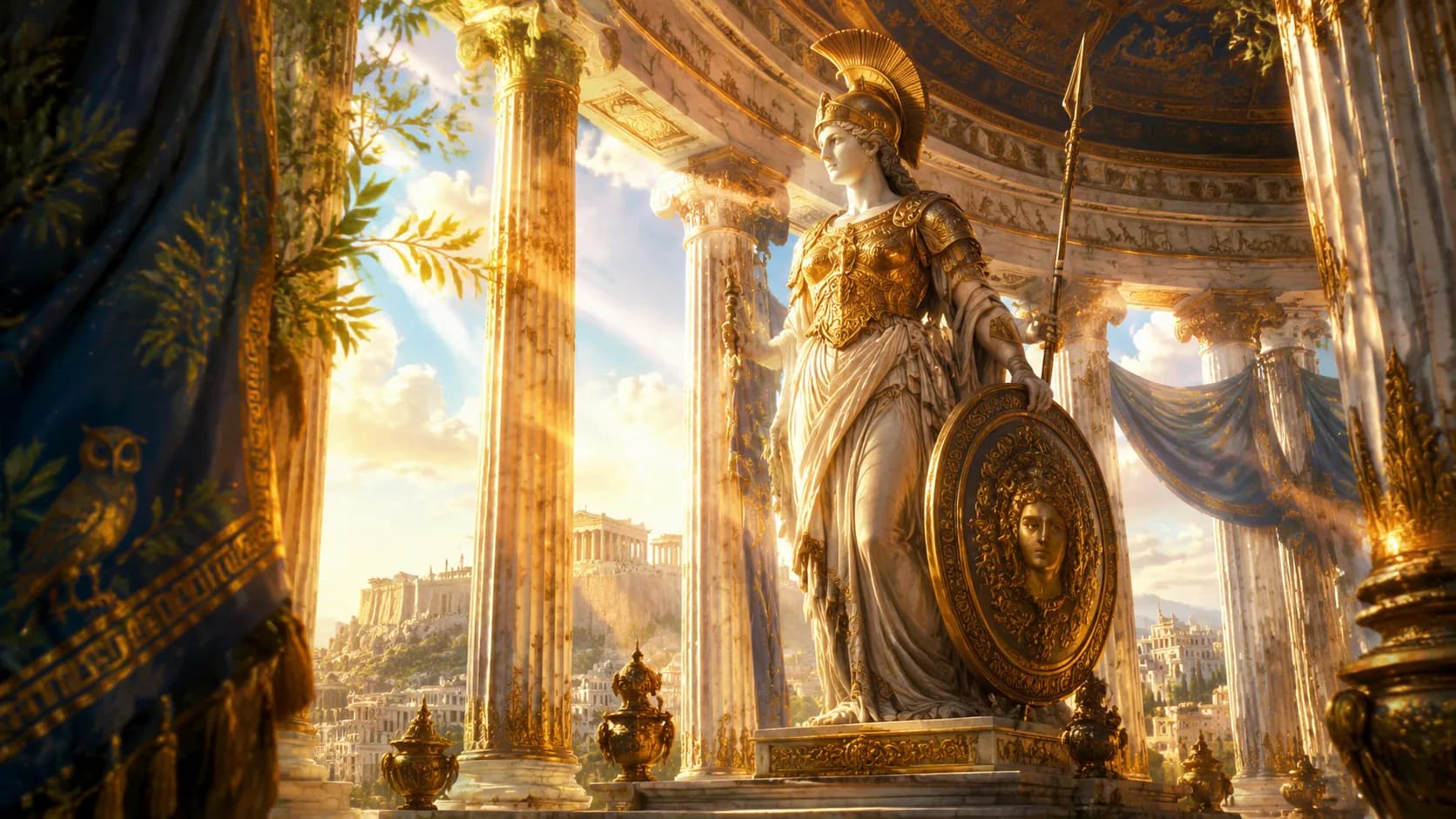
Athena and the Wisdom of the Ancient World
Discover Athena and the wisdom of the ancient world, from the goddess of wisdom, strategy, and craft to the Parthenon, Homer's Odyssey, the owl and olive tree, Greek philosophy, Athena's contest with Poseidon, parallel...
Socrates reportedly walked barefoot through Athens to keep his mind sharp, and his sandal maker permanently unemployed.
The Donations of Alexandria
In 34 BCE, Antony and Cleopatra staged the Donations of Alexandria, a magnificent ceremony that publicly declared their vision for a new Hellenistic empire and assigned territories to their children. This event took place in Alexandria's gymnasium before massive crowds, combining theatrical pageantry with serious political declarations that directly challenged Octavian's authority and Rome's traditional governance structures.
The ceremony's staging deliberately evoked both Egyptian pharaonic tradition and Hellenistic royal pageantry. Cleopatra sat on a golden throne dressed as Isis, while Antony appeared in the garb of the god Dionysus. Their children wore costumes representing the territories they would rule: Alexander Helios dressed as a Persian king, Cleopatra Selene as a Greek queen, and Ptolemy Philadelphus in Macedonian regalia. This visual spectacle communicated their intention to create a diverse empire uniting multiple cultural traditions under enlightened rulership.
Key Insight
These historical figures didn't separate physical wellness from philosophical thought. To them, it was all one continuous practice of living well.
The actual donations distributed vast territories across the eastern Mediterranean. Caesarion (Cleopatra's son with Julius Caesar) was declared King of Kings and given nominal authority over Egypt and Cyprus. Alexander Helios received Armenia, Media, and Parthia (some not yet conquered). Cleopatra Selene was granted Cyrenaica and Libya. Ptolemy Philadelphus received Syria and Asia Minor. Cleopatra herself was proclaimed Queen of Kings, ruling these territories alongside Antony. These distributions created a theoretical empire rivaling Rome itself in size and resources.
The political impact of this ceremony proved devastating to Antony's position in Rome. Octavian seized upon the Donations as evidence that Antony had abandoned Roman values and planned to transfer the empire's seat of power from Rome to Alexandria. The ceremony's eastern pageantry, the elevation of foreign children over Roman citizens, and the apparent subordination of Roman authority to Egyptian queenship provided powerful propaganda ammunition. Octavian portrayed Antony as bewitched by foreign influences, betraying his homeland for oriental luxury and a manipulative foreign queen charges that resonated with conservative Roman senators and traditional values advocates.

"The outcome at Actium proved that sometimes the best naval strategy is... having one."
Experience More with Visionaria
Download the app to explore guided historical and wellness journeys.
What's an ancient intellectual's favorite exercise? Jumping to conclusions.
This article is for educational and informational purposes only. Historical details are based on available research and may evolve as new evidence emerges.
Visionaria journeys are designed for relaxation, guided imagination, and personal enrichment. They are not a substitute for medical, mental health, legal, or professional advice.