
Athena and the Wisdom of the Ancient World
✨ Fun fact: Of all the gods and goddesses in the Greek pantheon, Athena is the one you would most want on your side during a pub quiz. She was the goddess of wisdom, strategic thinking, practical skill, weaving, pottery, mathematics, navigation, law, justice, courage, civilisation, and, remarkably, also the olive tree, which she personally invented (or at least, gifted to humanity, which amounts to the same thing on a divine CV). She had no mother in the conventional sense, having emerged fully grown and armoured from the forehead of Zeus, which is either the most dramatic entrance in all of mythology or the world's most elaborate headache cure, depending on your perspective. She was the only deity trusted by virtually everyone, gods and mortals alike, because she represented something rarer and more valued than raw power: the intelligent application of knowledge to the problems of being alive. She was, in essence, the patron goddess of people who solve problems by thinking about them carefully rather than hitting them with a very large rock, a qualification that, then as now, placed her in a fairly exclusive club.
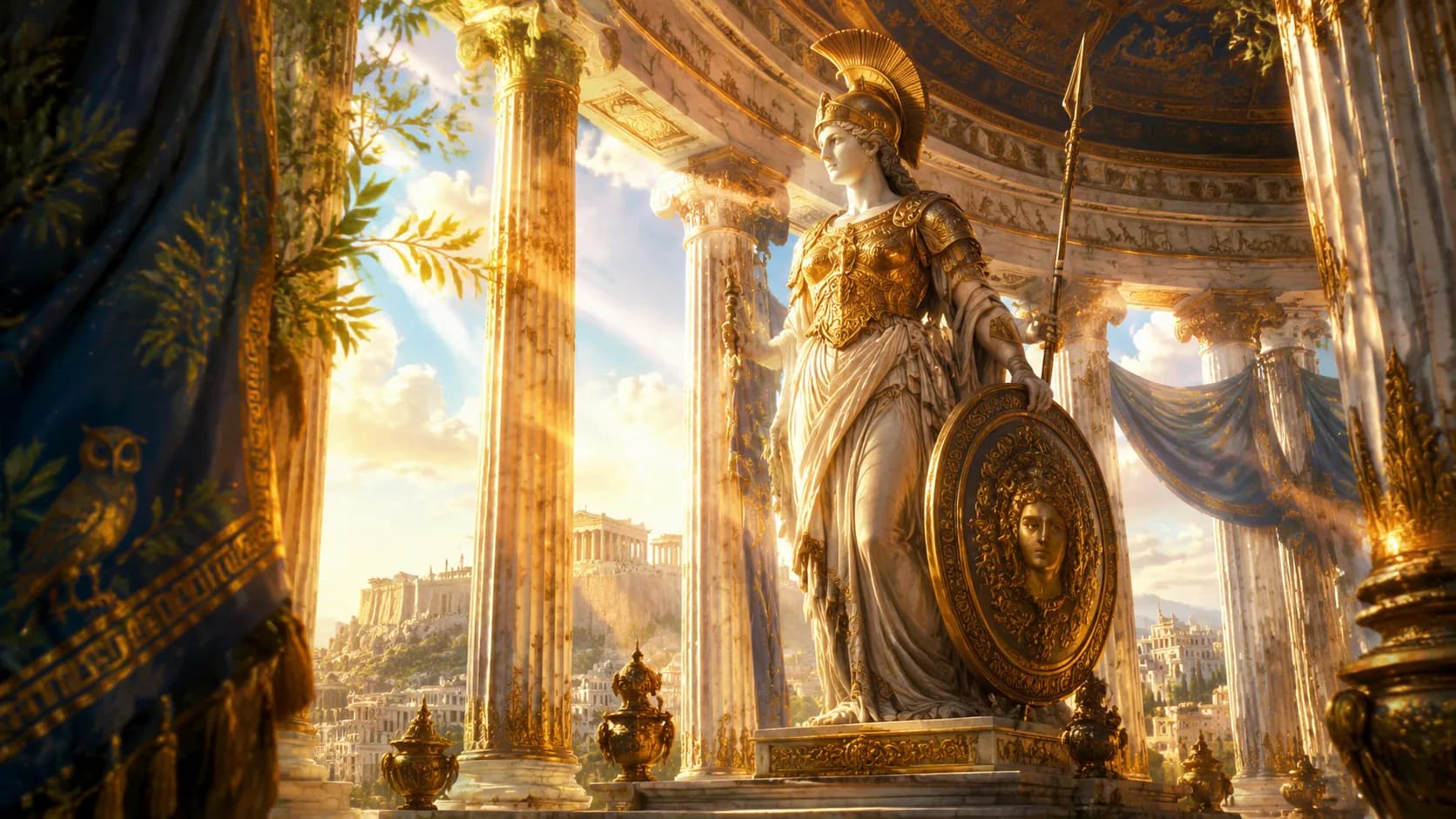
- Who Was Athena? The Goddess of Wisdom, Strategy, and Craft
- The Extraordinary Origin of Athena: Born From the Mind of Zeus
- Athena's Sacred Symbols and Their Hidden Meanings
- The Parthenon: Athena's Greatest Temple and Its Legacy
- Athena in Homer's Odyssey: The Divine Guide
- Athena vs. Poseidon: The Contest for Athens
- Athena's Influence on Philosophy, Science, and Education
- The Warrior-Scholar: Athena's Unique Approach to Conflict
- Athena in World Mythology: Parallels Across Cultures
- How Ancient Wisdom Traditions Connect to Modern Mindfulness
- Experiencing Athena's World Through Immersive Audio Journeys
- The Enduring Legacy of Athena in the Modern World
- The Bottom Line
- Frequently Asked Questions
In the vast and occasionally chaotic family tree of the Greek gods, Athena occupies a position of extraordinary distinction. She is not merely one deity among many she is the embodiment of an ideal that the ancient Greeks considered their highest achievement and most precious gift to civilisation: sophia, wisdom applied to the practical challenges of human life. Where Zeus wielded thunderbolts, Prometheus stole fire, and the Norse gods commanded storms, Athena's power was of a different and arguably more transformative kind: she taught humanity to think.
Athena was the Greek goddess of wisdom, strategic intelligence, practical craft, and civilisation one of the twelve Olympians and the patron deity of Athens, the city named in her honour. She presided over the intellectual and creative capacities that distinguished human beings from animals and civilised societies from chaotic ones: weaving, pottery, metalwork, shipbuilding, agriculture (particularly the cultivation of the olive), mathematics, navigation, law, and the strategic conduct of challenges not through brute force but through intelligence, planning, and foresight. Her Roman equivalent was Minerva, and her influence extended from the Acropolis of Athens to the farthest reaches of the Hellenistic world, from Homer's epic poetry to the foundations of Western philosophy, and from ancient temple architecture to the modern university system that still invokes her name and symbols.
This article is your comprehensive guide to Athena and the wisdom of the ancient world from her extraordinary origin and mythological relationships, to the Trojan narratives where she played a pivotal role, from the sacred symbols that encoded her teachings to the immersive audio journeys that now allow modern listeners to walk through her temples and experience her world in spatial 3D sound.
"It says something rather significant about the ancient Greeks that their most popular goddess was not the goddess of love, or power, or beauty, or wealth but the goddess of figuring things out. While other civilisations were busy building temples to deities of thunder, fertility, and assorted meteorological phenomena, the Athenians built the most magnificent temple in the ancient world for the goddess of sitting down, thinking carefully, and then solving the problem with an elegant combination of intelligence and practical skill. They named their city after her not after Zeus (who was technically in charge), not after Poseidon (who was technically responsible for the sea they depended on), and not after Dionysus (who was technically responsible for making parties tolerable). They chose Athena. They chose wisdom. It is, by any measure, one of the better municipal decisions in the history of civilisation."
Key Facts: Athena and the Wisdom of the Ancient World
- ••Divine Origin: Athena was born fully grown and armoured from the head of Zeus, king of the gods, making her unique among the Olympians as a deity who emerged from pure thought rather than conventional parentage, symbolising the idea that wisdom is born from the mind itself
- ••The Parthenon: Built between 447 and 432 BCE on the Athenian Acropolis, the Parthenon was dedicated to Athena Parthenos and housed a 12-metre gold-and-ivory statue of the goddess. It remains one of the most iconic structures in human history and a testament to the civilisation she represented
- ••Sacred Symbols: Athena's primary symbols, the owl (representing wisdom and the ability to see in darkness), the olive tree (representing peace, prosperity, and practical knowledge), and the aegis with Medusa's head (representing protection), encoded a sophisticated philosophy of intelligent living
- ••Homer's Guide: In Homer's Odyssey, Athena serves as Odysseus's divine guide and protector, not by removing obstacles but by sharpening his intelligence and resourcefulness, making her the literary archetype of wisdom as a practical, guiding force
- ••Contest with Poseidon: Athena won the patronage of Athens by offering the olive tree (a gift of lasting, practical value) over Poseidon's spring of salt water, establishing the principle that wisdom and sustained benefit triumph over spectacular but impractical displays of power
- ••Global Parallels: Athena finds parallels in wisdom deities across world cultures, including the Egyptian Neith, the Hindu Saraswati, the Norse Freyja (in her wisdom aspect), and the Celtic Brigid, suggesting a universal human recognition that wisdom deserves divine personification
Quick Answer
✨ Fun fact: Of all the gods and goddesses in the Greek pantheon, Athena is the one you would most want on your side during a pub quiz. She was the goddess of wisdom, strategic thinking, practical skill, weaving, pottery, mathematics, navigation, law, justice, courage, civilisation, and, remarkably, also the olive tree, which she personally invented (or at least, gifted to humanity, which amounts to the same thing on a divine CV). She had no mother in the conventional sense, having emerged fully grown and armoured from the forehead of Zeus, which is either the most dramatic entrance in all of mythology or the world's most elaborate headache cure, depending on your perspective. She was the only deity trusted by virtually everyone, gods and mortals alike, because she represented something rarer and more valued than raw power: the intelligent application of knowledge to the problems of being alive. She was, in essence, the patron goddess of people who solve problems by thinking about them carefully rather than hitting them with a very large rock, a qualification that, then as now, placed her in a fairly exclusive club.
Who Was Athena? The Goddess of Wisdom, Strategy, and Craft
Athena was, in the most fundamental sense, the deity of applied intelligence. While other gods presided over natural forces (Poseidon over the sea, Demeter over the harvest, Apollo over music and the sun), Athena presided over the human capacity to understand, shape, and improve the world through thought and skill. She was not a goddess of abstract philosophy that was more the domain of Apollo in his oracular aspect but of practical wisdom: the kind that builds ships, weaves cloth, cultivates olives, organises cities, writes laws, and resolves challenges through strategy rather than force.
Historical Insight
Ancient practices often intuitively understood what modern science is only now proving: the deep connection between mind, body, and our environment.
Her domains were remarkably wide ranging. She was the patron of craftspeople and artisans weavers, potters, metalworkers, carpenters, and builders all those who transformed raw materials into useful and beautiful objects through the application of skill and intelligence. She was the patron of strategic thinkers generals, statesmen, navigators, and anyone who needed to plan several moves ahead. She was the patron of heroes not because she made them stronger or braver, but because she made them smarter. In Homer's Iliad and Odyssey, in the myths of Perseus, Heracles, and Jason, and throughout Greek literature, Athena consistently appears as the divine advisor who helps mortals succeed through intelligence, planning, and resourcefulness rather than through miraculous intervention.
This made her profoundly different from most divine figures in ancient religion. Where Zeus inspired awe, Poseidon inspired fear, and Aphrodite inspired desire, Athena inspired respect the quiet, deep respect that human beings feel for intelligence that is used well, skill that is exercised beautifully, and wisdom that is applied generously. She was the goddess you prayed to not when you wanted a miracle but when you wanted to think more clearly which may be why, of all the ancient deities, her legacy has proven the most durable in the modern world.
A Roman walks into a bar, holds up two fingers, and says, 'Five beers, please.'
The Extraordinary Origin of Athena: Born From the Mind of Zeus
No deity in Greek mythology has a more symbolically charged origin than Athena. She was born from the head of Zeus literally from the mind of the king of the gods emerging fully grown, fully armoured, and fully wise. The myth, told most completely in Hesiod's Theogony and the Homeric Hymn to Athena, begins with Zeus receiving a prophecy that his first wife, the Titaness Metis (whose name means "wisdom" or "cunning intelligence"), would bear children who would eventually surpass him in power and wisdom.
Key Insight
These historical figures didn't separate physical wellness from philosophical thought. To them, it was all one continuous practice of living well.
Zeus, in a characteristically bold solution, swallowed Metis entirely thereby absorbing her wisdom into himself. But Metis was already with child, and when the time of Athena's arrival came, Zeus experienced such an overwhelming headache that he called upon Hephaestus (the god of the forge) to help. Hephaestus struck Zeus's head with an axe and from the opening, Athena emerged: fully adult, dressed in golden armour, carrying a spear, and giving a great shout that echoed across Olympus and the mortal world. The earth itself trembled, the seas churned, and the other gods looked on in astonishment at this unprecedented arrival.
The symbolism is remarkable and multilayered. Athena is literally born from thought itself from the mind of the most powerful being in the universe. She carries the wisdom of Metis (her mother) combined with the authority of Zeus (her father), making her the embodiment of intelligence invested with cosmic power. Her armour and spear signify that wisdom is not passive but actively engaged with the world prepared to defend civilisation, protect the just, and prevail through strategic brilliance. And her emergence fully formed suggests that true wisdom does not develop gradually through accumulation it arrives complete, as a sudden shift in perception, a flash of insight, an "aha" moment that transforms everything at once. The ancient Greeks understood something that modern neuroscience has confirmed: genuine understanding often comes not as a gradual process but as a sudden illumination.
"One does have to feel a certain sympathy for Zeus in this situation. Imagine the scenario: you are the king of the gods, ruler of Olympus, wielder of thunderbolts, and you develop what you initially assume is a routine headache. You try lying down. You try ambrosia. You try having someone hit you on the head with an axe, which in the ancient world was apparently considered a reasonable medical intervention. And then your fully armed, fully opinionated, fully adult daughter emerges from your skull and immediately begins reorganising things more efficiently. This is, in many ways, the most relatable parenting experience in all of mythology. Every parent has had the moment when their child arrives and immediately demonstrates that they are considerably more competent than expected. Zeus simply experienced this moment more literally and more loudly than most."

Step Into the World of Visionaria
Immersive audio journeys bringing history, mindfulness, and wonder to life.
An Epicurean, a Stoic, and a Cynic walk into a garden. The bartender says, 'Is this some kind of philosophical joke?'
Athena's Sacred Symbols and Their Hidden Meanings
Every Greek deity was associated with specific symbols animals, plants, objects that encoded essential truths about their nature and teachings. Athena's symbols were particularly rich and layered, forming a visual language that communicated her values across the ancient world. The three most important were the owl, the olive tree, and the aegis each carrying profound meanings that resonate to this day.
Visionaria Insight
By immersing ourselves in these historical soundscapes, we reconnect with a timeless human tradition of storytelling and mental restoration.
The owl (Glaukopis) was Athena's most recognisable companion. The little owl (Athene noctua literally "Athena's owl" in modern scientific nomenclature) appeared on Athenian coins, pottery, sculpture, and temple decorations throughout the classical period. Its association with Athena carried multiple layers of meaning. The owl sees clearly in darkness symbolising wisdom's ability to perceive truth where others see only confusion. The owl is patient and watchful observing before acting, which is the essence of strategic thinking. And the owl's large, forward facing eyes suggest concentrated, intelligent attention the focused gaze of a mind that misses nothing. The phrase "owls to Athens" (carrying owls to Athens, meaning bringing something where it already exists in abundance) became a Greek proverb testament to how thoroughly the owl and wisdom were linked in the public imagination.
The olive tree was Athena's second great symbol and arguably her greatest gift to humanity. According to myth, Athena created the olive tree during her contest with Poseidon for the patronage of Athens (more on this below). But the olive tree was far more than a mythological prop. In the ancient Mediterranean world, the olive was indispensable: its fruit provided food, its oil provided light (for lamps), cooking fuel, cosmetics, medicine, and religious ritual material, and its wood provided building material. A single olive tree could sustain a family for generations it was, quite literally, a technology for civilised living. Athena's association with the olive communicated that wisdom is not abstract theory but practical knowledge that sustains and enriches life.
The aegis a magical protective garment or shield, sometimes depicted bearing the head of the Gorgon Medusa represented Athena's protective aspect. The aegis was not primarily an offensive instrument; it was a symbol of protection through deterrence. The Gorgon's head, in this context, represented the power of wisdom to turn threats to stone to neutralise danger not through counter aggression but through the paralysing force of intelligent preparation and strategic presence. Athena wearing the aegis communicated that wisdom is the ultimate form of protection that the best defence is not a bigger weapon but a better mind.
Why did the historian break up with the archaeologist? Because her career was literally in ruins.
The Parthenon: Athena's Greatest Temple and Its Legacy
The Parthenon stands on the Athenian Acropolis as one of the most iconic structures in human history a temple that has represented the ideals of Western civilisation for nearly 2,500 years. Built between 447 and 432 BCE under the direction of the statesman Pericles and the architects Ictinus and Callicrates, with sculptural decoration by the master artist Phidias, the Parthenon was dedicated to Athena Parthenos (Athena the Virgin) and served as both a religious monument and a statement of Athenian cultural supremacy.
The temple housed one of the ancient world's greatest works of art: a 12 metre (approximately 40 foot) statue of Athena, constructed of gold and ivory (a technique called chryselephantine) over a wooden frame. The goddess was depicted standing, dressed in a long robe, wearing the aegis with Medusa's head, holding a figure of Nike (Victory) in her right hand and resting her left on a shield decorated with scenes of legendary engagements. The statue alone was said to contain approximately 1,140 kilograms of gold a treasure so vast that it also served as the city's financial reserve. The message was unmistakable: Athens invested its greatest wealth in wisdom.
Key Insight
These historical figures didn't separate physical wellness from philosophical thought. To them, it was all one continuous practice of living well.
The Parthenon's architectural brilliance reflected Athena's own values. The building incorporated subtle mathematical refinements columns that lean slightly inward, a floor that curves almost imperceptibly upward at the centre, corner columns that are fractionally thicker than the rest all designed to counteract optical illusions and make the temple appear perfectly proportioned to the human eye. These refinements demonstrate precisely the quality Athena embodied: the application of intelligent thought to practical problems, producing results that appear effortless but are, in fact, the product of extraordinary care and calculation. Through spatial audio recreations, modern listeners can now experience the Parthenon's acoustic environment the way sound resonated within its columns, the ceremonial chanting that would have filled its interior in a way that text and photography cannot convey.
"The Parthenon is, when you think about it, the most expensive compliment anyone has ever paid to the concept of thinking. The Athenians took the equivalent of their entire national treasury enough gold to fund a fleet of warships, rebuild the city several times over, or throw the most magnificent party in the history of the Mediterranean and used it to build a house for the goddess of being clever. This is roughly equivalent to a modern nation spending its entire GDP on a monument to critical thinking. One can only imagine the conversations at the Athenian assembly: 'But what if we need the money for something else?' 'What could possibly be more important than commemorating the value of using your brain?' Silence. Because in Athens, at least, the answer was obvious."
What's an ancient intellectual's favorite exercise? Jumping to conclusions.
Athena in Homer's Odyssey: The Divine Guide
If the Parthenon is Athena's greatest architectural monument, Homer's Odyssey is her greatest literary one. In this epic poem one of the foundational works of Western literature Athena plays a role that reveals her essential nature more clearly than any temple or statue: she is Odysseus's divine guide, protector, and intellectual companion throughout his ten year journey home from the Trojan engagement. But Athena's guidance is unlike that of any other deity in Greek literature. She does not carry Odysseus to safety, clear his path of obstacles, or fight his encounters for him. Instead, she sharpens his mind.
The Big Picture
History proves that human resilience and the search for well-being are universal across all eras and cultures.
Athena's relationship with Odysseus is, in many ways, the original model for the mentor student relationship that has shaped Western education ever since. She appears to Odysseus at crucial moments often in disguise not to give him answers but to help him think more clearly about his situation. She prompts him to consider options he hasn't thought of, reminds him of resources he's forgotten, and nudges his attention toward details that his stress or exhaustion have caused him to overlook. She is, in essence, the embodiment of that inner voice of clarity that appears when we most need it the sudden moment of insight that reveals the solution we've been struggling to see. Modern psychologists might describe Athena's role in the Odyssey as an externalisation of the executive function the prefrontal cortex's capacity for planning, strategic thinking, and wise decision making.
What makes Athena's presence in the Odyssey particularly remarkable is why she favours Odysseus. Homer makes it clear that Athena loves Odysseus not because he is the strongest or bravest of the Greek heroes (he is neither) but because he is the most intelligent and resourceful. "We are alike, you and I," she tells him in one of the poem's most beautiful passages. "Both of us know the value of a well-crafted plan." This moment a goddess recognising a mortal as her intellectual equal is one of the most moving in all of ancient literature, and it establishes a principle that has echoed through Western culture ever since: that intelligence is the quality most deserving of divine favour, and that wisdom, not power, is the truest path to homecoming.
Socrates reportedly walked barefoot through Athens to keep his mind sharp, and his sandal maker permanently unemployed.
Athena vs. Poseidon: The Contest for Athens
One of the most beloved myths about Athena is her contest with Poseidon for the patronage of Athens a story that encapsulates her values so perfectly that the Athenians depicted it on the western pediment of the Parthenon itself, where it would be the first thing visitors saw when approaching the temple. According to the myth, both Athena and Poseidon desired to be the patron deity of the city (then not yet named), and they agreed to settle the matter by each offering a gift to the citizens, who would choose the more valuable offering.
Did You Know?
The relentless drive to understand the world was seen not just as an academic pursuit, but as a spiritual and healing practice by the ancients.
Poseidon, god of the sea, struck the Acropolis rock with his trident, and from the ground burst a spring of water a dramatic, impressive, instantly spectacular display of divine power. However, the water was salt water useful for nothing practical. Athena, by contrast, knelt on the earth and planted an olive tree. It was not a dramatic gesture. There were no earthquakes, no thunder, no divine pyrotechnics. Just a tree small, unpretentious, and initially rather unimpressive. But the citizens, considering the matter carefully, chose Athena's gift. The olive tree would provide food, oil, wood, and shade for generations. It was a gift of lasting, practical, sustaining value whereas Poseidon's salt spring, however spectacular, was fundamentally useless.
The story's lesson is vintage Athena: substance over spectacle, wisdom over power, long term value over short term impression. It is also a founding myth for democracy itself the idea that citizens have the right and the capacity to evaluate competing offerings and choose the one that serves them best. The Athenians saw in this myth a validation of their own values: that a civilisation built on intelligent assessment and practical wisdom would always outlast one built on raw power and dramatic displays. This is a message that, as any creative thinker will recognise, remains as relevant today as it was 2,500 years ago.
An Epicurean, a Stoic, and a Cynic walk into a garden. The bartender says, 'Is this some kind of philosophical joke?'
Athena's Influence on Philosophy, Science, and Education
Athena's influence extended far beyond temples and myths she shaped the very institutions through which the ancient Greeks pursued and transmitted knowledge. The Academy of Plato, the Lyceum of Aristotle, and the broader tradition of Greek philosophical inquiry were all, in a profound sense, expressions of Athena's values: the belief that systematic thinking, disciplined inquiry, and the careful application of reason could reveal truths about the world that raw experience alone could not.
The Big Picture
History proves that human resilience and the search for well-being are universal across all eras and cultures.
The connection was not merely spiritual but practical. Athens's commitment to education it was among the first societies to institutionalise the formal instruction of young citizens was directly linked to its identity as Athena's city. To be Athenian was to be under Athena's protection, and Athena's protection meant, above all, the cultivation of intelligence and skill. The curriculum included grammar, rhetoric, mathematics, music, gymnastics, and philosophy a programme designed to produce what the Greeks called the kalos kagathos: the person who is both beautiful and good, whose excellence manifests in mind, body, and character simultaneously. This educational ideal the development of the whole person through a balanced combination of intellectual, physical, and ethical training has survived through the Roman humanitas, the Renaissance uomo universale, and the modern liberal arts tradition.
Athena's influence on science was equally profound. The Greek tradition of theoria systematic observation of the natural world conducted with the aim of understanding underlying principles was an extension of Athena's domain. When Hippocrates systematised medicine, when Euclid organised geometry, when Archimedes discovered the principles of buoyancy and leverage, they were practising what the Greeks considered Athena's art: the application of careful, methodical intelligence to the mysteries of the world. The scientific method itself observation, hypothesis, testing, refinement is, in its essence, structured curiosity applied with Athenian discipline. It is no accident that the modern world's most prestigious centres of learning from Oxford to MIT still use symbols (the owl, the lamp of learning, the classical column) that trace their lineage directly to Athena.
An Epicurean, a Stoic, and a Cynic walk into a garden. The bartender says, 'Is this some kind of philosophical joke?'
The Warrior-Scholar: Athena's Unique Approach to Conflict
One of the most complex and frequently misunderstood aspects of Athena is her role as a goddess associated with strategic engagement. Unlike Ares, who represented the chaotic, emotional, and often self-defeating aspects of conflict, Athena represented strategic intelligence applied to challenges the disciplined, thoughtful approach that seeks resolution through planning, foresight, and minimal unnecessary harm. The ancient Greeks made a clear distinction between these two aspects: Ares was feared and generally disliked (even by the other gods); Athena was respected and universally admired.
Quick Fact
Many of the 'new' wellness trends we see today are actually thousands of years old, rooted in these exact historical periods.
Athena's approach to conflict reflected her fundamental values. She favoured preparation over improvisation, strategy over aggression, and wisdom over brute force. In the myths of the Trojan narratives, Athena consistently supports the heroes who employ intelligence and resourcefulness Odysseus, who devises the legendary wooden horse; Diomedes, who follows careful tactical plans while opposing those who rely on blind aggression. Her iconic attribute, the spear, was not primarily a symbol of aggression but of reach the ability to engage with challenges from a considered distance rather than in the heat of close contact.
This concept the warrior scholar became one of Athena's most enduring legacies. It represented the ideal that the most effective response to challenges is not greater force but greater intelligence; that the best outcomes are achieved not by those who are strongest but by those who are wisest; and that true courage is not the absence of fear but the presence of a good plan. This ideal influenced everything from Spartan military education (which, despite its emphasis on physical toughness, also valued strategic thinking) to Roman military doctrine to the modern concept of strategic studies in universities worldwide.
"Athena's approach to conflict can be summarised in a single principle that every chess player, diplomat, and project manager would recognise: the best engagement is the one you don't need to have, because you planned well enough that the situation resolved itself. The second best is the one you win quickly through superior strategy. And the worst the one that Ares loved and Athena deplored is the prolonged, chaotic, everyone loses something kind, which is what happens when people fail to think things through. Modern conflict resolution theory has spent decades rediscovering what Athena taught the ancient Greeks in a single myth: that wisdom is the most powerful strategic asset, and that a good olive tree is worth more than all the salt water in the sea."
Why did the historian break up with the archaeologist? Because her career was literally in ruins.
Athena in World Mythology: Parallels Across Cultures
Athena was not unique to Greek culture in the sense that every major civilisation has developed divine personifications of wisdom suggesting that the recognition of intelligence as a sacred, transcendent quality is a universal feature of human consciousness. Studying Athena alongside her counterparts in other traditions reveals both the distinctive qualities of Greek wisdom culture and the deep, cross-cultural patterns that connect all human approaches to understanding.
Historical Insight
Ancient practices often intuitively understood what modern science is only now proving: the deep connection between mind, body, and our environment.
In Egyptian mythology, the goddess Neith (sometimes identified as a direct precursor to Athena by ancient Greek historians including Herodotus) shared many of Athena's attributes: she was a goddess of wisdom, weaving, and strategic thinking; she was associated with protection and the practical arts; and she was depicted as both a creative and a guiding force. The ancient connection between Neith and Athena suggests cultural exchange between Egypt and Greece that predated the classical period a reminder that the wisdom traditions of the ancient world were never isolated but always in conversation with one another.
In the Hindu tradition, Saraswati goddess of knowledge, music, art, speech, and learning represents perhaps the closest parallel to Athena. Like Athena, Saraswati is depicted as a figure of serene intelligence; like Athena, she presides over both the intellectual and creative arts; and like Athena, she is associated with a specific animal (the swan, symbolising discernment) and a specific practical domain (education). The Norse tradition offers parallels through the figure of Freyja (in her wisdom and magical knowledge aspects) and through Odin himself who, like Athena, was associated with both wisdom and the strategic conduct of challenges, and who famously sacrificed one eye for a drink from the Well of Wisdom. Even the Celtic goddess Brigid patron of poetry, healing, and smithcraft shares Athena's distinctive combination of creative art and practical intelligence.
Why did the Stoic cross the road? Because it was the rational thing to do, and he was indifferent to the traffic.
How Ancient Wisdom Traditions Connect to Modern Mindfulness
The connection between Athena's wisdom tradition and modern mindfulness practice is deeper than it might initially appear. At its core, the Greek concept of sophia (wisdom) shared fundamental qualities with what contemporary meditation research calls metacognition the ability to observe, understand, and direct one's own thinking processes. When the Delphic Oracle closely associated with Apollo but influenced by Athena's broader wisdom tradition issued its most famous commandment, "Know thyself" (gnothi seauton), it was articulating the same principle that underlies all modern mindfulness practice: that self-awareness is the foundation of wisdom, and wisdom is the foundation of a good life.
Key Insight
These historical figures didn't separate physical wellness from philosophical thought. To them, it was all one continuous practice of living well.
Athena's emphasis on practical intelligence wisdom applied to real challenges rather than abstract theorising also connects powerfully to modern evidence-based mindfulness approaches. Contemporary research has consistently shown that the most effective meditation practices are those that produce transferable benefits improvements in attention, emotional regulation, decision making, and creative thinking that manifest not only during meditation but throughout daily life. This is precisely what Athena represented: not contemplation for its own sake but contemplation that produces practical results. The modern meditator who practises curiosity meditation to improve creative thinking, or visualization meditation to enhance performance, is working within a tradition that Athena would have instantly recognised and endorsed.
Read more: How Spatial Audio Transforms Meditation Experiences

The Greek philosophical tradition that Athena inspired particularly Stoicism, with its emphasis on rational self-governance, attention to the present moment, and the strategic management of emotions bears remarkable similarities to modern cognitive behavioural therapy and mindfulness-based stress reduction. Marcus Aurelius's Meditations, Epictetus's Discourses, and Seneca's letters all describe mental practices (observation of thoughts, reframing of perspectives, cultivation of emotional resilience) that modern practitioners would recognise as mindfulness techniques. The thread connecting Athena's ancient temple to the modern meditation studio is unbroken a continuous tradition of using disciplined attention to cultivate wisdom, and wisdom to improve life.
A philosopher walked into a wall. His students asked if it hurt. He replied, 'The wall is an illusion, but my headache is quite real.'
Experiencing Athena's World Through Immersive Audio Journeys
For centuries, the only way to experience Athena's world was through text, art, or the ruins of her temples. Today, immersive audio technology has created an entirely new possibility: walking through Athena's temples, hearing the sounds of ancient Athens, and experiencing the acoustic environment of the Parthenon not as a static historical reconstruction but as a meditative journey that engages the imagination, calms the nervous system, and connects the listener to one of the world's most profound wisdom traditions.
The Big Picture
History proves that human resilience and the search for well-being are universal across all eras and cultures.
Visionaria's narrative audio journeys use spatial 3D audio to create these experiences positioning sounds in three-dimensional space around the listener so that footsteps echo on marble floors, ceremonial chanting resonates through columned halls, wind moves across the Acropolis, and the sounds of the ancient agora (marketplace) surround you with the bustling energy of classical Athens. The effect is not merely entertainment it is a genuine form of contemplative experience, using the brain's natural response to spatial sound to produce a state of immersive presence, focused attention, and emotional resonance that text alone cannot achieve.
These journeys draw on archaeological evidence, historical scholarship, and acoustic modelling to recreate environments with remarkable fidelity. The acoustics of the Parthenon how sound resonated within its columns and walls, how the voices of priests and celebrants carried through the sacred space have been studied by archaeoacousticians and can now be experienced through headphones as if standing within the temple itself. For the curious listener, these journeys offer something unprecedented: the chance to hear Athena's world rather than merely read about it, and to do so within a meditative framework that cultivates the very qualities of attention, wonder, and wisdom that Athena herself represented.
Read more: Why Fairy Tales Still Shape Imagination Today

"There is a pleasing circularity in using modern technology to recreate Athena's ancient world. Athena was, after all, the goddess of both wisdom and technology of both the idea and its practical implementation. She would, one suspects, have thoroughly approved of spatial audio: a technology that uses advanced mathematics, precise engineering, and creative artistry to produce an experience that deepens understanding and cultivates attention. She would probably have been less impressed by some of technology's other applications social media arguments, for instance, or automated customer service systems but a technology that lets people stand inside the Parthenon with their eyes closed and feel the presence of twenty-five centuries of wisdom? That, I think, she would have considered a proper use of human intelligence."
A Roman walks into a bar, holds up two fingers, and says, 'Five beers, please.'
The Enduring Legacy of Athena in the Modern World
Athena's legacy in the modern world is so pervasive that it has become largely invisible woven so thoroughly into the fabric of Western civilisation that we rarely notice its origin. The owl Athena's symbol appears on the logos of universities, libraries, and educational institutions worldwide. The Parthenon her temple has been replicated in government buildings, courthouses, and museums across Europe and North America (including a full scale replica in Nashville, Tennessee). The olive branch her gift remains the universal symbol of peace. And the principle she embodied that wisdom, applied intelligently, is the highest form of human achievement continues to define our educational institutions, our scientific traditions, and our cultural aspirations.
Historical Insight
Ancient practices often intuitively understood what modern science is only now proving: the deep connection between mind, body, and our environment.
In education, Athena's influence is everywhere. The liberal arts tradition the idea that education should develop the whole person through a combination of intellectual, creative, and ethical training is a direct descendant of the Athenian educational programme that operated under her patronage. University mottos worldwide invoke her values: Harvard's Veritas (Truth), Oxford's Dominus Illuminatio Mea (The Lord Is My Light, echoing the lamp of wisdom), and countless others that celebrate learning, knowledge, and the pursuit of understanding as the highest human endeavours.
Perhaps most significantly, Athena's legacy lives on in the idea that wisdom is accessible to everyone that it is not the exclusive possession of kings, priests, or an intellectual elite but a capacity inherent in every human mind that can be cultivated through education, practice, and disciplined attention. This democratic ideal of wisdom wisdom as a universal human right rather than a privilege is arguably Athena's greatest gift to the modern world. It is the principle that underlies public education, open access research, meditation apps that make contemplative practice available to anyone with a smartphone, and every institution that seeks to make knowledge freely available to all who seek it.
"If Athena could visit the modern world and given that she was a goddess, there is no particular reason to assume she couldn't I think she would find much to approve of and much to be perplexed by. She would approve of universities, libraries, the scientific method, and the concept of evidence-based medicine. She would approve of the Internet's potential as a repository of human knowledge, though she would almost certainly be dismayed by its actual content. She would be gratified that her owl still appears on educational institutions worldwide, though slightly confused about why it also appears on novelty coffee mugs. And she would, I think, be quietly pleased to discover that 2,500 years after her temples were built, human beings are still finding new ways to pursue the thing she valued most: the application of intelligence to the business of living well. Whether she would download a meditation app is, of course, a matter of speculation. But given that she was the goddess of practical technology, I suspect she would at least give it a five star review."

Meditation for Curiosity and Exploration
Discover how curiosity-driven meditation transforms mindfulness practice through active exploration, wonder, and engagement with ancient worlds, fantasy realms, and historical encounters.
Why did the ancient physician prescribe a long walk? Because he was tired of listening to the patient complain in his office.
The Bottom Line
Athena represents something timeless in the human story: the recognition that wisdom thoughtful, practical, strategically applied intelligence is the highest form of power. Born from the mind of Zeus, patron of Athens, guide of Odysseus, and inspiration for the philosophical tradition that shaped Western civilisation, she remains as relevant today as she was in the golden age of the Parthenon. Her lesson is simple and enduring: think carefully, act wisely, choose the olive tree over the salt spring, and never underestimate the power of a good plan.
Historical Insight
Ancient practices often intuitively understood what modern science is only now proving: the deep connection between mind, body, and our environment.
Ready to experience Athena's world? Visionaria offers narrative audio journeys through ancient Athens, Egyptian temples, mythological quests, and sacred landscapes in spatial 3D audio. Free to download on iOS and Android. Continue reading: explore Trojan Narratives That Shaped Greek Mythology, discover The Myth of Prometheus, or learn about Ancient Greek Philosophers.
Experience More with Visionaria
Download the app to explore guided historical and wellness journeys.
Why did the Stoic cross the road? Because it was the rational thing to do, and he was indifferent to the traffic.
This article is for educational and informational purposes only. Historical details are based on available research and may evolve as new evidence emerges.
Visionaria journeys are designed for relaxation, guided imagination, and personal enrichment. They are not a substitute for medical, mental health, legal, or professional advice.