Zeus and the Structure of the Olympian Gods: How Ancient Greece Organised Its Divine Hierarchy, Temples, Rituals & Cosmic Order
💡 Fun fact: The ancient Greeks didn't just worship their gods. They organised them like a government. Zeus wasn't merely the most powerful deity; he was the constitutional monarch of a divine administration, presiding over a structured hierarchy where each Olympian held a specific portfolio of cosmic responsibilities. Poseidon governed the seas. Athena managed wisdom and strategic craft. Apollo oversaw light, music, and prophecy. Hermes ran communications and commerce. It was, in effect, the world's first divine bureaucracy, and it worked so well that the Romans copied the entire organisational chart, changed the names, and pretended they'd thought of it themselves. Understanding how Zeus structured and governed this divine hierarchy reveals as much about ancient Greek civilisation as it does about their mythology, because the Olympians weren't just characters in stories. They were the operating system of Greek cultural, political, and spiritual life.
- The Rise of Zeus: From Titan Conflict to Cosmic Throne
- The Twelve Olympians: Roles, Domains & Cosmic Portfolios
- Mount Olympus: The Divine Court and Its Architecture
- Zeus as Governor: Justice, Law & Cosmic Order
- Family Dynamics: Alliances, Rivalries & Divine Relationships
- Temples and Worship: How Greeks Honoured the Olympians
- Festivals and Games: Celebrating Divine Power
- Heroes and Demigods: The Bridge Between Worlds
- The Olympian Influence on Art, Literature & Philosophy
- Olympians Across Cultures: Comparative Divine Hierarchies
- Experiencing Olympus Through Audio Journeys
- The Enduring Legacy of the Olympian Structure
- The Bottom Line
- Frequently Asked Questions
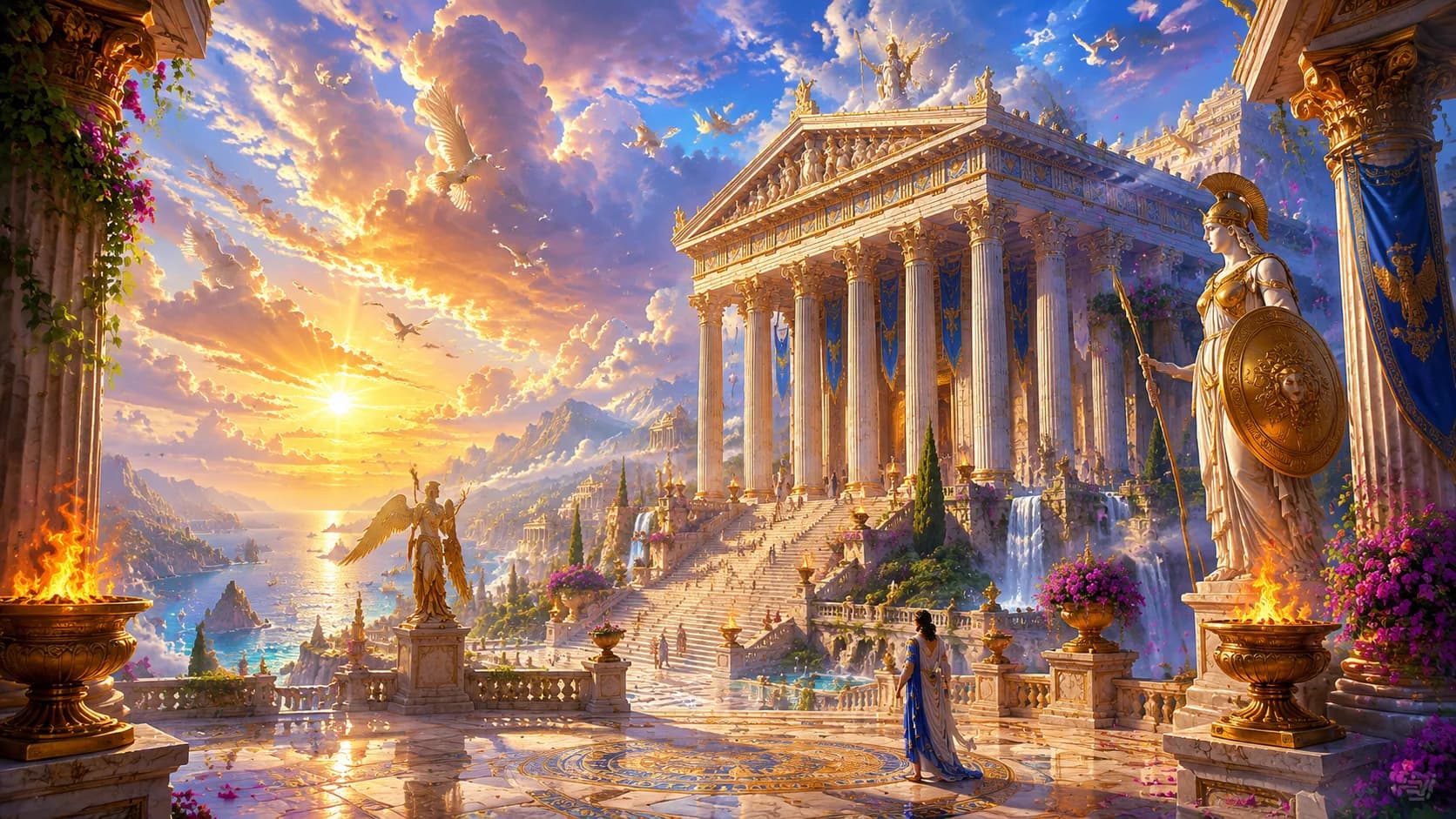
Picture Mount Olympus at dawn. Above the clouds that veil the mortal world, a palace of gleaming marble and celestial light crowns the highest peak in Greece. Inside, twelve thrones arranged in a great semi circle face the central seat the grandest of all, wreathed in golden lightning and eagle feathers. From this throne, Zeus, father of gods and mortals, surveys his realm: every storm cloud, every prayer whispered at a roadside shrine, every oath sworn between humans falls under his authority. To his right sits Athena, grey eyed and watchful. To his left, Hera, regal and formidable. Around the hall, the remaining Olympians occupy their designated places each responsible for a domain of existence as specific and essential as a government ministry. This is not merely mythology. For the ancient Greeks, this divine hierarchy was as real and consequential as any political constitution and understanding its structure is the key to understanding how Greek civilisation understood itself, its world, and its place in the cosmos.
Key Facts: Zeus & the Olympian Hierarchy
- ••The Twelve Olympians: The canonical twelve (Zeus, Hera, Poseidon, Demeter, Athena, Apollo, Artemis, Ares, Aphrodite, Hephaestus, Hermes, and either Hestia or Dionysus) each held a specific cosmic domain, functioning as an organised divine government with clear jurisdictions, alliances, and chains of authority
- ••Cosmic Division: After the Titanomachy, the three brothers divided the cosmos: Zeus received the sky and supreme authority, Poseidon the seas, and Hades the underworld, while the earth and Mount Olympus remained common ground, a system that mirrors the separation of powers in later democratic governance
- ••Temple Network: Over 1,000 temples and sanctuaries across the Greek world formed a worship infrastructure, including Olympia (Zeus), Delphi (Apollo), the Parthenon (Athena), Ephesus (Artemis), and Eleusis (Demeter), each serving as a centre of religious, political, and cultural activity for its patron deity
- ••Festival Culture: Major festivals such as the Olympic Games (Zeus), Panathenaea (Athena), Dionysia (Dionysus), and Eleusinian Mysteries (Demeter) drew participants from across the Greek world, creating shared cultural identity through worship of the Olympian hierarchy
- ••Lasting Influence: The Olympian structure persisted for over 1,200 years (roughly 1600 BCE-400 CE), was adopted wholesale by the Romans (who renamed but retained every deity and portfolio), and continues to shape Western literature, psychology (Jungian archetypes), planetary naming, and narrative traditions to this day
- ••Modern Experience: Immersive audio meditation platforms like Visionaria now use spatial 3D audio and guided visualisation to transport listeners into reconstructed Olympian temples, festivals, and mythological landscapes, making the divine hierarchy experiential rather than merely academic
Quick Answer
💡 Fun fact: The ancient Greeks didn't just worship their gods. They organised them like a government. Zeus wasn't merely the most powerful deity; he was the constitutional monarch of a divine administration, presiding over a structured hierarchy where each Olympian held a specific portfolio of cosmic responsibilities. Poseidon governed the seas. Athena managed wisdom and strategic craft. Apollo oversaw light, music, and prophecy. Hermes ran communications and commerce. It was, in effect, the world's first divine bureaucracy, and it worked so well that the Romans copied the entire organisational chart, changed the names, and pretended they'd thought of it themselves. Understanding how Zeus structured and governed this divine hierarchy reveals as much about ancient Greek civilisation as it does about their mythology, because the Olympians weren't just characters in stories. They were the operating system of Greek cultural, political, and spiritual life.
The Rise of Zeus: From Titan Conflict to Cosmic Throne
The story of Zeus's rise to power is, at its heart, a story about the transition from primordial chaos to structured cosmic governance a theme that resonated so deeply with the Greeks that they made it the foundational narrative of their entire religious system. Before Zeus, the cosmos was governed by the Titans, led by Kronos, who had seized power from his father Ouranos (the sky) in an earlier generation of divine succession. Kronos, fearful that his own children would replicate his rise, swallowed each of them at the moment of their arrival. But Rhea, Kronos's consort, concealed the youngest child Zeus and substituted a stone wrapped in swaddling clothes. Zeus was raised secretly in a cave on the island of Crete, nurtured by the nymph Amaltheia and guarded by the Kouretes, young warriors whose rhythmic movements masked the infant god's cries.
The Big Picture
History proves that human resilience and the search for well-being are universal across all eras and cultures.
When Zeus reached maturity, he returned to confront Kronos and compelled the Titan to release his siblings Hera, Poseidon, Demeter, Hestia, and Hades who emerged fully grown and immediately allied with their youngest brother. What followed was the Titanomachy, a cosmic engagement lasting ten years in which Zeus and the Olympians, aided by the hundred-handed Hecatoncheires and the one eyed Cyclopes (who forged Zeus's thunderbolts, Poseidon's trident, and Hades's helm of invisibility), prevailed against the Titans. This wasn't merely a physical contest it was a civilisational transition, the replacement of the old, chaotic order with a new, structured hierarchy governed by Zeus's authority. The defeated Titans were confined to Tartarus, and the cosmos was divided among the three victorious brothers by lot: Zeus received the sky and supreme kingship, Poseidon the seas, and Hades the underworld. The earth and Olympus itself remained common territory.
What makes this origin narrative structurally important is that Zeus's authority was not absolute by divine right it was earned and shared. He became king through leadership, strategic alliance, and the agreement of his siblings. His rule was legitimate because it replaced tyranny (Kronos's swallowing of his children) with governance (a structured hierarchy where each deity held specific, respected domains). This pattern legitimacy through merit and consensus rather than mere force profoundly influenced Greek political philosophy, including the development of Athenian democracy. The mythological structure of Olympus mirrored the political ideals of the civilisation that created it.
The Olympian succession myth (Ouranos → Kronos → Zeus) encodes a remarkably sophisticated political theory: each generation of rulers is more just than the last. Ouranos suppressed his children. Kronos swallowed his. Zeus distributed power among his siblings. The Greeks used mythology to argue that governance naturally evolves toward greater justice and broader participation a concept that directly informed their invention of democracy.
"Zeus's rise to power involved hiding in a cave, being raised by a goat, and organising his siblings to overthrow their father which, to be fair, is roughly how most family Thanksgiving dinners feel, minus the thunderbolts. Minus most of the thunderbolts."
A Roman walks into a bar, holds up two fingers, and says, 'Five beers, please.'
The Twelve Olympians: Roles, Domains & Cosmic Portfolios
The Twelve Olympians functioned as a divine cabinet, each deity governing a specific portfolio of cosmic, natural, and human affairs. Understanding these portfolios and the relationships between them reveals the extraordinary sophistication with which the Greeks conceptualised the forces shaping their world. Zeus (Jupiter in Roman tradition) held the sky, weather, kingship, justice, hospitality, and oaths. As supreme deity, he maintained cosmic order (moira) and enforced the laws of hospitality (xenia) the sacred obligation to treat guests and strangers with generosity, a principle so central to Greek culture that its violation was considered a divine offence. Hera (Juno) governed marriage, family, childbirth, and the sanctity of domestic bonds. Her frequent conflicts with Zeus in mythology symbolised the tension between institutional commitment and individual desire a theme as relevant today as it was three thousand years ago.
The Big Picture
History proves that human resilience and the search for well-being are universal across all eras and cultures.
Poseidon (Neptune) ruled the seas, earthquakes, and horses three domains that reflected the Greek experience of maritime power, geological instability, and cavalry aristocracy. Demeter (Ceres) governed agriculture, harvest, and the seasonal cycle her myth of losing and recovering her daughter Persephone explained the origin of winter and spring, embedding agricultural knowledge into narrative. Athena (Minerva) managed wisdom, strategic craft, weaving, and the defence of cities she was patron of Athens, and the Parthenon was her greatest temple. Apollo governed light, music, poetry, prophecy, healing, and archery a remarkably broad portfolio that positioned him as the deity of civilisational refinement. His oracle at Delphi was the most important prophetic centre in the Greek world. Artemis (Diana) presided over the hunt, wilderness, the moon, and young women's transitions to adulthood.
Ares (Mars) embodied the raw energy of conflict and uniquely among the Olympians, he was largely disliked by both gods and mortals, representing the aspect of confrontation that even the Greeks found distasteful (they preferred Athena's strategic wisdom to Ares' chaotic aggression). Aphrodite (Venus) governed love, beauty, desire, and procreation forces the Greeks recognised as simultaneously creative and disruptive. Hephaestus (Vulcan) managed fire, metalworking, craftsmanship, and technology the divine artisan whose forge produced everything from Zeus's thunderbolts to Achilles' armour. Hermes (Mercury) oversaw communication, commerce, travellers, boundaries, and the passage of souls to the afterlife a remarkably versatile deity who functioned as the system's messenger and facilitator. The twelfth seat alternated between Hestia (goddess of the hearth and domestic stability) and Dionysus (god of wine, ecstasy, and theatre) a substitution that itself tells a story about the Greek tension between domestic order and creative liberation.
The Twelve Olympians governed over 12 distinct cosmic domains for more than 1,200 years (c. 1600 BCE 400 CE). Their worship encompassed over 1,000 temples across the Greek world, with major sanctuaries drawing pilgrims from hundreds of independent city states making the Olympian hierarchy one of the longest lasting and most geographically widespread religious systems in human history.
"The Olympian pantheon was essentially a divine org chart. Zeus was CEO. Athena was Head of Strategy. Apollo ran PR and the arts programme. Hermes managed logistics and communications. Ares was the security consultant nobody actually liked. And Dionysus was that one colleague who kept trying to turn every meeting into a party successfully, as it turned out."
Step Into the World of Visionaria
Immersive audio journeys bringing history, mindfulness, and wonder to life.
A time traveler went back to antiquity to teach them about 'holistic health.' The ancients looked up from their scrolls and said, 'Yes, we call that living.'
Mount Olympus: The Divine Court and Its Architecture
Mount Olympus at 2,917 metres the highest peak in Greece served as both the physical anchor and mythological setting for the divine hierarchy. In Greek religious imagination, the summit existed beyond the reach of weather, clouds, and mortal perception: a realm of perpetual light, temperate air, and celestial architecture where the gods assembled in a great hall to deliberate, feast, and govern the cosmos. Homer's descriptions in the Iliad and Odyssey established the canonical image: a palace of gold and marble where the gods reclined on thrones arranged by rank, drinking nectar, consuming ambrosia, and debating the affairs of mortals and immortals alike.
The architecture of the Olympian court was not merely decorative it encoded the hierarchy's structure. Zeus's throne occupied the central, elevated position, flanked by Hera's throne on one side. The remaining Olympians' thrones were arranged in a semi circle radiating outward, their positions reflecting both familial relationship and cosmic rank. Hephaestus had constructed each throne with unique materials and designs reflecting the deity's domain Poseidon's was adorned with coral, pearls, and seahorse carvings; Athena's was carved from silver with golden owls; Apollo's gleamed with gold and was inlaid with precious amber. This spatial arrangement communicated an essential principle: the divine hierarchy was ordered but collaborative, a court of distinct powers arranged around a central authority rather than a pyramid of subordination.
Did You Know?
The relentless drive to understand the world was seen not just as an academic pursuit, but as a spiritual and healing practice by the ancients.
The real Mount Olympus, visible from much of central Greece, provided a constant physical reminder of the divine presence. When clouds gathered around its summit, the Greeks understood the gods to be deliberating in concealment. When lightning struck the peak, Zeus was announcing his will. When the mountain stood clear and luminous at dawn, the divine court was serene. This integration of landscape and mythology meant that the Olympian hierarchy wasn't an abstract theological concept it was a visible, physical reality anchored to the most imposing natural feature in the Greek world. Every Greek who looked northward saw the home of the gods, and understood their place within a cosmos that stretched from the fields around their city to the celestial palace above the clouds.
"Mount Olympus: the original gated community. Cloud cover included, views of all of Greece, exclusive membership of twelve (sometimes thirteen if Dionysus crashed the party), and an HOA enforced by thunderbolts. Real estate values: literally infinite."
Why did the historian break up with the archaeologist? Because her career was literally in ruins.
Zeus as Governor: Justice, Law & Cosmic Order
Zeus's role as king of the gods extended far beyond mere supremacy he was the embodiment of cosmic justice (. In Hesiod's Theogony and Works and Days, Zeus is presented not merely as the strongest god but as the one who established the principles by which the universe operates. He assigned each deity their domain (timai honours or prerogatives), established the laws of hospitality (xenia), enforced the sanctity of oaths, punished hubris (excessive pride that transgressed divine boundaries), and maintained the cosmic balance (moira) that prevented any single force divine or mortal from accumulating disproportionate power.
Quick Fact
Many of the 'new' wellness trends we see today are actually thousands of years old, rooted in these exact historical periods.
This governance function was deeply personal in Greek imagination. Zeus was Zeus Xenios (protector of guests and strangers), Zeus Horkios (guardian of oaths), Zeus Polieus (protector of cities), and Zeus Soter (saviour). Each epithet described a specific governance function and each had associated rituals, sanctuaries, and festivals. A merchant swearing an oath invoked Zeus Horkios. A host welcoming a stranger honoured Zeus Xenios. A city celebrating its founding sacrificed to Zeus Polieus. The divine hierarchy's structure wasn't just a theological abstraction it was woven into the practical fabric of daily life, providing a framework for ethics, law, and social behaviour that operated through religious observance rather than written statute.
The philosophical implications were profound. Zeus's governance model authority constrained by principles, power distributed among specialised domains, legitimacy derived from the maintenance of cosmic balance rather than mere force provided the Greeks with a template for thinking about governance that directly influenced the development of Athenian democracy, Spartan constitutional monarchy, and later Roman republicanism. When Plato and Aristotle debated the ideal state, they were working within a conceptual framework whose foundations had been laid by mythological narratives about how Zeus organised and governed the divine realm.
A Roman walks into a bar, holds up two fingers, and says, 'Five beers, please.'
Family Dynamics: Alliances, Rivalries & Divine Relationships
The Olympian hierarchy was not a serene bureaucracy it was a family, with all the complexity, tension, loyalty, jealousy, and affection that family relationships entail. The Greeks understood that power structures are always also emotional structures, and their mythology explored this insight with extraordinary psychological sophistication. Zeus and Hera's marriage the central relationship of the divine hierarchy was simultaneously the foundation of cosmic order and a source of perpetual conflict. Hera, as queen of the gods and goddess of marriage, embodied the principle of committed partnership; Zeus, with his numerous liaisons with mortals and other deities, embodied the restless creative energy that transcends institutional bounds. Their dynamic produced both heroes (like Hercules, whom Hera opposed) and crises that tested the stability of the entire divine order.
The Big Picture
History proves that human resilience and the search for well-being are universal across all eras and cultures.
Sibling relationships further enriched the hierarchy's dynamics. Zeus and Poseidon maintained a relationship of mutual respect tempered by rivalry both acknowledged Zeus's supremacy, but Poseidon's domain (the seas) was genuinely independent, and the earth shaker occasionally challenged his brother's decisions. Athena, as Zeus's most trusted child, occupied a unique position: she was his strategic advisor, his representative in the mortal world, and the only deity who could wield his thunderbolt. Apollo and Artemis, twin children of Zeus and Leto, formed a complementary pair: he governed civilisational refinement (light, music, healing); she governed the wild spaces beyond civilisation (wilderness, the hunt, the moon). Together they represented the Greek understanding that civilisation and nature were not opposed but interdependent.
Even the conflicts within the family served structural purposes in Greek mythology. Hephaestus's lameness and his marriage to Aphrodite (who preferred Ares) explored the tension between craftsmanship and beauty, between productive labour and passionate desire. Hermes' early theft of Apollo's cattle resolved through negotiation and the gift of the lyre modelled how disputes within a hierarchy could be resolved through creative exchange rather than force. Ares' isolation among the Olympians (disliked by most, including his own parents) illustrated the Greek conviction that raw aggression, while sometimes necessary, was the least admirable form of power. Every relationship within the Olympian family encoded a psychological and cultural insight that the Greeks explored through ritual, art, and storytelling for over a millennium.
Read more: Underground Worlds and the Center of the Earth: Mythology, Science & Imagination (2026)
"The Olympian family dynamics make every modern family drama look straightforward. Your uncle makes awkward comments at holidays? Zeus's brother literally controls the oceans and periodically threatens to flood everything. Your siblings compete for attention? Athena and Ares had a fundamental disagreement about whether wisdom or force was more important and they brought armies into it. Thanksgiving on Mount Olympus must have been absolutely spectacular."
Why did the inventor of the wheel win an award? Because his idea really got things rolling.
Temples and Worship: How Greeks Honoured the Olympians
The temple network of ancient Greece was the physical infrastructure of the Olympian hierarchy a vast, interconnected system of sanctuaries, altars, and sacred precincts that anchored divine worship to specific landscapes across the Greek world. Over 1,000 temples and sacred sites served the Olympian gods, each designed according to architectural principles that reflected the deity's character and domain. The Temple of Zeus at Olympia housing Phidias's colossal chryselephantine statue, one of the Seven Wonders of the Ancient World was the pre eminent sanctuary of the supreme god, drawing pilgrims from every Greek city state for the quadrennial Olympic Games. The Parthenon in Athens, dedicated to Athena Parthenos, embodied the goddess's principles of measured perfection through mathematical proportions so precise that modern architects still study them. Apollo's sanctuary at Delphi, perched on the slopes of Mount Parnassus, housed the Pythia the oracle whose pronouncements influenced everything from personal decisions to interstate relations.
Worship practices varied by deity but shared common elements: prayer, offerings, libations, processions, and communal feasting. Animal offerings the central ritual act followed precise protocols determined by the deity and occasion: cattle for Zeus and Poseidon, goats for Apollo and Artemis, pigs for Demeter, doves for Aphrodite. The ritual affirmed the relationship between mortals and immortals: humans offered the thigh bones wrapped in fat (the gods' portion), retaining the meat for communal consumption a practice mythologically grounded in the story of Prometheus's original offering to Zeus. This wasn't mere formality; it was a reciprocal relationship ( in which human devotion earned divine favour, protection, and guidance.
Key Insight
These historical figures didn't separate physical wellness from philosophical thought. To them, it was all one continuous practice of living well.
The Temple of Zeus at Olympia housed Phidias's colossal chryselephantine (gold and ivory) statue of Zeus standing 12 metres tall, it was one of the Seven Wonders of the Ancient World. Ancient visitors reported that the statue was so overwhelming that it seemed as if Zeus himself might rise from his throne and burst through the roof. The experience of encountering this statue was the closest the ancient world came to the immersive awe that modern spatial audio recreates.
The temple was also a community centre, treasury, and political space. Temples stored public wealth, displayed civic art, and served as sites for important civic functions. The Parthenon held Athens's treasury. Delphi's sacred precinct contained treasure houses built by various city states as expressions of civic prestige. The sanctuary at Eleusis, dedicated to Demeter and Persephone, hosted the Eleusinian Mysteries the most sacred and secret religious experience in the Greek world, which initiated participants into profound truths about the human condition that they were sworn never to reveal. The Olympian hierarchy wasn't confined to myth it was built into the landscape, the economy, the social calendar, and the physical infrastructure of Greek civilisation.
Why did the historian break up with the archaeologist? Because her career was literally in ruins.
Festivals and Games: Celebrating Divine Power
The festival calendar was the heartbeat of the Olympian hierarchy's relationship with mortal life. Every major deity had one or more festivals dedicated to their worship, and these celebrations were among the most important events in the Greek social calendar occasions when normal activity ceased, communities gathered, and the boundaries between divine and mortal realms became temporarily permeable. The Olympic Games, held every four years at Olympia in honour of Zeus, were the most prestigious. During the Games, a sacred truce (ekecheiria) halted all conflicts across the Greek world, allowing athletes and spectators to travel safely to Olympia. This truce enforced in Zeus's name demonstrated the Olympian hierarchy's power to transcend political divisions and create shared cultural identity across hundreds of independent city states.
The Panathenaea in Athens celebrated Athena with processions, athletic and musical competitions, and the presentation of a new peplos (woven garment) to the goddess's statue the procession immortalised on the Parthenon frieze that now resides in the British Museum. The Great Dionysia, Athens's dramatic festival in honour of Dionysus, produced the theatrical tradition that gave the world dramatic theatre and comedy Aeschylus, Sophocles, Euripides, and Aristophanes all competed at this festival, making Dionysus's worship the direct ancestor of Western drama. The Eleusinian Mysteries, celebrating Demeter and Persephone, offered participants a transformative initiatory experience that ancient sources describe as the most profound spiritual event available in Greek religion those who were initiated described a fundamental change in their understanding of existence and their relationship to the cycles of nature.
Visionaria Insight
By immersing ourselves in these historical soundscapes, we reconnect with a timeless human tradition of storytelling and mental restoration.
These festivals served multiple functions simultaneously. They were religious observances that maintained the relationship between mortals and gods. They were cultural events that showcased artistic, athletic, and intellectual achievement. They were economic occasions that brought trade, commerce, and wealth to host cities. And they were diplomatic instruments that created shared identity across the politically fragmented Greek world. The Olympian hierarchy, through its festival system, achieved something remarkable: it unified a civilisation of independent, often competing city states into a coherent cultural community defined by shared worship, shared stories, and shared celebrations of divine power.
"The Olympic Games were essentially a continent wide ceasefire enforced by a god who could throw lightning. Remarkably effective diplomacy. Modern international organisations take note: perhaps what the UN Security Council really needs is a credible thunderbolt."
An Epicurean, a Stoic, and a Cynic walk into a garden. The bartender says, 'Is this some kind of philosophical joke?'
Heroes and Demigods: The Bridge Between Worlds
The Olympian structure included a critical intermediary layer between the fully divine Olympians and ordinary mortals: the heroes and demigods. These extraordinary figures children of divine mortal unions or mortals elevated by exceptional achievement served as bridges between the human and divine realms, translating cosmic principles into human scale narratives of courage, ingenuity, endurance, and transformation. Hercules (Heracles), Zeus's most famous mortal son, embodied the principle that extraordinary challenges can be overcome through strength, perseverance, and the willingness to serve. His Twelve Labours took him to the edges of the known world and beyond, confronting the chaos that threatened civilisational order each labour functioning as both a literal adventure and a metaphorical lesson about human capability in the face of overwhelming difficulty.
Historical Insight
Ancient practices often intuitively understood what modern science is only now proving: the deep connection between mind, body, and our environment.
Perseus, another son of Zeus, demonstrated the hero's role as civilisational protector his journey to confront Medusa required divine assistance (gifts from Athena, Hermes, and the nymphs), illustrating how heroic achievement depends on the support of cosmic forces aligned through the Olympian hierarchy. Odysseus, though fully mortal, was the hero most closely associated with Athena's patronage his ten year journey home from Troy demonstrated the Greek ideal of mētis (cunning intelligence) as a form of heroism equally valid as physical strength. Theseus, hero of Athens, embodied the political dimension of heroism: his legendary unification of the Attic communities into the city state of Athens connected the heroic tradition directly to civic identity and democratic governance.
The hero cult was also a significant form of worship that complemented Olympian religion. Heroes received offerings at their tombs and sacred sites not as gods but as powerful intermediate beings who could intercede with the Olympians on behalf of the communities that honoured them. The hero cult provided a local, personal dimension to the cosmic Olympian hierarchy: while Zeus governed the universe from Olympus, the local hero buried in the community's soil, intimately connected to its identity and history provided a divine presence that was immediate, accessible, and deeply personal. This layered system Olympians above, heroes between, mortals below gave Greek religion a structural coherence that allowed it to operate simultaneously at cosmic, communal, and individual scales.
Why did the historian break up with the archaeologist? Because her career was literally in ruins.
The Olympian Influence on Art, Literature & Philosophy
The Olympian hierarchy was the single most important influence on Greek artistic and intellectual production and through Greece, on the entire Western creative tradition. In literature, the Olympians provided the framework for both epic and dramatic narrative. Homer's Iliad and Odyssey the foundational texts of Western literature are structured around divine interventions that determine human outcomes: Athena guides Odysseus, Poseidon opposes him, Zeus balances their competing interests, and the hero navigates the consequences. This pattern human agency operating within and against divine frameworks became the template for Western narrative itself, from Virgil's Aeneid to Milton's Paradise Lost to the modern fantasy genre.
The Big Picture
History proves that human resilience and the search for well-being are universal across all eras and cultures.
In visual art, the Olympians provided the subjects for the greatest achievements of Greek sculpture, painting, and architectural decoration. Phidias's colossal statues of Zeus at Olympia and Athena in the Parthenon were considered among the finest artworks ever created. The Parthenon's sculptural programme depicting the birth of Athena, the contest between Athena and Poseidon for Athens, and the Panathenaic procession used the Olympian narrative to express civic identity through artistic excellence. These artistic traditions, transmitted through Roman adoption and Renaissance recovery, established the visual language of Western art: when Michelangelo painted the Sistine Chapel ceiling, he was working within a tradition of divine iconography whose foundations were laid by Greek artists depicting the Olympian hierarchy.
In philosophy, the Olympian structure provided the conceptual vocabulary for Greek thinking about order, justice, knowledge, and the nature of reality. Plato's theory of Forms abstract, perfect principles underlying imperfect material reality bears structural resemblance to the Olympian model of divine archetypes governing the mortal world. Aristotle's systematic categorisation of knowledge into distinct domains (physics, ethics, aesthetics, politics, logic) mirrors the Olympian distribution of cosmic portfolios among specialised deities. Even the philosophical critiques of traditional religion Xenophanes questioning anthropomorphic gods, the Stoics reinterpreting the Olympians as natural forces operated within the conceptual framework that the Olympian hierarchy had established. The structure was so foundational that even its critics could not think outside it.
"Every time you watch a superhero film with a team of heroes who each have a specific power and a distinct personality, you're watching a modern retelling of the Olympian structure. Today's superhero film franchises are essentially Mount Olympus with better special effects and worse family dynamics. Which is saying something, because the Olympians' family dynamics were already cinema worthy."
What's an ancient intellectual's favorite exercise? Jumping to conclusions.
Olympians Across Cultures: Comparative Divine Hierarchies
The Olympian model of structured divine hierarchy was not unique to Greece nearly every major civilisation developed comparable systems of organised divine governance, and the parallels reveal deep patterns in how human societies conceptualise cosmic order. The Romans adopted the Greek structure most directly, mapping their existing deities onto Greek equivalents and absorbing the entire Olympian organisational system: Jupiter=Zeus, Juno=Hera, Neptune=Poseidon, Minerva=Athena, Mars=Ares, Venus=Aphrodite, Mercury=Hermes, and so on. The Roman adoption was so thorough that it preserved Greek mythology in Latin literature Ovid's Metamorphoses, Virgil's Aeneid which became the primary transmission vehicles for Greek mythological knowledge through the medieval period and into the Renaissance.
Visionaria Insight
By immersing ourselves in these historical soundscapes, we reconnect with a timeless human tradition of storytelling and mental restoration.
Beyond Rome, parallel structures appear across world cultures. The Egyptian divine hierarchy centred on Ra (later Amun Ra) as supreme deity, with Osiris governing the afterlife, Isis managing healing and magic, Thoth overseeing wisdom and writing, and Hathor presiding over love and beauty mirrors the Olympian distribution of cosmic portfolios among specialised deities. The Norse pantheon Odin (wisdom, sovereignty), Thor (sky, weather, protection), Freya (love, fertility), Loki (trickery, transformation) structured its divine hierarchy around remarkably similar domains, despite developing independently in Scandinavia. Hindu mythology's trimurti Brahma (creation), Vishnu (preservation), Shiva (transformation) represents another approach to the same fundamental question: how does the cosmos organise its governing forces?
Read more: Meditation for Curiosity and Exploration
These cross-cultural parallels suggest that the impulse to organise divine power into structured hierarchies reflects something fundamental about how human cognition categorises the forces shaping existence. The Greek contribution was not the invention of divine hierarchy but its extraordinary articulation the richness of characterisation, the complexity of inter divine relationships, the integration of myth with ritual, art, philosophy, and civic life. The Olympian structure became the most influential model because Greek civilisation thought most deeply and expressed most vividly what other cultures intuited: that the cosmos operates through the interaction of distinct, powerful, and sometimes competing forces, each governing a specific domain of existence.
An Epicurean, a Stoic, and a Cynic walk into a garden. The bartender says, 'Is this some kind of philosophical joke?'
Experiencing Olympus Through Audio Journeys
Interactive audio journeys and guided visualisation stories offer a uniquely powerful way to experience the Olympian hierarchy not as academic information but as immersive, embodied experience. Through spatial 3D audio, modern listeners can stand in reconstructed Olympian temples, hear the specific acoustics of marble colonnades, feel the spatial presence of colossal cult statues, and sense the atmosphere of sacred spaces that have been in ruins for centuries. The technology transforms mythological knowledge from something you know about into something you experience engaging the same brain systems that produce genuine spatial awareness, emotional resonance, and narrative absorption.
Visionaria's Greek mythology journeys are built on archaeological research and historical reconstruction. When you enter the Temple of Zeus at Olympia through spatial audio, the environment is based on what historians, architects, and archaeologists have determined about the original space: the dimensions, materials, lighting, acoustics, and atmosphere of a building that ancient visitors described as one of the most awe-inspiring structures in the world. When you attend a reconstructed Olympic festival, the sounds of competition, spectation, ritual, and celebration are grounded in ancient sources that describe these events in detail. This commitment to accuracy means that the mental time travel experience is not fantasy but evidence-based reconstruction as close to genuinely walking through ancient Olympia as modern technology can achieve.
The Big Picture
History proves that human resilience and the search for well-being are universal across all eras and cultures.
When spatial audio places you inside the Temple of Zeus hearing the specific acoustics, sensing the scale, feeling the atmosphere your brain encodes the information as experiential memory rather than semantic memory, making it more durable and emotionally meaningful.
The meditative dimension adds another layer. By experiencing the Olympian hierarchy through narrative meditation, listeners engage their imagination, emotional processing, and reflective capacity simultaneously producing not just knowledge but understanding, not just information but insight. The archetypes of the Olympian gods wisdom (Athena), creative expression (Apollo), resilience (Hercules), love (Aphrodite), communication (Hermes), craft (Hephaestus) function as psychological mirrors in meditation, inviting listeners to explore which divine qualities resonate with their own strengths, challenges, and aspirations. This transforms the ancient mythological structure from a historical curiosity into a living tool for self-understanding and personal development.
"Three thousand years ago, you'd need to travel to Olympia, wait four years for the Games, and hope the gods were in a good mood. Today, you put on headphones and let spatial audio reconstruct the entire experience in your living room. The Olympians, one suspects, would approve of the efficiency especially Hermes, who was always looking for faster ways to get things done."
Why did the historian break up with the archaeologist? Because her career was literally in ruins.
The Enduring Legacy of the Olympian Structure
The Olympian hierarchy's influence extends far beyond the ancient world, permeating modern language, science, psychology, art, and storytelling in ways so fundamental that most people don't recognise their mythological origins. The planets of our solar system are named after the Roman equivalents of the Olympian gods: Mercury, Venus, Mars, Jupiter, Saturn, Neptune, Pluto. Our calendar preserves divine associations: January (Janus), March (Mars), June (Juno). Scientific terminology is saturated with Olympian references: mercurial (changeable, like Hermes/Mercury), aphrodisiac (from Aphrodite), Herculean (from Hercules), Olympic (from Olympus). The very word museum comes from the Muses, divine daughters of Zeus who presided over the arts and sciences.
In psychology, Carl Jung's theory of archetypes drew directly on the Olympian structure, identifying universal patterns of human experience that correspond to the divine portfolios: the Ruler (Zeus), the Sage (Athena), the Lover (Aphrodite), the Creator (Hephaestus), the Explorer (Hermes), the Hero (Hercules). Jungian archetypal psychology and its application in everything from psychotherapy to brand marketing to creative visualisation is essentially a psychological translation of the Olympian hierarchy, recognising that the Greek gods represent permanent features of human experience rather than historical curiosities. Narrative meditation practices that use mythological archetypes draw on this insight, using the Olympian figures as vehicles for psychological exploration and personal growth.
Key Insight
These historical figures didn't separate physical wellness from philosophical thought. To them, it was all one continuous practice of living well.
The storytelling tradition that the Olympians inspired remains the foundation of Western narrative. The hero's journey departure, initiation, return is the structural template for everything from Homer's Odyssey to a famous space saga, from dragon myths to modern fantasy literature. The concept of a team of diverse, specialised individuals united against a common challenge the superhero teams of modern cinema, the questing fellowships of epic fantasy descends directly from the Olympian model of a divine council where each member contributes unique capabilities. The Olympian structure, born in Bronze Age Greece and elaborated over twelve centuries, has proved to be one of the most durable and adaptable conceptual frameworks ever devised by human civilisation as alive and influential today as it was when pilgrims first climbed the steps of the Temple of Zeus at Olympia.
"If Zeus could see how deeply his organisational structure has permeated modern civilisation our planets, our calendars, our psychology, our stories, even our meditation apps he would almost certainly demand royalties. And knowing Zeus, he'd accept payment in thunderbolts."
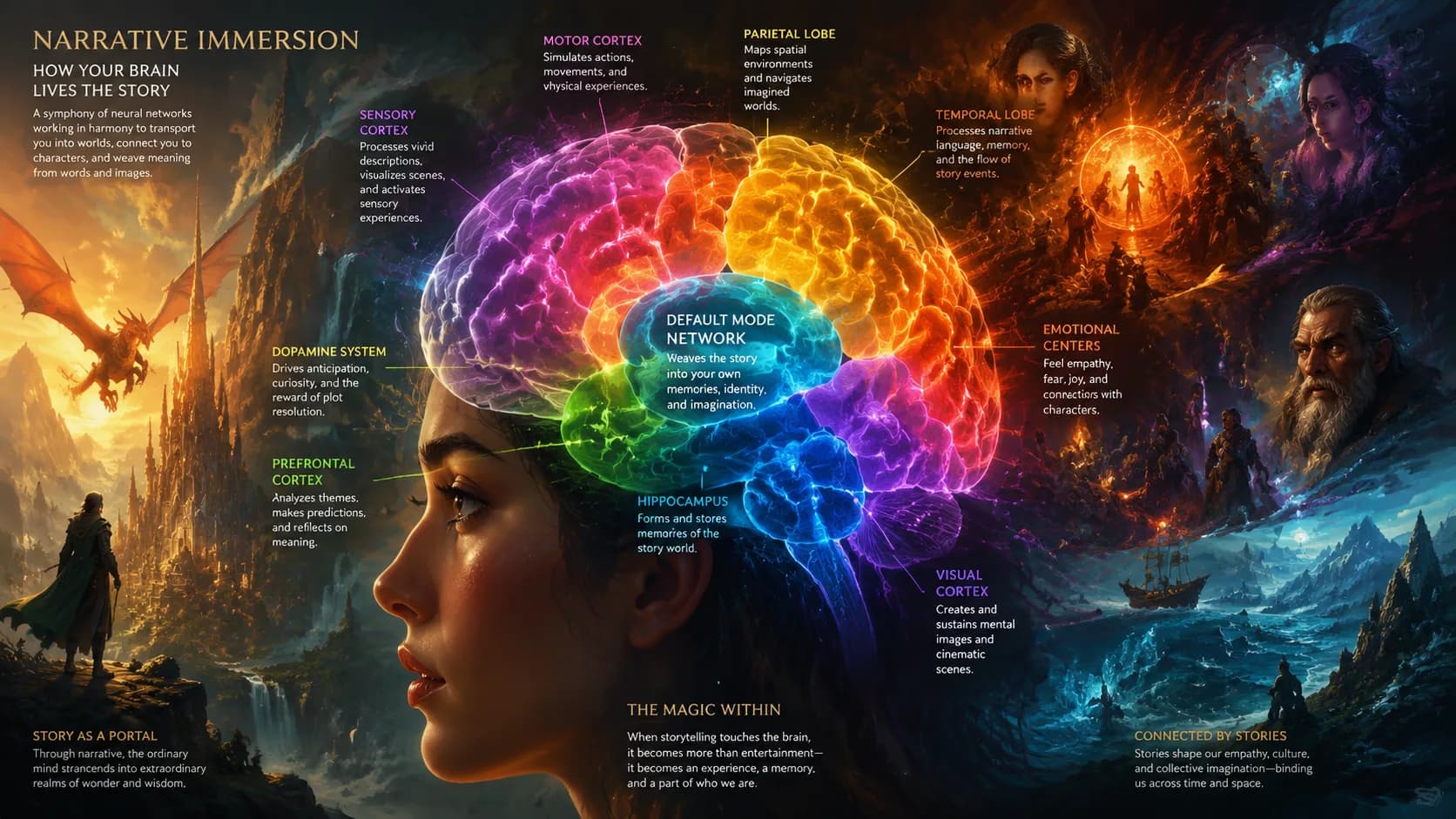
Why the Brain Experiences Stories as Reality: The Neuroscience of Narrative Immersion
Discover why the brain experiences stories as reality, from neural coupling and mirror neurons to narrative transportation, the neurochemistry of storytelling, spatial audio immersion, story-based meditation, and how i...
What's an ancient intellectual's favorite exercise? Jumping to conclusions.
The Bottom Line
Zeus and the Olympian hierarchy represent one of the most sophisticated and influential systems of mythological thought ever developed a structured divine government that shaped Greek religion, politics, art, philosophy, and social life for over a millennium, and whose influence continues to permeate modern civilisation through language, psychology, storytelling, and cultural tradition.
Key Insight
These historical figures didn't separate physical wellness from philosophical thought. To them, it was all one continuous practice of living well.
This guide explored Zeus's rise to power, the cosmic portfolios of the Twelve Olympians, the architecture of Mount Olympus, Zeus's governance principles, divine family dynamics, the temple and worship infrastructure, festival culture, the hero tradition, artistic and philosophical influence, cross-cultural parallels, how audio journeys make the Olympian world experiential, and the hierarchy's enduring legacy.
"You've just spent nineteen minutes learning about the divine organisational structure of an ancient civilisation. If Zeus were watching and in Greek mythology, he always is he'd appreciate the thoroughness. Now, close your eyes, put on headphones, and let spatial audio show you what reading alone cannot: the sound of wind through Olympian columns, the distant echo of a hymn rising from a marble temple, and the unmistakable presence of something vast and ancient and very much alive in the imagination. The gods, as it turns out, aren't gone. They just moved to a different medium."
Experience More with Visionaria
Download the app to explore guided historical and wellness journeys.
Why did the historian break up with the archaeologist? Because her career was literally in ruins.
This article is for educational and informational purposes only. Historical details are based on available research and may evolve as new evidence emerges.
Visionaria journeys are designed for relaxation, guided imagination, and personal enrichment. They are not a substitute for medical, mental health, legal, or professional advice.