The Architecture of the Acropolis Explained
✨ Fun fact: The Parthenon contains not a single straight line. Every surface that appears perfectly flat (the floor, the columns, the entablature) is in fact subtly curved, tilted, or tapered by amounts ranging from a few millimetres to several centimetres, all calculated with a mathematical precision that modern architects find genuinely intimidating. The ancient Greeks accomplished this using nothing more than rope, plumb lines, optical intuition, and what appears to have been an almost supernatural understanding of how the human eye perceives geometry. They built a temple so meticulously engineered that it has looked "perfect" to every generation of observers for 2,500 years, while simultaneously ensuring that almost nothing about it is geometrically straight. This is the architectural equivalent of making a person feel completely at ease in a conversation while secretly juggling seventeen invisible objects behind your back, except the objects are Pentelic marble blocks weighing up to ten tonnes each, and the conversation has lasted two and a half millennia.
- What Is the Acropolis and Why Does Its Architecture Matter?
- The Parthenon: Masterpiece of Classical Greek Architecture
- The Propylaea: Gateway to the Sacred Hill
- The Erechtheion and the Caryatid Porch
- The Temple of Athena Nike: Celebrating Triumph and Grace
- Optical Illusions and Mathematical Precision in Acropolis Design
- Building Materials and Construction Techniques of the Ancient Greeks
- The Acropolis Through the Centuries: Transformation and Renewal
- How Spatial Audio Brings Ancient Architecture to Life
- The Influence of Acropolis Architecture on the Modern World
- Experiencing the Acropolis Through Immersive Meditation
- The Future of Ancient Architectural Heritage
- The Bottom Line
- Frequently Asked Questions
Rising 150 metres above the city of Athens on a flat topped limestone outcrop, the Acropolis is the most famous architectural complex of the ancient world and, by many measures, the most influential in all of human history. Its buildings have shaped the course of Western architecture, art, and aesthetics for two and a half millennia, inspiring everything from Roman temples and Renaissance churches to the United States Capitol Building and the British Museum. To understand the architecture of the Acropolis is to understand the moment in human civilisation when architecture first became, in the fullest sense, an art form when builders stopped merely constructing shelters and started creating spaces that were designed to move, inspire, and transform the people who entered them.
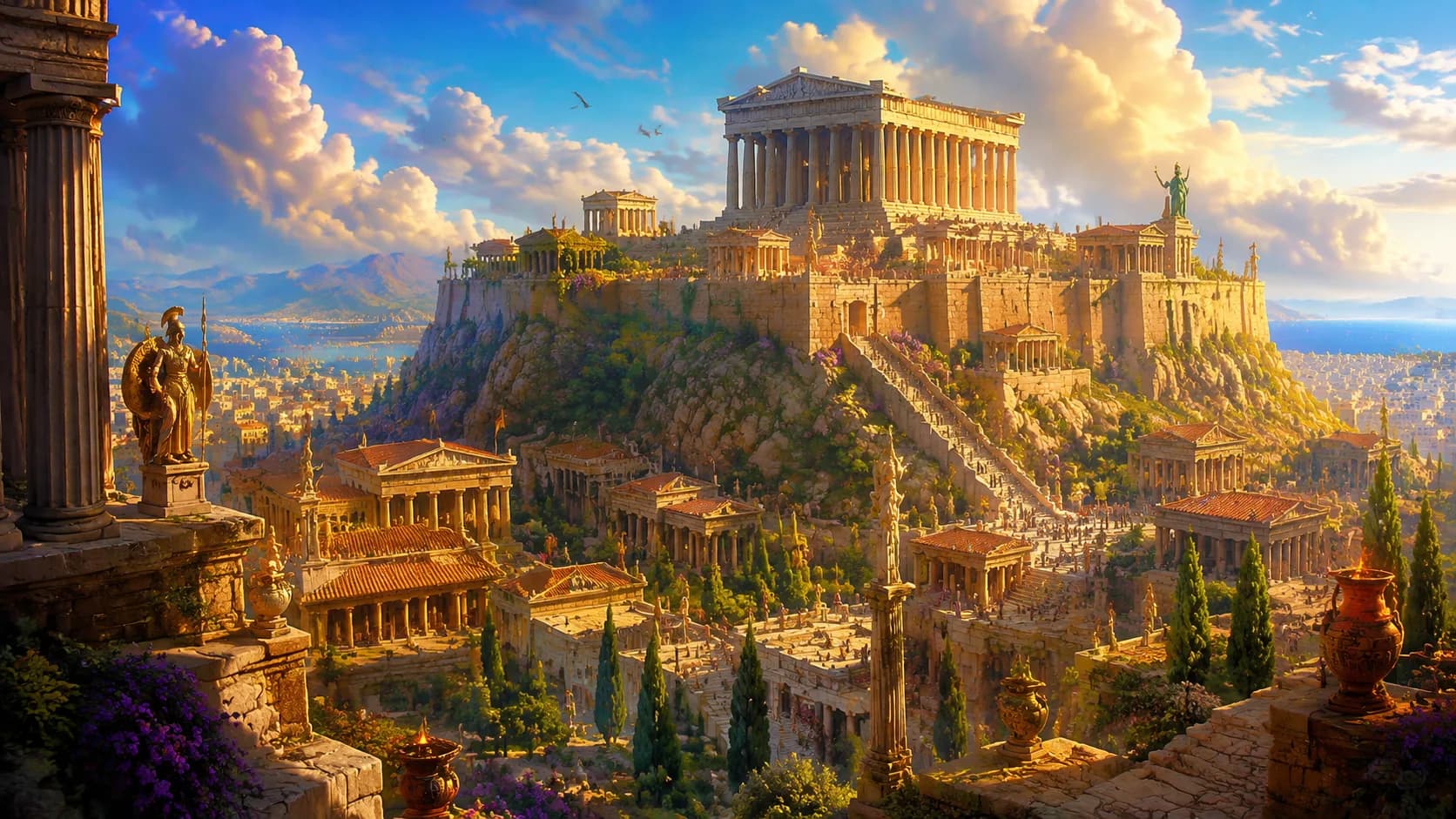
The Acropolis of Athens (Greek: Ακρόπολη Αθηνών) is a fortified hilltop citadel in the centre of Athens, Greece, containing the remains of several ancient buildings of extraordinary architectural and historical significance, most notably the Parthenon, the Propylaea, the Erechtheion, and the Temple of Athena Nike. Built primarily during the 5th century BCE the so called "Golden Age" of Athens under the ambitious building programme of the statesman Pericles, the Acropolis represents the highest achievement of classical Greek architecture: a synthesis of mathematical precision, aesthetic refinement, engineering innovation, and spiritual purpose that has never been surpassed. The complex was designed as both a sacred precinct dedicated to Athena (patron goddess of Athens) and a civic monument celebrating Athenian democracy, cultural achievement, and the pursuit of excellence (arete). Its architectural vocabulary Doric and Ionic columns, pediments, friezes, optical refinements became the foundation of the classical tradition that continues to influence architecture, design, and visual culture worldwide. Recognised as a UNESCO World Heritage Site since 1987, the Acropolis remains the single most visited monument in Greece and one of the most studied architectural complexes in the world.
This comprehensive guide explores every major building on the Acropolis from the Parthenon's astonishing optical refinements to the Erechtheion's ethereal Caryatids explaining how ancient Greek architects achieved effects that still challenge modern engineering, how immersive audio technology now allows listeners to experience these spaces acoustically, and why the principles established on this hilltop remain the foundation of architectural beauty across the world.
Key Facts: The Architecture of the Acropolis
- ••Construction Period: The major buildings were constructed between 447 and 406 BCE during the leadership of Pericles, with Phidias serving as artistic director and Ictinus and Callicrates as principal architects of the Parthenon
- ••Four Principal Buildings: The Parthenon (temple of Athena Parthenos), the Propylaea (monumental gateway), the Erechtheion (with its famous Caryatid Porch), and the Temple of Athena Nike (celebrating triumph and grace)
- ••Material: Pentelic marble from Mount Pentelicus, 16 kilometres northeast of Athens, a fine-grained white marble that develops a warm golden patina over time, giving the buildings their distinctive honey-coloured glow at sunset
- ••Optical Refinements: The Parthenon contains no perfectly straight lines. Every surface is subtly curved or tilted to counteract optical illusions, creating a building that appears more perfect than geometric perfection itself
- ••Architectural Orders: The complex combines both Doric (Parthenon exterior, Propylaea) and Ionic (Erechtheion, Temple of Athena Nike, Parthenon interior frieze) orders, a revolutionary mixing of styles that influenced all subsequent classical architecture
- ••UNESCO World Heritage: Designated in 1987, the Acropolis receives over 3 million visitors annually and remains the most influential architectural complex in Western civilisation, its principles visible in government buildings, museums, and cultural institutions worldwide
Quick Answer
✨ Fun fact: The Parthenon contains not a single straight line. Every surface that appears perfectly flat (the floor, the columns, the entablature) is in fact subtly curved, tilted, or tapered by amounts ranging from a few millimetres to several centimetres, all calculated with a mathematical precision that modern architects find genuinely intimidating. The ancient Greeks accomplished this using nothing more than rope, plumb lines, optical intuition, and what appears to have been an almost supernatural understanding of how the human eye perceives geometry. They built a temple so meticulously engineered that it has looked "perfect" to every generation of observers for 2,500 years, while simultaneously ensuring that almost nothing about it is geometrically straight. This is the architectural equivalent of making a person feel completely at ease in a conversation while secretly juggling seventeen invisible objects behind your back, except the objects are Pentelic marble blocks weighing up to ten tonnes each, and the conversation has lasted two and a half millennia.
What Is the Acropolis and Why Does Its Architecture Matter?
The word "acropolis" comes from the Greek akron (highest point) and polis (city), and while many Greek cities had an acropolis, when people say "the Acropolis" they invariably mean the one in Athens the Sacred Rock that rises above the Attic plain like a natural pedestal designed by geography specifically for the purpose of displaying humanity's finest buildings. The site has been continuously inhabited or used for over 5,000 years, with evidence of settlement dating to the Neolithic period, but the buildings that made it immortal were constructed during a concentrated burst of creative energy between 447 and 406 BCE roughly forty years that produced some of the most important architecture ever built.
Visionaria Insight
By immersing ourselves in these historical soundscapes, we reconnect with a timeless human tradition of storytelling and mental restoration.
The architecture of the Acropolis matters because it represents the moment when human beings first demonstrated that buildings could be more than functional structures. The Parthenon doesn't merely shelter; it communicates. Its proportions convey harmony. Its optical refinements create an almost musical sense of visual rhythm. Its sculptural programme tells stories about the relationship between gods and mortals, civilisation and nature, order and vitality. Every element from the massive Doric columns to the smallest carved metope was designed to work together in a unified aesthetic statement about what Athens believed, valued, and aspired to become.
Read more: How to Practice Story Meditation at Home

This is why the Acropolis continues to influence architecture today. The principles established here proportion, optical refinement, the integration of structure and ornament, the idea that architecture should elevate the spirit are still taught in every architecture school in the world. When you walk into a building that feels "right" without being able to explain why a courthouse, a museum, a library there is a very good chance that the proportions making you feel that way were first worked out on a limestone hilltop in Athens during the time of Socrates and Plato.
An Epicurean, a Stoic, and a Cynic walk into a garden. The bartender says, 'Is this some kind of philosophical joke?'
The Parthenon: Masterpiece of Classical Greek Architecture
The Parthenon (Greek: Παρθενώνας, from parthenos, meaning "maiden" a reference to Athena Parthenos) is the centrepiece of the Acropolis and the most famous building of the ancient world. Constructed between 447 and 438 BCE (with sculptural decoration continuing until 432 BCE), it was designed by the architects Ictinus and Callicrates under the artistic supervision of Phidias, the greatest sculptor of antiquity. The building is a Doric peripteral temple meaning it is surrounded on all four sides by a colonnade of freestanding columns with 8 columns across the short ends and 17 along each long side, for a total of 46 exterior columns.
What makes the Parthenon extraordinary is not merely its size (approximately 69.5 metres long by 30.9 metres wide) or its materials (entirely constructed from Pentelic marble), but the unprecedented sophistication of its design. The building's proportions follow a consistent ratio 4:9 that appears everywhere: in the relationship between column diameter and column spacing, between the width and length of the floor plan, and between the height of the entablature and the height of the entire facade. This mathematical consistency creates a sense of visual harmony that the human eye registers instinctively, even without understanding the geometry behind it.
Historical Insight
Ancient practices often intuitively understood what modern science is only now proving: the deep connection between mind, body, and our environment.
Inside the Parthenon stood Phidias's chryselephantine (gold and ivory) statue of Athena Parthenos approximately 12 metres tall, covered with over 1,100 kilograms of gold, and considered one of the wonders of the ancient world. The statue is long gone, but the building that housed it continues to demonstrate that architecture at its finest is a form of philosophy made visible: the Parthenon expresses in marble what Plato expressed in words the idea that behind the messy, imperfect world of appearances lies a realm of perfect, eternal forms.
"The Parthenon's proportional system is so thorough that if an ancient Greek architect had been given the dimensions of a single column drum, they could have mathematically derived the measurements of the entire building every column, every step, every metope, every triglraph from that one piece of stone. This is roughly equivalent to being handed a single brick and correctly deducing the complete floor plans, elevations, and decorative programme of an entire cathedral. It is the kind of mathematical elegance that causes modern architects to oscillate between profound admiration and quiet professional despair."

Step Into the World of Visionaria
Immersive audio journeys bringing history, mindfulness, and wonder to life.
A Roman walks into a bar, holds up two fingers, and says, 'Five beers, please.'
The Propylaea: Gateway to the Sacred Hill
The Propylaea (Greek: Προπύλαια, meaning "before the gates") is the monumental gateway through which all visitors entered and still enter the Acropolis. Designed by the architect Mnesicles and built between 437 and 432 BCE, it is one of the most architecturally innovative buildings of antiquity, and its influence on gateway and entrance architecture has been enormous. The Propylaea was the first building visitors encountered as they climbed the steep western approach to the Acropolis, and its design was calculated to create a specific sequence of architectural experiences anticipation, revelation, and awe that modern architects would recognise as "processional design."
The building's central section features a deep colonnade of six Doric columns on its western (outer) face and six more on its eastern (inner) face, creating a covered passage that dramatically frames the first view of the Parthenon as visitors emerge on the far side. Between these two Doric facades, Mnesicles placed tall Ionic columns one of the earliest known examples of combining both architectural orders in a single building. This was revolutionary: the Doric order (sturdy, masculine, austere) and the Ionic order (slender, elegant, decorative) had previously been used separately, and Mnesicles's decision to combine them created a visual dialogue between strength and refinement that influenced temple design across the ancient world.
Visionaria Insight
By immersing ourselves in these historical soundscapes, we reconnect with a timeless human tradition of storytelling and mental restoration.
The Propylaea also contained the Pinakotheke (picture gallery) one of the earliest known purpose built art galleries in history in its northern wing. Ancient sources describe it as containing panel paintings by leading Athenian artists, making the approach to the Acropolis not merely an architectural experience but a cultural one: visitors moved through art, through architecture, and through increasingly sacred space, arriving at the Parthenon having been thoroughly prepared intellectually, emotionally, and spiritually for the encounter with Athens's greatest building.
"The Propylaea is essentially the ancient Greek answer to the question: 'How do you make walking through a doorway feel like a spiritual experience?' And the answer, it turns out, involves six Doric columns, six Ionic columns, a ceiling painted with gold stars on a dark blue background, a calculated framing of the Parthenon at the exit, and a world class art gallery on the left. Modern airport designers, who must solve the rather less elevated version of this problem 'How do you make walking through a security checkpoint feel like something other than a minor indignity?' have, on the whole, been less successful."
Why did the historian break up with the archaeologist? Because her career was literally in ruins.
The Erechtheion and the Caryatid Porch
The Erechtheion (Greek: Ερέχθειον) is the most architecturally complex building on the Acropolis and perhaps the most unusual temple in the entire Greek world. Built between 421 and 406 BCE, it occupies the most sacred part of the hilltop, the site where, according to Athenian mythology, Athena and Poseidon competed for the patronage of the city. The building had to accommodate multiple cults, sacred objects, and holy sites on a dramatically uneven terrain the north side of the building sits approximately 3 metres lower than the south which forced the architects to create one of the most inventive ground plans in ancient architecture.
Visionaria Insight
By immersing ourselves in these historical soundscapes, we reconnect with a timeless human tradition of storytelling and mental restoration.
The building's most famous feature is undoubtedly the Porch of the Caryatids (Porch of the Maidens) on its south side a small projecting porch supported not by columns but by six sculptured female figures (korai) who stand in graceful contrapposto, their draped garments serving as the visual equivalent of column flutes. The Caryatids are among the most recognisable images of ancient Greek art, and their design represents an extraordinary achievement: each figure simultaneously functions as a structural support (bearing the weight of the entablature and roof), a work of sculpture (displaying individual poses and expressions), and an architectural element (maintaining the proportions and visual rhythm of a columned porch).
The interior of the Erechtheion housed several of Athens's most sacred objects: the ancient olivewood cult statue of Athena Polias (the most venerated image in the city), the sacred olive tree that Athena was said to have given Athens, and the mark of Poseidon's trident on the rock where the god had struck the earth to produce a salt spring. The building was thus a architectural container for mythology a place where the physical and the sacred intersected, where visitors could see, touch, and stand in the very locations where the gods were believed to have walked.
Why did the ancient physician prescribe a long walk? Because he was tired of listening to the patient complain in his office.
The Temple of Athena Nike: Celebrating Triumph and Grace
Perched on the southwestern bastion of the Acropolis a dramatic position overlooking the approach path and the plain below the Temple of Athena Nike (Greek: Ναός Αθηνάς Νίκης) is the smallest of the Acropolis's four principal buildings and, in many ways, the most exquisite. Designed by the architect Callicrates and built between approximately 427 and 424 BCE, it is a miniature Ionic amphiprostyle temple meaning it has columns at the front and back but not along the sides with four elegant Ionic columns on each end, standing approximately 4 metres tall.
The temple was dedicated to Athena Nike Athena in her aspect as goddess of triumph and its position was chosen with extraordinary care. Visitors climbing the steep approach to the Acropolis would see the temple above them on their right, its delicate Ionic columns silhouetted against the sky, as a beacon of aspiration and grace. The temple's sculptural frieze depicted scenes from both mythological and historical Greek narratives, and its parapet featured reliefs of Nike (Victory) figures adjusting their sandals images of such grace and delicacy that they remain among the finest examples of classical Greek relief sculpture.
Did You Know?
The relentless drive to understand the world was seen not just as an academic pursuit, but as a spiritual and healing practice by the ancients.
Despite its small size, the Temple of Athena Nike demonstrates a principle central to all Acropolis architecture: every building, regardless of scale, received the same quality of design, craftsmanship, and aesthetic attention. The column capitals are carved with the same precision as the Parthenon's. The proportional system is equally rigorous. The sculptural programme is equally ambitious. The ancient Greeks did not reserve excellence for large buildings and offer something lesser for small ones a lesson that modern designers and architects continue to learn from the Acropolis.
"The Temple of Athena Nike occupies approximately the same floor area as a generous modern living room, and yet it contains more architectural sophistication per square metre than most entire buildings constructed since. This is slightly humbling for modern architects, who occasionally struggle to make a 400 square metre house look interesting, and then discover that Callicrates made 27 square metres look like the gateway to the divine using nothing but four Ionic columns, a modest entablature, and an extremely good understanding of how sunlight interacts with marble at different times of day."
A philosopher walked into a wall. His students asked if it hurt. He replied, 'The wall is an illusion, but my headache is quite real.'
Optical Illusions and Mathematical Precision in Acropolis Design
Perhaps the most remarkable aspect of Acropolis architecture and particularly the Parthenon is its system of optical refinements: deliberate deviations from geometric perfection that are calculated to make the building look more perfect than a geometrically perfect building would. This system was described by the Roman architect Vitruvius in his treatise De Architectura (1st century BCE) and has since been confirmed and elaborated by centuries of precise measurement, most notably by the architect Francis Cranmer Penrose in the 1840s.
Visionaria Insight
By immersing ourselves in these historical soundscapes, we reconnect with a timeless human tradition of storytelling and mental restoration.
The most significant refinements include: Stylobate curvature the temple's floor (stylobate) is not flat but curves gently upward in the centre, rising approximately 6 centimetres along the long sides and 3 centimetres along the short ends. This counteracts the optical illusion that makes a perfectly flat surface appear to sag in the middle, especially when viewed against the sky. Column entasis each column swells slightly in the middle (the swelling is approximately 1.7 centimetres on a column diameter of about 1.9 metres), preventing the visual impression of concavity that a perfectly straight column creates. Column inclination the columns lean inward very slightly (if extended, they would meet at a point approximately 2.4 kilometres above the building), creating a barely perceptible convergence that gives the building a sense of visual stability and cohesion.
Corner column thickening the columns at the corners of the building are slightly thicker than the others (by approximately 4 centimetres in diameter) to compensate for the optical effect of appearing thinner when silhouetted against bright sky rather than seen against the darker background of the cella wall. These refinements are so subtle that most visitors are completely unaware of them which is, of course, the point. The refinements exist not to be noticed but to make the building feel intuitively, effortlessly right in a way that a geometrically "correct" building would not.
"The Parthenon's optical refinement system is perhaps the finest example in human history of what might be called 'invisible excellence' work that is so perfectly executed that it becomes invisible, perceived not as a technical achievement but as natural beauty. The analogy would be a musician whose technique is so flawless that you forget about technique entirely and simply experience the music, or a sentence so well crafted that you don't notice the craft, only the meaning. The ancient Greeks understood that the highest form of art is the art that conceals art and then they built it, in marble, on a hilltop, and made it last for two and a half thousand years."
Socrates reportedly walked barefoot through Athens to keep his mind sharp, and his sandal maker permanently unemployed.
Building Materials and Construction Techniques of the Ancient Greeks
The construction of the Acropolis buildings required engineering capabilities that continue to impress modern architects and structural engineers. The primary material was Pentelic marble a fine-grained white marble quarried from Mount Pentelicus, approximately 16 kilometres northeast of Athens. Pentelic marble was chosen not only for its beauty but for its unique property of developing a warm, honey golden patina over time as iron traces in the stone oxidise the reason the Parthenon glows amber at sunset. An estimated 22,000 tonnes of marble were quarried, transported, and assembled for the Parthenon alone.
Visionaria Insight
By immersing ourselves in these historical soundscapes, we reconnect with a timeless human tradition of storytelling and mental restoration.
The blocks were cut at the quarry with remarkable precision some joints are so tight that it is impossible to insert a razor blade between them and transported to the Acropolis on ox-drawn carts along a purpose built road. On site, they were lifted into position using cranes, ramps, and an ingenious system of pulleys. The blocks were not held together by mortar (the Greeks used dry construction) but by precisely cut iron clamps sealed with molten lead to prevent corrosion, and wooden dowels for vertical alignment. This dry joint technique meant that every block had to be cut with extreme precision there was no mortar to fill gaps or compensate for errors.
Read more: How Story Worlds Improve Mental Relaxation

The column drums were finished in situ after assembly the final fluting was carved with the drums already stacked and in position, ensuring perfect continuity from one drum to the next. This approach required extraordinary skill and patience: a single error in carving a flute would be visible as a discontinuity that could never be corrected. The fact that the Parthenon's 46 exterior columns, each composed of 10-12 drums with 20 flutes each, show virtually no such discontinuities testifies to a level of craftsmanship that modern stone carvers regard with something approaching reverence.
A philosopher walked into a wall. His students asked if it hurt. He replied, 'The wall is an illusion, but my headache is quite real.'
The Acropolis Through the Centuries: Transformation and Renewal
The story of the Acropolis after its initial construction is a story of continuous transformation a sacred site that adapted to successive civilisations, religions, and cultural eras while maintaining its architectural power. Under Roman rule (from 146 BCE), the Acropolis was treated with reverence: Roman emperors added inscriptions and minor modifications but left the major buildings largely intact, recognising their status as masterworks of a civilisation the Romans deeply admired. The Parthenon continued to function as a temple to Athena for nearly a thousand years.
Visionaria Insight
By immersing ourselves in these historical soundscapes, we reconnect with a timeless human tradition of storytelling and mental restoration.
In the 6th century CE, the Parthenon was converted into a Christian church dedicated to the Virgin Mary (Theotokos) a transformation that, while altering some interior elements, actually helped preserve the building by giving it an active religious function and ensuring its continued maintenance. In 1456, following the Ottoman arrival, the Parthenon was converted into a mosque, and a minaret was added another transformation that, again, kept the building in active use and thus in reasonable repair. The most significant structural alteration came in 1687, when a Venetian bombardment struck the building, which was being used as an ammunition store, causing a catastrophic explosion that removed the central section of the cella and many of the columns.
The modern preservation era began in earnest in the early 19th century, and the ongoing restoration programme (begun in 1975 and continuing today) represents one of the most ambitious architectural conservation projects in the world. Using original marble from Pentelicus, ancient construction techniques, and advanced laser scanning and computer modelling, conservators are painstakingly reassembling fallen elements and replacing corroded iron clamps with titanium ensuring that the buildings will endure for centuries to come while remaining as faithful as possible to their original 5th century appearance.
"The Acropolis has, over its 2,500 year architectural life, been a Greek temple complex, a Roman tourist attraction, a Byzantine church, an Ottoman mosque, an ammunition store (briefly and regrettably), an open air ruin, a Romantic era pilgrimage destination, a nationalist symbol, a UNESCO World Heritage Site, and a selfie backdrop. It has survived every single one of these transformations with its fundamental architectural dignity intact, which is more than can be said for most buildings that have to adapt to even one change of use. If there is a lesson here, it is that genuinely good architecture is almost indestructible not because it cannot be physically altered, but because its essential qualities of proportion, light, and spatial harmony persist regardless of what happens to the surface details."
Why did the ancient physician prescribe a long walk? Because he was tired of listening to the patient complain in his office.
How Spatial Audio Brings Ancient Architecture to Life
One of the most exciting developments in the study and experience of ancient architecture has been the emergence of archaeoacoustics the science of understanding how ancient buildings sounded. Architecture is not only a visual art; it is profoundly an acoustic one. The Parthenon's marble columns, walls, and ceiling created a specific acoustic environment reverberations, echoes, resonances that was integral to the experience of being inside the building. When a hymn was sung in the Parthenon, the sound interacted with the architecture in ways that modern acoustic modelling can now reconstruct with remarkable fidelity.
Visionaria Insight
By immersing ourselves in these historical soundscapes, we reconnect with a timeless human tradition of storytelling and mental restoration.
Spatial 3D audio technology makes it possible for modern listeners to experience these acoustic environments through headphones hearing the Parthenon's interior as it would have sounded during a ceremony, walking through the Propylaea with accurate reverberation modelling, or standing in the Erechtheion and hearing the difference between the north porch's tall acoustic space and the intimate Caryatid porch. This is not ambient background music; it is architectural sound design the recreation of spatial acoustic environments based on the physical properties of the buildings.
Visionaria's narrative audio journeys through ancient Athens use these principles to create experiences that are both educationally rich and deeply calming. Listeners walk through the Propylaea hearing footsteps on marble, wind between columns, and the spatial character of the gateway's deep colonnade; they enter the Parthenon and experience the way sound changes as they move through the building; they stand before the Caryatids and hear the intimate acoustic signature of the small porch. The architecture becomes not something you look at in photographs but something you inhabit acoustically a vivid, immersive experience that the brain processes as genuinely being there.
A time traveler went back to antiquity to teach them about 'holistic health.' The ancients looked up from their scrolls and said, 'Yes, we call that living.'
The Influence of Acropolis Architecture on the Modern World
The architectural vocabulary established on the Acropolis columns, pediments, entablatures, proportional systems, the integration of sculpture and architecture became the foundation of the Western architectural tradition and remains visibly present in buildings worldwide. The transmission pathway runs from Athens through Rome (which adopted and adapted Greek architectural orders), through the Renaissance (which revived classical forms after the medieval period), through Neoclassicism (which made Greek and Roman architecture the dominant style of the 18th and 19th centuries), and into the present day, where classical elements continue to signify permanence, authority, culture, and civic dignity.
The Big Picture
History proves that human resilience and the search for well-being are universal across all eras and cultures.
The most obvious descendants of the Parthenon include the United States Capitol Building in Washington, D.C. (whose dome and colonnade are directly inspired by classical Greek and Roman models), the British Museum in London (whose south facade is a near direct quotation of a Greek temple front), the Lincoln Memorial (a Doric temple explicitly modelled on the Parthenon), and Nashville's full scale Parthenon replica (built in 1897 as a testament to the enduring power of the original design). But the influence extends far beyond these obvious examples every building that uses columns, pediments, or proportional harmonies based on mathematical ratios is, to some degree, an architectural descendant of the Acropolis.
Beyond specific stylistic elements, the Acropolis established the broader principle that architecture is a cultural statement that the way a society builds its most important buildings reveals what it values, what it aspires to, and how it understands its place in history. This idea that architecture is not merely construction but communication is arguably the Acropolis's most enduring legacy, influencing how creativity and cultural expression continue to shape the built environment worldwide.
Why did the Stoic cross the road? Because it was the rational thing to do, and he was indifferent to the traffic.
Experiencing the Acropolis Through Immersive Meditation
The intersection of ancient architecture and modern meditation creates a uniquely powerful experience. When a listener enters an immersive audio journey through the Acropolis, something remarkable happens: the brain engages both its spatial processing systems (constructing a three-dimensional mental model of the buildings based on audio cues) and its relaxation pathways (responding to the calm, rhythmic narration and the natural beauty of the described environment). The result is a state that combines deep relaxation with active cognitive engagement calm but not passive, focused but not stressed.
Ancient architecture is particularly effective as a meditation environment because it provides what psychologists call "soft fascination" environmental stimuli that are interesting enough to hold attention without being demanding enough to cause cognitive strain. The Parthenon's proportions, the Caryatids' serene expressions, the play of light through the Propylaea's columns, the warmth of Pentelic marble in afternoon sunlight these are elements that the mind can engage with pleasurably and indefinitely, without the effort or fatigue that intense concentration produces.
Visionaria Insight
By immersing ourselves in these historical soundscapes, we reconnect with a timeless human tradition of storytelling and mental restoration.
Imagination training through architectural meditation also builds visual spatial skills that have broad cognitive benefits. Regular practice of mentally inhabiting detailed architectural spaces has been linked to improved spatial reasoning, enhanced memory, and greater creative flexibility. The inner world that a listener constructs during an Acropolis meditation the columns, the marble surfaces, the views across Athens, the quality of the light becomes a permanent cognitive resource: a beautiful, calming mental environment that can be revisited at any time, with increasing vividness, as the practice develops.
Read more: The Legend of King Arthur and the Knights of the Round Table

"There is something wonderfully ironic about the fact that the Acropolis a hilltop that Pericles intended as a permanent display of Athenian greatness has found its most recent incarnation as a meditation environment. One imagines Pericles, who commissioned the buildings with the explicit aim of awing visitors, allies, and rivals, being informed that people in the 21st century close their eyes, put on headphones, and mentally walk through his buildings in order to feel calm and spiritually refreshed. He would probably be both confused and delighted: confused because the technology would require explanation, and delighted because the buildings are apparently still working after 2,500 years, even for people who have never been to Athens."
What's an ancient intellectual's favorite exercise? Jumping to conclusions.
The Future of Ancient Architectural Heritage
The convergence of digital technology, immersive audio, and archaeological research is creating unprecedented opportunities for experiencing, understanding, and preserving ancient architectural heritage. Technologies such as photogrammetry, laser scanning, and acoustic modelling now allow researchers to create extremely accurate digital reconstructions of ancient buildings not only as they appear today but as they appeared and sounded when they were new, complete with painted surfaces, bronze fittings, and acoustic environments.
For the Acropolis specifically, ongoing projects are using these technologies to create complete digital twins of the buildings at various points in their history the Parthenon with its original polychrome (multi coloured) paint scheme, the Erechtheion with its interior furnishings, the Propylaea with its painted ceiling of gold stars on blue. These reconstructions, combined with spatial 3D audio that recreates the acoustic properties of the spaces, offer a form of temporal travel the ability to experience these buildings not as weathered ruins but as the vibrant, colourful, acoustically rich environments they were designed to be.
Did You Know?
The relentless drive to understand the world was seen not just as an academic pursuit, but as a spiritual and healing practice by the ancients.
The future also holds the exciting possibility of adaptive architectural experiences journeys through the Acropolis that respond to the listener's emotional state, pacing preferences, and areas of interest. Imagine entering the Propylaea at your own pace, spending more time with the Caryatids because your engagement data suggests you find them particularly calming, or hearing additional historical detail about the Parthenon's construction because you've expressed interest in engineering. This personalised ancient architecture is the next frontier and Visionaria is at the forefront of making it accessible to anyone with headphones and a sense of wonder.
"It is worth noting that the ancient Greeks, who invented the architectural principles that define the Acropolis, also invented the word 'museum' from mouseion, a temple of the Muses, a place where the arts were preserved and celebrated. They would, I think, have thoroughly approved of the idea that their greatest buildings could now be experienced by anyone, anywhere in the world, through immersive audio that recreates the acoustic and spatial qualities of the original spaces. The Acropolis was always meant to be experienced, not merely studied and the technologies of the 21st century are, for the first time, making that experience available to people who cannot physically travel to Athens. The Muses, one suspects, would be pleased. Athena, who was always a pragmatist, would probably have asked for a download link."

The Architecture of Magical Kingdoms in Fantasy Worlds
Explore the breathtaking architecture of fantasy kingdoms, from floating sky castles to underground crystal caverns, enchanted forests to elemental palaces. Discover how magical architecture shapes legendary realms.
Why did the historian break up with the archaeologist? Because her career was literally in ruins.
The Bottom Line
The architecture of the Acropolis is not merely a collection of beautiful old buildings it is the foundational grammar of Western architecture, a living demonstration of what happens when mathematical precision, aesthetic intuition, engineering mastery, and spiritual purpose converge on a single hilltop. The Parthenon's optical refinements, the Propylaea's processional design, the Erechtheion's innovative planning, and the Temple of Athena Nike's exquisite proportions together represent the moment when humanity first proved that architecture could be more than construction it could be art, philosophy, and cultural statement simultaneously.
Did You Know?
The relentless drive to understand the world was seen not just as an academic pursuit, but as a spiritual and healing practice by the ancients.
Ready to experience it? Visionaria offers immersive journeys including walks through the Acropolis and ancient Athens in spatial 3D audio. Free to download on iOS and Android. Continue reading: explore Apollo and Ancient Music Rituals, discover Athena and the Wisdom of the Ancient World, or learn about The Mysteries of Delphi.
Experience More with Visionaria
Download the app to explore guided historical and wellness journeys.
An Epicurean, a Stoic, and a Cynic walk into a garden. The bartender says, 'Is this some kind of philosophical joke?'
This article is for educational and informational purposes only. Historical details are based on available research and may evolve as new evidence emerges.
Visionaria journeys are designed for relaxation, guided imagination, and personal enrichment. They are not a substitute for medical, mental health, legal, or professional advice.