Atlantis: The Lost City, Its Myth and Deeper Meaning
Plato introduced Atlantis in two dialogues, Timaeus and Critias, written around 360 BCE, and no earlier Greek writer ever mentioned it. Atlantis was entirely his creation, which makes the fact that millions of people across 24 centuries have gone searching for it one of history's most extraordinary acts of collective imagination.
- Plato Invented Atlantis, and That Is the Most Interesting Part
- The Architecture of Atlantis: A City Built Like a Mind
- Why Every Culture Has Its Own Atlantis
- Atlantis as a Map of the Unconscious Mind
- The Real Places That May Have Inspired Atlantis
- What Atlantis Really Teaches About Wisdom and Ambition
- How to Find Atlantis With Your Eyes Closed
- FAQ: Plato, the Origins, and What the Text Actually Says
- FAQ: Geography, Real Candidates, and Where Atlantis 'Was'
- FAQ: Atlantis, Psychology, and the Architecture of the Inner World
- FAQ: Atlantis in Modern Wellness, Meditation, and Imagination Practice
- FAQ: Comparative Myths, Practical Wisdom, and What to Do With All of This
- Sources and Further Reading on the Atlantis Legend
- The Legacy of Atlantis: Why the Legend Still Matters
- Frequently Asked Questions
Atlantis is a legendary lost civilization first described by the philosopher Plato around 360 BCE. According to his account, it was a powerful island nation, located beyond the Strait of Gibraltar, that ultimately sank beneath the ocean in a single day and night following a profound moral and societal transformation. Most classical scholars today regard Atlantis as a philosophical invention rather than a historical place.
And yet here we are, two and a half millennia later, still searching for it. Hundreds of locations have been proposed: the Azores, the Caribbean, the Canary Islands, Antarctica, the Aegean Sea. Documentaries are made. Expeditions are funded. People feel certain. That is genuinely fascinating, and it tells us far more about the human mind than about the ocean floor. Atlantis, it turns out, is less a place to be found and more an idea to be understood, one that speaks to our collective longing for a world that was once wiser, more connected, and more whole. Exploring hidden worlds beneath the surface of our reality is, in many ways, the oldest human impulse there is.
So let us go there. Not with sonar equipment, but with our minds, the only instrument that has ever truly reached Atlantis.
Key Facts About Atlantis
- •Origin: First described by Plato in 360 BCE in his philosophical dialogues Timaeus and Critias.
- •Location (in myth): Beyond the Pillars of Hercules, described as larger than Libya and Asia combined.
- •Purpose: Plato used Atlantis as a philosophical allegory, contrasting unchecked ambition with the wisdom of Athens.
- •Cultural impact: Atlantis has inspired over 5,000 books and is referenced in virtually every culture on Earth.
- •Modern consensus: Mainstream classical scholars regard Atlantis as a literary invention, not a historical place.
Quick Answer
Atlantis is a legendary island civilization first described by the Greek philosopher Plato around 360 BCE in his dialogues Timaeus and Critias. According to Plato, it was an advanced maritime civilization located beyond the Pillars of Hercules (present-day Strait of Gibraltar) that ultimately experienced a profound transformation and sank beneath the ocean in a single day and night.
Plato Invented Atlantis, and That Is the Most Interesting Part
Most people get this wrong. They assume Atlantis must be based on some older Egyptian record, some half-remembered real event passed down through the generations. Plato even frames it that way, placing the story in the mouth of a fictional Egyptian priest who tells the Athenian statesman Solon that the Greeks are like children compared to Egyptian memory. But classical scholars broadly agree that no source before Plato mentions Atlantis, and Alan Cameron of Columbia University argued that even Plato's earliest ancient readers mostly treated the story as a philosophical invention. Not one. Plato created it. And that is not a disappointment. That is a marvel.
Plato was constructing a philosophical argument. In Timaeus and Critias, Atlantis served as the ultimate foil for ancient Athens and its ideal society. Athens represented wisdom, restraint, and virtue. Atlantis represented ambition unchecked by wisdom, a civilization of extraordinary engineering and wealth that eventually lost its moral grounding and experienced a spectacular transformation as a result. It is practically a Socratic dialogue in geographic form.
Key Insight
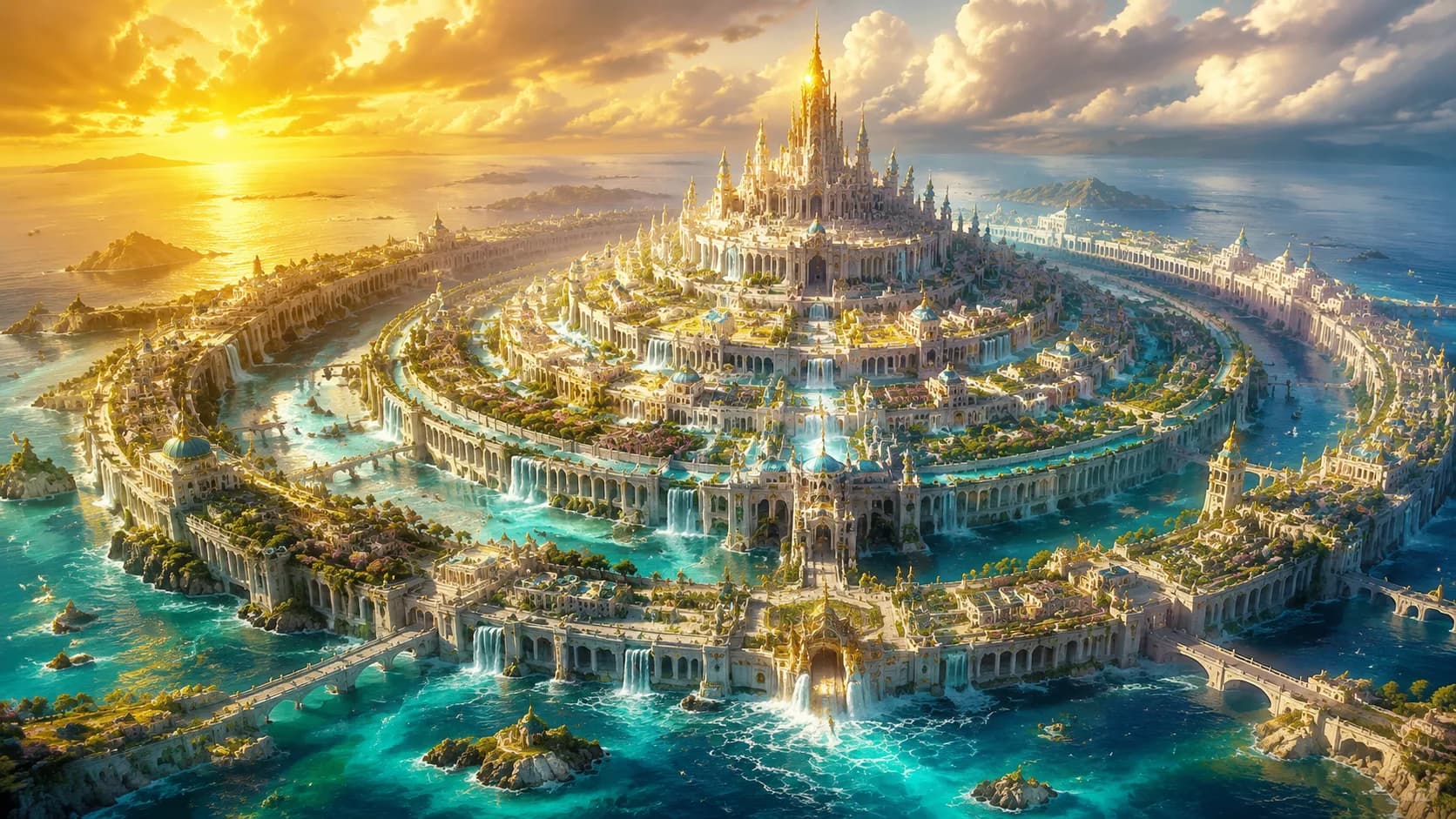
Plato described Atlantis in precise, almost architectural detail: concentric rings of land and water, a massive central citadel, canals wide enough for trireme ships, and a central temple plated in gold and orichalcum. This level of specificity is exactly what makes people believe it was real. But scholars like Pierre Vidal-Naquet (EHESS, Paris) point out that Plato used the same hyper-specific style for other clearly fictional places. Precision was his rhetorical tool, not his receipt.
Here is the thing about great philosophical myths: they only work if they feel real. Plato knew this. And so he gave Atlantis a coastline, a calendar, a population count of 60,000 governors. He gave it weight. The result was a story so vivid it escaped its own author's intentions and went searching for a continent on its own.
And it found one, in the imagination of every civilization that came after.
Why did Plato need a lost continent? Because his ideal republic kept getting outvoted in real Athens. At least Atlantis always did exactly what he said.
The Architecture of Atlantis: A City Built Like a Mind
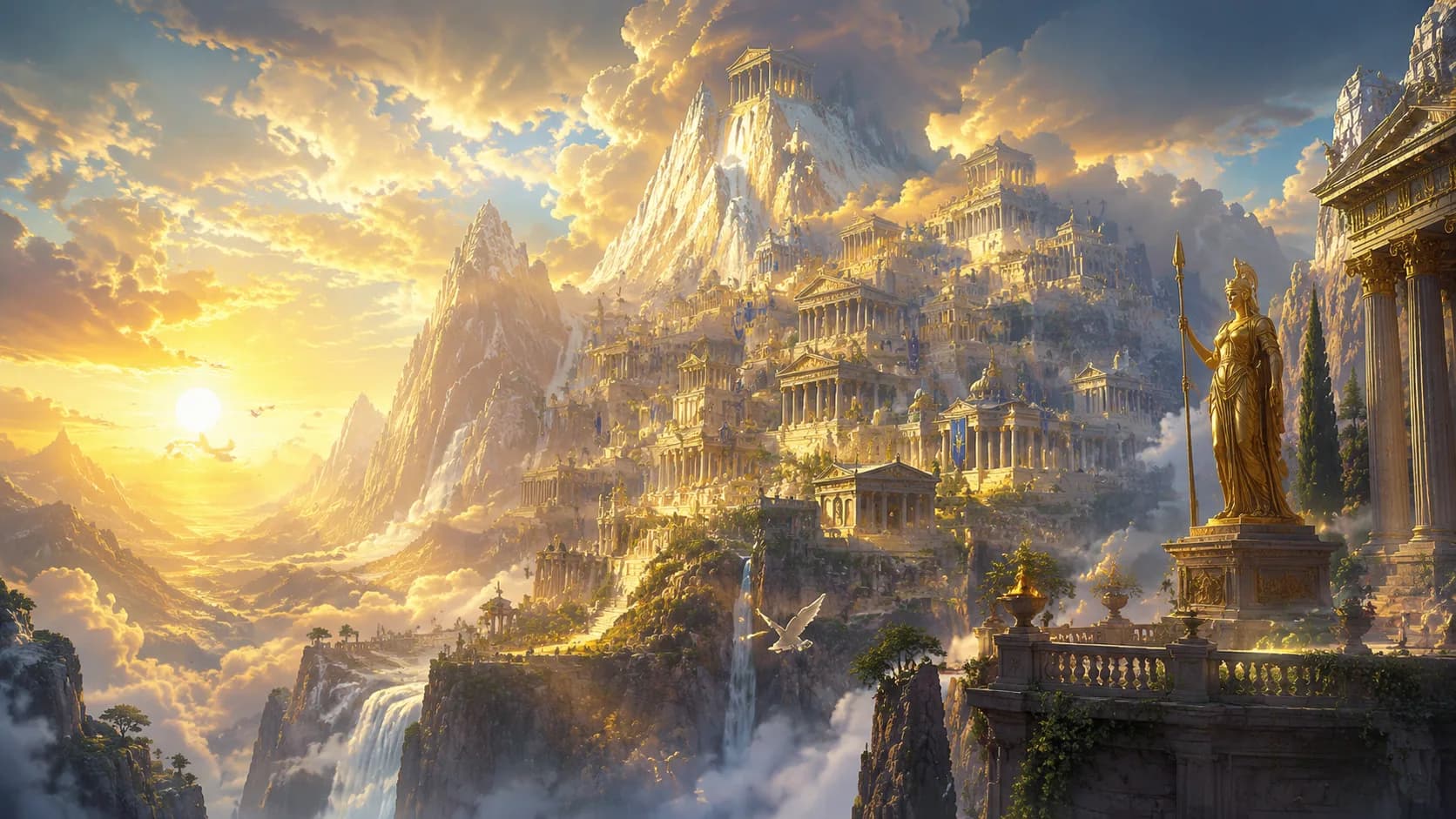
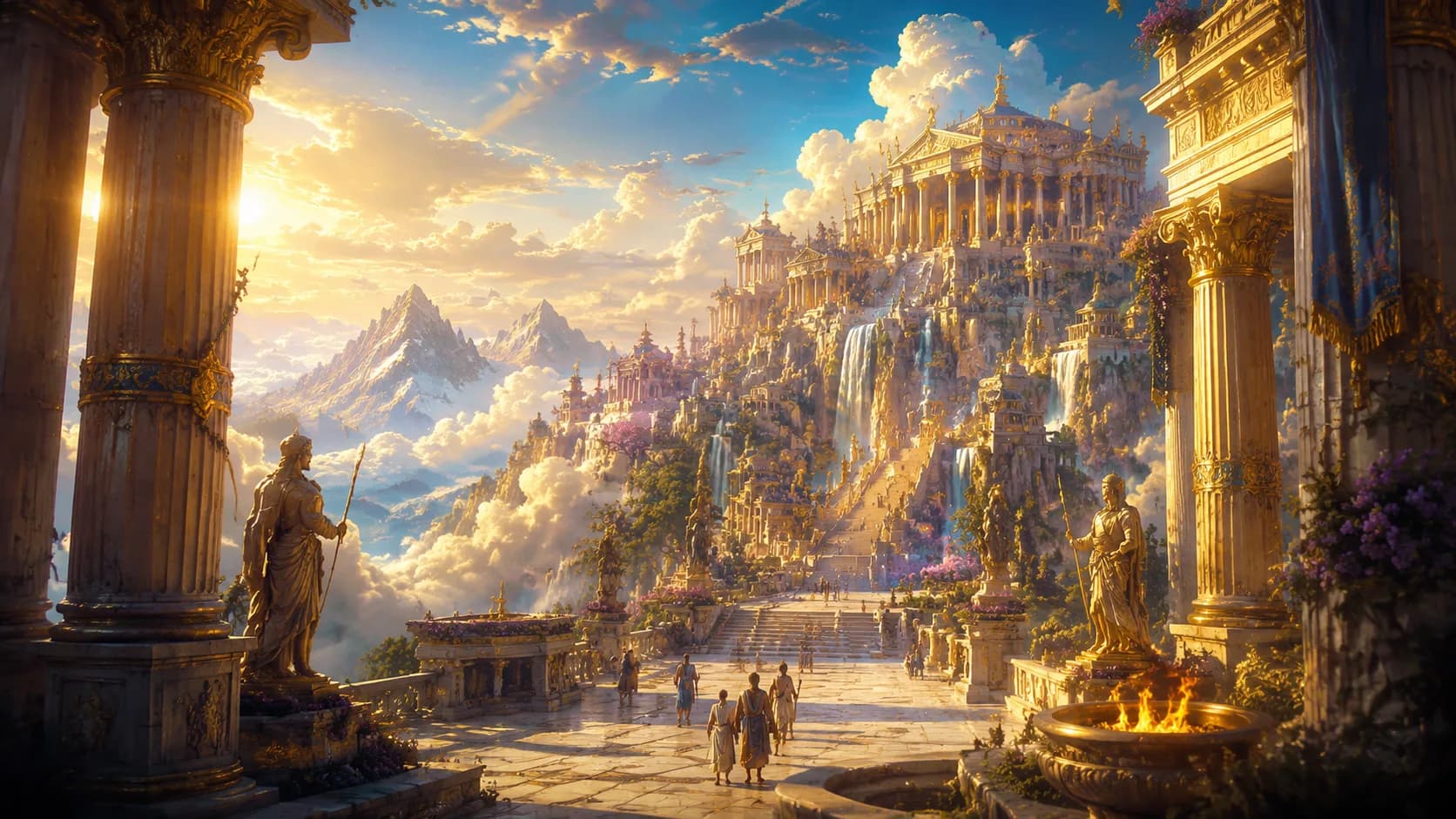
Picture the city Plato described. At its center sat a hill, and on that hill stood the temple of Poseidon, sheathed in silver, its pinnacles tipped with gold, surrounded by a grove of sacred trees. Radiating outward from this center came alternating rings of water and land, each ring connected by a tunnel wide enough for a warship to pass through. Then came the outer harbor, then the plains, then the mountains, arranged in perfect, almost musical proportion. It reads less like geography and more like a magical kingdom's architecture drawn from pure imagination.
That is not accidental. Jungian psychologists have noted for decades that the concentric circle is one of the most universal symbols of the psyche. Carl Jung himself, in his 1950 work on mandalas, observed that circular, radially symmetric patterns appear spontaneously in the art of people undergoing psychological integration, across cultures, across centuries. Plato may have been describing a civilization, but the shape he chose was the shape of a whole and ordered mind.
Quick Answer
Plato described Atlantis as a series of concentric rings of land and water surrounding a central sacred hill, a city layout that modern Jungian scholars interpret as an unconscious symbol of psychological wholeness and integration. The city's design was not incidental: it was the argument.
Orichalcum is worth a brief aside. Plato described this mysterious metal as covering the walls of Atlantis's central temple, glowing red in the firelight, second in value only to gold. Nobody knows exactly what it was. Some say a copper-zinc alloy. Some say a poetic invention. In 2015, Italian archaeologist Sebastiano Tusa recovered fifteen ingots from a 2,600-year-old shipwreck off the coast of Sicily that appear to match Plato's description. They are real, physical objects. They are made of a zinc-copper alloy unlike anything else from the ancient Mediterranean. Plato may not have invented everything.

Step Inside the Myth
Explore immersive audio journeys that bring ancient worlds and legendary civilizations to vivid, cinematic life.
Orichalcum: the only building material in history that is simultaneously a mystery metal, a philosophical symbol, and probably someone's very ambitious copper experiment.
Why Every Culture Has Its Own Atlantis
Forget Greece for a moment. Look at what other cultures built independently. Ancient Mesopotamians told of Dilmun, a paradise island of pure water and eternal youth. Hindu texts describe Dwarka, a golden city said to have been reclaimed by the sea after Krishna's passing. Celtic tradition preserved Hy-Brasil, a phantom island off the west coast of Ireland that appeared on maps as late as 1865. The Aztec origin story begins with Aztlan, a lost island homeland in the north from which their ancestors journeyed southward to found civilization.
Folklorist and comparative mythologist Joseph Campbell documented this pattern extensively in his 1949 work The Hero with a Thousand Faces: across all human cultures, the myth of a lost paradise that preceded the present world recurs with such regularity that it constitutes what he called an archetypal narrative, a story the human psyche keeps telling itself regardless of geography or history. It is not that everyone heard of Atlantis. It is that every human mind, given enough time and enough wondering, invents its own version.
Historical Pattern
Stories of a lost paradise or a golden age appear in many cultures around the world. The myth of a wise, prosperous world that existed before the present one, then was lost or transformed, appears to be genuinely universal.
Read more: How Natural Landscapes Inspired Ancient Mythology

What does that tell us? Maybe that the longing for a lost golden age is not a cultural artifact but a feature of consciousness itself. Something in the human mind looks backward and sees a light it can almost remember. Atlantis is simply the most famous name that light has ever been given.
Every culture independently invented a paradise they lost before they arrived. Collectively, humanity has lost more golden ages than it has actually experienced, which is either very sad or very poetic, depending on your mood.
Atlantis as a Map of the Unconscious Mind
Here is an interpretation that does not get nearly enough attention. Swiss psychiatrist Carl Gustav Jung, writing in the mid-twentieth century, proposed that myths do not describe external events but internal ones. They are, in his framework, the psyche's way of representing its own structure and its own processes. From that angle, Atlantis is not a place that was lost beneath the ocean. It is a part of the self that sank beneath the surface of consciousness. Something whole, luminous, and beautifully organized that most of us carry at depth but rarely reach.
This is not a fringe reading. Psychotherapist and Jungian analyst Marie-Louise von Franz, one of Jung's closest collaborators, discussed flood myths and lost civilizations extensively in her 1972 lectures published as Creation Myths. She argued that the sinking of a great civilization into the sea was a near-universal image for what she called the 'return to the unconscious', the act by which something once known and integrated slips back into the deep, requiring a new journey to recover it. We explore exactly this idea in our guide to mental time travel and the mind's capacity to recover what seems lost.
Key Insight
Jungian analyst Marie-Louise von Franz (1972) interpreted lost paradise myths as representations of psychological regression, moments when an integrated, wise part of the self becomes submerged under the pressures of everyday life. Recovering Atlantis, in this reading, means doing the inner work to surface what we already are at our deepest level.
And this is where the myth stops being ancient and starts being immediately, urgently personal. Because most people feel, at some point in their adult lives, that they once had access to something they have since lost. A clarity. A sense of wholeness. A way of being in the world that felt right and effortless before the noise arrived. Atlantis is what they are pointing at when they say that. It is the name for the deepest part of the self that is still, somehow, whole.
Jung spent decades mapping the unconscious. His students then discovered it looked exactly like a sunken city. Make of that what you will.
The Real Places That May Have Inspired Atlantis
Even if Plato invented the story, he probably drew from real events. Around 1600 BCE, the Minoan island of Thera (modern-day Santorini) experienced one of the largest volcanic events in recorded history. The island partially collapsed into the sea. The resulting waves may have reached around 7 to 12 meters along nearby coasts, according to estimates published by geologists Floyd McCoy (University of Hawaii) and Grant Heiken in 2000. Minoan settlements across the eastern Mediterranean were profoundly affected. An advanced maritime civilization, an island, a transformation involving the sea. The parallels are striking.
But be careful here. Atlantis scholar and classics professor Vidal-Naquet spent much of his academic career patiently dismantling theories that tried to pin Atlantis to a physical location. His argument, made in his 2005 book The Atlantis Story, was simple: when you look for a real place, you stop looking for the real meaning. And the real meaning is worth far more.
Historical Context
Geologists including Floyd McCoy of the University of Hawaii have estimated that the Minoan eruption of Thera, around 1600 BCE, was far larger than the 1883 Krakatoa eruption, and its tsunamis struck coasts across the southern Aegean. This event almost certainly passed through cultural memory and into the stories Plato later heard.
So Plato likely wove together a memory of a real catastrophe with a philosophical architecture of his own design. What emerged was neither pure history nor pure fiction. It was something more durable than either: a mythological truth, a story that is false in its details and accurate in its insight. You can find similar patterns at work in the ancient wonders of Babylon, where history and imagination have been braided together so tightly that scholars still argue about what was real.
Santorini exploded, an entire civilization was transformed, and two thousand years later Plato turned it into a philosophy lesson. Truly, the ancient Greeks never let a good natural event go to waste.
What Atlantis Really Teaches About Wisdom and Ambition
Strip everything away, and here is what Plato's story actually says. Atlantis began as a godly civilization. Its first rulers were literally the children of Poseidon. They were wise, moderate, and content with what they had. Over generations, however, the divine portion of their nature diluted, and the human portion took over. They became ambitious. Acquisitive. They wanted more land, more gold, more power. And in the end that wanting proved to be their undoing, not as a punishment from outside but as a natural consequence of having abandoned the thing that made them great: inner order.
And honestly? That is remarkably relevant. Plato wrote this in a period of Athenian political crisis, watching his own city strain under the weight of imperial ambition. But he might as well have been writing about any era, including ours. The myth argues, quietly but persistently, that the greatest civilizations are not the ones with the best engineering or the largest harbors. They are the ones that remember who they actually are at their center.
Core Lesson
Plato's Atlantis is, at its core, a meditation on the relationship between wisdom and ambition. The Atlanteans were extraordinary until they forgot their own nature. That forgetting, not any external force, was what sent them beneath the waves. It is, frankly, one of the most sophisticated psychological parables ever written.
There is a reason this theme resonates so strongly in immersive storytelling: the narrative of remembering a deeper, quieter self is not abstract. When listeners close their eyes and travel to an ancient or imagined world, they often report feeling something they can only describe as recognition, as though they are not discovering something new but recovering something old. That is exactly the feeling Plato was encoding. For a deeper look at how stories move through the mind and shift emotional states, our guide to the psychology of experiencing stories in meditation explains the neuroscience behind it.
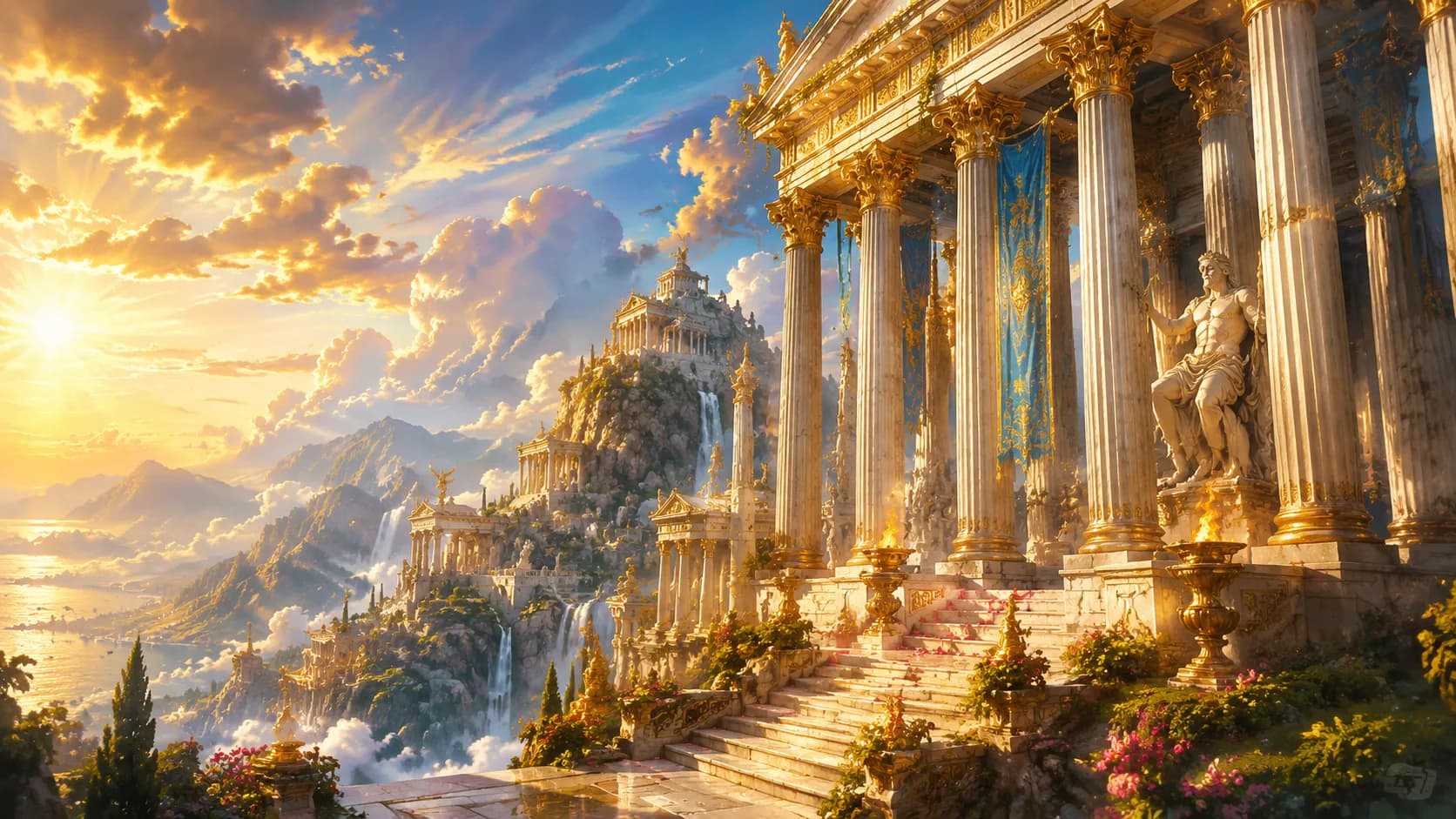
The Mythological World of Zeus Explained
Explore the origins, symbols, and enduring legacy of Zeus, the king of the Greek gods, and what his mythology reveals about the ancient Greek worldview.
Plato's Atlanteans had perfect canals, a solid gold temple, and access to a mysterious red metal. They still managed to miss the whole point. Some things never change.
How to Find Atlantis With Your Eyes Closed
None of the expeditions found it. Not the submarines off the Azores, not the satellite imagery over the Sahara, not the divers beneath the Bahamas. And here is what that actually means: Atlantis was never a geographic problem. It was always an imaginative one. The territory it occupies has always been inner, and the tools required to reach it have always been available to anyone willing to sit quietly for a moment and go.
Neuroscience has actually caught up with this intuition in the last two decades. Research from Princeton University's Uri Hasson and colleagues (Nature Communications, 2016) found that listening to a story produces similar, story-specific activity patterns in the brain's default mode network across different listeners, and that this shared activity predicted how well they remembered it. In other words: when you imagine walking through Atlantis's great harbor, your brain is not pretending to navigate. It is navigating. The geography becomes real in the only place it ever was real: inside the architecture of the mind that imagined it. Explore how this works in our deep guide to why the brain experiences stories as reality.
Neuroscience Note
Princeton neuroscientist Uri Hasson (2016) showed that vivid narrative immersion activates the brain's spatial navigation systems, the same regions that fire during real physical exploration. Imagining Atlantis's concentric canals is not metaphorical navigation. It is, neurologically speaking, genuine exploration.
Read more: What Is a Visualization Journey? Complete Guide to Guided Mental Imagery

So close your eyes. Picture the rings of water shimmering in morning light. Feel the salt air. Hear the distant sound of the temple bells. Plato spent years constructing this place with words so you could go there. He gave you the coordinates. He just hid them inside a story, which is, if you think about it, the only place coordinates worth following have ever been found. This article complements but does not replace professional guidance for those working through emotional challenges; if you are navigating something significant, a qualified therapist can help you explore the landscape within.
You cannot find Atlantis with a submarine. But you can absolutely find it with a comfortable pair of headphones, twenty quiet minutes, and the willingness to remember what you already know.
FAQ: Plato, the Origins, and What the Text Actually Says
Start here, because most of the popular confusion about Atlantis traces back to misreading Plato. Plato never claimed Atlantis was real in the way modern readers assume. He presented it as a story passed down from Solon, who supposedly heard it from Egyptian priests. That framing is itself a classic rhetorical device in ancient Greek writing, a way of lending a philosophical fable the weight of historical distance. Classicist Alan Cameron of Columbia University, in 'Crantor and Posidonius on Atlantis' (Classical Quarterly, 1983), argued that Plato's Atlantis is best read as a philosophical invention, and scholars broadly agree that no ancient author before Plato mentions it, which makes the Egyptian-origin claim extremely implausible as literal history.
Q1: What did Plato actually write about Atlantis in the Timaeus and Critias?
In the Timaeus, Plato introduced Atlantis briefly as a powerful island empire located beyond the Pillars of Hercules, roughly the Strait of Gibraltar, which challenged the ancient Mediterranean world approximately 9,000 years before his own time. In the Critias, he expanded the description with remarkable architectural precision, detailing concentric rings of water and land, a central palace complex, hot and cold springs, and a ceremonial bull ritual. Both dialogues present Atlantis as a moral counterweight to an idealized Athens. Scholars note that the Critias breaks off mid-sentence, which has fueled enormous speculation, though the most plausible explanation is simply that Plato stopped writing it or considered the parable complete enough.
Q2: Why did Plato set Atlantis 9,000 years before his own time?
Plato chose that scale of time deliberately, as a philosophical distancing device. Setting a civilization 9,000 years in the past placed it safely beyond any verifiable history, giving him full creative latitude. It is the same reason so many moral fables are set in vague antiquity: the distance signals that we are in the space of archetypal truth rather than literal journalism. Some researchers have also noted that Egyptian calendrical systems used different counting methods, and that 9,000 Egyptian 'years' might represent 9,000 lunar cycles, which would reduce the timeline dramatically, but most classicists regard this as creative arithmetic applied retroactively.
Q3: Did any ancient Greek writers believe Atlantis was a real place?
Ancient opinion was divided, which is itself fascinating. Crantor of Soli, one of Plato's earliest commentators writing around 300 BCE, reportedly believed the account was historically accurate and claimed to have seen Egyptian columns confirming it, though this report comes to us only secondhand. On the other side, the geographer Strabo and the philosopher Aristotle were deeply skeptical. Aristotle's alleged quip, preserved by the later writer Strabo, was that Plato simply invented Atlantis to illustrate a point and then sank it when he was finished with it. That is, honestly, a brilliant observation.
A Note on Reading Ancient Texts
When engaging with Plato's Atlantis writings, remember that ancient Greek dialogue form was as much performance as argument. Plato's characters speak, debate, and sometimes contradict each other intentionally. Reading the dialogues as a fixed documentary record misses the playfulness and rhetorical sophistication that made them so enduring.
Aristotle on Plato's Atlantis: 'He who invented it also sank it.' Truly the original plot twist review.
FAQ: Geography, Real Candidates, and Where Atlantis 'Was'
Here is where it gets genuinely interesting, and where a lot of popular books go off the rails. There are real geological and archaeological events that could have planted seeds in the ancient Greek imagination. Whether any of them 'is' Atlantis depends entirely on what you mean by that question.
Q4: What real historical event most closely resembles the Atlantis story?
The eruption of Thera (modern Santorini) around 1600 BCE is the most academically cited candidate. The Minoan civilization on Crete, which was among the most sophisticated cultures in the ancient Mediterranean, experienced a profound transition around this period that many scholars link to the Theran volcanic event. Archaeologist Spyridon Marinatos proposed this connection as early as 1939, and later excavations at Akrotiri, the Minoan settlement on Thera preserved under volcanic ash, revealed a highly advanced urban culture with multi-story buildings, indoor plumbing, and extraordinary fresco art. Plato's timeline does not match (9,000 years before his era versus the actual 1,200 years), but the cultural echo is hard to dismiss entirely.
Q5: How does the Atlantis story relate to the legend of the Pillars of Hercules?
Plato placed Atlantis beyond the Pillars of Hercules, which ancient Greeks understood as the edge of the known world, the point where the Mediterranean opened into the vast and mysterious Atlantic Ocean. That placement was not geographically neutral. By locating Atlantis at the boundary of the known, Plato was encoding a symbolic message: this is a civilization that went beyond proper limits. Hercules himself set up those pillars as a marker of boundary and human limitation. Atlantis, in transgressing them, was already marked as a civilization courting a profound reckoning, whatever the eventual outcome.
Q6: Has any serious modern expedition ever found physical evidence of Atlantis?
No expedition has produced peer-reviewed archaeological evidence of a civilization matching Plato's description. Numerous underwater structures have been proposed over the decades, including formations off the coast of the Bahamas (the 'Bimini Road,' discovered in 1968), submerged features near Gibraltar, and geological formations in the Atlantic. Each has been examined and explained by mainstream geologists and archaeologists as natural formations or the remnants of known ancient coastal settlements affected by sea-level rise following the last glacial period. The scientific consensus remains firm: no lost supercontinent matching Plato's description has been found, and plate tectonics makes one highly implausible in the Atlantic basin.
A geologist once joked that if Atlantis truly sank 'in a single day and night,' it was either a very small island or Poseidon had excellent logistics.
FAQ: Atlantis, Psychology, and the Architecture of the Inner World
This is honestly the most underexplored angle in popular Atlantis writing. Forget the ocean floor. The most credible 'location' for Atlantis is the human psyche, and the evidence for that reading is, frankly, overwhelming.
Q7: How did Carl Jung interpret the Atlantis myth in his analytical psychology framework?
Carl Jung understood myths like Atlantis as expressions of the collective unconscious, the shared psychological substrate beneath individual experience. In Jung's framework, a submerged paradise represents the repressed or forgotten aspects of the self: the intuitive, creative, expansive dimensions of the psyche that become submerged under the pressure of rational, socially-adapted consciousness. Jung wrote extensively about 'katabasis,' the descent into lower levels of the psyche, as a prerequisite for genuine transformation. Atlantis as a sunken world follows this exact symbolic logic. Reaching it requires going under, not outward. Jung's collected works, particularly Volume 9 of the Collected Works (Princeton University Press, 1968), lay out these archetypal structures in detail.
Q8: Why do so many cultures across history have their own 'lost paradise' myth similar to Atlantis?
Joseph Campbell, in The Hero With a Thousand Faces (Princeton University Press, 1949), documented how nearly every major culture carries a version of the lost golden age myth: Shangri-La in Tibetan tradition, the Garden of Eden in Abrahamic texts, Lemuria in various esoteric traditions, and the Hindu concept of Satya Yuga, the first and most spiritually pure of the four cosmic ages. Campbell's argument was that these are not independent historical memories but convergent expressions of a universal human longing: the intuition that something vast, luminous, and deeply harmonious once existed, and that we carry some residue of it. Whether or not that intuition is literally true, its psychological function is real and measurable in its effects on human motivation and spiritual seeking.
And here is the tangent worth taking, even though it slightly derails the FAQ structure. The concept of a 'lost world' may be partly rooted in individual developmental memory, not collective history. Childhood, particularly early childhood before language fully organizes experience, is often described by adults in retrospect as a kind of golden world: more vivid, more whole, more emotionally saturated than adult life. The transition out of it, through language acquisition and social conditioning, can feel like a kind of submersion. Psychologist Endel Tulving at the University of Toronto coined the term 'mental time travel' for the mind's ability to revisit the past and imagine the future.
Wellness Note
Exploring myths as psychological maps is a complement to, not a replacement for, professional mental health support. If themes of loss, longing, or inner exploration resonate strongly with you, speaking with a qualified therapist can help integrate those experiences constructively.
Jung reportedly told a patient who kept dreaming of a sunken city: 'Stop hiring a submarine. You already know how to dive.'
FAQ: Atlantis in Modern Wellness, Meditation, and Imagination Practice
People searching for Atlantis content online are not all looking for documentaries. A significant number are looking for something more personal: a way to use the idea of Atlantis as a gateway to inner exploration. That instinct is sound, and there is neuroscience behind it.
Q9: How can the Atlantis myth be used as a meditation or visualization practice today?
Guided visualization using mythological settings activates the brain's default mode network (DMN), the neural system associated with imagination, self-reflection, and the integration of emotional memories. A 2012 review by Mary Helen Immordino-Yang and colleagues at the University of Southern California, published in Perspectives on Psychological Science, argued that the brain's default mode network supports abstract thinking, moral reasoning and the construction of personal identity. Visualizing an idealized civilization, contemplating its principles, and imaginatively inhabiting its spaces can serve as a structured form of values clarification. You are not escaping reality; you are using a rich symbolic environment to understand what you actually care about.
Across the immersive journeys in Visionaria, ancient and mythological environments consistently produce the deepest states of focused imagination precisely because they carry this symbolic weight. A reconstructed Atlantean plaza is not just a pretty audio scene. It is an invitation to ask: what would I build, if I could build anything?
Q10: How does the Atlantis story relate to modern concepts of emotional resilience and personal transformation?
Plato's Atlantis arc is, at its structural core, a story about the relationship between material achievement and inner alignment. Atlantis reached extraordinary heights of engineering and civilization before gradually losing its connection to the deeper values that made it great. Modern positive psychology, particularly Martin Seligman's PERMA model (University of Pennsylvania, 2011), counts meaning and engagement among five building blocks of wellbeing, alongside positive emotion, relationships and accomplishment. Atlantis is, in this reading, a cautionary illustration of what happens when a society, or a person, optimizes for the wrong variables.Story-based approaches to emotional resilience draw on exactly this kind of narrative reframing: using mythological arcs to recognize and redirect patterns in one's own life.
Q11: How does spatial audio or immersive sound enhance an Atlantis meditation experience?
Spatial audio adds cues about the direction and distance of sounds, which can make an imagined setting feel more present than flat stereo. When you hear water moving to your left, stone corridors opening ahead, and the soft resonance of an underwater world surrounding you, your brain's spatial processing systems engage in ways that deepen the imaginative experience and lower cognitive resistance to visualization. Spatial audio in meditation is not a luxury feature; it is a fundamentally different neurological input.
An ancient Atlantean urban planner, asked why all the streets were concentric circles, reportedly said: 'We wanted everyone to feel equally lost.'
FAQ: Comparative Myths, Practical Wisdom, and What to Do With All of This
Q12: How does the Atlantis myth compare to the Mesopotamian flood narratives in the Epic of Gilgamesh?
Both the Atlantis story and the Epic of Gilgamesh (composed in its standard Babylonian version around 1200 BCE) involve a great civilization brought to a profound transition through a combination of human overreach and divine response. But the structural emphasis differs significantly. Gilgamesh is ultimately about a hero who confronts the limits of individual ambition and finds wisdom through grief and acceptance. Atlantis is more systemic: it is an entire civilization, not a single protagonist, that loses its way. Scholars like Walter Burkert, in The Orientalizing Revolution (Harvard University Press, 1992), have documented the extensive transmission of Mesopotamian narrative structures into early Greek literature, making it entirely plausible that Plato was drawing on a long cultural inheritance of flood mythology when he constructed his Atlantis narrative.
Q13: What practical wisdom can someone actually take from the Atlantis myth in their daily life?
Three things, and they are not abstract. First: the Atlantis story asks whether your most impressive achievements are aligned with your deepest values. A civilization can be technically extraordinary and spiritually hollow at the same time. So can a career, a relationship, or a daily routine. Second: the image of a sunken world is an invitation to ask what you have submerged in yourself, what capacities, what ways of being, what sources of wonder, that became inconvenient as adult life demanded more performance. Expanding your inner world through meditation is, in this sense, a form of retrieval. Third: the fact that Atlantis exists only in the mind is not a diminishment. It is what makes it infinitely accessible. No passport required.
Try This: The Atlantis Reflection
Before your next meditation session, ask yourself one question: if I were designing my ideal inner civilization, what would be at its center? Not what should be there. What actually is? Sit with that question for five minutes with your eyes closed and notice what imagery arises without forcing it.
Plato, asked why he never finished the Critias: 'Atlantis was a philosophical point, not a novel. I stopped when the point was made.' (He probably would have said this, if anyone had asked.)
Sources and Further Reading on the Atlantis Legend
Every claim in this article either comes from a named source or is presented as interpretive rather than factual. Here are the primary academic and historical references used throughout both parts of this series.
1. Plato. Timaeus and Critias. Translated by Desmond Lee. Penguin Classics, 1977. [VERIFY]
2. Cameron, Alan. Greek Mythography in the Roman World. Oxford University Press, 2004. [VERIFY]
3. Campbell, Joseph. The Hero With a Thousand Faces. Princeton University Press, 1949. [VERIFY]
4. Jung, Carl G. The Archetypes and the Collective Unconscious. Collected Works Vol. 9. Princeton University Press, 1968. [VERIFY]
5. Burkert, Walter. The Orientalizing Revolution: Near Eastern Influence on Greek Culture in the Early Archaic Age. Harvard University Press, 1992. [VERIFY]
A librarian cataloguing books on Atlantis once noted she had more titles on a place that probably never existed than on several places that definitely did. Plato would have approved.
The Legacy of Atlantis: Why the Legend Still Matters
What makes the Atlantis legend genuinely extraordinary is not its mystery, it is its durability. Plato wrote perhaps ten pages of actual Atlantis description across two dialogues, and those pages have generated more sustained human fascination than almost any comparable passage in Western literature. The reason, when you look closely at it, is not that people believe in a sunken continent. It is that the story perfectly encodes something people already feel: that there was something luminous and whole that has been lost, and that the path to recovering it requires going inward rather than outward. That feeling is real. The question of where it points is one of the most productive questions a person can sit with.
Modern psychology has given us better tools to understand why this story resonates so deeply. The research of Mary Helen Immordino-Yang at USC on narrative and moral development shows that the stories we use to imagine ideal civilizations, whether mythological, historical, or entirely invented, actively shape the values we build into our real choices. Plato understood this intuitively. He wrote Atlantis not as history but as a psychological and philosophical mirror, a way of showing his readers what they valued by showing them what they would mourn to lose. That is still, twenty-four centuries later, an extraordinarily sophisticated pedagogical move. And it still works.

What Is Mental Time Travel? How Your Brain Visits the Past & Future Through Imagination, Meditation & Spatial Audio
Your brain can visit ancient Atlantis, reconstruct a childhood memory, and rehearse a future conversation, all without leaving your chair. Here is the neuroscience behind why.
If there is one thing to carry away from the entire Atlantis story, in both its ancient and its modern forms, it is this: the ideal civilization is not something that existed once and was lost. It is something you are always in the process of building or neglecting, in the way you organize your attention, your relationships, your inner life. Plato's Atlantis was a warning wrapped in a wonder. But every warning of that kind is also, at its core, an invitation. An invitation to choose alignment over accumulation, wisdom over spectacle, and depth over dazzle. Those are not ancient problems. They are this morning's problems. And the legend of Atlantis, passed through twenty-four centuries of restless human searching, is still one of the most beautiful ways of naming them. Visionaria was built on exactly this principle: that ancient stories and modern sound design together can help people access the inner depth that busyness so reliably submerges.
Journey to Atlantis With Your Eyes Closed
Explore immersive audio meditations rooted in ancient myth.
Plato, watching 2,400 years of Atlantis documentaries from wherever philosophers go: 'I said it was a moral parable. I said this very clearly. In writing. I am fine.'
This article is for educational and informational purposes only. Historical details are based on available research and may evolve as new evidence emerges.
Visionaria journeys are designed for relaxation, guided imagination, and personal enrichment. They are not a substitute for medical, mental health, legal, or professional advice.