Storytelling as Meditation: Ancient Practice, Modern Technology
💡 Fun fact: When researchers at Princeton University scanned the brains of a storyteller and a listener simultaneously, they discovered something extraordinary: the listener's brain activity began to mirror the storyteller's in real time—a phenomenon called "neural coupling." In some cases, the listener's brain actually anticipated the storyteller's next neural pattern, meaning the listener's brain was running the story slightly ahead of the teller's. Your brain doesn't just passively receive stories. It co-creates them. And that co-creation is one of the deepest forms of meditation humanity has ever practised.
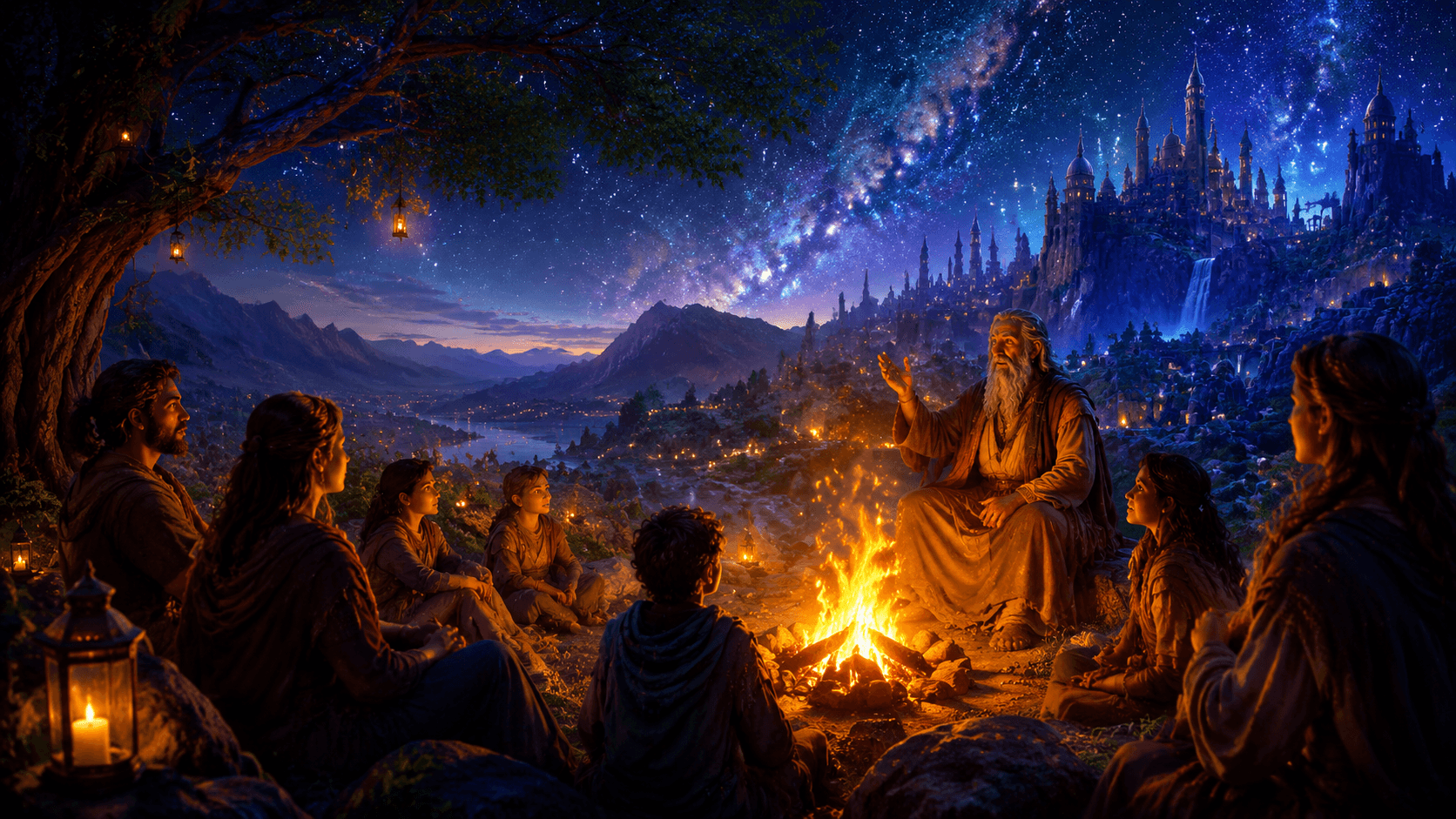
Long before anyone coined the word "meditation," long before mindfulness apps and breathing exercises and yoga studios, human beings gathered around fires and told each other stories. They didn't call it meditation. They called it culture, ritual, wisdom, entertainment, healing. But the neurological and psychological effects of deep story listening the stilling of anxious thought, the absorption into vivid present moment experience, the emotional catharsis, the sense of connection to something larger than oneself are precisely the effects that modern meditation seeks to produce. The myth of Orpheus, whose music moved the very rulers of the Underworld, captures this ancient understanding: that narrative art, at its deepest expression, has the power to transform consciousness itself.
Storytelling meditation is a contemplative practice that uses narrative engagement through mythological tales, historical journeys, guided imaginative scenarios, or immersive audio experiences as the primary vehicle for achieving meditative states of relaxation, presence, and emotional regulation. Unlike traditional meditation techniques that ask practitioners to narrow attention to a single focal point (breath, mantra, body sensation), storytelling meditation broadens attention across a rich, multi sensory narrative landscape, engaging the auditory cortex, motor cortex, sensory cortices, hippocampus, mirror neuron networks, and emotional processing centres simultaneously. This comprehensive neural engagement naturally suppresses the default mode network the brain system responsible for rumination, self critical thinking, and anxiety producing deep, effortless calm without the attentional struggle that makes traditional meditation challenging for beginners. Practised in various forms by every culture in human history from Aboriginal Dreamtime ceremonies and Hindu epic recitations to Buddhist Jataka tales and Greek mystery rites storytelling meditation represents the convergence of humanity's oldest contemplative tradition with its newest technology: immersive spatial audio that places the listener physically inside the story's world.
In this complete guide, you'll explore the ancient roots of narrative meditation across world cultures, discover the neuroscience that explains why stories create such powerful meditative states, learn how modern spatial audio technology amplifies this ancient practice, understand why storytelling engages the mind where breath focused techniques sometimes struggle, and find practical guidance for building a personal story meditation practice that combines experiential mindfulness with the timeless power of narrative.
"For 40,000 years, humans have been using stories to calm, heal, connect, and transform. Then, sometime around 2010, we collectively decided that the pinnacle of meditation was staring at a wall and counting breaths. Nothing against walls or breathing both are excellent. But our ancestors had something rather more interesting in mind. They had the Odyssey. They had Dreamtime. They had entire cosmologies to journey through. Modern storytelling meditation simply remembers what our species knew all along: that the best meditation is a really good story."
Key Facts: Storytelling as Meditation
- ••40,000+ year history: Cave paintings, oral traditions, and ritual storytelling represent humanity's oldest form of contemplative practice—predating formalised meditation techniques by tens of thousands of years
- ••7-12 brain regions engaged: Story-based meditation simultaneously activates the auditory cortex, motor cortex, sensory cortices, hippocampus, amygdala, mirror neuron networks, and prefrontal cortex—producing more comprehensive neural engagement than any other meditation format
- ••Neural coupling: Princeton research demonstrates that a listener's brain activity mirrors and even anticipates the storyteller's neural patterns—meaning story meditation literally synchronises your brain with another mind's contemplative state
- ••Higher retention rates: Story-based meditation shows significantly higher beginner retention than breath-focused meditation (where 50-60% of new practitioners discontinue within the first month), because narrative interest provides automatic, effortless engagement
- ••Cross-cultural universality: Every known human culture has practised some form of contemplative storytelling—from Aboriginal Dreamtime to Buddhist Jataka tales to Hindu Ramayana recitations to Norse saga evenings—suggesting that narrative meditation is a fundamental human capability
- ••Spatial audio amplification: Modern 3D audio technology positions 50-100+ sound elements around the listener in three-dimensional space, creating the neurological experience of being physically present inside the story—an immersion level that ancient storytellers could only achieve through ritual, rhythm, and firelight
Quick Answer
💡 Fun fact: When researchers at Princeton University scanned the brains of a storyteller and a listener simultaneously, they discovered something extraordinary: the listener's brain activity began to mirror the storyteller's in real time—a phenomenon called "neural coupling." In some cases, the listener's brain actually anticipated the storyteller's next neural pattern, meaning the listener's brain was running the story slightly ahead of the teller's. Your brain doesn't just passively receive stories. It co-creates them. And that co-creation is one of the deepest forms of meditation humanity has ever practised.
What Is Storytelling Meditation?
Storytelling meditation is, at its core, the practice of using narrative absorption as a pathway to meditative awareness. When you become deeply engaged in a story whether told by a voice around a fire, read in a book, or delivered through immersive spatial audio your brain enters a state that shares remarkable characteristics with classical meditation: the default mode network quiets, present moment awareness intensifies, emotional processing deepens, and the chattering internal monologue that dominates ordinary waking consciousness falls silent, replaced by the vivid, sensory rich world of the narrative.
What distinguishes storytelling meditation from simply "listening to a story" is intentionality and design. The stories are crafted specifically to deepen meditative engagement using pacing that matches breath rhythms, sensory descriptions that activate the body's relaxation response, narrative arcs that guide emotional processing, and environments that invite exploratory awareness. A well designed story meditation doesn't just tell you about an ancient city it places you inside one, inviting you to notice textures, listen to distant sounds, feel temperature changes, and move through architectural spaces with the same mindful attention a traditional meditator brings to their breath.
Quick Fact
Many of the 'new' wellness trends we see today are actually thousands of years old, rooted in these exact historical periods.
The practice bridges the gap between two things modern culture often separates: relaxation and engagement. Traditional meditation relaxes but can feel passive or difficult. Entertainment engages but doesn't necessarily calm. Storytelling meditation achieves both simultaneously your mind is actively engaged in the narrative world while your body and nervous system are deeply relaxed by the meditative design of the experience. This dual state which researchers call relaxed alertness or flow state meditation is the hallmark of effective contemplative practice across every tradition that has ever used narrative as its vehicle.
"If you've ever been so absorbed in a book that someone had to say your name three times before you heard them, congratulations you've experienced a spontaneous storytelling meditation. The only difference between that and a designed narrative meditation is that the designed version is optimised for maximum calm, maximum presence, and maximum neural engagement. It's the difference between accidentally stumbling into a beautiful garden and being guided through one by someone who knows where all the best flowers are."
A philosopher walked into a wall. His students asked if it hurt. He replied, 'The wall is an illusion, but my headache is quite real.'
The Ancient Roots of Narrative Mindfulness
The idea that storytelling is a new approach to meditation is a modern misconception. In truth, narrative based contemplative practice is far older than any formalised meditation technique taught today. The cave paintings of Lascaux (approximately 17,000 years old) and Altamira (approximately 36,000 years old) are almost certainly connected to narrative rituals the images weren't decorations but components of storytelling ceremonies conducted in deep, resonant cavern spaces. The combination of narrative, darkness, firelight, and acoustically powerful environments created what researchers now recognise as proto meditation experiences: altered states of consciousness achieved through sensory immersion in guided narrative.
Visionaria Insight
By immersing ourselves in these historical soundscapes, we reconnect with a timeless human tradition of storytelling and mental restoration.
Aboriginal Australian Dreamtime traditions the world's oldest continuous cultural practice, stretching back an estimated 60,000 years provide the clearest example of storytelling as meditation. Dreamtime stories aren't simply myths to be intellectually understood; they are contemplative experiences to be entered. Told in specific landscapes, accompanied by rhythmic music, body painting, and ceremonial movement, Dreamtime narratives guide participants into states of deep connection with land, ancestors, and cosmic patterns. The telling itself is the practice the narrative is the meditation object, and the listening is the meditation.
In the Hindu tradition, the recitation of the Ramayana and Mahabharata has served a contemplative function for at least 3,000 years. The practice of katha (sacred storytelling) is explicitly described as a form of bhakti (devotional meditation) listening to the narrative with full attention is considered a path to spiritual transformation equivalent to seated meditation or yogic practice. Buddhist Jataka tales stories of the Buddha's previous lives were similarly designed as contemplative instruments: each tale embeds a specific meditative insight within a narrative that engages the listener's full attention. And in Greek culture, the recitation of the Iliad and Odyssey in temple settings combined narrative absorption with ritual contemplation, creating experiences that scholars now recognise as structurally equivalent to guided meditation.
Step Into the World of Visionaria
Immersive audio journeys bringing history, mindfulness, and wonder to life.
A philosopher walked into a wall. His students asked if it hurt. He replied, 'The wall is an illusion, but my headache is quite real.'
How Stories Create the Meditative State
The meditative power of storytelling rests on a simple but profound neurological principle: the brain has finite attentional resources, and a sufficiently engaging story recruits most of them. When your auditory cortex is processing a narrator's voice, your motor cortex is simulating the physical actions described, your sensory cortices are generating phantom sensations of warmth, texture, and scent, your hippocampus is constructing spatial maps of the story's environment, and your amygdala is processing the narrative's emotional content there is simply no cognitive bandwidth left for the anxious, self referential processing that dominates ordinary consciousness.
This is the same mechanism that makes traditional meditation work but achieved through a different route. In breath meditation, you deliberately withdraw attention from anxious thoughts by concentrating it on a single point. In storytelling meditation, anxious thoughts are naturally displaced by the comprehensive engagement of a rich narrative. The result is neurologically equivalent: the default mode network the brain's "worry machine" goes quiet. But the subjective experience is quite different. Where breath meditation requires effortful concentration (which beginners often find frustrating), story meditation provides effortless absorption (which beginners find enjoyable). Both paths lead to the same mountain. The narrative path simply has better scenery along the way.
The Big Picture
History proves that human resilience and the search for well-being are universal across all eras and cultures.
Stories also create meditative states through emotional regulation by proxy. When Orpheus descends into the Underworld for love, or when Hercules faces his twelve labours, the listener experiences these emotional journeys through mirror neuron activation feeling echoes of courage, longing, determination, and resolution without the overwhelming intensity of personal experience. This "emotional practice at a safe distance" builds genuine emotional resilience over time, developing the capacity to sit with difficult feelings that is the hallmark of advanced meditation practice.
"Traditional meditation tells your wandering mind to sit down and focus on breathing. Storytelling meditation gives your wandering mind something so interesting to wander into that it forgets to generate anxiety. Both approaches achieve the same neurological result: a quiet default mode network and a fully present consciousness. But one of them involves exploring ancient Athens, meeting mythological heroes, and hearing spatial audio thunderstorms. The other involves watching air enter your nostrils. Choose your adventure."
A Roman walks into a bar, holds up two fingers, and says, 'Five beers, please.'
The Neuroscience of Story-Based Meditation
Neuroscience research over the past two decades has revealed that story listening produces brain activation patterns remarkably similar to those observed in experienced meditators but through mechanisms that are accessible to complete beginners. The key findings paint a compelling picture of why narrative is such an effective meditation vehicle.
Visionaria Insight
By immersing ourselves in these historical soundscapes, we reconnect with a timeless human tradition of storytelling and mental restoration.
Neural coupling (Princeton University, Uri Hasson's lab): When a speaker tells a story and a listener receives it, their brain activity becomes temporally coupled the same neural patterns fire in both brains, with the listener's sometimes anticipating the speaker's. This means that story meditation doesn't just calm your mind it synchronises your neural activity with a deliberately crafted contemplative narrative, literally tuning your brain to the storyteller's meditative frequency. No other meditation technique produces this inter brain synchronisation effect.
Default mode network suppression: Multiple neuroimaging studies confirm that engaging narrative suppresses DMN activity as effectively as experienced meditator's breath focused practice. The difference is that narrative suppression occurs automatically the story's engagement does the work, whereas breath meditation requires trained concentration. For beginners, this means first session effectiveness with narrative meditation that might take weeks or months to achieve through traditional techniques.
Cortisol reduction: A 2019 study published in Psychoneuroendocrinology found that guided narrative meditation reduced salivary cortisol (the primary stress hormone) by 23% more than equivalent length breath focused meditation in beginner participants. The researchers attributed this to the broader neural engagement of narrative, which produces more comprehensive parasympathetic activation. For people whose stress response is difficult to manage, immersive story based meditation may be the most effective first line intervention available.
Why did the Stoic cross the road? Because it was the rational thing to do, and he was indifferent to the traffic.
Oral Traditions as Contemplative Practice
To understand storytelling meditation fully, we must recognise that oral tradition was humanity's primary contemplative technology for the vast majority of our existence. For at least 60,000 years (and possibly 100,000+), before writing, before books, before any formalised meditation system, human beings used spoken narrative as their principal means of accessing altered states of consciousness, processing difficult emotions, transmitting wisdom, and creating collective spiritual experiences.
Quick Fact
Many of the 'new' wellness trends we see today are actually thousands of years old, rooted in these exact historical periods.
Consider the conditions under which these stories were told. In Aboriginal Australia, Dreamtime narratives were shared in specific landscapes beside rivers, beneath particular rock formations, on ancestral walking paths so that the physical environment reinforced the story's content. The teller's voice combined with natural sounds: wind, water, birdsong, crackling fire. Participants sat or lay in comfortable positions. The narrative might last hours, its rhythm attuned to the body's natural cycles. Every element of this practice comfortable posture, environmental immersion, extended duration, rhythmic pacing, community presence corresponds precisely to elements that modern meditation science identifies as optimal for deep contemplative states.
In Norse culture, the sagas were recited during long winter evenings in firelit longhouses. The combination of warmth, firelight, darkness, and sustained narrative created what modern researchers would recognise as a collective trance state participants reporting afterwards a sense of having "been there," of having walked alongside Thor or sailed with the Aesir. In West African griot traditions, master storytellers combined narrative with musical instrumentation (the kora, the balafon), creating multi sensory experiences that engaged entire communities in shared contemplative states. Every one of these traditions understood without neuroscience vocabulary that stories, properly told, transform consciousness.
"Imagine explaining modern meditation apps to an Aboriginal elder with 60,000 years of Dreamtime storytelling tradition behind them. 'So you sit in a room, put in small ear devices, and listen to someone tell you to breathe?' They'd be very polite about it. But they'd also wonder why it took us so long to figure out what they've known since the Pleistocene: that the best way to calm a human mind is to give it a really good story. Preferably one with ancestors, landscape, and cosmic significance."
What's an ancient intellectual's favorite exercise? Jumping to conclusions.
From Campfire to Headphones: Technology's Role
The transition from campfire storytelling to headphone based narrative meditation isn't a break with tradition it's a technological continuation of humanity's oldest contemplative practice. Each generation has used the best available technology to enhance storytelling's meditative power. Ancient cultures used firelight, resonant cave acoustics, and rhythmic instrumentation. Medieval cultures added cathedral architecture, stained glass, and organ music. The printing press enabled solitary contemplative reading. Radio brought narrative into homes. And now, spatial audio technology places the listener physically inside the story's world achieving a level of immersion that previous generations could only approach through elaborate ritual design.
Did You Know?
The relentless drive to understand the world was seen not just as an academic pursuit, but as a spiritual and healing practice by the ancients.
The key technological milestones in storytelling meditation's evolution form a clear arc of increasing immersion. Writing (c. 3200 BCE) allowed stories to be preserved and experienced privately, enabling solitary contemplative reading. Printing (c. 1440 CE) democratised access to narrative texts. Audio recording (c. 1877) captured the human voice, preserving the storyteller's rhythm, tone, and emotional nuance. Stereo sound (c. 1930s) added spatial width. Digital audio (c. 1980s) enabled perfect reproduction. And spatial audio (c. 2010s) completes the immersion circle by positioning sounds in full three dimensional space around the listener recreating the enveloping quality of campfire storytelling in environments that ancient storytellers could never have imagined.
What spatial audio specifically adds is involuntary environmental presence. When sounds are positioned around you in 3D space a river to your left, wind above, footsteps behind your brain processes these spatial cues automatically, using the same auditory processing systems it uses in real world environments. You don't have to try to feel present in the story's world; your auditory cortex creates the sensation of presence for you. This is the technological bridge that connects a 21st century listener wearing headphones to the experiential quality of hearing an Aboriginal elder narrate a Dreamtime story beside a real river under real stars both experiences create genuine, neurologically measurable environmental presence through immersive audio.
An Epicurean, a Stoic, and a Cynic walk into a garden. The bartender says, 'Is this some kind of philosophical joke?'
Spatial Audio and the Evolution of Storytelling
Spatial audio represents the most significant advancement in storytelling technology since the invention of recording itself. By using Head Related Transfer Functions (HRTF) mathematical models of how sound is filtered by the human ear, head, and torso audio engineers can position any sound element at any point in three dimensional space around the listener. A bird singing above and behind you. A river flowing past at ankle height to your right. Footsteps approaching from your left. Temple bells resonating from a specific direction and distance. Each element occupies a precise, convincing position in your auditory field.
For storytelling meditation, this technology creates a fundamental qualitative shift. Traditional audio meditation involves listening to a voice telling you about a place. Spatial audio meditation involves being in that place. When you hear the marketplace of ancient Athens positioned around you in three dimensions vendors calling from specific locations, a fountain splashing at your two o'clock, footsteps passing behind you, the echo of columns to your right your brain constructs a genuine spatial map of the environment. You don't imagine being there. Your auditory cortex processes the input as though you are there. The meditation deepens accordingly.
Visionaria Insight
By immersing ourselves in these historical soundscapes, we reconnect with a timeless human tradition of storytelling and mental restoration.
The implications for storytelling meditation are profound. Ancient storytellers used firelight, rhythmic music, and resonant environments to create immersion. Modern spatial audio achieves comparable and in some respects superior immersion through precision engineering. A campfire storyteller could surround you with atmosphere; spatial audio can surround you with a precisely detailed, historically accurate, emotionally designed world containing dozens of individually positioned sound elements, each contributing to the environmental reality of the narrative. The ancient practice hasn't changed. The technology has simply caught up to what storytelling has always been trying to do: transport you somewhere else entirely.
"Ancient storytellers spent their entire lives mastering the art of transporting listeners to other worlds using nothing but their voice, a fire, and the stars overhead. Spatial audio engineers do something remarkably similar, except they use HRTF algorithms, binaural processing, and 50 100 individually positioned sound elements per scene. The storyteller would probably be impressed by the technology. The engineer would definitely be impressed by the storyteller. Both are doing the same thing: building worlds that the listener's brain can inhabit. They'd have a lot to talk about."
Why did the Stoic cross the road? Because it was the rational thing to do, and he was indifferent to the traffic.
Why Stories Engage Where Breath Alone Cannot
One of the most persistent challenges in meditation practice is beginner retention. Research consistently shows that 50 60% of people who begin a meditation practice discontinue within the first month and the primary reason cited is that sustained attention on a single focus point (breath, mantra) feels difficult, boring, or frustrating for untrained minds. This isn't a character flaw; it's neuroscience. The human brain evolved to attend to novelty, narrative, social information, and environmental change not to static stimuli. Asking an untrained mind to focus on breathing for 20 minutes is asking it to do something it was not designed for.
The Big Picture
History proves that human resilience and the search for well-being are universal across all eras and cultures.
Storytelling meditation works with the brain's natural attentional design rather than against it. Stories provide exactly the stimuli the brain evolved to prioritise: novelty (what happens next?), social information (what is this character feeling?), environmental data (where are we now?), and emotional relevance (why does this matter?). When these elements are present, sustained attention is not effortful it's automatic. You don't have to force yourself to pay attention to a good story. Your brain does it involuntarily, because attending to narrative is one of its primary evolutionary functions.
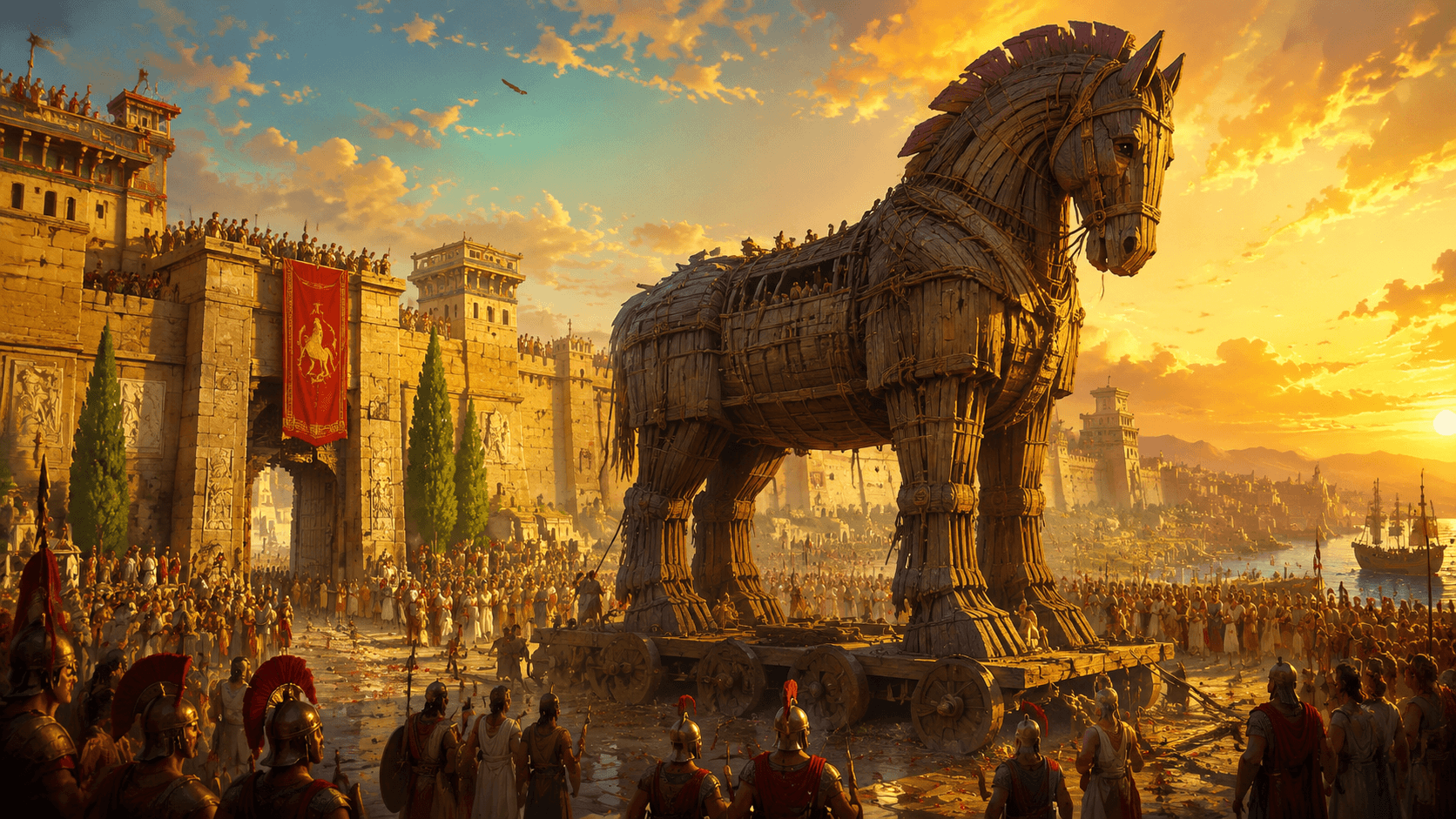
Read more: The Story of the Trojan Horse and the Fall of Troy
This doesn't make storytelling meditation "easy meditation" or "meditation lite." The depth of presence achieved during deep narrative absorption is neurologically equivalent to experienced meditators' states during focused practice. The difference is in accessibility, not depth. Heroic narrative meditation produces the same cortisol reduction, the same default mode network suppression, the same parasympathetic activation as traditional meditation but through a pathway that is enjoyable rather than effortful, engaging rather than austere, and welcoming rather than daunting. For the millions of people who have "tried meditation and it didn't work," storytelling meditation offers not a lesser alternative but a different doorway into the same room.
What's an ancient intellectual's favorite exercise? Jumping to conclusions.
Building Emotional Resilience Through Narrative
Beyond immediate relaxation, storytelling meditation builds a capacity that traditional meditation develops more slowly: emotional resilience the ability to experience difficult emotions without being overwhelmed by them. This capacity develops through a mechanism unique to narrative practice: emotional experience at a safe distance.
Did You Know?
The relentless drive to understand the world was seen not just as an academic pursuit, but as a spiritual and healing practice by the ancients.
When you engage with the story of Orpheus navigating the Underworld for love, your mirror neuron networks activate in response to his courage, his longing, his determination, and his moment of doubt. You experience these emotions but at a narrative remove that allows you to process them without personal threat. This is the psychological mechanism behind what Aristotle called catharsis: the purification of emotions through vicarious experience. Modern psychology confirms his insight narrative engagement allows the brain to practice emotional processing in a safe context, developing neural pathways that then transfer to real life emotional challenges.
Research at the University of Toronto demonstrated that regular fiction readers show higher empathy scores, better emotional regulation, and stronger theory of mind abilities than non readers capabilities that correspond precisely to the goals of mindfulness meditation. Storytelling meditation amplifies these benefits by adding the meditative design elements (pacing, sensory immersion, parasympathetic activation) that transform narrative engagement from passive entertainment into active contemplative practice. The result is a meditation approach that builds genuine psychological resilience alongside the relaxation and presence benefits common to all meditation forms.
"Your brain can't tell the difference between your own emotional experience and one you're having through a well told story. Mirror neurons fire either way. So when you spend 18 minutes experiencing Orpheus's courage through narrative meditation, your brain develops the same neural patterns it would develop from your own act of courage minus the trip to the actual Underworld. It's emotional gym membership with significantly fewer existential risks."
A Roman walks into a bar, holds up two fingers, and says, 'Five beers, please.'
The Art of Listening as Meditation
At the heart of storytelling meditation lies a skill that modern culture has largely forgotten: deep listening. In ancient oral traditions, listening was not passive consumption it was an active contemplative practice requiring the full engagement of attention, imagination, emotional sensitivity, and embodied awareness. The listener's role was understood to be as creatively demanding as the teller's: the teller provided words; the listener built worlds.
Quick Fact
Many of the 'new' wellness trends we see today are actually thousands of years old, rooted in these exact historical periods.
Modern neuroscience validates this ancient understanding. Listening to narrative is one of the most neurologically active states the brain can enter. The auditory cortex decodes speech. The language centres extract meaning. The motor cortex simulates physical actions. The sensory cortices generate imagined sensations. The hippocampus constructs spatial environments. The amygdala processes emotional content. The prefrontal cortex integrates everything into coherent experience. Seven to twelve brain regions working in coordinated activity all triggered by the simple act of listening well.
Storytelling meditation recovers this art by creating conditions optimal for deep listening: a comfortable physical position, closed eyes (eliminating visual competition for cognitive resources), high quality audio that rewards attentive listening, and narrative content designed to progressively deepen engagement. The practice teaches a form of attention that transfers to daily life the capacity to listen fully to another person, to be present with environmental sounds, to notice the rich auditory texture of everyday experience that usually passes unobserved. In this sense, storytelling meditation doesn't just use listening as a meditation technique it develops listening itself into a mindfulness skill that enriches every moment of waking life.
Why did the historian break up with the archaeologist? Because her career was literally in ruins.
Designing Your Personal Story Meditation Practice
Building an effective storytelling meditation practice begins with understanding your own narrative preferences and meditation goals. Different types of stories serve different contemplative purposes, and the most effective practice aligns story selection with what you need most.
For stress reduction and relaxation: Choose stories set in natural environments with gentle pacing ancient city gardens, forest journeys, coastal walks, mountain contemplations. These narratives emphasise sensory immersion over dramatic tension, creating a sustained parasympathetic response that unwinds accumulated stress. Sessions of 15 20 minutes before sleep are particularly effective. For emotional resilience and personal growth: Choose heroic narratives and mythological journeys that involve challenge, courage, and resolution. These stories activate mirror neuron networks and build the emotional processing pathways associated with psychological strength. Morning sessions work best, as the narrative's emotional arc carries a sense of capability into the day ahead.
Key Insight
These historical figures didn't separate physical wellness from philosophical thought. To them, it was all one continuous practice of living well.
Recommended weekly structure: Begin with 3 4 sessions per week. Alternate between relaxation focused and growth focused narratives. Keep sessions between 10 25 minutes. After 2 3 weeks, most practitioners find a natural rhythm some prefer daily short sessions (10 minutes), others prefer 3 4 longer sessions (20 25 minutes). The key is consistency: regular shorter sessions produce more cumulative benefit than occasional marathon sessions. Within 4 6 weeks, you should notice measurable improvements in baseline stress levels, emotional regulation, sleep quality, and the capacity for sustained, relaxed attention in daily life.
Read more: The Origins of Dragons Across World Mythology

"Designing your story meditation practice is like building a personal library for your brain. Monday: a relaxing walk through Babylon's Hanging Gardens (stress reduction). Wednesday: Odysseus navigating challenges (emotional resilience). Friday: a contemplative visit to Plato's Academy (philosophical reflection). Sunday: Norse mythology in spatial thunderstorm audio (adventure). Your brain gets a different kind of workout each session, and it never gets bored. Try doing that with breath counting."
Why did the historian break up with the archaeologist? Because her career was literally in ruins.
The Future of Storytelling Meditation with Visionaria
Visionaria represents the convergence of humanity's oldest contemplative practice with its most sophisticated audio technology. With 150+ immersive spatial audio journeys spanning Greek mythology, Norse legends, ancient city explorations, historical adventures, and contemplative nature experiences, Visionaria provides a storytelling meditation library unmatched in scope, quality, and immersive depth.
Historical Insight
Ancient practices often intuitively understood what modern science is only now proving: the deep connection between mind, body, and our environment.
Each journey is built on three pillars. Narrative excellence: stories crafted for meditative engagement, with pacing that matches relaxation rhythms, sensory descriptions that activate the body's calm response, and emotional arcs that build genuine psychological resilience. Historical and mythological accuracy: environments based on archaeological research and scholarly sources, because historically accurate detail deepens immersion by satisfying the brain's coherence checking systems. Spatial audio immersion: 50 100+ individually positioned sound elements per journey, creating three dimensional environments that your auditory cortex processes as genuinely real.

How to Practice Guided Imagination Journeys
Learn how to practice guided imagination journeys step by step. Master visualization techniques, spatial audio immersion, and narrative meditation to explore ancient worlds, mythological realms, and fantasy landscapes...
A time traveler went back to antiquity to teach them about 'holistic health.' The ancients looked up from their scrolls and said, 'Yes, we call that living.'
The Bottom Line
You've explored storytelling as meditation from its 40,000+ year history as humanity's original contemplative practice, through the neuroscience of neural coupling and default mode network suppression, to the modern spatial audio technology that creates unprecedented levels of narrative immersion. You've discovered why stories engage the brain more comprehensively than breath focused techniques, how narrative builds emotional resilience through safe emotional processing, and how to design a personal practice that combines ancient wisdom with modern technology.
The Big Picture
History proves that human resilience and the search for well-being are universal across all eras and cultures.
Through Visionaria, this ancient practice is available right now 150+ immersive spatial audio journeys waiting to carry you into the same contemplative states that humans have accessed through storytelling since the very first campfire. Put on headphones. Close your eyes. Let the story begin.
"Forty thousand years ago, a human sat by a fire and told a story. The listeners' breathing slowed. Their eyes went soft. The world's noise fell away, replaced by a vivid inner landscape of heroes, landscapes, and meaning. That was the first meditation session. Everything since every breath count, every body scan, every mantra repetition is a variation on what that storyteller discovered: that the human mind, given the right narrative, naturally settles into a state of deep, peaceful, richly alive awareness. We've been telling stories to calm our minds since before we built cities, wrote alphabets, or named the stars. Spatial audio just helps us hear them better."
Experience More with Visionaria
Download the app to explore 150+ guided historical and wellness journeys.
Why did the historian break up with the archaeologist? Because her career was literally in ruins.