The Tower of Babel and the Myth of Languages
💡 Fun fact: The word "Babel" likely derives from the Akkadian "Bab-ilim" meaning "Gate of God", though the Hebrew Bible playfully connects it to "balal" (to confuse), giving us one of history's most famous etymological puns.
- What Is the Tower of Babel?
- The Biblical Narrative: Genesis Chapter 11
- Historical Babylon and the Great Ziggurat
- The Etemenanki: Real Tower Behind the Myth
- Linguistic Origins: How Languages Actually Diverge
- The Tower of Babel Across World Cultures
- Symbolism and Meaning: Ambition, Unity, and Communication
- The Tower of Babel in Art and Literature
- Archaeological Evidence from Ancient Mesopotamia
- Modern Parallels: Language, Technology, and Global Communication
- The Tower of Babel as a Meditation Theme
- Why the Myth of Babel Still Resonates Today
- The Bottom Line
- Frequently Asked Questions
The Tower of Babel is one of the most enduring origin myths in human civilisation a narrative from the Book of Genesis (11:1-9) that explains why humanity speaks thousands of different languages rather than sharing a single tongue. According to the story, the people of the earth once spoke one language and resolved to build a great tower reaching the heavens in the land of Shinar, identified with ancient Babylon. The divine response was to diversify their speech, scattering them across the earth and ending their monumental project forever. This ancient narrative has captivated theologians, linguists, artists, and storytellers for over 2,500 years, raising profound questions about ambition, unity, communication, and what it means to be human.
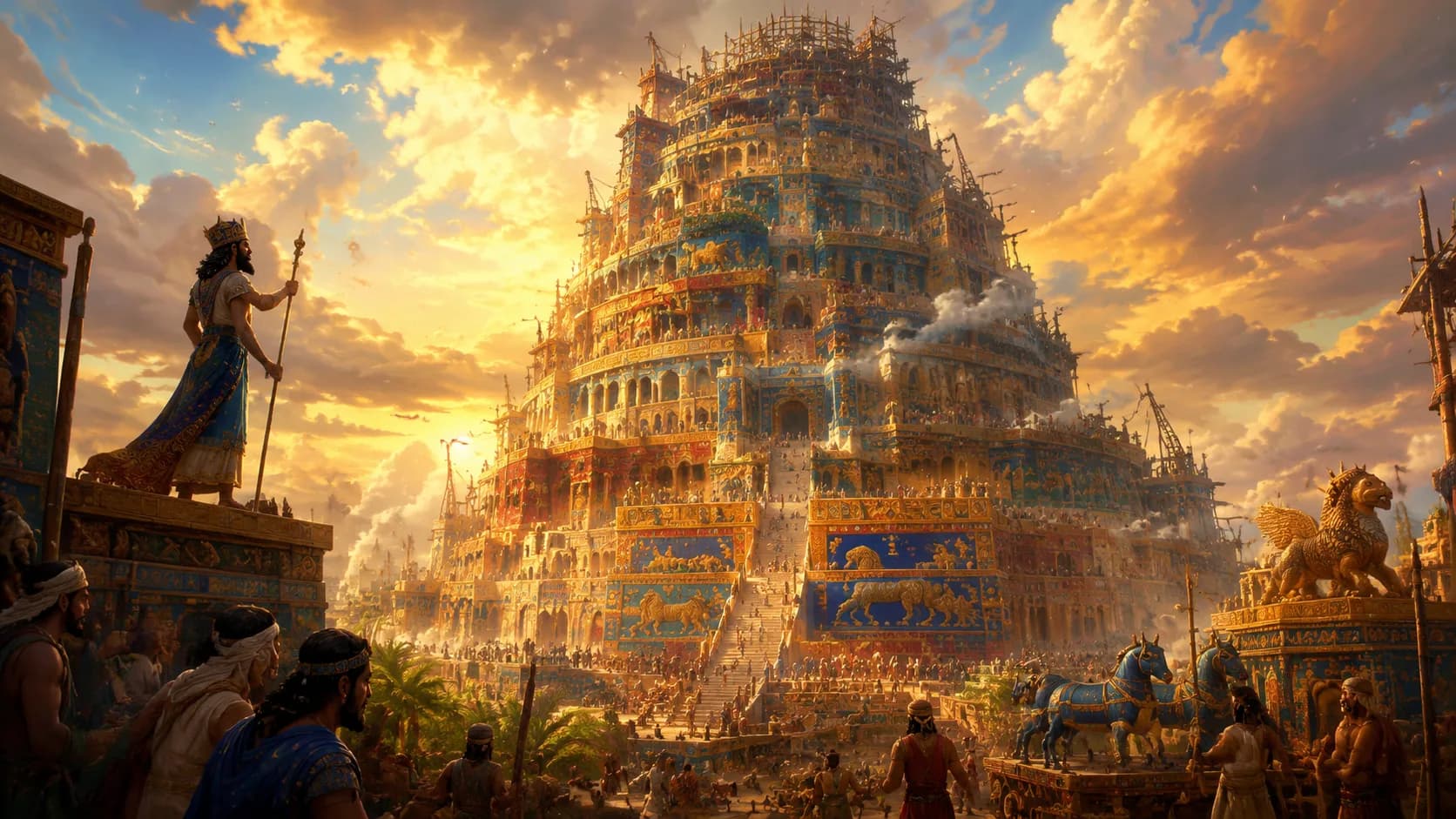
Imagine standing at the base of an enormous stepped pyramid a ziggurat rising tier upon tier into the Mesopotamian sky. Around you, thousands of labourers carry sun baked bricks and bitumen mortar, their voices blending into a single, unified chorus of purpose. The air smells of river clay and ambition. This is ancient Babylon at the height of its grandeur, and the structure before you may be the very inspiration for one of humanity's most famous myths. Through Visionaria's immersive audio journeys, you can experience this world with spatial 3D audio that places you inside ancient Mesopotamia.
In this comprehensive guide, we explore the Tower of Babel myth from every angle its biblical origins in Genesis, the historical Etemenanki ziggurat that likely inspired it, the real science of how languages diverge and evolve, parallel myths from cultures around the world, its rich symbolism about human ambition and divine authority, its enduring presence in art and literature, archaeological discoveries from Mesopotamia, modern parallels in our globalised world, and how immersive audio meditation brings this ancient story to life. Whether you're fascinated by mythology, linguistics, archaeology, or the timeless power of storytelling, the Tower of Babel offers something profound for every curious mind.
"They say the Tower of Babel was the world's first failed group project. One minute everyone's on the same page literally and the next, nobody can agree on what 'brick' means."
Key Facts About the Tower of Babel
- ••Source: Book of Genesis 11:1-9 (Hebrew Bible / Old Testament)
- ••Location: Land of Shinar (ancient Babylonia, modern-day Iraq)
- ••Historical Inspiration: Etemenanki ziggurat, approximately 91 metres (300 feet) tall
- ••Core Theme: Origin of linguistic diversity and the scattering of peoples
- ••Languages Today: Approximately 7,000 languages spoken worldwide
- ••Etymology: "Babel" from Akkadian "Bab-ilim" (Gate of God); Hebrew wordplay on "balal" (to confuse)
- ••Cultural Parallels: Similar myths exist in Sumerian, Mesoamerican, African, and South Asian traditions
Quick Answer
💡 Fun fact: The word "Babel" likely derives from the Akkadian "Bab-ilim" meaning "Gate of God", though the Hebrew Bible playfully connects it to "balal" (to confuse), giving us one of history's most famous etymological puns.
What Is the Tower of Babel?
The Tower of Babel is a foundational narrative from the Hebrew Bible that has shaped Western understanding of linguistic diversity for millennia. Found in Genesis 11:1 9, this compact yet powerful story describes a time when all of humanity spoke a single language and settled together in a plain in the land of Shinar a region scholars identify with ancient Babylonia, in modern day southern Iraq. United by their common tongue, the people resolved to build a city with a tower whose pinnacle would reach the heavens, ensuring their name would endure and preventing their dispersal across the earth.
Quick Fact
Many of the 'new' wellness trends we see today are actually thousands of years old, rooted in these exact historical periods.
The narrative occupies a pivotal position within the broader Genesis account, serving as a bridge between the primordial history of humanity (chapters 1-11) and the patriarchal narratives beginning with Abraham in chapter 12. It functions as an aetiology an origin story explaining a feature of the natural or cultural world in this case, the puzzling fact that humanity speaks thousands of mutually unintelligible languages rather than sharing a common form of communication. The story suggests that linguistic diversity was not a natural development but a deliberate act of divine intervention.
What makes the Tower of Babel narrative particularly fascinating is its layered complexity. On the surface, it explains language diversity. Beneath that, it explores themes of human ambition, collective power, the relationship between humanity and the divine, the tension between unity and diversity, and the consequences of overreaching. These themes have resonated across centuries and cultures, making the Tower of Babel one of the most interpreted, depicted, and discussed stories in the entire biblical canon. Scholars from ancient wisdom traditions to modern linguistic departments continue to engage with its implications.
Why did the inventor of the wheel win an award? Because his idea really got things rolling.
The Biblical Narrative: Genesis Chapter 11
The Genesis account of the Tower of Babel is remarkably concise only nine verses in the Hebrew original yet it packs extraordinary narrative power. The text opens with a striking declaration: "Now the whole earth had one language and the same words" (Genesis 11:1). This brief statement establishes a world of perfect linguistic unity, where every human being could communicate freely with every other. The people migrate eastward and discover a plain in the land of Shinar, where they choose to settle rather than continue spreading across the earth as they had been doing since the time of Noah.
What follows is a remarkably human moment of collective ambition. The people say to one another: "Come, let us make bricks, and burn them thoroughly" (11:3). They develop a new technology fired bricks with bitumen mortar instead of stone and mortar and propose building a city and a tower with its top in the heavens. Their stated motivation is twofold: to "make a name for ourselves" and to prevent being "scattered abroad upon the face of the whole earth" (11:4). This reveals both creative ambition and a deep fear of dispersal and insignificance.
The divine response is recorded with deliberate literary parallelism. Just as the people said "Come, let us make bricks," now the Lord says, "Come, let us go down and confuse their language" (11:7). The Hebrew text employs a sophisticated wordplay: the city is called Babel (Babylon) because the Lord "balal" (confused) the language of all the earth. The result is both linguistic fragmentation and geographic dispersal the very outcome the builders had sought to prevent. The story ends with the people scattered and the tower presumably abandoned, a monument to interrupted ambition.
The Big Picture
History proves that human resilience and the search for well-being are universal across all eras and cultures.
The Hebrew text uses the plural "let us" in both the human and divine speeches, creating a literary mirror that highlights the contrast between human collective action and divine response. This rhetorical device emphasises that the story is fundamentally about the relationship between human ambition and divine authority.
Biblical scholars note that the narrative structure follows a chiastic pattern a literary device common in ancient Near Eastern texts where the second half of a passage mirrors the first in reverse order. The people's unity leads to ambitious construction, which leads to divine observation, which leads to divine action, which leads to linguistic confusion, which leads to dispersal. This careful structure suggests the story was crafted with great literary sophistication, not merely recorded as a folk memory.
"Imagine being the project manager on the Tower of Babel. One day your team is perfectly aligned, the next day your sprint retrospective requires 72 translators."

Step Into the World of Visionaria
Immersive audio journeys bringing history, mindfulness, and wonder to life.
Why did the historian break up with the archaeologist? Because her career was literally in ruins.
Historical Babylon and the Great Ziggurat
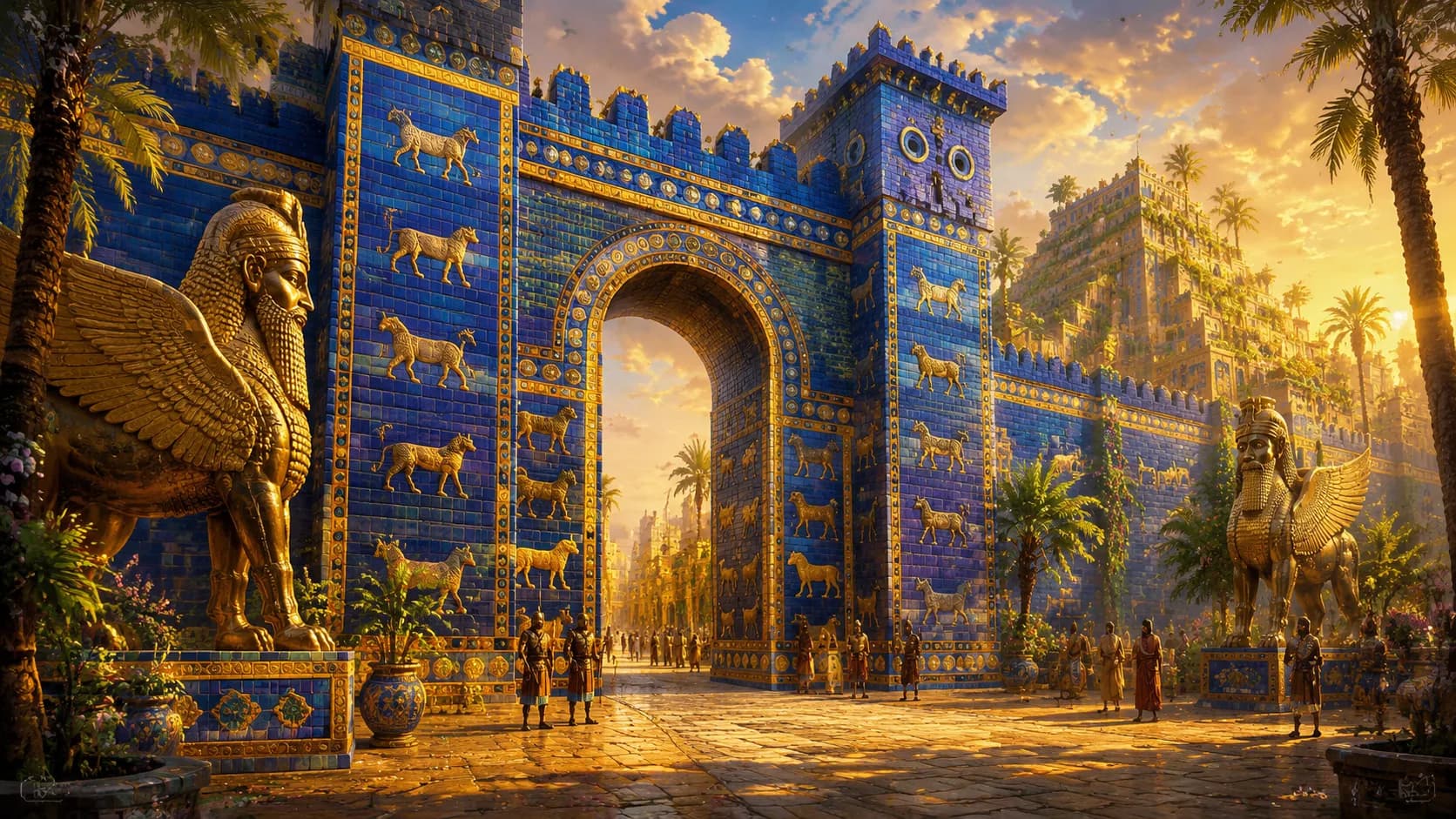
To understand the Tower of Babel, we must first understand the city that inspired it. Babylon was one of the most magnificent cities of the ancient world, located on the Euphrates River in what is now central Iraq. At its peak under King Nebuchadnezzar II (reigned c. 605-562 BCE), Babylon was the largest city on earth, home to perhaps 200,000 people within walls so massive that, according to the Greek historian Herodotus, a chariot drawn by four horses could turn around on top of them. The city's Ishtar Gate, adorned with brilliant blue glazed bricks depicting dragons and bulls, was one of the ancient world's most spectacular entrances.
Babylon's religious architecture was dominated by ziggurats massive stepped pyramids that served as the foundations for temples to the gods. Unlike Egyptian pyramids, which were solid structures serving as royal tombs, Mesopotamian ziggurats were functional religious buildings with temples at their summits where priests performed rituals, made offerings, and communed with the divine. The ziggurat form itself was symbolic: a stairway connecting earth to heaven, a physical manifestation of the relationship between the human and divine realms.
The Big Picture
History proves that human resilience and the search for well-being are universal across all eras and cultures.
The connection between Babylon's ziggurats and the Tower of Babel narrative seems almost inevitable. Jewish scribes and scholars who encountered Babylon firsthand during the Babylonian Exile (586-539 BCE) would have witnessed the massive Etemenanki ziggurat, either standing or in ruins. The sight of this enormous structure rising nearly 100 metres above the flat Mesopotamian plain combined with the cosmopolitan, multilingual character of the Babylonian empire, likely reinforced and shaped the Genesis narrative for its final audience. Through Visionaria's cinematic meditation experiences, you can experience this remarkable city as it once appeared.
Babylon at its peak covered an area of approximately 900 hectares (2,200 acres), making it one of the largest cities in the ancient world. The inner city alone contained over 50 temples dedicated to various Mesopotamian deities.
"Babylon had the Hanging Gardens, the Ishtar Gate, and the Etemenanki ziggurat. Meanwhile, my city can't even agree on where to put a roundabout."
An Epicurean, a Stoic, and a Cynic walk into a garden. The bartender says, 'Is this some kind of philosophical joke?'
The Etemenanki: Real Tower Behind the Myth
The Etemenanki whose name translates from Sumerian as "Temple of the Foundation of Heaven and Earth" was a massive ziggurat located in the sacred precinct of Babylon, adjacent to the great temple of Marduk known as the Esagila. This structure is widely considered the most likely historical inspiration for the Tower of Babel, and its documented dimensions, construction history, and cultural significance align remarkably well with the biblical narrative.
Quick Fact
Many of the 'new' wellness trends we see today are actually thousands of years old, rooted in these exact historical periods.
According to the Esagila Tablet, a cuneiform text from 229 BCE that describes the temple complex in detail, the Etemenanki consisted of seven tiers rising to an approximate height of 91 metres (300 feet). The base measured roughly 91 by 91 metres nearly square making it one of the largest structures in the ancient world. The topmost tier housed a temple where, according to Herodotus, a golden table and couch were placed for the god Marduk. No human was permitted to sleep in this chamber except a single woman chosen by the god himself.
The construction and reconstruction history of the Etemenanki spans centuries. The original structure may date to the Old Babylonian period (c. 1894-1595 BCE), but it was the Neo-Babylonian king Nabopolassar (reigned 626-605 BCE) who began the major restoration, continued by his son Nebuchadnezzar II. Nebuchadnezzar's building inscription proudly declares: "I made the tower of Babylon the ziggurat, Etemenanki, rise up... I raised its peak with baked bricks covered with copper." This royal boast about tower building resonates powerfully with the Babel narrative's themes of ambition and monumental construction.
The ziggurat's fate after the Neo-Babylonian period is particularly poignant. When Alexander the Great conquered Babylon in 331 BCE, he found the Etemenanki partially in ruins. Impressed by its grandeur even in decay, Alexander ordered the rubble cleared with the intention of rebuilding it. He set 10,000 men to work on the project, but his premature passing in Babylon in 323 BCE left the reconstruction incomplete. The great tower that may have inspired one of humanity's most famous myths ultimately succumbed not to divine intervention but to the passage of time, the erosion of empires, and the shifting course of the Euphrates River.
Why did the inventor of the wheel win an award? Because his idea really got things rolling.
Linguistic Origins: How Languages Actually Diverge
While the Tower of Babel offers a mythological explanation for linguistic diversity, the scientific understanding of how languages diverge is itself a fascinating story one that reveals the extraordinary creativity and adaptability of the human mind. Modern linguistics traces the world's approximately 7,000 languages to natural processes of change, migration, isolation, and cultural evolution that have been operating for tens of thousands of years.
Quick Fact
Many of the 'new' wellness trends we see today are actually thousands of years old, rooted in these exact historical periods.
Languages change continuously through several well-documented mechanisms. Sound shifts gradually alter pronunciation over generations the "Great Vowel Shift" in English, for example, transformed Middle English pronunciation between roughly 1400 and 1700 CE, which is why Chaucer's English sounds so different from Shakespeare's. Grammatical simplification and complexification alter sentence structure over centuries. Lexical borrowing introduces new words from neighbouring languages through trade, conquest, and cultural exchange. And semantic drift changes the meanings of existing words the English word "nice" originally meant "foolish" in Middle English.
The comparative method, developed by 19th century philologists, allows linguists to trace these changes backward, reconstructing ancestral "proto languages" that existed thousands of years ago. The most famous example is Proto-Indo-European, the hypothetical ancestor of languages as diverse as English, Hindi, Greek, Russian, and Persian. By comparing systematic sound correspondences across daughter languages, linguists have reconstructed much of this ancestral language's vocabulary, grammar, and even aspects of the culture of its speakers pastoral nomads who likely lived on the Pontic Caspian steppe around 4000-3000 BCE.
Understanding how languages naturally evolve makes the Babel myth even more meaningful it represents humanity's ancient attempt to explain a phenomenon that modern science has only recently begun to fully understand. The real story of language diversity is, in many ways, even more wondrous than the myth.
Geographic isolation is the primary engine of language divergence. When populations split and lose regular contact, their speech naturally drifts in different directions over centuries. This process mirrors biological speciation just as isolated animal populations evolve into distinct species, isolated human communities develop distinct languages. The mountains of Papua New Guinea, for instance, have produced over 800 distinct languages in an area smaller than France, precisely because rugged terrain kept communities separated for millennia. Similarly, the indigenous languages of Australia, the Americas, and sub Saharan Africa reflect tens of thousands of years of migration, settlement, and gradual linguistic drift.
"Languages are like children: they start by copying their parents, then rebel during adolescence, and eventually become completely unintelligible to older generations."
Why did the historian break up with the archaeologist? Because her career was literally in ruins.
The Tower of Babel Across World Cultures
The Tower of Babel is far from the only myth explaining linguistic diversity. Cultures across every inhabited continent have developed their own narratives to account for the puzzling fact that humanity speaks thousands of mutually unintelligible languages. These parallel myths suggest that the question "Why don't we all speak the same language?" is a fundamental human concern, not merely a biblical curiosity.
Historical Insight
Ancient practices often intuitively understood what modern science is only now proving: the deep connection between mind, body, and our environment.
Sumerian Parallels: Enmerkar and the Lord of Aratta
The oldest known parallel to the Babel story comes from Sumerian literature, predating the biblical text by centuries. The epic of Enmerkar and the Lord of Aratta contains a passage describing a golden age when "the whole universe, the people in unison... could address the god Enlil in a single language." The text then describes the god Enki changing the speech of humanity, introducing confusion where there was once unity. This remarkable parallel suggests the Babel narrative drew on a shared Mesopotamian tradition about a lost era of linguistic harmony.
Mesoamerican and Global Traditions
Similar myths appear across the globe. The Aztec tradition tells of a great flood after which the survivors were transformed into different beings speaking different tongues. The K'iche' Maya creation epic, the Popol Vuh, describes the gods deliberately giving different languages to the first peoples to prevent them from becoming too powerful. In West African Yoruba tradition, the natural world itself played a role in linguistic fragmentation different environments shaped different ways of speaking. Among Aboriginal Australian peoples, Dreamtime stories frequently explain how different language groups emerged from the travels and transformations of ancestral beings across the landscape.
The prevalence of these myths across unrelated cultures raises fascinating questions. Do they reflect a shared human psychological need to explain diversity? Are they independent responses to the universal experience of encountering people who speak differently? Or might they preserve distant memories of real linguistic fragmentation events? While scholars debate these questions, the sheer universality of the "lost unity" theme suggests it touches something deep in the human psyche a longing for connection and understanding that transcends individual cultures, much like the universal themes explored in heroic journey myths around the world.
"Turns out every culture has a story about why we can't understand each other. The universal answer seems to be: the gods got nervous when we actually started cooperating."
A time traveler went back to antiquity to teach them about 'holistic health.' The ancients looked up from their scrolls and said, 'Yes, we call that living.'
Symbolism and Meaning: Ambition, Unity, and Communication
The Tower of Babel is one of the most symbolically rich narratives in all of ancient literature. Across millennia of interpretation, scholars, theologians, philosophers, and artists have drawn a remarkable range of meanings from these nine compact verses. The story operates simultaneously as an aetiology (explaining language diversity), a moral parable (about the consequences of hubris), a theological statement (about divine sovereignty), and a political commentary (about the nature of empires and collective endeavour).
Perhaps the most immediate reading of the Tower of Babel concerns human ambition. The builders seek to construct a tower "with its top in the heavens" a phrase that suggests not merely architectural achievement but an attempt to breach the boundary between the human and divine realms. In the ancient Near Eastern worldview, the heavens were the exclusive domain of the gods. A tower reaching the heavens was therefore not just ambitious engineering but a form of trespass, an assertion that human collective power could rival or access divine privilege. This theme of overreaching ambition what the Greeks would later call hubris appears throughout ancient mythology.
The Paradox of Unity and Diversity
The Big Picture
History proves that human resilience and the search for well-being are universal across all eras and cultures.
The Babel story presents a profound paradox about unity and diversity. The builders are united they speak one language, share one purpose, and cooperate perfectly. Yet this very unity enables their overreaching ambition. The divine response is to introduce diversity, which halts the project but also creates the rich tapestry of human cultures, languages, and perspectives that characterises our world. Is linguistic diversity a punishment or a gift? The text seems deliberately ambiguous, and readers have argued both sides for centuries. Some see the scattering as a judgment; others view it as a necessary step in humanity's maturation and the fulfilment of the divine command to "fill the earth."
The power of language is central to the story's symbolism. The builders' unity depends entirely on their shared language when that is taken away, everything else collapses. This insight anticipates modern understanding of language as the foundation of culture, cooperation, and civilisation. Without shared language, even the most ambitious projects become impossible. The story suggests that communication is not merely a tool but the very foundation of collective human achievement a truth that resonates powerfully in our age of storytelling and global connection.
"The Tower of Babel teaches us that with great unity comes great power, and with great power comes a sudden inability to agree on what to have for lunch."
A time traveler went back to antiquity to teach them about 'holistic health.' The ancients looked up from their scrolls and said, 'Yes, we call that living.'
The Tower of Babel in Art and Literature
Few biblical narratives have inspired artists and writers as prolifically as the Tower of Babel. From medieval manuscripts to Renaissance masterpieces to contemporary fiction, the image of a great tower rising toward heaven and the chaos of its abandonment has provided inexhaustible creative material. The story's visual and conceptual richness makes it one of the most depicted scenes in the history of Western art.
Pieter Bruegel the Elder's Masterwork
The most famous artistic rendering is undoubtedly Pieter Bruegel the Elder's "The Tower of Babel" (1563), now housed in the Kunsthistorisches Museum in Vienna. Bruegel depicted the tower as an enormous, spiralling structure resembling a Roman colosseum scaled to impossible proportions, set against a Flemish landscape with a bustling port city at its base. The painting brilliantly captures the story's tension between human ambition and natural limitation the tower is magnificently detailed in its lower levels but increasingly chaotic and unfinished as it rises, literally crumbling at its summit even as construction continues. Bruegel painted at least three versions of the subject, suggesting a deep personal fascination with the theme.
Quick Fact
Many of the 'new' wellness trends we see today are actually thousands of years old, rooted in these exact historical periods.
Literary Interpretations Across Centuries
In literature, the Tower of Babel has inspired works ranging from Dante's De Vulgari Eloquentia (c. 1302-1305), which uses the Babel story as a starting point for discussing the origins of European languages, to Jorge Luis Borges' "The Library of Babel" (1941), which reimagines the tower as an infinite library containing every possible combination of letters a universe of total linguistic possibility that paradoxically becomes meaningless. Franz Kafka's unfinished novel The Castle has been read as a Babel allegory about the impossibility of communicating with higher authority. More recently, Ted Chiang's novella "Story of Your Life" (adapted into the film Arrival) explores themes of linguistic diversity and the possibility that language shapes perception itself.
The Tower of Babel has also influenced architectural imagination. The ziggurats of ancient Mesopotamia inspired stepped pyramid designs throughout history, from the Spiral Minaret of Samarra (851 CE) to modernist skyscrapers. The European Union's parliament building in Strasbourg was explicitly designed to evoke an "unfinished tower," symbolising the ongoing project of European unity through linguistic and cultural diversity. Even in architecture, the myth continues to speak to fundamental questions about what humans can build together and what limits apply.
"Bruegel painted the Tower of Babel three times. Either he really loved the subject, or he kept misunderstanding his own instructions proving the myth's point rather elegantly."
What's an ancient intellectual's favorite exercise? Jumping to conclusions.
Archaeological Evidence from Ancient Mesopotamia
Archaeological excavations in Mesopotamia have provided remarkable evidence connecting the Tower of Babel narrative to real historical structures and cultural contexts. While archaeology cannot prove or disprove a mythological narrative, it can illuminate the world that produced the story, revealing how closely the Genesis account reflects genuine Mesopotamian realities.
The site of ancient Babylon was first systematically excavated by the German archaeologist Robert Koldewey between 1899 and 1917. Koldewey uncovered the foundations of the Etemenanki ziggurat in the sacred precinct of Babylon, confirming its existence and approximate dimensions. The base measured roughly 91 metres on each side, matching descriptions in the Esagila Tablet. Koldewey also discovered the Ishtar Gate, the Processional Way, and extensive remains of Nebuchadnezzar's palace, confirming Babylon's status as one of the ancient world's most impressive cities.
Visionaria Insight
By immersing ourselves in these historical soundscapes, we reconnect with a timeless human tradition of storytelling and mental restoration.
Perhaps the most compelling archaeological connection to the Babel narrative comes from cuneiform tablets discovered at Babylon and other Mesopotamian sites. Building inscriptions from Nebuchadnezzar II describe his ambitious construction programme in language that echoes the Genesis account. One inscription reads: "The building, the house of the foundation of heaven and earth, which had become dilapidated... I sought to restore." Another describes workers from many lands and languages labouring together on the project a detail that resonates powerfully with the Babel story's themes of multilingual cooperation and confusion.
In 2011, scholars identified a Babylonian stone tablet (now in the Schøyen Collection) depicting King Nebuchadnezzar II standing beside a stepped tower with an inscription describing the Etemenanki's construction. This is the only known ancient depiction of the structure believed to have inspired the Tower of Babel.
The archaeological record also reveals that Babylon was a genuinely multilingual city. Cuneiform tablets from the Neo-Babylonian period include texts in Akkadian, Sumerian, Aramaic, and other languages, reflecting the empire's diverse population. Diplomatic correspondence, commercial records, and literary texts demonstrate that Babylon was a crossroads of languages and cultures a place where the experience of linguistic diversity was a daily reality, not merely a mythological memory. This multicultural character makes Babylon the perfect setting for a story about the origin of linguistic fragmentation, much as Athens became the setting for myths about wisdom and democracy.
A Roman walks into a bar, holds up two fingers, and says, 'Five beers, please.'
Modern Parallels: Language, Technology, and Global Communication
The Tower of Babel myth resonates with striking relevance in our contemporary world. In many ways, the 21st century is experiencing both a reversal and a repetition of the Babel story. On one hand, technology is creating new forms of linguistic unity machine translation, global English, and digital communication are bridging language barriers as never before. On the other hand, we continue to build ambitious collective projects that push the boundaries of human capability, raising the same questions about hubris, cooperation, and the limits of collective endeavour that the ancient myth explored.
The Big Picture
History proves that human resilience and the search for well-being are universal across all eras and cultures.
The internet has become the modern equivalent of a universal language in some respects. Digital communication platforms allow people speaking hundreds of different languages to share information, conduct commerce, and build communities across linguistic boundaries. Machine translation services like Google Translate process over 100 billion words per day, creating real time bridges between languages that would have seemed miraculous to the builders of Babel. Yet this technological unity coexists with persistent linguistic fragmentation only about 5% of the world's languages have a significant online presence, and the digital divide often reinforces rather than bridges linguistic inequality.
Meanwhile, humanity continues to build its own "towers." International projects like the International Space Station, the Large Hadron Collider, and global climate agreements require unprecedented cooperation across languages, cultures, and political systems. These projects face exactly the challenges the Babel myth describes: misunderstanding, competing priorities, and the difficulty of maintaining shared purpose across diverse groups. The European Union, with its 24 official languages, is perhaps the most explicit modern parallel a deliberate attempt to maintain unity through diversity, with language at the very centre of the challenge. Through immersive audio experiences, we can reflect on these timeless dynamics.
UNESCO estimates that a language becomes extinct approximately every two weeks. By the end of this century, up to 50% of the world's 7,000 languages may have fallen silent. This ongoing loss of linguistic diversity adds urgency to the Babel myth's meditation on the value and fragility of human communication.
Read more: Meditation for Creativity and Imagination Expansion

"We've essentially built a digital Tower of Babel called the internet. The good news: everyone can connect. The bad news: have you read the comments section?"
What's an ancient intellectual's favorite exercise? Jumping to conclusions.
The Tower of Babel as a Meditation Theme
The Tower of Babel offers extraordinarily rich material for contemplative and meditative practice. Its themes of ambition, communication, unity, diversity, and the relationship between human effort and larger forces speak directly to the inner landscape of personal reflection. Through Visionaria's immersive audio journeys, these ancient themes become vehicles for deep meditation and self-discovery, enhanced by spatial 3D audio technology that places you inside the story.
Did You Know?
The relentless drive to understand the world was seen not just as an academic pursuit, but as a spiritual and healing practice by the ancients.
Imagine closing your eyes and finding yourself standing on the sun baked plain of ancient Shinar. The ground beneath your feet is warm clay. Around you, the sound of a great community at work fills the air the rhythmic thud of brick making, the calls of labourers coordinating their efforts, the creak of wooden scaffolding as the tower rises tier by tier into a sky of brilliant Mesopotamian blue. Through cinematic meditation, you experience this scene not as an observer but as a participant, feeling the shared purpose and collective energy of humanity working together toward a single, awe-inspiring goal.
As the meditation deepens, you might explore the inner Tower of Babel the way our own minds contain many "languages," competing voices of desire, fear, ambition, and wisdom that don't always communicate with one another. The fragmentation of language in the myth mirrors the fragmentation of attention, intention, and self-understanding that meditation practice seeks to address. By contemplating the Babel story through guided visualisation, we can explore our own relationship with communication, ambition, and the many voices within us that seek harmony. This approach aligns with the principles of narrative meditation, using story as a gateway to inner understanding.
"Meditation tip: if your inner voices are speaking different languages, you might be having a Tower of Babel moment. Just breathe universal translation isn't required."
Why did the ancient physician prescribe a long walk? Because he was tired of listening to the patient complain in his office.
Why the Myth of Babel Still Resonates Today
After more than 2,500 years, the Tower of Babel remains one of the most discussed, depicted, and debated stories in human culture. Its enduring resonance stems from the fact that it addresses questions every generation must confront: What are the limits of human ambition? Is diversity a gift or a curse? What happens when we can no longer understand one another? These questions are as urgent in the age of artificial intelligence, global pandemics, and climate change as they were in ancient Babylon.
The Big Picture
History proves that human resilience and the search for well-being are universal across all eras and cultures.
The myth resonates because it captures a universal human experience: the frustration of being misunderstood. Whether between nations, cultures, generations, political parties, or romantic partners, the experience of speaking and not being heard or hearing and not understanding is one of the most common sources of human conflict and suffering. The Babel story dignifies this experience by placing it within a cosmic narrative, suggesting that our struggles with communication are not merely personal failings but part of the fundamental condition of being human.
Perhaps most profoundly, the Tower of Babel invites us to consider whether diversity is ultimately a strength. The builders had perfect unity but used it for a single, narrow purpose. After the scattering, humanity developed thousands of languages, each encoding a unique way of perceiving and describing reality. The Hopi language contains no tenses, encouraging its speakers to think of time differently than English speakers. Mandarin Chinese uses tonal distinctions that enable extraordinary poetic compression. The Aboriginal Australian language Guugu Yimithirr uses cardinal directions instead of relative ones ("the cup is north of the plate" rather than "to the right"), giving its speakers an extraordinary sense of orientation. Each language represents a unique experiment in human consciousness a perspective that would never have existed if the builders of Babel had succeeded in their project of universal uniformity.
Through Visionaria's immersive audio journeys, you can explore these themes in a deeply personal way. By transporting yourself to ancient Babylon, hearing the sounds of a civilisation that inspired one of humanity's most enduring myths, and reflecting on the meaning of language, communication, and human connection, you engage with the Tower of Babel not as a distant legend but as a living meditation on what it means to be human in a world of beautiful, bewildering diversity. The best way to understand ancient stories is to walk through the ancient world yourself.

The Best Audio Meditation Experiences in 2026
Discover the best audio meditation experiences in 2026, from spatial 3D audio and narrative-driven journeys to immersive soundscapes, binaural beats, nature sounds, cinematic meditation, and the science of sound healing.
An Epicurean, a Stoic, and a Cynic walk into a garden. The bartender says, 'Is this some kind of philosophical joke?'
The Bottom Line
You've explored the Tower of Babel and the myth of languages from the biblical narrative in Genesis 11:1-9 and the historical Etemenanki ziggurat in ancient Babylon to the real science of how languages diverge, parallel myths from cultures around the world, and the story's profound symbolism about human ambition, communication, and diversity.
Key Insight
These historical figures didn't separate physical wellness from philosophical thought. To them, it was all one continuous practice of living well.
This article covered the Genesis narrative's literary structure, the Etemenanki's archaeological evidence, how modern linguistics explains the world's 7,000+ languages, the Babel theme across Sumerian, Mesoamerican, and African traditions, its extraordinary legacy in art and literature from Bruegel to Borges, modern parallels in technology and globalisation, and how immersive audio meditation brings ancient Babylon to life.
To experience the world that inspired the Tower of Babel yourself, download the Visionaria app and explore ancient Babylon, the Ishtar Gate, and the Processional Way through spatial 3D audio.
"In the end, the Tower of Babel might be the most relatable ancient myth: a group of people with a great idea, perfect teamwork, and then surprise everything falls apart because of communication issues."
Experience More with Visionaria
Download the app to explore guided historical and wellness journeys.
Why did the inventor of the wheel win an award? Because his idea really got things rolling.
This article is for educational and informational purposes only. Historical details are based on available research and may evolve as new evidence emerges.
Visionaria journeys are designed for relaxation, guided imagination, and personal enrichment. They are not a substitute for medical, mental health, legal, or professional advice.