Thor and the Thunder Gods of Norse Mythology
⚡ Fun fact: Thor's hammer Mjölnir always returns to his hand when thrown. Essentially, the Norse gods invented the boomerang, except theirs weighed a ton and came with lightning effects. The Vikings really knew how to accessorize.
- Who Is Thor? The Mighty God of Thunder
- Mjölnir: The Legendary Hammer of Thor
- Thor as Protector of Asgard and Midgard
- Thor's Legendary Encounters with the Giants
- Thor and Loki: The Most Complex Relationship in Mythology
- Thunder Gods Across World Cultures
- Norse Cosmology: The Nine Realms and Yggdrasil
- Ragnarök: Thor's Greatest Challenge and Transformation
- Viking Worship and the Cult of Thor
- Thor's Modern Legacy in Culture and Imagination
- Norse Mythology and the Power of Imaginative Meditation
- Experience Norse Mythology Through Visionaria
- The Bottom Line
- Frequently Asked Questions
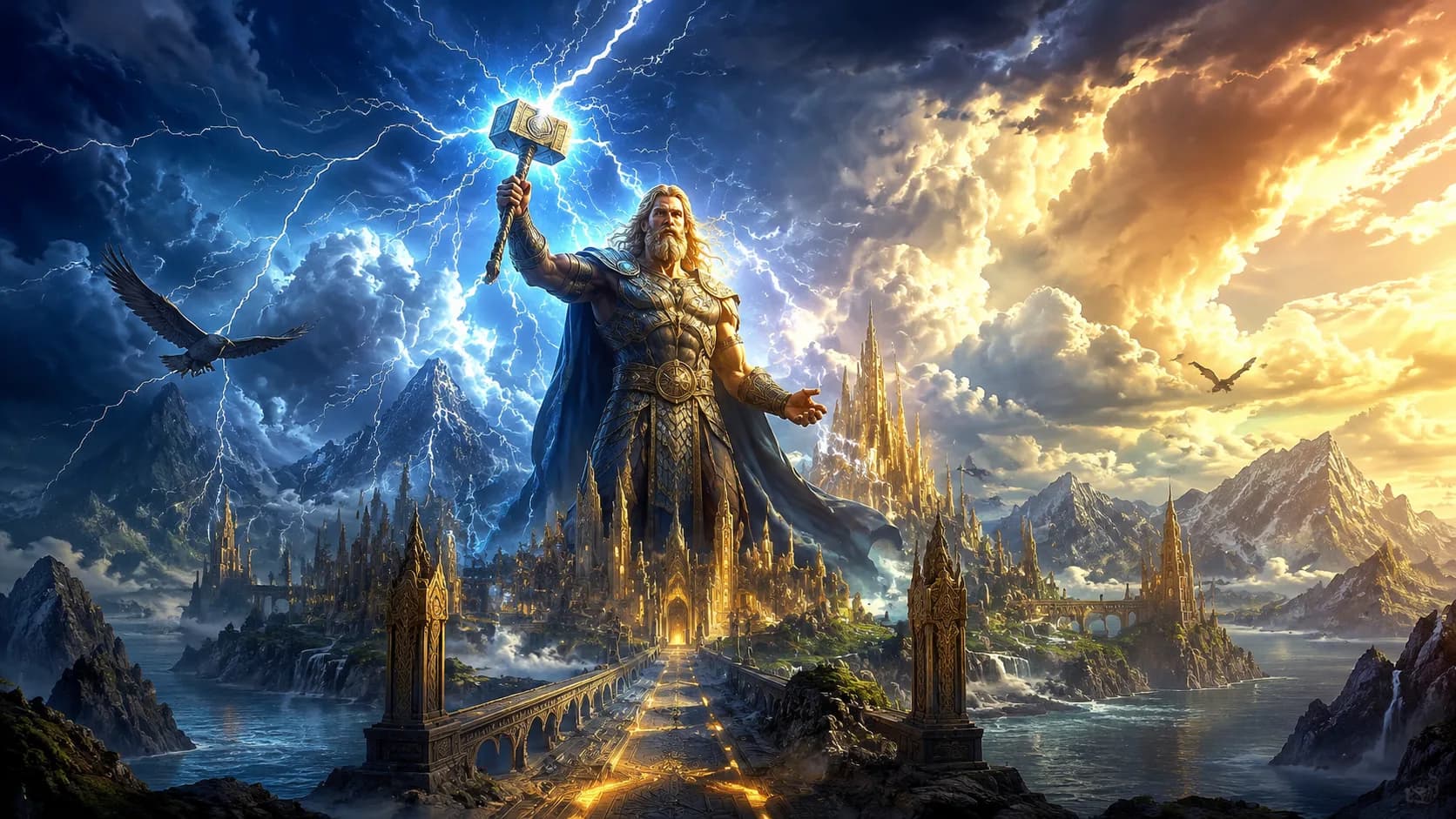
When thunder cracks across a darkened sky, something ancient stirs in the human imagination. For the Norse people who settled Scandinavia's fjords and forests over a thousand years ago, that sound carried a name: Thor the red bearded god of thunder, lightning, and storms, son of Odin the All Father, protector of gods and humans alike. With his legendary hammer Mjölnir in hand, Thor stood as the mightiest champion of Asgard, the eternal guardian against the forces of chaos, and the most beloved deity of the common people across the Viking world.
Thor, the thunder god of Norse mythology, is the divine figure who personifies the power of thunderstorms, the protection of humanity, and the eternal struggle between order and chaos in the Norse cosmological tradition. Son of Odin and the earth goddess Jörð, Thor wields the enchanted hammer Mjölnir forged by dwarven craftsmen and capable of leveling mountains and rides a chariot drawn by two magical goats across the sky, producing the sound of thunder. His mythology encompasses encounters with frost giants, cosmic serpents, and trickster gods, forming one of the richest and most enduring mythological traditions in human history. The thunder gods of Norse mythology represent universal themes of courage, strength, guardianship, and the triumph of perseverance that continue to resonate across cultures today.
In this comprehensive guide, you'll journey through the complete mythology of Thor and the Norse thunder gods from Mjölnir's legendary forging to Thor's epic encounters with giants, his complex relationship with Loki the trickster, the cosmic drama of Ragnarök, and the enduring cultural legacy that echoes from Viking longhouses to modern cinema. Along the way, you'll discover how these ancient stories connect to the universal human experience of imagination, wonder, and the quest for meaning and how interactive audio journeys can bring these myths to life through the power of spatial audio and guided visualization.
"Thor walks into a bar. The bartender says, 'We don't serve thunder gods here.' Thor replies, 'That's fine, I'll have whatever's on tap.' The sky rumbles approvingly. Even Mjölnir knows a good pun when it hears one."
Key Facts About Thor and Norse Thunder Gods
- ••Identity: Thor (Old Norse: Þórr) is the Norse god of thunder, lightning, storms, strength, and the protection of humanity
- ••Family: Son of Odin (All-Father) and Jörð (Earth goddess); married to Sif, the golden-haired goddess
- ••Legendary Weapon: Mjölnir, an enchanted hammer that always returns when thrown; also wears iron gloves (Járngreipr) and a strength-doubling belt (Megingjörð)
- ••Primary Sources: The Poetic Edda (13th century) and the Prose Edda by Snorri Sturluson (c. 1220 CE)
- ••Cultural Legacy: Thursday (Thor's Day) is named after him; Mjölnir pendants were the most popular Viking-age jewelry
- ••Parallel Figures: Zeus (Greek), Jupiter (Roman), Indra (Hindu), Perun (Slavic). Thunder gods appear in nearly every ancient culture
Quick Answer
Explore Thor, the mighty thunder god of Norse mythology: his legendary hammer Mjölnir, epic encounters with giants, his role as protector of Asgard and Midgard, and the enduring cultural legacy of the Norse thunder gods. Discover how these timeless myths inspire imagination and meditation.
Who Is Thor? The Mighty God of Thunder
In the Norse pantheon, Thor occupies a unique and beloved position. While his father Odin rules as the All Father wise, mysterious, and sometimes remote Thor is the god of the people. He is accessible, straightforward, and fiercely protective. Where Odin pursues knowledge through sacrifice and cunning, Thor acts through raw strength, unshakeable courage, and an uncompromising commitment to defending the weak against the powerful. This made him the most widely worshipped deity across the Viking world, from Norwegian fishing villages to Icelandic farmsteads to Swedish trading posts.
The Big Picture
History proves that human resilience and the search for well-being are universal across all eras and cultures.
The Prose Edda describes Thor as immensely powerful, with a red beard that crackles with electricity, eyes that flash like lightning, and a voice that booms like thunder across the heavens. He is the strongest of all the gods a fact that even Odin acknowledges. His appetite is legendary; in one famous tale, he devours an entire ox at a feast, inspiring generations of Norse poets to celebrate his prodigious consumption with equal parts awe and humor. Thor's physical description connects him directly to the natural phenomenon he embodies: the thunderstorm, raw and overwhelming, yet essential for life and renewal.
Beyond his physical prowess, Thor represents reliability and justice in Norse culture. He is the god you pray to when your crops need rain, when your ship faces a storm, or when your community faces a threat. While other gods may be capricious or calculating, Thor is consistent: he stands between chaos and order, swinging Mjölnir against anything that threatens the realms he has sworn to protect. Archaeological evidence confirms his popularity more Mjölnir pendants have been found across Scandinavia than symbols of any other Norse deity, and place names invoking Thor appear across Norway, Sweden, Denmark, Iceland, and the British Isles.
Thor's character also reveals surprising depth. He is not merely a figure of force. The Prose Edda shows him as a loving father, a loyal friend, and on occasion genuinely puzzled by the world's complexities. His encounters with giants and tricksters often involve not just physical challenges but intellectual and emotional ones, revealing a figure who grows through experience. This combination of tremendous power and relatable humanity is what has made Thor endure in human imagination for over a millennium, from Viking age runestones to modern blockbuster films.
Thor rides a chariot drawn by two magical goats, Tanngrisnir and Tanngnjóstr. The goats can be consumed for food each evening and will regenerate fully by morning provided their bones are left intact. This detail reflects the Norse understanding of natural cycles: consumption and renewal, seasons turning, life perpetually regenerating from what came before.
A Roman walks into a bar, holds up two fingers, and says, 'Five beers, please.'
Mjölnir: The Legendary Hammer of Thor
No artifact in Norse mythology is more iconic than Mjölnir (pronounced "MYOL neer"), Thor's enchanted hammer. Its name likely derives from a Proto Norse word meaning "lightning" or "crusher," and its story is as fascinating as the god who wields it. According to the Prose Edda, Mjölnir was forged deep within the earth by the dwarven brothers Sindri (also called Eitri) and Brokkr master craftsmen whose skill surpassed anything in the nine realms. The hammer's creation is itself a tale of mischief, competition, and imperfection made perfect.
Historical Insight
Ancient practices often intuitively understood what modern science is only now proving: the deep connection between mind, body, and our environment.
The story begins with Loki, who after one of his trademark pranks wagers his own head that the dwarven brothers cannot forge treasures superior to those created by the Sons of Ivaldi. Sindri and Brokkr accept the challenge, but Loki desperate to win transforms into a fly and stings Brokkr repeatedly during the forging to disrupt his work. Despite the interference, the brothers produce three magnificent treasures: a golden boar, a self-replicating gold ring, and Mjölnir. The only flaw: Loki's final sting caused the hammer's handle to be slightly shorter than intended. The gods judged Mjölnir the greatest treasure anyway, recognizing that even imperfection could be magnificent.
Mjölnir's properties are extraordinary. It never misses its target and always returns to Thor's hand after being thrown an ancient precursor to the boomerang concept, but infinitely more powerful. It can level mountains, summon lightning, and generate thunderstorms. But Mjölnir is not merely an instrument of power; it is also a sacred tool of consecration and blessing. The Norse used Mjölnir symbols to bless marriages, births, and funerals, to consecrate fields for planting, and to protect homes from misfortune. This dual nature fierce power combined with gentle protection mirrors Thor's own character and helps explain why Mjölnir became the most beloved symbol in Viking culture.
To wield Mjölnir, Thor requires two additional magical items: Járngreipr (iron gloves) to grip the hammer's immense power, and Megingjörð (a belt of strength) that doubles his already god-like might. Together, these three artifacts make Thor the most formidable champion in the Norse cosmos a figure whose strength serves not personal ambition but communal protection, not conquest but guardianship.
"Loki's plan to sabotage the hammer resulted in a shorter handle. Which means Mjölnir is basically the world's most powerful short handled umbrella. And honestly? It handles thunderstorms better than any umbrella I've ever owned."

Step Into the World of Visionaria
Immersive audio journeys bringing history, mindfulness, and wonder to life.
Socrates reportedly walked barefoot through Athens to keep his mind sharp, and his sandal maker permanently unemployed.
Thor as Protector of Asgard and Midgard
Thor's primary role in Norse cosmology is as protector of both Asgard the realm of the gods and Midgard the realm of humans. This dual guardianship makes him unique among the Norse deities. While other gods serve specific functions (Freya oversees love and fertility, Tyr presides over justice and honor), Thor's domain is safety itself. He stands at the boundary between the ordered realms and the chaotic forces of Jötunheimr (the land of the giants), ensuring that the beings who threaten cosmic order cannot cross into the worlds of gods and mortals.
The Norse concept of cosmic order known as Innangard (the enclosed, civilized space) versus Útangard (the wild, chaotic space beyond the fence) places Thor squarely at the boundary. He is the living fence, the guardian who ensures that the forces of entropy, represented by the frost giants and chaos beings, do not overwhelm the structured world. Every thunderstorm was understood as evidence of Thor's ongoing protection: the lightning was his hammer striking against the giants, the thunder was the sound of cosmic conflict, and the rain that followed was the blessing that sustained life.
Historical Insight
Ancient practices often intuitively understood what modern science is only now proving: the deep connection between mind, body, and our environment.
This role resonated deeply with the Norse people because their own lives were defined by the boundary between order and chaos. Farming communities cleared forests to create ordered fields surrounded by wilderness. Viking sailors navigated between the known coastal waters and the terrifying open ocean. Thor's mythology gave cosmic meaning to this daily experience: just as Thor stood between Asgard and Jötunheimr, every Norse person stood between their cultivated world and the wild unknown. The god's tireless protection reminded them that this boundary, while dangerous, could always be defended.
Thor's protective nature extended particularly to travelers and those at sea. Viking ships often carried Mjölnir symbols, and sailors would invoke Thor's name before voyages. The connection makes mythological sense: Midgard is surrounded by the world ocean, home to the great serpent Jörmungandr Thor's eternal rival. By calling on Thor, sailors aligned themselves with the one god whose strength could match the ocean's fury, transforming a dangerous voyage into an act of faith in cosmic protection.
Archaeological excavations across Scandinavia have unearthed more than 1,000 Mjölnir amulets far more than symbols of any other Norse deity. These were worn by men, women, and children of all social classes, confirming Thor's status as the "people's god" whose protection was sought by everyone, from farmers to kings.
"Thor: protector of two entire realms, full time giant deterrent, part time weather system. His job description would crash LinkedIn. 'Skills: Thunder generation, hammer retrieval, goat chariot driving, cosmic boundary maintenance.'"
A time traveler went back to antiquity to teach them about 'holistic health.' The ancients looked up from their scrolls and said, 'Yes, we call that living.'
Thor's Legendary Encounters with the Giants
The most thrilling stories in Norse mythology are Thor's encounters with the Jötnar (giants) beings of chaos and primal force who represent everything that threatens cosmic order. These tales, preserved in the Poetic Edda and Prose Edda, range from triumphant to humbling, and they reveal Thor as a character far more nuanced than a simple strongman.
Perhaps the most famous is the tale of Thor's visit to Útgarða Loki, the giant king of the outer world. In this story, Thor, Loki, and their companions journey to the giants' fortress, where Thor is challenged to a series of seemingly simple contests. He is asked to drain a drinking horn but the horn is secretly connected to the ocean. He is asked to lift a cat but the cat is actually the world serpent Jörmungandr in disguise. He is challenged to a wrestling match against an old woman who turns out to be Elli, the personification of old age, whom nothing in the universe can overcome. Thor comes closer to succeeding in each impossible task than any being has before, and the giant king reveals the deceptions with genuine awe at Thor's strength.
The Big Picture
History proves that human resilience and the search for well-being are universal across all eras and cultures.
This story is remarkable because it shows Thor encountering challenges he cannot simply hammer through. He faces limitations with grace, learns humility without losing dignity, and earns respect precisely because he gave his all against forces that were, by design, beyond anyone's strength. The tale teaches that true courage isn't about always winning it's about facing impossible challenges with everything you have and emerging wiser for the experience.
Other encounters showcase Thor's more triumphant side. In the Hymiskviða, Thor embarks on a fishing expedition where he hooks Jörmungandr the world serpent that encircles all of Midgard. The poem describes the terrifying moment when the serpent's eyes meet Thor's, the ocean boiling around them, before the fishing line snaps and the serpent sinks back into the depths. This encounter foreshadows their final meeting at Ragnarök and represents one of the most dramatic moments in all of world mythology two cosmic forces confronting each other across the boundary between order and chaos.
An Epicurean, a Stoic, and a Cynic walk into a garden. The bartender says, 'Is this some kind of philosophical joke?'
Thor and Loki: The Most Complex Relationship in Mythology
No relationship in Norse mythology is as fascinating, as contradictory, or as emotionally rich as the bond between Thor and Loki. In the original myths, Loki is Odin's blood brother not Thor's brother but the two travel together more frequently than any other pair of gods, creating a dynamic that alternates between genuine companionship, exasperation, grudging respect, and fundamental opposition.
In many tales, Thor and Loki function as complementary opposites. Thor embodies strength, directness, and straightforward honor. Loki embodies cunning, shape shifting, and moral ambiguity. Together, they solve problems that neither could handle alone. When Thor's hammer is stolen by the giant Thrymr in the famous Þrymskviða, it is Loki who devises the plan to recover it dressing Thor as a bride to infiltrate the giant's hall. Thor's strength delivers the final blow, but Loki's cleverness makes it possible. Their partnership illustrates a profound mythological truth: that strength without wit is incomplete, and wit without strength is powerless.
Did You Know?
The relentless drive to understand the world was seen not just as an academic pursuit, but as a spiritual and healing practice by the ancients.
The Þrymskviða deserves special attention as one of the most entertaining tales in all of Norse mythology. When Thrymr demands the goddess Freya as his bride in exchange for Mjölnir, the gods are horrified. Loki suggests disguising Thor as Freya complete with bridal veil, jewelry, and the famous necklace Brísingamen. The comedy escalates as Thor struggling to maintain the deception devours an entire ox, eight salmon, and three barrels of mead at the wedding feast. When Thrymr lifts the veil to kiss his "bride" and recoils at the blazing eyes beneath, Loki smoothly explains that "Freya" has been so excited about the wedding she hasn't slept for eight nights. The moment Mjölnir is placed in the "bride's" lap for the blessing ceremony, Thor seizes it and reveals himself in a scene of thunderous justice.
Yet the relationship eventually fractures. As the mythological cycle progresses, Loki's actions become increasingly harmful to the gods, culminating in events that contribute to Ragnarök. Thor's response to Loki's betrayals is not rage but sorrow mingled with resolve the grief of someone who once called a companion friend and must now acknowledge that the friendship has become impossible. This emotional complexity is what elevates Norse mythology above simple adventure stories into genuine literature of the human condition.
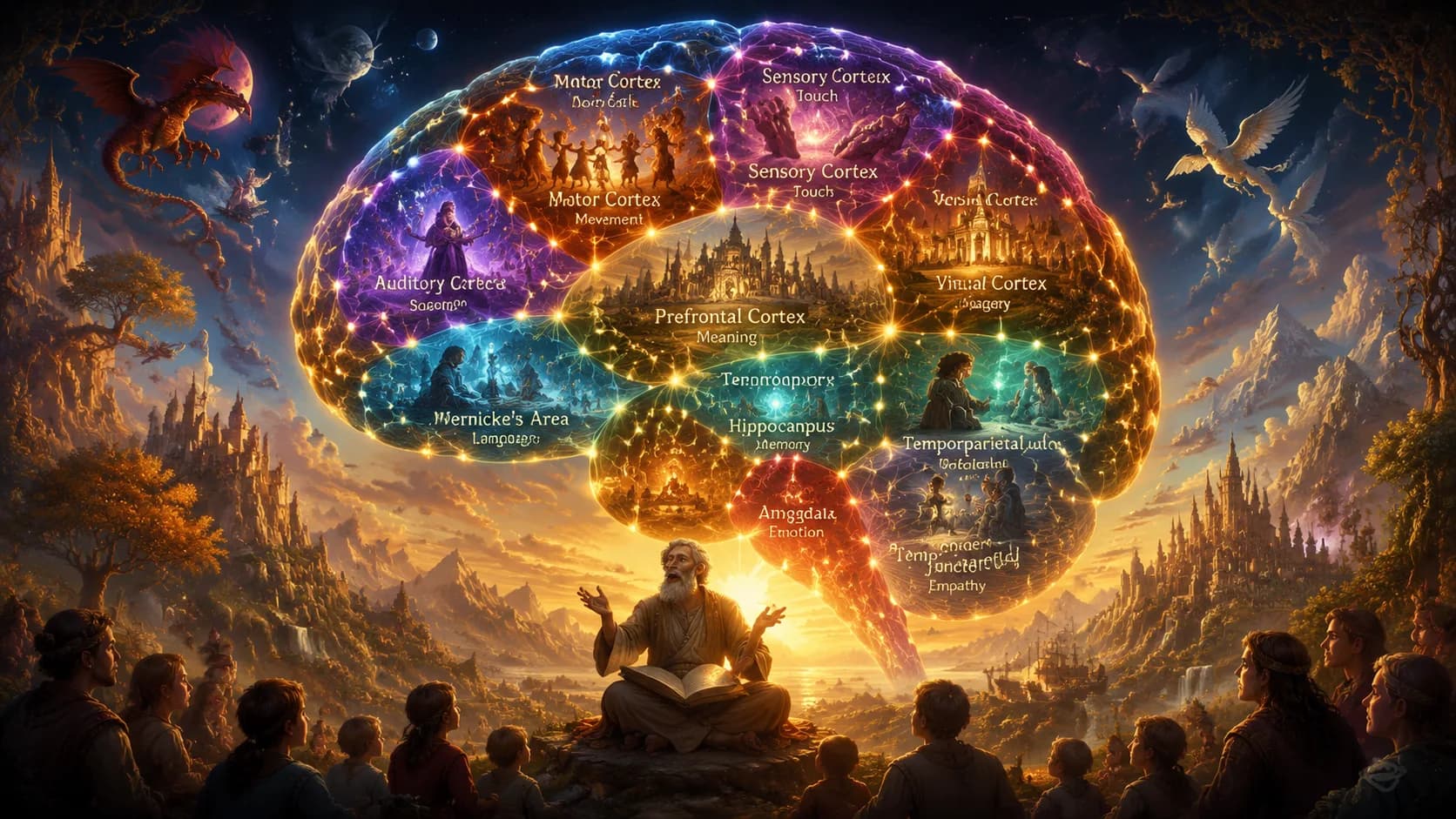
Read more: How Storytelling Activates Multiple Brain Regions
"Thor and Loki are basically the original odd couple roommates. Thor: 'Let's handle this problem directly.' Loki: 'Or... hear me out... we could dress you up as a bride.' Thor: '...This is the last time I let you plan anything.' Narrator: It was not the last time."
A Roman walks into a bar, holds up two fingers, and says, 'Five beers, please.'
Thunder Gods Across World Cultures
Thor is the most famous thunder god in Western culture, but he is far from the only one. Nearly every civilization in human history has created a thunder deity, suggesting that the experience of thunderstorms triggers something universal in human mythology making. Comparing these figures reveals both the uniqueness of Thor's character and the shared human impulse to personify nature's most dramatic force.
Zeus, the Greek king of the gods, wields thunderbolts forged by the Cyclopes and rules from Mount Olympus. While Thor is the people's champion approachable and protective Zeus is a ruler: powerful but often distant, his thunder expressing authority rather than guardianship. Jupiter, the Roman equivalent, blends Zeus's regal nature with Rome's emphasis on institutional power. Where Thor defends individuals, Jupiter defends the state.
Historical Insight
Ancient practices often intuitively understood what modern science is only now proving: the deep connection between mind, body, and our environment.
Indra, the Vedic thunder god of Hindu tradition, shares Thor's giant fighting nature. Both face cosmic serpents (Jörmungandr for Thor, Vritra for Indra), both wield enchanted implements (Mjölnir and the Vajra), and both are associated with rain, fertility, and the protection of cosmic order. The parallels are so striking that scholars have traced both figures to a common Proto-Indo-European thunder god a deity worshipped thousands of years before either Norse or Hindu traditions existed as separate cultures.
In Slavic mythology, Perun occupies Thor's role almost exactly a thunder god who rides across the sky, strikes his enemies with lightning, and is worshipped as the protector of the common people. West African Shango, the Yoruba god of thunder, wields a double headed axe and embodies justice through storm power. Japanese Raijin creates thunder by striking drums arranged in a circle. Chinese Lei Gong punishes the guilty with lightning bolts. The global pattern is unmistakable: wherever humans have heard thunder, they have imagined a god behind it and that god is almost always a protector.
Read more: What Is an Imagination Training Practice?
The Proto-Indo-European thunder god, reconstructed by linguists as *Perkwunos (the "Striker"), is the common ancestor of Thor, Zeus, Jupiter, Indra, and Perun. This figure existed over 5,000 years ago, making the thunder god archetype one of the oldest continuous mythological traditions in human history.
A time traveler went back to antiquity to teach them about 'holistic health.' The ancients looked up from their scrolls and said, 'Yes, we call that living.'
Norse Cosmology: The Nine Realms and Yggdrasil
To understand Thor's role fully, you need to understand the Norse cosmological framework one of the most elaborate and imaginatively rich world systems ever created by human culture. The Norse universe consists of Nine Realms, all connected by Yggdrasil, the World Tree an immense ash tree whose branches extend into the heavens and whose roots reach into the deepest underworlds.
Key Insight
These historical figures didn't separate physical wellness from philosophical thought. To them, it was all one continuous practice of living well.
Asgard sits at the highest level, home to the Æsir gods including Odin, Thor, and Tyr. Connected to Asgard by the shimmering rainbow bridge Bifröst is Midgard the human world, encircled by the vast ocean where Jörmungandr lies coiled. Below and around these central realms are Jötunheimr (realm of the giants), Alfheimr (realm of the light elves), Svartálfaheimr (realm of the dwarves who forged Mjölnir), Vanaheimr (realm of the Vanir gods), Niflheimr (realm of primordial ice and mist), Muspelheimr (realm of primordial fire), and Helheimr (realm where those who pass from old age or illness find their continuation).
Thor's guardianship extends primarily over Asgard and Midgard, but his journeys take him throughout the Nine Realms. He regularly travels to Jötunheimr to confront giants, crosses Bifröst on his way to and from mortal affairs, and his hammer's power is felt in every corner of the cosmos. Yggdrasil itself is tended by the Norns three wise women who weave the destinies of all beings and is fed by the Well of Urð, whose waters contain all wisdom and memory. This interconnected cosmology means that everything Thor does ripples through the entire universe, giving his actions cosmic significance.
The richness of Norse cosmology makes it exceptionally well suited for imagination training and immersive audio journeys. Each of the Nine Realms has its own distinct atmosphere, soundscape, and emotional resonance from Asgard's golden halls to Niflheimr's whispering mists to Muspelheimr's roaring flames. Spatial audio brings these environments to vivid life, allowing listeners to hear the creak of Yggdrasil's branches, feel the shimmer of Bifröst beneath their feet, and experience the vast, interconnected wonder of the Norse cosmos firsthand.
"The Norse had nine realms connected by a cosmic tree. We have nine browser tabs connected by Wi-Fi. The Vikings would be impressed by our multitasking. Less impressed by our screen time."
A philosopher walked into a wall. His students asked if it hurt. He replied, 'The wall is an illusion, but my headache is quite real.'
Ragnarök: Thor's Greatest Challenge and Transformation
Ragnarök often translated as the "Twilight of the Gods" is the climactic event of Norse mythology: a cosmic transformation in which the old world ends and a new one begins. Unlike the linear apocalypses of other traditions, Ragnarök is cyclical it is not the end of everything, but a necessary transformation from which a renewed, purified world emerges. Thor's role in this event is among the most dramatic and emotionally powerful in all of world mythology.
The Völuspá (the "Prophecy of the Seeress"), the most important poem in the Poetic Edda, describes Ragnarök in vivid, haunting detail. The signs begin with Fimbulvetr three consecutive winters with no summer between them. Morality breaks down. The great wolf Fenrir breaks free from his bonds. Jörmungandr, the world serpent, rises from the ocean, flooding the land. Loki leads an army of chaos beings against the gods. The Bifröst bridge shatters under the weight of the advancing forces.
In the final confrontation, each god faces their destined opponent. Odin faces Fenrir. Freyr faces the fire giant Surtr. And Thor faces Jörmungandr his ancient rival, the serpent he once hooked on a fishing line, the cosmic embodiment of chaos that encircles the world. Their encounter is one of the most powerful passages in Norse literature: Thor succeeds in overcoming the world serpent, striking it down with Mjölnir in a moment of supreme triumph. But the serpent's venom has taken its toll, and Thor walks nine steps before the great thunder god falls.
Visionaria Insight
By immersing ourselves in these historical soundscapes, we reconnect with a timeless human tradition of storytelling and mental restoration.
What makes this story transcendent rather than merely tragic is what follows. The world does not end it transforms. From the cosmic upheaval, a new earth rises, green and fertile. Thor's sons, Magni and Móði, inherit Mjölnir and carry their father's protective legacy into the renewed world. The sun returns. Life begins again. Ragnarök teaches that endings are not endings but transitions that even the mightiest forces in the universe serve a larger cycle of renewal. Thor's final act is not one of loss but of ultimate sacrifice: he gives everything so that the world may begin again, ensuring through his sons that protection, courage, and strength will endure forever.
Ragnarök's cyclical nature distinguishes Norse mythology from traditions with linear endings. The Norse understood that transformation requires courage, and renewal requires sacrifice. Thor's willingness to face impossible odds knowing the outcome embodies the highest Norse virtue: courage not in the absence of knowledge about consequences, but in full awareness of them.
"Ragnarök is essentially the universe's way of rebooting. Thor's sons inherit Mjölnir and start fresh. So even Norse mythology believed in sequels. Hollywood didn't invent anything the Vikings were franchising mythology a thousand years early."
A time traveler went back to antiquity to teach them about 'holistic health.' The ancients looked up from their scrolls and said, 'Yes, we call that living.'
Viking Worship and the Cult of Thor
While Odin was revered by kings, poets, and warriors seeking wisdom, Thor was the god of everyday people. Archaeological evidence, literary sources, and place name studies confirm that Thor was the most widely worshipped deity in the Viking world. His cult was especially strong among farmers, sailors, craftspeople, and settlers the common folk who needed protection, rain for their crops, safe voyages, and strength against the many challenges of Scandinavian life.
Did You Know?
The relentless drive to understand the world was seen not just as an academic pursuit, but as a spiritual and healing practice by the ancients.
Mjölnir amulets are the most abundant religious artifacts from the Viking Age. Found across Scandinavia, the British Isles, Iceland, and even as far as Kievan Rus (modern Ukraine and Russia), these small hammer pendants were worn around the neck as symbols of protection and faith. Notably, when Christianity began spreading across Scandinavia in the 10th and 11th centuries, some craftsmen created molds that could produce both Mjölnir pendants and Christian crosses a fascinating glimpse into a transitional period where both faiths coexisted.
Thor's name is woven into the Scandinavian landscape itself. Hundreds of place names across Norway, Sweden, Denmark, and Iceland contain Thor-related elements: Torshavn (Thor's Harbor) in the Faroe Islands, Thorsö (Thor's Island), Thorsberg, Thorshöj (Thor's Mound), and countless others. The frequency of these names far exceeding those of any other god confirms Thor's dominance in popular religious practice. Even the English word "Thursday" (Thor's Day) preserves his name in the weekly calendar, a testament to the deep cultural roots of his worship.
Worship of Thor involved outdoor ceremonies at sacred groves and stone circles rather than enclosed temples (though the great temple at Uppsala in Sweden housed a famous statue of Thor alongside Odin and Freyr). Offerings included food, drink, and the ritual slaughter of goats animals sacred to Thor. Prayers to Thor were practical and direct, reflecting the god's straightforward character: requests for rain, safe travel, protection from enemies, and strength in challenging times.
An Epicurean, a Stoic, and a Cynic walk into a garden. The bartender says, 'Is this some kind of philosophical joke?'
Thor's Modern Legacy in Culture and Imagination
Few mythological figures have enjoyed as dramatic a modern renaissance as Thor. From 19th century Romantic nationalism to 21st century cinema, Thor has been continuously reimagined across art, literature, music, and popular culture, demonstrating the extraordinary adaptability and emotional resonance of Norse mythology.
Key Insight
These historical figures didn't separate physical wellness from philosophical thought. To them, it was all one continuous practice of living well.
The modern revival began during the Romantic era of the 18th and 19th centuries, when Scandinavian intellectuals rediscovered the Eddas and sagas. Painters like Mårten Eskil Winge created iconic images of Thor confronting the giants, while composers like Richard Wagner drew on Norse mythology for his monumental Ring Cycle. These artists recognized what the original Norse poets knew: that these myths contain universal emotional truths that transcend any particular time or culture.
In contemporary popular culture, Thor's presence is enormous. Comic books, films, television shows, and video games have introduced billions of people to Norse mythology often with significant creative liberties, but always drawing on the core themes of courage, protection, and the tension between strength and wisdom. The popularity of these modern interpretations has sparked genuine interest in the original myths, leading millions of people back to the Poetic Edda and Prose Edda. This is mythology working exactly as it should: ancient stories adapting to new forms while maintaining their essential emotional and philosophical power.
The appeal of Thor in the modern world connects to something deep in human psychology. In an era of complexity, ambiguity, and information overload, there is something profoundly satisfying about a figure who stands for clear values protection, courage, loyalty and acts on them without hesitation. Thor represents the part of us that wants to face challenges head on, defend what we love, and trust that strength combined with good intentions can make a difference. That's not naivety; it's one of the most enduring aspirations of the human spirit.
"Thor went from Viking prayers to Hollywood blockbusters in about 1,000 years. That's the longest casting process in entertainment history. But honestly? He was worth the wait."
Why did the historian break up with the archaeologist? Because her career was literally in ruins.
Norse Mythology and the Power of Imaginative Meditation
Norse mythology's richly imagined worlds from Asgard's golden halls to Niflheimr's ethereal mists make it an exceptionally powerful vehicle for imagination training and cinematic meditation. The detailed sensory environments described in the Eddas naturally translate into immersive visualization experiences that train the mind's creative faculties while promoting deep relaxation and focused awareness.
Did You Know?
The relentless drive to understand the world was seen not just as an academic pursuit, but as a spiritual and healing practice by the ancients.
When you imagine standing on the Bifröst bridge, feeling the rainbow shimmer beneath your feet while gazing up at Asgard's towering walls, your brain activates the same neural pathways used for actual sensory experience. Research in narrative psychology confirms that mythological visualization produces measurable benefits: reduced cortisol levels, enhanced creative thinking, improved emotional regulation, and strengthened neural connectivity between brain regions associated with imagination and executive function.
The emotional range of Norse mythology makes it particularly valuable for meditation. Thor's courage inspires confidence. The cosmic scope of Yggdrasil cultivates perspective and wonder. The cyclical nature of Ragnarök provides a framework for understanding personal transformation the idea that difficult transitions are not endings but necessary steps toward renewal. By immersing yourself in these mythological landscapes through guided audio journeys, you access these emotional and cognitive benefits in a focused, intentional way.
Spatial audio technology elevates this experience dramatically. Imagine hearing the crack of lightning from above as Thor swings Mjölnir, the distant roar of a frost giant from your left, and the creaking of Yggdrasil's vast branches from all around you. This three-dimensional soundscape provides the auditory scaffolding that helps your brain construct vivid, detailed mental imagery turning mythology from something you read about into something you experience. The result is an imagination training session that is simultaneously meditative and thrilling, calming and creatively stimulating.
"Meditation apps: 'Focus on your breathing.' Visionaria: 'Focus on dodging Mjölnir while crossing the Bifröst bridge.' Guess which one I actually look forward to every morning?"
Why did the Stoic cross the road? Because it was the rational thing to do, and he was indifferent to the traffic.
Experience Norse Mythology Through Visionaria
Visionaria brings the world of Norse mythology to life through interactive audio journeys that combine professional cinematic narration, spatial 3D audio, and guided visualization techniques. Walk across the Bifröst bridge hearing its crystalline resonance beneath your feet. Stand in the great hall of Valhalla as Odin's ravens circle overhead. Feel the ground tremble as Thor's chariot races across the heavens. These aren't just stories they're experiences you create with your own imagination, supported by the richest audio environments available on any meditation platform.
Did You Know?
The relentless drive to understand the world was seen not just as an academic pursuit, but as a spiritual and healing practice by the ancients.
With journeys set in five ancient cities, from Athens to Troy, Visionaria offers a place for every imagination. Norse mythology journeys transport you into the Nine Realms from Asgard's golden towers to the eerie beauty of Niflheimr. Pair these with journeys through ancient Athens, Babylon's Ishtar Gate, or the Enchanted Winter Kingdom's hidden doorway, and you have a complete imagination training library that grows richer with every session.
"Visionaria: because 'staring at my phone' is fine, but 'closing my eyes and walking through Asgard with spatial audio' is significantly cooler. Thor would approve. He loves a good upgrade."
The Story Behind Beauty and the Beast: Origins, Symbolism & Timeless Magic
Discover the enchanting origins of Beauty and the Beast, from ancient Cupid and Psyche legends to Madame de Beaumont's 18th-century fairy tale.
Why did the Stoic cross the road? Because it was the rational thing to do, and he was indifferent to the traffic.
The Bottom Line
You've journeyed through the complete mythology of Thor and the Norse thunder gods from the forging of Mjölnir to Ragnarök's cosmic transformation, from Thor's encounters with frost giants to the universal thunder god archetype that spans every major civilization. These ancient stories endure because they speak to something timeless in human experience: the longing for protection, the admiration of courage, and the understanding that even the mightiest forces serve cycles of renewal.
Did You Know?
The relentless drive to understand the world was seen not just as an academic pursuit, but as a spiritual and healing practice by the ancients.
This guide covered Thor's identity and character, Mjölnir's legendary origins, Thor's role as cosmic protector, his encounters with giants and his complex bond with Loki, thunder gods across world cultures, Norse cosmology's Nine Realms, Ragnarök's transformative power, Viking worship practices, and Thor's enduring modern legacy.
Experience More with Visionaria
Download the app to explore guided historical and wellness journeys.
What's an ancient intellectual's favorite exercise? Jumping to conclusions.
This article is for educational and informational purposes only. Historical details are based on available research and may evolve as new evidence emerges.
Visionaria journeys are designed for relaxation, guided imagination, and personal enrichment. They are not a substitute for medical, mental health, legal, or professional advice.