The Sacred World of Apollo and Ancient Music Rituals
✨ Fun fact: In ancient Greece, music was not considered entertainment. It was considered technology. The Greeks believed that specific musical modes possessed the power to alter emotional states with the precision of a pharmacist mixing compounds. The Dorian mode produced courage and steadiness. The Phrygian mode induced ecstatic enthusiasm. The Mixolydian mode evoked deep feeling and contemplation. Plato took this so seriously that in his ideal republic, he proposed banning certain musical modes entirely, on the grounds that they might make citizens too relaxed or too emotional, which is perhaps the earliest known example of music censorship and quite possibly the first time anyone said "turn that down, you'll corrupt the youth." The god Apollo, who presided over this extraordinary sonic pharmacy, was not merely the patron of pleasant melodies. He was the divine guarantor that the right sounds, performed in the right way, in the right place, could heal the sick, purify the polluted, reveal the future, and connect mortal minds to the infinite. Twenty-five centuries later, modern neuroscience is confirming what Apollo's priests always knew: sound changes the brain. The ancient Greeks simply got there first, and they had better architecture.
- Who Was Apollo? The God of Music, Light, and Prophecy
- The Sacred Role of Music in Ancient Greek Religion
- Apollo's Lyre: The Instrument That Shaped Western Music
- The Pythian Games: Athletic and Musical Competitions at Delphi
- Hymns, Paeans, and Choral Odes: Singing for the Gods
- The Muses and Apollo: Divine Inspiration in Ancient Music
- The Oracle at Delphi: Where Music Met Prophecy
- Ancient Greek Musical Instruments and Their Sacred Uses
- Music Therapy in the Ancient World: Healing Through Sound
- Ritual Processions and Festival Music in Ancient Greece
- How Visionaria Recreates Ancient Music Rituals Through Spatial Audio
- The Legacy of Apollo's Music in the Modern World
- The Bottom Line
- Frequently Asked Questions
In the ancient Greek world, music was sacred. It was not background entertainment or casual amusement it was a divine technology, a gift from the gods that possessed the power to heal the body, purify the soul, reveal hidden truths, and create communion between the mortal and the divine. And at the centre of this extraordinary Greek cultural achievement stood Apollo the radiant god of music, light, prophecy, and harmony whose influence shaped not only ancient religious practice but the entire trajectory of Western musical civilisation.
Ancient Greek music rituals were structured ceremonial practices in which music vocal, instrumental, and choral served as the primary medium of communication between humans and the divine. These rituals encompassed temple ceremonies (in which hymns and instrumental performances accompanied offerings, purifications, and prayers), festival processions (in which musicians led sacred parades through city streets to sanctuaries), competitive music performances (most notably at the Pythian Games at Delphi), therapeutic sound practices (in which specific musical modes were prescribed for physical and psychological healing), oracular consultations (where music accompanied prophetic trance states), and choral education (where young citizens learned music as a fundamental component of civic and moral development). Together, these practices constituted one of the most sophisticated sacred music cultures in human history one whose principles continue to resonate in modern audio meditation and sound healing.
This article is your comprehensive guide to Apollo's sacred world and the music rituals of ancient Greece from the mythological origins of Apollo's lyre and the oracular ceremonies at Delphi to the Pythian Games, from the science of sound and consciousness to how spatial 3D audio technology can recreate these ancient acoustic environments, and from the musical instruments of the Greek world to the legacy that connects Apollo's temple musicians to today's immersive audio experiences.
"The ancient Greeks had a word mousike that encompassed not just music as we understand it but the entire domain of the Muses: music, poetry, dance, philosophy, astronomy, and history. When a Greek said someone was 'musical,' they didn't mean the person could carry a tune at dinner parties. They meant the person possessed a well-ordered soul one that was harmoniously balanced, intellectually curious, and aesthetically refined. By this definition, most modern musicians would qualify only partially (excellent at the tune carrying, less certain about the soul ordering), while most ancient Greek philosophers would qualify enthusiastically despite being, by all surviving accounts, mediocre singers. The lesson, perhaps, is that the Greeks understood something we've forgotten: music is not something you do. It's something you are."
Key Facts: Apollo and Ancient Music Rituals
- ••Apollo's Domain: Apollo was the Greek god of music, poetry, light, prophecy, healing, plague, archery, and the arts, one of the most complex and widely worshipped deities in the Greek pantheon, with major sanctuaries at Delphi, Delos, and across the Mediterranean world
- ••The Pythian Games: Held every four years at Delphi from 586 BCE, the Pythian Games were one of the four great Panhellenic festivals and uniquely emphasised musical competition, featuring contests for kitharists, auletes, and singers alongside athletic events
- ••Musical Modes: The Greeks developed a system of musical modes (Dorian, Phrygian, Lydian, Mixolydian, and others) that they believed possessed specific psychological and physiological effects, the foundation of Western music theory and an early precursor to modern music therapy
- ••Sacred Instruments: The primary instruments of Greek sacred music were the lyre (associated with Apollo and rational harmony), the kithara (a professional concert instrument), and the aulos (a double-reed wind instrument associated with Dionysus and ecstatic states)
- ••Music as Education: Music education (mousike) was a compulsory element of Greek civic education. Every free citizen was expected to sing, play an instrument, and understand music theory as fundamental requirements of an educated, morally developed person
- ••Cosmic Harmony: Pythagoras and his followers believed that the planets produced inaudible "music of the spheres", that the universe itself was structured by the same mathematical ratios that govern musical harmony, an idea that influenced Western philosophy and science for over two thousand years
Quick Answer
✨ Fun fact: In ancient Greece, music was not considered entertainment. It was considered technology. The Greeks believed that specific musical modes possessed the power to alter emotional states with the precision of a pharmacist mixing compounds. The Dorian mode produced courage and steadiness. The Phrygian mode induced ecstatic enthusiasm. The Mixolydian mode evoked deep feeling and contemplation. Plato took this so seriously that in his ideal republic, he proposed banning certain musical modes entirely, on the grounds that they might make citizens too relaxed or too emotional, which is perhaps the earliest known example of music censorship and quite possibly the first time anyone said "turn that down, you'll corrupt the youth." The god Apollo, who presided over this extraordinary sonic pharmacy, was not merely the patron of pleasant melodies. He was the divine guarantor that the right sounds, performed in the right way, in the right place, could heal the sick, purify the polluted, reveal the future, and connect mortal minds to the infinite. Twenty-five centuries later, modern neuroscience is confirming what Apollo's priests always knew: sound changes the brain. The ancient Greeks simply got there first, and they had better architecture.
Who Was Apollo? The God of Music, Light, and Prophecy
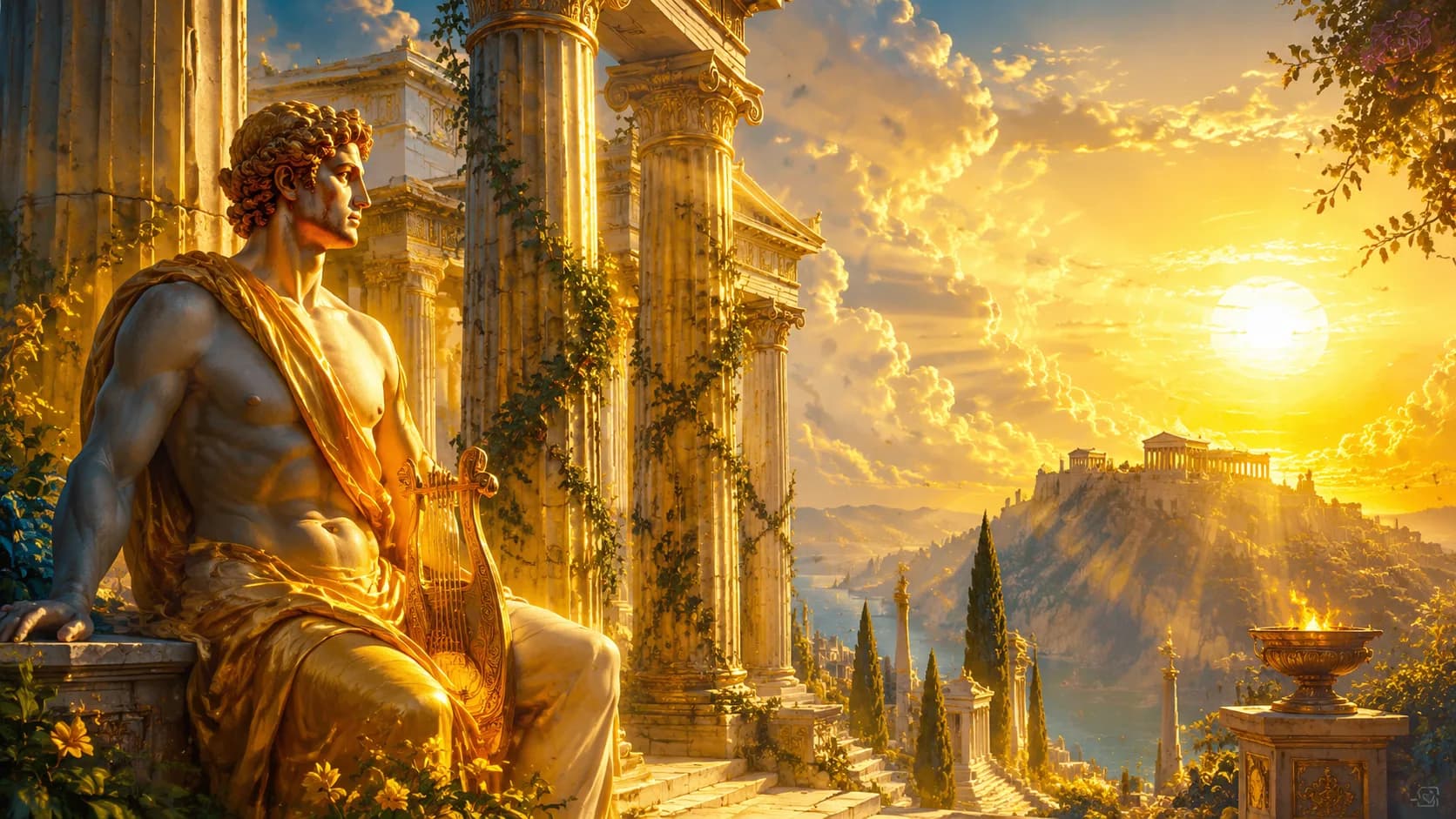
Apollo was among the most important and complex deities in the Greek pantheon a god whose domains encompassed music, poetry, light, the sun, prophecy, healing, archery, and the arts. He was the son of Zeus, king of the gods, and the Titaness Leto, and the twin brother of Artemis, goddess of the hunt. Born on the sacred island of Delos a location that became one of his most important sanctuaries Apollo embodied the Greek ideal of kalokagathia: the unity of beauty, excellence, and moral goodness. He was typically depicted as a radiantly handsome young man carrying a lyre and wearing a laurel crown, the very image of civilised grace and creative power.
Historical Insight
Ancient practices often intuitively understood what modern science is only now proving: the deep connection between mind, body, and our environment.
What makes Apollo particularly fascinating is the breadth and apparent contradictions of his divine portfolio. He was simultaneously the god of music (the most gentle of arts) and of archery (requiring precision and discipline). He was the god of healing who could also send plagues. He was the god of rational order and harmony who presided over the ecstatic prophecies at Delphi. These apparent contradictions resolve when we understand that the Greeks saw Apollo as the principle of cosmic order itself the divine force that transforms chaos into harmony, darkness into light, and raw sound into music. He was not simply a god who liked music; he was the god through whom the mathematical structure of the universe found its most beautiful expression in sound.
Apollo's significance extended far beyond mythology into the practical fabric of Greek civilisation. His oracle at Delphi was the most authoritative prophetic institution in the ancient world consulted by city states before making major decisions about colonisation, legislation, and diplomacy. His sanctuaries served as centres of musical education and performance. His festivals the Pythian Games foremost among them established the principle that artistic excellence deserves the same civic honour as athletic achievement. And his association with the harmony of the spheres the Pythagorean idea that the cosmos itself produces music gave ancient Greek culture a profound philosophical framework linking music, mathematics, and the fundamental structure of reality.
An Epicurean, a Stoic, and a Cynic walk into a garden. The bartender says, 'Is this some kind of philosophical joke?'
The Sacred Role of Music in Ancient Greek Religion
To understand ancient Greek music rituals, we must first understand something that modern listeners often find surprising: in ancient Greece, there was no secular music. All music was, in some sense, sacred. Every musical performance whether at a temple ceremony, a theatrical production, a funeral, a wedding, or a symposium was understood to exist within a divine framework established by Apollo and the Muses. When a musician played the lyre, they were not merely producing pleasant sounds; they were participating in a cosmic activity that connected human creativity to the mathematical harmony underlying all of existence.
This sacred understanding of music manifested in every aspect of Greek religious practice. No temple ceremony could be conducted without music. Hymns (humnoi) were sung to invoke the gods' attention and favour. Paeans songs of praise, healing, and thanksgiving accompanied offerings and purification rites. The aulos (a double reed instrument often compared to the modern oboe, though the comparison flatters neither instrument) provided the rhythmic foundation for sacred processions and sacrificial rituals. Choral songs, performed by trained groups of citizens, narrated the great myths and reinforced communal identity through shared musical experience.
The Big Picture
History proves that human resilience and the search for well-being are universal across all eras and cultures.
The Greeks believed that different musical modes possessed different psychological and moral powers a concept they called ethos. The Dorian mode was considered noble, steadfast, and courage promoting suitable for the education of warriors and the ceremonies of civic virtue. The Phrygian mode was associated with enthusiasm and ecstatic states appropriate for the worship of Dionysus and for moments of intense emotional expression. The Lydian mode was considered relaxing and sensuous beautiful but potentially morally softening if overused. This system of modal ethics was taken so seriously that both Plato and Aristotle devoted substantial philosophical attention to which musical modes should be permitted in education and civic life demonstrating that in ancient Greece, music was not a matter of taste but a matter of public moral concern.
"The ancient Greeks' approach to music regulation makes modern debates about explicit content warnings look remarkably mild. Plato, in his Republic, proposed banning the Mixolydian and 'relaxed' Lydian modes from his ideal city because they produced 'idleness and intemperance.' He permitted only the Dorian mode (for courage) and the Phrygian mode (for moderate enthusiasm). This is roughly equivalent to a modern government announcing that citizens may listen exclusively to military marches and moderately upbeat folk music, which gives you some idea of why Plato's republic remained firmly theoretical. Aristotle, characteristically more reasonable, suggested that all modes had their place depending on the context a position that has endured somewhat better, though it took Western civilisation about two thousand additional years to arrive at the concept of 'just let people listen to what they want.'"

Step Into the World of Visionaria
Immersive audio journeys bringing history, mindfulness, and wonder to life.
A philosopher walked into a wall. His students asked if it hurt. He replied, 'The wall is an illusion, but my headache is quite real.'
Apollo's Lyre: The Instrument That Shaped Western Music
The story of Apollo's lyre is one of the most charming myths in all of Greek mythology and one that reveals the profound connection the Greeks saw between cleverness, divine beauty, and the origins of music. According to the Homeric Hymn to Hermes, the infant god Hermes barely hours old crawled from his cradle, found a tortoise, and fashioned the first lyre from its shell, using ox gut strings and a yoke of reed. When Apollo discovered that the precocious baby had also stolen his sacred cattle, he confronted Hermes in fury. But Hermes played the lyre and the sound was so beautiful that Apollo's anger dissolved instantly. He traded his entire herd of cattle for the instrument, and the lyre became Apollo's most sacred possession and most recognisable attribute.
Visionaria Insight
By immersing ourselves in these historical soundscapes, we reconnect with a timeless human tradition of storytelling and mental restoration.
The lyre's significance in Greek culture extended far beyond its mythological origins. It was the instrument of civilised education, philosophical contemplation, and sacred ceremony. Every freeborn Greek boy was expected to learn the lyre as part of his education not to become a professional musician, but because the Greeks believed that musical training developed the rational and aesthetic faculties essential to good citizenship. The lyre represented measured, rational beauty strings of specific lengths producing notes in mathematically precise intervals, a physical demonstration that the universe was governed by harmony and proportion. Pythagoras's famous discovery that musical intervals correspond to simple numerical ratios (the octave is 2:1, the fifth is 3:2, the fourth is 4:3) was made using a stringed instrument, and it became the foundation of both Western music theory and the philosophical conviction that mathematics is the language of the cosmos.
Read more: Story Meditation Apps Compared: Complete Guide (2026)
The professional concert version of the lyre the kithara was a larger, more powerful instrument with a wooden resonating body, typically seven strings (though later versions had as many as twelve), and a rich, carrying tone suitable for large outdoor performances. The kithara was the instrument of the professional kitharode the elite musician singer who performed at the great festivals and competitions. Kitharodes were among the most celebrated figures in Greek public life, and winners at the Pythian Games achieved a level of fame comparable to modern concert virtuosos, though they received a laurel crown rather than a recording contract, which is arguably the more dignified arrangement.
Why did the inventor of the wheel win an award? Because his idea really got things rolling.
The Pythian Games: Athletic and Musical Competitions at Delphi
The Pythian Games, held every four years at Delphi in honour of Apollo, were one of the four great Panhellenic festivals of ancient Greece alongside the Olympic Games at Olympia, the Isthmian Games at Corinth, and the Nemean Games at Nemea. But the Pythian Games held a unique distinction: they were originally and primarily a music festival. The earliest Pythian Games, traditionally dated to 586 BCE in their reorganised form, were competitions in singing and instrumental performance. Athletic events were added later a reversal of the modern assumption that sports came first and arts were the afterthought.
The musical competitions at the Pythian Games were organised into several categories. Kitharoedia singing to one's own kithara accompaniment was considered the most prestigious event, combining vocal artistry, instrumental skill, and the ability to interpret epic poetry with emotional depth. Auloedia was singing with aulos accompaniment provided by a separate musician. Kitharis was purely instrumental kithara performance. Aulesis was purely instrumental aulos performance. Competitors performed before panels of judges, and the standard of performance was extraordinarily high these were the finest musicians from across the Greek world, gathered at the most sacred musical site on Earth, competing for the honour of Apollo's laurel crown.
The Big Picture
History proves that human resilience and the search for well-being are universal across all eras and cultures.
The prize at the Pythian Games was not money or material goods but a wreath of laurel leaves cut from a sacred tree in the Vale of Tempe a symbol of Apollo's favour and the highest honour a musician could receive. The laurel crown represented something that the Greeks valued above financial reward: divine recognition of excellence. Winners were celebrated throughout the Greek world with statues, public honours, and poems commissioned to commemorate their victories some of which, by the great poet Pindar, survive to this day. The Pythian Games established a principle that persists in Western culture: that artistic achievement deserves the same public honour and celebration as athletic excellence, a principle that feels both ancient and strikingly modern.
Read more: The Origins of Dragons Across World Mythology

"The logistics of the Pythian Games reveal something charming about the ancient Greek relationship with music: the organisers had to deal with precisely the same problems that modern music festival organisers face. Performers argued about the running order. Judges were accused of favouritism (the Delphians themselves were banned from competing, presumably after one too many suspiciously convenient home victories). The acoustic conditions of the outdoor performance space changed with the weather. And there is at least one recorded instance of an aulos player complaining that the audience talked during his performance which suggests that the problem of concert hall etiquette is not, as we sometimes imagine, a modern invention but an eternal feature of the human condition. Apollo, one suspects, would have been equally annoyed."
A philosopher walked into a wall. His students asked if it hurt. He replied, 'The wall is an illusion, but my headache is quite real.'
Hymns, Paeans, and Choral Odes: Singing for the Gods
The vocal traditions of ancient Greek sacred music were extraordinarily rich and varied. Hymns (humnoi) were songs of praise addressed to specific deities, performed at temple ceremonies, festivals, and public gatherings. The Homeric Hymns a collection of thirty-three poems composed between the seventh and fifth centuries BCE provide our fullest picture of this tradition, narrating the myths and celebrating the powers of the Olympian gods in language of remarkable beauty and dramatic force. Each hymn functioned not merely as a song but as a ritual invocation an act of calling the god's attention and establishing a relationship of reciprocal honour between the human community and the divine.
Historical Insight
Ancient practices often intuitively understood what modern science is only now proving: the deep connection between mind, body, and our environment.
Paeans were a distinctive category of sacred song particularly associated with Apollo. Originally songs of healing and protection the word paean derives from Paian, an epithet of Apollo as healer they evolved to encompass songs of thanksgiving, celebration, and communal solidarity. Paeans were sung before and after important events: before departure on military campaigns, after successful conclusions, at symposia, and at moments of civic joy or relief. The communal nature of the paean was essential it was typically sung by a group, often with call and response structure, creating a shared musical experience that bound the community together through collective voice and rhythm. This principle that shared singing creates social cohesion is confirmed by modern neuroscience research showing that synchronised musical activity produces oxytocin and strengthens interpersonal bonding.
Choral odes performed by trained choruses of citizens represented the pinnacle of Greek musical art. These were complex compositions integrating poetry, music, and choreographed dance (the Greek word choreia encompassed all three) performed at festivals, dramatic productions, and religious ceremonies. The great choral poets Pindar, Bacchylides, Simonides created works of extraordinary intellectual and emotional sophistication, weaving mythological narratives with moral reflection, political commentary, and praise of human excellence. Choral performance required extensive training and rehearsal, and participation in a chorus was considered both a civic duty and a spiritual practice an experience that cultivated the individual soul while strengthening the collective community.
A philosopher walked into a wall. His students asked if it hurt. He replied, 'The wall is an illusion, but my headache is quite real.'
The Muses and Apollo: Divine Inspiration in Ancient Music
Apollo did not preside over music alone he led the Muses, the nine divine daughters of Zeus and the Titaness Mnemosyne (Memory), each of whom governed a specific domain of artistic and intellectual endeavour. Apollo was their Musagetes their leader and conductor and together they formed a divine ensemble that embodied the Greek ideal of creative excellence. Calliope presided over epic poetry, Clio over history, Euterpe over lyric poetry and music, Thalia over comedy, Melpomene over dramatic arts, Terpsichore over dance, Erato over love poetry, Polyhymnia over sacred song, and Urania over astronomy. The very word "music" derives from the Muses mousike and the concept that artistic inspiration comes from a divine source beyond the individual artist remains embedded in Western culture to this day.
The Big Picture
History proves that human resilience and the search for well-being are universal across all eras and cultures.
The Muses' association with Mnemosyne (Memory) was deeply significant. The Greeks understood that all art depends on memory the memory of stories, of techniques, of emotional experiences, of the cultural traditions that give individual works their context and meaning. An artist without memory is an artist without material. By making the Muses daughters of Memory, the Greeks encoded a profound truth about creativity: that originality emerges not from a vacuum but from deep engagement with what has come before. Every musician who has ever been inspired by an earlier musician's work which is to say, every musician who has ever existed is demonstrating the principle that the ancient Greeks understood as the parentage of the Muses.
The practical implication of this divine framework was that artistic creation was understood as collaboration between human skill and divine inspiration. A poet or musician did not simply decide to create they invoked the Muse, opening themselves to a force beyond their individual capacity. This is why virtually every epic poem in the Greek tradition begins with an invocation: "Sing, O Muse..." or "Tell me, Muse..." The artist's role was not to originate but to receive and shape what the divine offered. This understanding produced a relationship with creativity that was simultaneously humble (the artist acknowledges a source beyond themselves) and ambitious (what they receive is genuinely divine). Modern research on creative flow states describes strikingly similar phenomena the experience of ideas arriving from somewhere beyond conscious deliberation, which the Greeks would have recognised immediately as the Muse at work.
Why did the ancient physician prescribe a long walk? Because he was tired of listening to the patient complain in his office.
The Oracle at Delphi: Where Music Met Prophecy
The Oracle at Delphi the most famous prophetic institution in the ancient world was fundamentally a musical phenomenon. The Pythia, Apollo's priestess, delivered her prophecies in a state of inspired trance that was induced, maintained, and expressed through sound. The consultation process was accompanied by music at every stage: hymns were sung during the preparatory rituals, the Pythia's utterances often took rhythmic or verse forms, and the priests who interpreted her words framed their responses in hexameter poetry the same metrical form used for epic poetry and sacred hymns.
Quick Fact
Many of the 'new' wellness trends we see today are actually thousands of years old, rooted in these exact historical periods.
The acoustic environment of the Temple of Apollo at Delphi was itself a sacred instrument. The temple's architecture created specific resonance patterns that amplified and transformed sound in ways that enhanced the oracular experience. The adyton the inner sanctum where the Pythia sat was a small, enclosed space with stone walls that would have produced significant reverberation, causing the priestess's voice to sound larger, more complex, and more otherworldly than natural speech. This architectural acoustics whether consciously designed or fortuitously discovered contributed to the profound sense of divine presence that pilgrims reported when receiving their oracles.
Modern acoustic archaeology has begun to reveal just how sophisticated ancient temple acoustics could be. Research at ancient sacred sites worldwide has demonstrated that many temples and ritual spaces were designed or at minimum, selected for their acoustic properties. Stone chambers that produce standing waves at frequencies known to affect consciousness. Corridors whose length creates specific reverberation times. Spaces where whispers at one point can be heard clearly at another, seemingly miraculous location. The ancients may not have had the vocabulary of modern acoustics, but they had centuries of empirical observation, and they understood that the right space, with the right sounds, could produce experiences that transcended ordinary consciousness a principle that spatial 3D audio technology is now recreating through digital means.
A time traveler went back to antiquity to teach them about 'holistic health.' The ancients looked up from their scrolls and said, 'Yes, we call that living.'
Ancient Greek Musical Instruments and Their Sacred Uses
The instrumental world of ancient Greece was more diverse than many people realise, and each instrument carried specific religious and cultural associations that determined when, where, and for whom it could be played. The primary division was between string instruments (associated with Apollo, rational order, and measured beauty) and wind instruments (associated with Dionysus, ecstatic states, and emotional intensity). This was not merely a musical preference but a cosmological statement the two families of instruments represented two fundamental approaches to the relationship between humans and the divine.
The lyre (chelys) was the most common string instrument a small, portable instrument with a tortoiseshell resonator and typically seven strings, suitable for domestic music making and education. The kithara was its professional counterpart a large, heavy, elaborately decorated instrument with a wooden resonating body that produced a fuller, more powerful sound suitable for outdoor performance and competition. The barbitos was a larger, deeper voiced lyre particularly associated with sympotic (drinking party) music and the poetry of Sappho and Alcaeus. All three instruments were played by plucking the strings with a plectrum or the fingers, producing the clear, resonant tones that the Greeks associated with rational clarity and emotional balance.
Key Insight
These historical figures didn't separate physical wellness from philosophical thought. To them, it was all one continuous practice of living well.
The aulos often misleadingly translated as "flute" but actually a double reed instrument closer to the modern oboe was the most important wind instrument. It produced a penetrating, emotionally intense sound that could be heard over large crowds and outdoors, making it essential for processions, dramatic performances, and ecstatic rituals. The aulos was associated with Dionysus rather than Apollo, and its emotional intensity made it simultaneously indispensable (no festival was complete without it) and philosophically suspect (Plato recommended limiting its use). Other wind instruments included the syrinx (pan pipes, associated with the pastoral god Pan), salpinx (a trumpet used for military and ceremonial signals), and various types of percussion including the tympanon (frame drum, associated with the worship of Cybele and Dionysus) and kymbala (small cymbals). Together, this instrumental palette gave Greek musicians a rich sonic vocabulary for expressing the full range of sacred and secular experience.
"The ancient Greek debate about the relative merits of the lyre versus the aulos is, in retrospect, one of the longest running arguments in music history. Apollo's supporters argued that the lyre produced sounds of mathematical beauty, cultivated rational thought, and was suitable for civilised society. Dionysus's supporters argued that the aulos produced sounds of emotional power, liberated the soul from excessive rationality, and was considerably more exciting at parties. This argument continued for centuries, involved some of the greatest minds in Western philosophy, and was never resolved which makes it essentially identical to every subsequent debate about musical taste in human history. The only difference is that the ancient Greeks conducted their arguments in significantly better architecture."
Why did the historian break up with the archaeologist? Because her career was literally in ruins.
Music Therapy in the Ancient World: Healing Through Sound
Perhaps the most remarkable aspect of ancient Greek music culture and the one with the most direct connection to modern audio meditation and sound healing was the widespread practice of music therapy. The Greeks did not treat music therapy as an alternative or complementary practice; they considered it a primary medical intervention, prescribed by physicians and administered with the same seriousness as herbal remedies or surgical procedures. Apollo himself was both the god of music and the god of healing a conjunction that the Greeks did not consider coincidental but revelatory of a deep connection between sound and wellbeing.
Did You Know?
The relentless drive to understand the world was seen not just as an academic pursuit, but as a spiritual and healing practice by the ancients.
The philosophical foundation for Greek music therapy was the concept of harmonia the idea that health is a state of balance and proportion in the body and soul, and that illness results from the disruption of this balance. Music, which is itself structured by mathematical proportion and harmonic ratios, was believed to have the power to restore harmony to disordered systems. Specific musical modes were prescribed for specific conditions: the Dorian mode for steadiness and emotional regulation, the Phrygian mode for energising and motivating, specific rhythmic patterns for anxiety and agitation. The physician Asclepiades of Bithynia (c. 124-40 BCE) reportedly used musical modes to treat patients with what we would now call psychological conditions, and the legendary healer musician Orpheus was said to have the power to heal any ailment through the perfection of his playing.
Modern neuroscience has, remarkably, confirmed many of the ancient Greeks' intuitions about music and healing. Sound directly stimulates the vagus nervehelping the body relax and the mind settle. Modern researchers have explored how specific frequencies and rhythms affect mood and attention, an intriguing echo of the ancient Greek modal system. The growing field of clinical music therapy used in modern hospitals for pain management, neurological rehabilitation, and mental health treatment represents, in many ways, a scientific rediscovery of principles that Apollo's priests understood and practised twenty-five centuries ago.
Why did the historian break up with the archaeologist? Because her career was literally in ruins.
Ritual Processions and Festival Music in Ancient Greece
Among the most spectacular expressions of ancient Greek sacred music were the ritual processions (pompai) that formed the centrepiece of major religious festivals. These were not simple parades but carefully choreographed musical religious performances involving entire communities hundreds or thousands of citizens moving through sacred routes while musicians played, choruses sang, and the rhythm of collective movement created a shared experience of extraordinary power. The Panathenaia in Athens, the Karneia in Sparta, the Delia on Delos, and the processional approaches to Delphi all featured elaborate musical processions that were among the defining experiences of Greek civic and religious life.
Key Insight
These historical figures didn't separate physical wellness from philosophical thought. To them, it was all one continuous practice of living well.
The sonic experience of a Greek religious procession would have been immersive in a way that anticipates modern spatial audio environments. Imagine standing along the Sacred Way as the Pythian procession approaches: first you hear the distant sound of the aulos a penetrating, reedy tone that carries far through the mountain air. Then the rhythm of drums and the clashing of cymbals as the percussion section draws nearer. Then the voices of the chorus, rising in a hymn to Apollo, the melody braiding with the instruments to create a sound that fills the valley. Then the crunch of hundreds of feet on the stone road, the clinking of ceremonial objects, the murmur of prayers. The sound approaches, surrounds you, passes through you, and gradually recedes a three-dimensional sonic experience created not by technology but by the careful arrangement of musicians in physical space.
The Athenian Great Panathenaia held every four years in honour of Athena but featuring musical competitions modelled on the Pythian format included both athletic and musical contests, with substantial prizes (including jars of sacred olive oil) for victorious musicians. The procession from the Kerameikos cemetery to the Acropolis famously depicted on the Parthenon frieze featured kithara players, aulos players, and singers alongside priests, officials, sacrificial animals, and the sacred peplos (robe) for the cult statue of Athena. Music was not accompaniment to these processions; it was their animating force the element that transformed a walk through the city into a communion with the divine.
A Roman walks into a bar, holds up two fingers, and says, 'Five beers, please.'
How Visionaria Recreates Ancient Music Rituals Through Spatial Audio
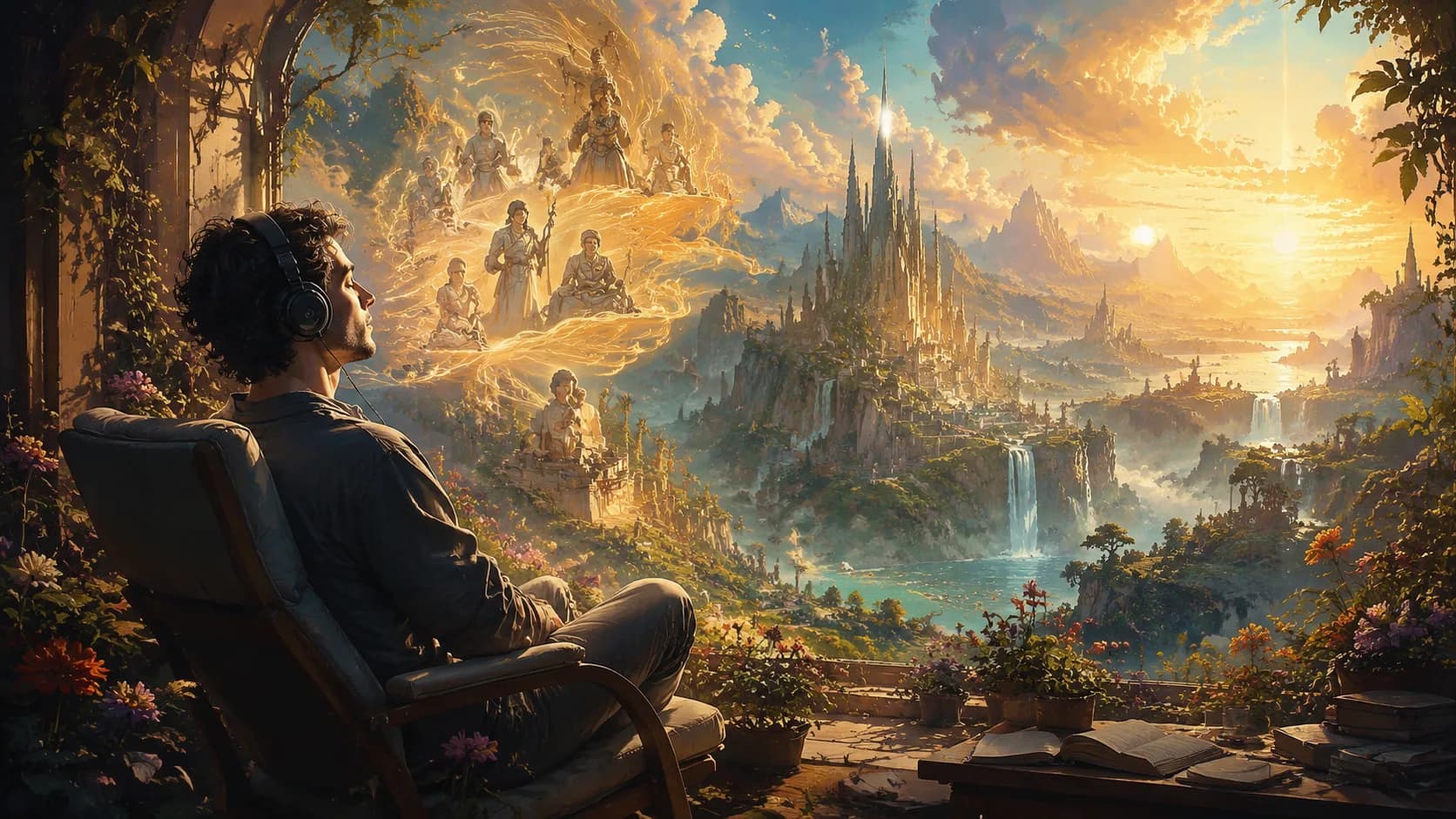
Visionaria's approach to ancient world meditation journeys draws directly on the principles of Greek sacred music using spatial 3D audio technology to recreate the acoustic environments of ancient temples, sanctuaries, and festival spaces with remarkable fidelity. When you listen to a Visionaria journey set in Apollo's temple at Delphi, the spatial audio positions sounds in three-dimensional space around you: the echo of the narrator's voice off stone walls, the distant sound of a lyre playing from the temple portico, the murmur of pilgrims approaching from behind, the whisper of wind through the sacred laurel grove to your left.
Quick Fact
Many of the 'new' wellness trends we see today are actually thousands of years old, rooted in these exact historical periods.
The design process for these journeys involves research into ancient acoustic archaeology the study of how sound behaved in historical architectural spaces. The dimensions, materials, and geometry of ancient temples produce specific reverberation patterns, resonant frequencies, and spatial acoustics that can be modelled with modern audio software and reproduced through headphones. This means that when Visionaria places you inside a Greek temple, the acoustic properties of the space the echo, the resonance, the way sound reflects off stone surfaces are based on the actual physics of ancient architecture, not generic reverb effects. The result is an experience of genuine architectural presence your brain processes the acoustic information and constructs a spatial model of the environment that feels authentically real.
This approach connects modern immersive audio meditation to the deepest principles of ancient Greek sacred music. The Greeks believed that the right sounds, in the right space, could transform consciousness that a hymn sung in Apollo's temple was not the same as a hymn sung in an ordinary room, because the architecture itself participated in the sacred experience. Visionaria's spatial audio technology operates on precisely the same principle: by accurately recreating the acoustic environment, it allows the sound to produce effects that depend not just on the content of the audio but on the spatial context in which it is experienced. In this sense, modern spatial audio meditation is not a departure from ancient practice but a technological continuation of it.
"I should note that recreating the acoustic environment of an ancient Greek temple through headphones involves certain artistic liberties. We can model the reverberation characteristics of stone architecture with considerable accuracy. We can position sounds in three-dimensional space with precision that Apollo himself might have admired. But we cannot, with current technology, reproduce the experience of standing in the actual temple the warmth of Mediterranean sunlight on your skin, the scent of incense and laurel, the weight of your wool chiton in the afternoon heat, or the slight nervousness of being about to ask a divine oracle whether you should invade Sicily. For those additional sensory details, we must rely on the listener's imagination which, as the Greeks well understood, is itself a divine gift, and a remarkably powerful one at that."
An Epicurean, a Stoic, and a Cynic walk into a garden. The bartender says, 'Is this some kind of philosophical joke?'
The Legacy of Apollo's Music in the Modern World
The influence of Apollo's sacred music culture on the modern world is so pervasive that it has become nearly invisible like the air we breathe, it surrounds everything without being consciously noticed. Western music theory the system of scales, intervals, harmonics, and notation that underlies everything from symphonies to pop songs traces its origins directly to the Greek modal system and Pythagoras's discovery of mathematical ratios in music. The very concept of a "concert" a public performance of music for an audience, with trained performers, a designated space, and critical evaluation derives from the competitive musical performances at the Pythian Games and other Greek festivals.
The Greek understanding of music as therapy has experienced a remarkable renaissance in recent decades. Clinical music therapy is now a recognised healthcare profession, used in hospitals and therapeutic settings for pain management, stroke rehabilitation, autism spectrum support, dementia care, and mental health treatment. The scientific mechanisms underlying these applications vagal stimulation, brainwave entrainment, emotional regulation through auditory processing are precisely the mechanisms that the Greeks described in their own terms when they spoke of music's power to restore harmonia to disordered bodies and souls. Apollo would, one imagines, be deeply satisfied to learn that modern hospitals are prescribing what his priests prescribed twenty-five centuries ago.
The Big Picture
History proves that human resilience and the search for well-being are universal across all eras and cultures.
Perhaps most profoundly, the Greek conviction that music connects humans to something larger than themselves that it is a bridge between the mortal and the cosmic, between individual consciousness and universal harmony continues to resonate in the modern experience of music and meditation. When a listener puts on headphones and is transported by a spatial audio meditation journey to a state of deep calm, expanded awareness, and connection with beauty, they are experiencing something that Apollo's worshippers would have recognised immediately: the transformative power of sound, delivered through a different technology but working on the same human nervous system, the same human imagination, and the same human need for transcendence that has driven our species to make music since the very beginning. The instruments have changed. The principle has not.
"If Apollo were to visit a modern meditation app, I suspect his review would be mixed but ultimately positive. He would approve of the spatial audio technology ('Finally, you mortals have figured out how to position sounds in three-dimensional space it only took you twenty-five centuries'). He would appreciate the narrative-driven journeys ('Stories and music together yes, this is exactly what I've been saying'). He might quibble with some of the sound design choices ('The lyre tuning in your Delphi journey is adequate, though I could offer notes'). But I believe he would be genuinely moved by the fundamental project: using the best available technology to give people access to the transformative power of sound. That is, after all, what his temples were designed to do. The fact that the temple now fits in your pocket would, I think, strike even a god as rather impressive."
The Myth of Hercules and the Hero's Journey: Complete Guide to Greek Mythology's Greatest Legend
Discover the myth of Hercules and the hero's journey from the Twelve Labors and Joseph Campbell's monomyth to ancient Greek heroism, inner transformation, resilience, and how immersive audio meditation brings mytholog...
A philosopher walked into a wall. His students asked if it hurt. He replied, 'The wall is an illusion, but my headache is quite real.'
The Bottom Line
Apollo's sacred world of music represents one of humanity's greatest cultural achievements a civilisation that understood, with remarkable depth and sophistication, that sound is the most direct pathway to transformation of consciousness. From the lyre's mathematical harmonies to the Pythian Games' celebration of musical excellence, from the healing modes prescribed by physician musicians to the acoustic architecture of Delphi's temple, the ancient Greeks created a sacred music culture whose principles remain as valid and as powerful as they were twenty-five centuries ago.
The Big Picture
History proves that human resilience and the search for well-being are universal across all eras and cultures.
Read more: The Psychology of Experiencing Stories in Meditation

Ready to experience the world of Apollo through spatial 3D audio? Visionaria offers immersive journeys through ancient civilisations, mythological quests, and sacred landscapes free to download on iOS and Android. Continue exploring: discover The Mysteries of Delphi and the Oracle Experience, learn about The Best Audio Meditation Experiences in 2026, or explore The Sacred Temples of Ancient Egypt.
Experience More with Visionaria
Download the app to explore guided historical and wellness journeys.
A philosopher walked into a wall. His students asked if it hurt. He replied, 'The wall is an illusion, but my headache is quite real.'
This article is for educational and informational purposes only. Historical details are based on available research and may evolve as new evidence emerges.
Visionaria journeys are designed for relaxation, guided imagination, and personal enrichment. They are not a substitute for medical, mental health, legal, or professional advice.