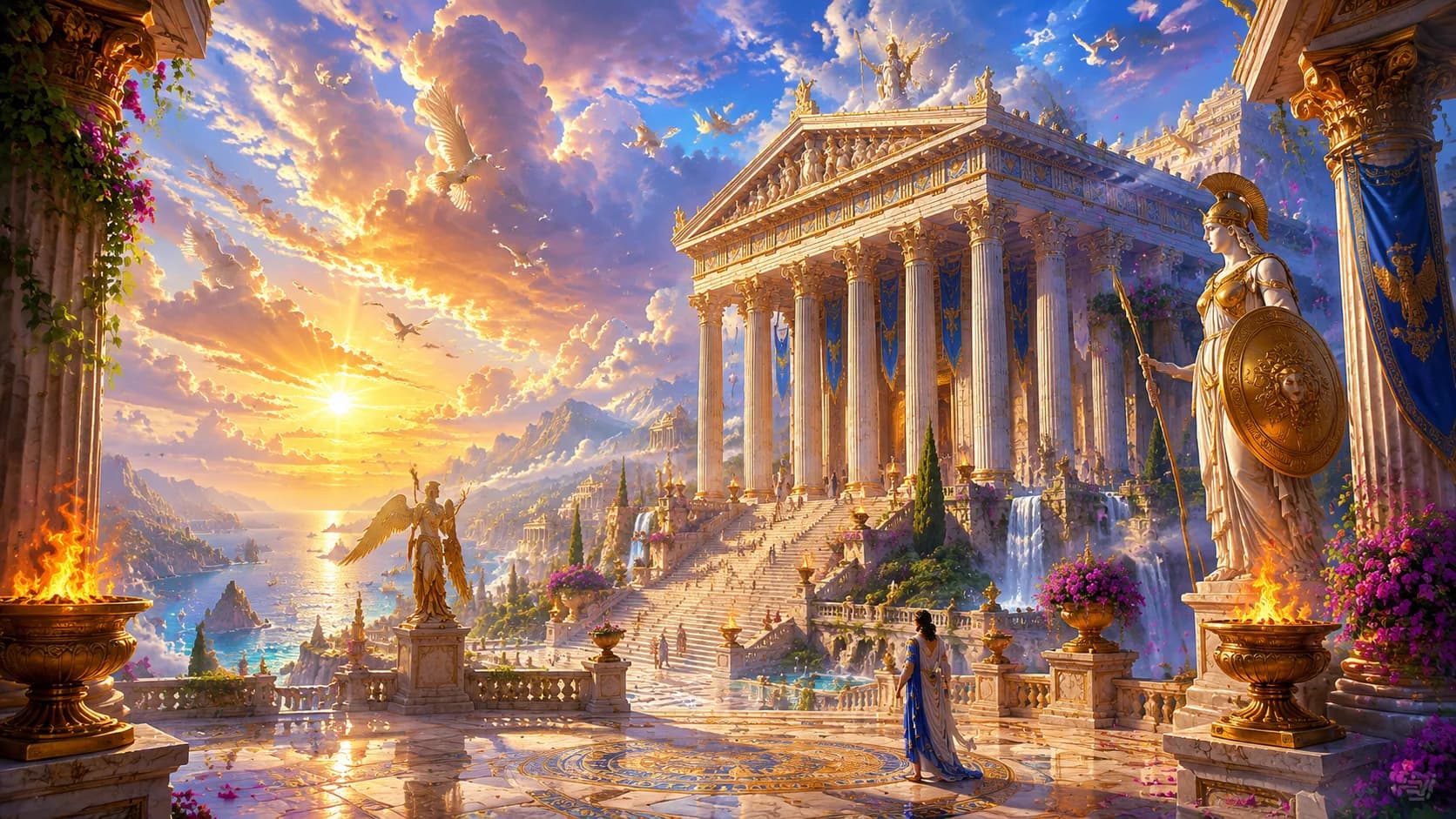
The Trojan War Stories That Shaped Greek Mythology
✨ Fun fact: Homer's Iliad, the foundational text of the Trojan War saga, covers only about 50 days of a ten-year conflict, roughly the same proportion as a two-hour film covering the final weekend of a decade-long project. Homer clearly understood the power of narrative focus. He also understood that audiences don't need ten years of content when you give them Achilles arguing with Agamemnon, the gods picking sides like rival sports fans, and Odysseus inventing the world's most famous wooden horse. Quality over quantity, 2,800 years before content marketing existed.
- The Origins of the Trojan Conflict: How It All Began
- The Judgment of Paris: The Choice That Changed Everything
- Helen of Troy: The Face That Launched a Thousand Ships
- Achilles: The Greatest Champion of the Greek Forces
- Odysseus: The Strategist Who Turned the Tide
- Hector: Troy's Noble Defender and Beloved Prince
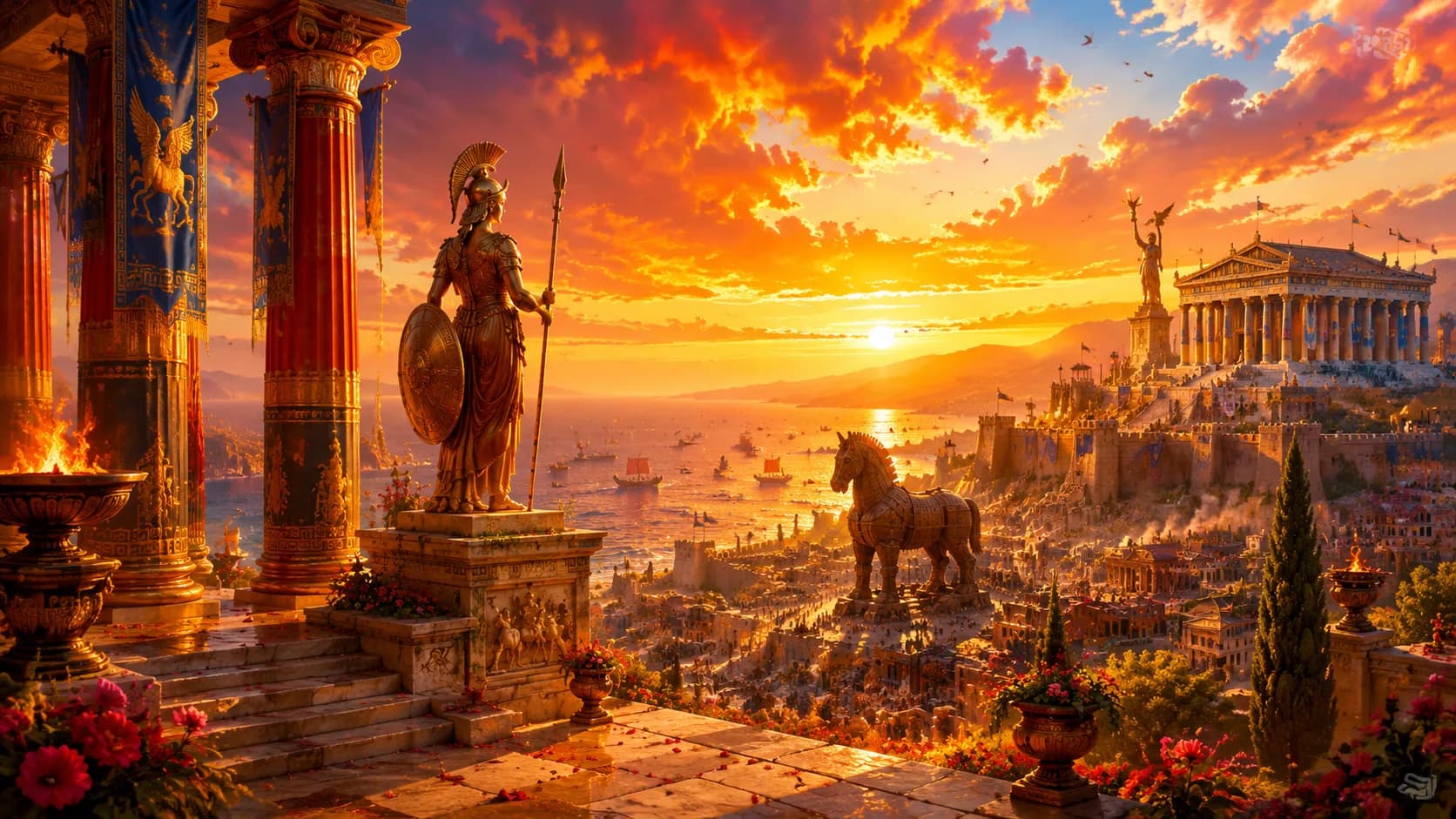
- The Trojan Horse: History's Most Famous Strategic Deception
- The Divine Players: Gods and Goddesses in the Trojan Saga
- The Odyssey: Journeys Born from the Trojan Legacy
- How the Trojan Stories Shaped Western Literature and Art
- Archaeological Troy: Where Myth Meets History
- Experience the Trojan Saga Through Visionaria
- The Bottom Line
- Frequently Asked Questions
The Trojan War is the single most influential cycle of stories in Western civilization a vast tapestry of heroism, divine rivalry, human passion, and strategic brilliance that has shaped how humanity tells stories, defines honor, and understands the relationship between mortals and the divine for nearly three millennia. From the golden apple that ignited the conflict to the legendary wooden horse that concluded it, the Trojan War saga encompasses dozens of interconnected narratives that established the archetypes, moral frameworks, and storytelling patterns still operating at the heart of modern literature, cinema, and immersive audio experiences. These are not merely ancient tales they are the narrative DNA of Western culture, the source code from which virtually every subsequent tradition of heroic storytelling has drawn.
The Trojan War stories are a cycle of interconnected Greek mythological narratives centered on the ten year conflict between the allied Greek kingdoms and the city of Troy that established the foundational archetypes of Western heroism, divine intervention, strategic cunning, and epic storytelling, preserved primarily through Homer's Iliad and Odyssey and expanded through the broader Epic Cycle. These stories matter because they did more than entertain ancient audiences they created the vocabulary of Western narrative: the concept of the complex hero (Achilles), the cunning strategist (Odysseus), the noble defender (Hector of Troy), the faithful spouse (Penelope), and the intervention of supernatural forces in human affairs. Modern narrative psychology recognizes these patterns as archetypal structures that continue to shape how humans process experience, construct identity, and find meaning making the Trojan War stories not just historical curiosities but living frameworks for understanding the human condition. Through immersive spatial 3D audio, these epic tales now reach listeners with unprecedented sensory depth, transforming ancient poetry into experiences that engage the same imaginative faculties Homer's original audiences employed around firelit audiences 2,800 years ago.
This article explores the Trojan War stories that shaped Greek mythology from the divine rivalries that ignited the conflict to the heroes who defined it, the legendary stratagem that concluded it, the archaeological evidence that grounds it in history, and the extraordinary literary legacy that carries it into the present. Whether you're fascinated by the legendary creatures and divine figures of Greek mythology, the epic quests that tested human limits, or the intersection of myth and archaeological discovery, this journey through Troy's stories will transform how you understand the narratives that built Western civilization.
Key Facts About the Trojan War Stories
- ••Duration & Scope: The Trojan War, as depicted in mythology, lasted ten years (approximately 1194-1184 BCE), involved over 1,000 ships, and drew heroes from virtually every Greek kingdom, making it the largest military undertaking in mythological history and the central event around which Greek heroic culture organized its identity
- ••Literary Legacy: Homer's Iliad (approximately 15,693 lines) and Odyssey (approximately 12,110 lines) are the oldest surviving works of Western literature, composed around 750-700 BCE from oral traditions dating centuries earlier. They established the narrative conventions that every subsequent Western epic, novel, and film has inherited
- ••Archaeological Evidence: Heinrich Schliemann's excavations at Hisarlik, Turkey (beginning 1870) revealed a multi-layered city matching descriptions of Troy, with Layer VIIa showing evidence of a significant conflict around 1180 BCE, confirming that the mythological stories preserve genuine cultural memories of Bronze Age events
- ••Hero Count: The Trojan War cycle features over 100 named heroes on both sides, 12 major Olympian gods actively participating, and dozens of interconnected story arcs, creating the most complex narrative ecosystem in ancient literature
- ••Cultural Impact: The Trojan War stories directly influenced Roman mythology (through Virgil's Aeneid), medieval romance literature, Renaissance art, Enlightenment philosophy, and modern entertainment, from Shakespeare's Troilus and Cressida to Hollywood blockbusters and immersive audio experiences
- ••Narrative Innovation: The Trojan War stories pioneered literary techniques still used today: beginning in medias res (in the middle of the action), the unreliable narrator, parallel plotlines, dramatic irony, and the "journey home" narrative structure that underlies everything from epic fantasy sagas to modern road-trip films
Quick Answer
✨ Fun fact: Homer's Iliad, the foundational text of the Trojan War saga, covers only about 50 days of a ten-year conflict, roughly the same proportion as a two-hour film covering the final weekend of a decade-long project. Homer clearly understood the power of narrative focus. He also understood that audiences don't need ten years of content when you give them Achilles arguing with Agamemnon, the gods picking sides like rival sports fans, and Odysseus inventing the world's most famous wooden horse. Quality over quantity, 2,800 years before content marketing existed.
The Origins of the Trojan Conflict: How It All Began
The Trojan War did not begin on a distant plain or in a council chamber it began at a wedding celebration on Mount Olympus, when the goddess Eris (Discord), furious at being excluded from the festivities, tossed a golden apple inscribed "For the Fairest" among the assembled deities. This single act of divine provocation set in motion a cascade of choices, rivalries, and journeys that would reshape the ancient world and create the most influential story cycle in Western literature. The myth understood something profound about the nature of great events: they rarely begin with grand declarations they begin with small moments of pride, jealousy, and desire that ripple outward into consequences no one could foresee.
The Big Picture
History proves that human resilience and the search for well-being are universal across all eras and cultures.
Three goddesses claimed the apple Hera, Athena, and Aphrodite and Zeus, wisely refusing to judge the contest himself, delegated the decision to Paris, a prince of Troy living as a shepherd on Mount Ida. Each goddess offered a bribe: Hera promised dominion over all Asia, Athena offered wisdom and prowess in conflict, and Aphrodite offered the love of the most beautiful woman in the world Helen of Sparta. Paris chose Aphrodite's gift, a decision that would bring the Greek armies to Troy's gates and ensure that the question of what constitutes wise choice versus impulsive desire would echo through storytelling traditions for millennia.
Read more: Meditation for Curiosity and Exploration

What makes this origin story so psychologically sophisticated is its recognition that the roots of great conflicts are rarely simple they involve interconnected webs of divine vanity, human passion, and the unintended consequences of seemingly minor choices. The golden apple didn't cause the Trojan War; it revealed existing tensions between the gods, between Greek and Trojan cultures, between duty and desire that were already present beneath the surface. This layered causality is precisely what makes the Trojan War stories so much richer than simple tales of good versus challenging: every character has comprehensible motivations, every choice carries weight, and the outcome emerges from the complex interaction of human and divine agency, much as in the myth of Prometheus.
Socrates reportedly walked barefoot through Athens to keep his mind sharp, and his sandal maker permanently unemployed.
The Judgment of Paris: The Choice That Changed Everything
The Judgment of Paris is one of mythology's most profound meditations on the nature of choice and its irreversible consequences. When the young Trojan prince stood before three of the most powerful beings in the cosmos, he was not merely selecting a beauty contest winner he was choosing between three visions of the good life: power (Hera), wisdom (Athena), and love (Aphrodite). Each choice would have led to a radically different future, not just for Paris but for the entire Mediterranean world. This mythological structure the fateful choice between competing goods became one of the most enduring templates in Western storytelling, from medieval romance to modern decision theory philosophy.
Paris's choice of Aphrodite reveals something the ancient Greeks understood with remarkable clarity: desire and beauty exert a power over human decision making that can override reason, ambition, and self-interest. Paris didn't choose poorly because he was foolish he chose as humans so often choose, following the pull of immediate emotional resonance over long term strategic thinking. This psychological insight is what makes the Judgment of Paris timeless rather than merely archaic. It speaks to the same tension that modern narrative psychology explores: the gap between what we know to be wise and what we feel compelled to pursue.
Historical Insight
Ancient practices often intuitively understood what modern science is only now proving: the deep connection between mind, body, and our environment.
The artistic legacy of the Judgment of Paris is equally remarkable. From ancient Greek pottery to Renaissance masterworks by Cranach, Rubens, and Renoir, this single mythological moment has been reimagined by every major artistic tradition in Western history each era projecting its own values, aesthetics, and anxieties onto the scene. The fact that artists continue to find new meaning in this 3,000 year old story speaks to the enduring power of mythological storytelling: the best myths don't deliver fixed messages but provide symbolic frameworks that each generation can inhabit and interpret anew.
"Paris was offered the rulership of Asia, unmatched wisdom in conflict, or the love of the most beautiful woman alive and he chose love. Historians have spent centuries debating whether this was romantic or short sighted. Psychologists call it 'present bias.' Economists call it 'failure to properly discount future consequences.' Poets call it 'being human.' Paris, for his part, would probably have called it 'following his heart,' which is the kind of answer that sounds profound until you realize it launched 1,186 ships. The heart, it turns out, has a very aggressive logistics department."

Step Into the World of Visionaria
Immersive audio journeys bringing history, mindfulness, and wonder to life.
A Roman walks into a bar, holds up two fingers, and says, 'Five beers, please.'
Helen of Troy: The Face That Launched a Thousand Ships
Helen of Troy or Helen of Sparta, as she was known before her departure remains one of the most complex and debated figures in world mythology. Was she a willing participant who chose to leave with Paris, or a reluctant figure compelled by Aphrodite's irresistible power? Ancient sources offer conflicting accounts, and this ambiguity is itself part of Helen's enduring fascination. She represents a question that mythology asks but deliberately refuses to answer definitively: how much of human action is free choice, and how much is shaped by forces beyond individual control?
Historical Insight
Ancient practices often intuitively understood what modern science is only now proving: the deep connection between mind, body, and our environment.
What makes Helen remarkable as a mythological figure is that her significance extends far beyond her beauty. She is the pivot point around which the entire Trojan War turns the catalyst whose personal situation mobilized the greatest military expedition in mythological history. Every Greek king had sworn an oath (the Oath of Tyndareus) to defend the marriage rights of whoever married Helen, which meant that when Paris brought her to Troy, the entire network of Greek alliances activated. This narrative structure a personal event triggering vast political and military consequences became one of the foundational templates for epic storytelling, visible in everything from the personal dramas that reshape nations to modern geopolitical thrillers.
The ancient Greeks' treatment of Helen also reveals their sophisticated understanding of narrative perspective. In Homer's Iliad, Helen is portrayed with remarkable sympathy she is shown regretting the consequences of her journey to Troy, weaving a tapestry depicting the conflict, and treated with respect by the Trojans even as their city faces an extended siege because of her presence. This nuanced portrayal, avoiding simple condemnation or idealization, was revolutionary for its time and established the principle that great storytelling requires complex characters whose motivations resist easy judgment a principle that narrative meditation continues to explore.
A philosopher walked into a wall. His students asked if it hurt. He replied, 'The wall is an illusion, but my headache is quite real.'
Achilles: The Greatest Champion of the Greek Forces
Achilles is the archetype of the warrior hero whose extraordinary gifts come at an extraordinary cost and his story established the template for the "complex hero" that has dominated Western literature from Greek drama through Shakespeare to modern cinema. The son of the mortal king Peleus and the sea goddess Thetis, Achilles was gifted with strength, speed, and prowess that made him virtually unmatched on any field. But his defining characteristic in the Iliad is not his physical excellence it is his emotional intensity: his pride, his capacity for rage, his deep loyalty to those he loves, and his ultimate confrontation with the knowledge that his glorious life would be brief.
Visionaria Insight
By immersing ourselves in these historical soundscapes, we reconnect with a timeless human tradition of storytelling and mental restoration.
The Iliad opens not with the beginning of the conflict but with Achilles' withdrawal from the Greek forces after a dispute with the commander Agamemnon over honor and recognition. This choice to prioritize personal dignity over collective obligation drives the entire plot of the Iliad and poses the central question that the epic explores: what matters more, individual honor or communal responsibility? The Greeks gave this question no easy answer, and neither has any subsequent culture. Every story about a gifted individual whose pride conflicts with their duty from Hamlet to modern superheroes inherits its fundamental structure from Achilles' choice, making this the foundational narrative of emotional complexity in Western storytelling.
Achilles' relationship with his companion Patroclus is one of the most emotionally powerful relationships in all literature. When Patroclus falls in an encounter with Hector while wearing Achilles' armor, Achilles' grief transforms the entire course of the conflict he returns to the field not for glory or duty but for love and loss, channeling his anguish into renewed purpose. This narrative arc established the principle that the most compelling motivation in heroic storytelling is not ambition or obligation but personal connection a principle that continues to drive character-driven narratives from modern fantasy epics to immersive audio experiences.
"Achilles was offered a choice: a long, peaceful life of comfortable obscurity, or a short, glorious life that would be remembered forever. He chose glory. Three thousand years later, we're still talking about him, so the strategy worked. Meanwhile, billions of people who chose the long, peaceful option are completely forgotten. This is not life advice. This is just mythology being honest about what makes a good story. Comfortable obscurity makes for excellent living but questionable narrative material."
A philosopher walked into a wall. His students asked if it hurt. He replied, 'The wall is an illusion, but my headache is quite real.'
Odysseus: The Strategist Who Turned the Tide
If Achilles represents the archetype of the heroic champion, Odysseus represents something equally important and perhaps more enduring: the archetype of the clever survivor. King of Ithaca, renowned not for physical superiority but for his cunning intelligence (metis), eloquence, and adaptability, Odysseus embodies the Greek ideal that wisdom and strategic thinking are as valuable as strength and in the long run, more so. It was Odysseus who conceived the Trojan Horse, the stratagem that concluded the decade-long siege; it was Odysseus who navigated the most extraordinary journey home in literary history; and it is Odysseus whose character type the trickster hero who succeeds through wit rather than force continues to populate stories from detective fiction to science fiction.
Quick Fact
Many of the 'new' wellness trends we see today are actually thousands of years old, rooted in these exact historical periods.
Odysseus's role in the Trojan War demonstrates the Greek conviction that intelligence is a form of heroism. While Achilles embodied the ideal of individual excellence on the field, Odysseus represented the complementary ideal of strategic vision the ability to see the larger picture, anticipate consequences, and devise solutions that physical prowess alone cannot achieve. The Trojan Horse was not just a clever trick; it was a paradigm shift in how the Greeks approached their challenge a recognition that ten years of direct confrontation had not achieved what a single night of creative deception could accomplish. This insight that the most difficult problems often require lateral thinking rather than greater force has made Odysseus a symbol of intellectual heroism celebrated by thinkers and innovators throughout history.
Read more: Meditation for Sleep Using Storytelling Journeys

The Odyssey, Homer's sequel focused entirely on Odysseus's ten year journey home, extended his character into the archetype of the eternal wanderer the figure who must navigate unknown territories, resist temptations, overcome seemingly impossible obstacles, and ultimately find their way back to what matters most. This narrative template became the foundation for the entire Western tradition of journey literature: from Virgil's Aeneid and Dante's Divine Comedy to modern epic fantasy sagas and every quest narrative that sends a protagonist into the unknown and returns them transformed.
A time traveler went back to antiquity to teach them about 'holistic health.' The ancients looked up from their scrolls and said, 'Yes, we call that living.'
Hector: Troy's Noble Defender and Beloved Prince
Among the most remarkable achievements of the Iliad is its deeply sympathetic portrayal of Hector, Troy's greatest champion, who fights not for personal glory or divine favor but for the defense of his family, his city, and his people. In a story told from the Greek perspective, Hector emerges as perhaps the most fully human and emotionally resonant character a devoted husband, a loving father, a responsible prince, and a courageous defender who knows that the odds are ultimately against him yet chooses to stand regardless. Homer's willingness to make the "opposing" hero the most sympathetic figure in the poem was a revolutionary act of narrative empathy that established the principle that great literature transcends partisan perspectives.
The scene in which Hector bids farewell to his wife Andromache and their infant son Astyanax (Book 6 of the Iliad) is widely regarded as one of the most poignant moments in all of literature. The baby cries at the sight of his father's plumed helmet; Hector removes it, laughs, and holds his son to the sky, praying that the child will one day surpass his father. This scene, composed roughly 2,800 years ago, continues to move readers because it captures something universally recognizable: the tension between public duty and private love, the knowledge that the people we love most are the people we must sometimes leave in order to protect them.
Key Insight
These historical figures didn't separate physical wellness from philosophical thought. To them, it was all one continuous practice of living well.
Hector's ultimate encounter with Achilles represents the Trojan War's emotional climax not because of its physical dimensions but because of its moral weight. Hector faces Achilles knowing he cannot prevail, choosing to stand and meet his fate rather than retreat behind Troy's walls. His courage is not the fearlessness of a hero who believes himself invincible but the deeper courage of a person who acts rightly despite knowing the cost. This distinction between reckless bravery and principled steadfastness became one of the most important moral concepts in Western ethics and remains central to how stories teach emotional resilience.
"Hector is the Trojan War character that most readers end up admiring the most, which is narratively inconvenient because he's on the opposing side. Homer essentially created the sympathetic antagonist 2,800 years before Hollywood discovered that audiences love complex characters more than simple ones. The entire tradition of the 'noble adversary' from Shakespeare's Brutus to Thanos traces back to Homer looking at Hector and thinking: 'What if the other side's hero was actually the most relatable person in the story?' Narrative genius. Also, frankly, a bit rude to the Greeks."
Why did the inventor of the wheel win an award? Because his idea really got things rolling.
The Trojan Horse: History's Most Famous Strategic Deception
The Trojan Horse is arguably the single most famous stratagem in human storytelling so iconic that it has entered languages worldwide as a metaphor for any deceptive device that conceals its true purpose behind an appealing exterior. The story, as told in later sources (the Horse itself is only briefly mentioned in the Odyssey and fully narrated in Virgil's Aeneid), describes how Odysseus conceived the plan to build an enormous wooden horse, conceal a select group of Greek champions inside, and present it to the Trojans as a sacred offering. When the Trojans brought the horse inside their walls, the hidden Greeks emerged under cover of darkness and opened the gates for the returning army.
Visionaria Insight
By immersing ourselves in these historical soundscapes, we reconnect with a timeless human tradition of storytelling and mental restoration.
What makes the Trojan Horse such an enduring story is not just its cleverness but what it reveals about the psychology of trust and perception. The Trojans were not foolish they had successfully defended their city for ten years against the greatest military force the Greek world could assemble. Their decision to accept the horse was based on reasonable (if ultimately incorrect) interpretations of the evidence: the Greeks appeared to have departed, the horse appeared to be a religious offering, and the Trojan priest Laocoön's warnings went unheeded. The story teaches that even intelligent, experienced people can be deceived when they encounter something that confirms what they want to believe a psychological insight that modern behavioral science calls "confirmation bias."
The legacy of the Trojan Horse extends far beyond military strategy into the foundations of Western thinking about deception, persuasion, and appearance versus reality. It influenced Plato's Cave allegory, Machiavelli's political theory, and modern cybersecurity terminology ("Trojan" malware). The story's central insight that the most effective strategies often work by exploiting expectations rather than overwhelming defenses has made it a reference point in fields from business strategy to cognitive science, demonstrating how a single mythological episode can generate creative frameworks that remain applicable across millennia.
"The Trojan Horse is the greatest strategic innovation in mythology, and it was essentially a large wooden animal left outside the front door. In modern terms, it's a suspicious package the size of a building. The Trojans looked at it and said, 'Free horse? Wonderful, bring it in.' In fairness, they'd never encountered this particular strategy before. In further fairness, nobody since has tried it either because after 3,200 years, it remains the kind of plan that only works once. Odysseus understood: the best ideas are the ones nobody has seen before. The second best ideas are the ones nobody would believe."
An Epicurean, a Stoic, and a Cynic walk into a garden. The bartender says, 'Is this some kind of philosophical joke?'
The Divine Players: Gods and Goddesses in the Trojan Saga
One of the most distinctive features of the Trojan War stories is the active participation of the Olympian gods, who don't merely observe from above but intervene directly, take sides, protect favorites, and sometimes even engage in encounters themselves. Zeus presides as an often conflicted arbiter; Athena champions the Greeks with strategic guidance; Apollo protects the Trojans and sends plague when offended; Aphrodite rescues Paris from harm; Ares joins the Trojan cause; and Poseidon, Hera, and Hephaestus support the Greeks. This divine partisanship created one of mythology's richest thematic layers: the idea that human affairs are shaped by forces larger than human understanding.
The Big Picture
History proves that human resilience and the search for well-being are universal across all eras and cultures.
The Greek gods in the Trojan War are remarkably human in their motivations they participate not out of cosmic necessity but out of personal grudges, injured vanity, romantic attachments, and competitive rivalry. Hera and Athena support the Greeks because Paris rejected them in the Judgment; Aphrodite supports Troy because Paris chose her; Apollo and Artemis favor Troy for their own reasons. This portrayal of divine motivation as fundamentally personal rather than transcendent was one of ancient Greek religion's most distinctive features and it gave the Trojan War stories a psychological complexity that stories with purely benevolent or purely malevolent divine figures cannot achieve.
The theological implications of divine participation in the Trojan War resonated through Western thought for centuries. If the gods themselves could not agree on the right outcome, what hope did mortals have of achieving moral certainty? This inherent ambiguity gave Greek mythology its unique philosophical depth a depth that later traditions, including Virgil's Roman adaptation, Dante's Christian reimagining, and modern psychological interpretations, have continued to explore. The Trojan War's divine apparatus anticipated what modern psychology would later articulate: that human experience is shaped by forces biological, social, unconscious that often exceed individual awareness and control.
A Roman walks into a bar, holds up two fingers, and says, 'Five beers, please.'
The Odyssey: Journeys Born from the Trojan Legacy
The Odyssey transforms the Trojan War from a story about collective conflict into a story about individual transformation through journey and ordeal. Odysseus's ten year voyage home to Ithaca encountering the Cyclops, the enchantress Circe, the Sirens, the perils of Scylla and Charybdis, and the Land of the Departed established the "journey home" narrative as one of Western literature's most enduring structural templates. Every story about returning from an extraordinary experience to ordinary life, every narrative about the difficulty of reconciling who you've become with where you came from, inherits its DNA from Odysseus's long voyage across wine dark seas.
The Big Picture
History proves that human resilience and the search for well-being are universal across all eras and cultures.
The Odyssey also pioneered what would become the adventure quest genre a sequence of distinct episodes, each presenting a unique challenge that tests a different aspect of the hero's character. The Cyclops episode tests physical resourcefulness; the Lotus Eaters test resolve; Circe's island tests self-discipline; the Sirens test the ability to resist temptation; and the journey to the realm of the departed tests the courage to confront loss and memory. This episodic structure, in which each challenge reveals a new dimension of the protagonist, became the template for quest narratives from magical fantasy sagas to modern immersive audio-guided imagination journeys.
Perhaps the Odyssey's greatest narrative innovation was its emotional core: the longing for home. Odysseus encounters immortality (offered by the nymph Calypso), eternal pleasure (the Lotus Eaters), and supernatural power (Circe) and rejects all of them in favor of returning to his mortal wife, his aging father, and his island kingdom. This choice ordinary human connection over extraordinary experience established a moral framework that continues to shape storytelling: the idea that the ultimate reward of any journey is not the treasure found abroad but the relationships and home preserved through faithfulness and endurance.
Why did the ancient physician prescribe a long walk? Because he was tired of listening to the patient complain in his office.
How the Trojan Stories Shaped Western Literature and Art
The influence of the Trojan War stories on Western literature and art is so pervasive that it is almost impossible to overstate. Virgil's (29-19 BCE) reimagined the Trojan War from the perspective of Aeneas, a surviving Trojan prince who journeys to Italy and becomes the legendary ancestor of Rome transforming a Greek story of triumph into a Roman story of resilience, duty, and destiny. The Aeneid became the foundational text of Roman literary culture and, through the Middle Ages, one of the most widely read works in Western education, ensuring that the Trojan War remained at the center of European cultural consciousness for two millennia.
Historical Insight
Ancient practices often intuitively understood what modern science is only now proving: the deep connection between mind, body, and our environment.
Medieval European literature adopted and transformed the Trojan War for its own purposes. Benoît de Sainte Maure's (c. 1160) recast the Trojan heroes as medieval knights, while Geoffrey Chaucer's Troilus and Criseyde (c. 1385) explored the love story of two Trojan figures with a psychological depth that anticipated the modern novel. Shakespeare's Troilus and Cressida (c. 1602) further complicated the tradition, presenting the Trojan War with dark irony and moral ambiguity that reflected the Elizabethan era's own conflicts. Each adaptation preserved the essential narrative architecture while transforming the meaning demonstrating the Trojan War's unique capacity to serve as a mirror for whatever era encounters it, much as fairy tales adapt across cultures while preserving core structures.
In modern culture, the Trojan War's influence extends from Hollywood blockbusters (Wolfgang Petersen's Troy, 2004) to literary reimaginings (Madeline Miller's The Song of Achilles, Pat Barker's The Silence of the Girls) to video games, graphic novels, and immersive experiences. The story's themes honor versus survival, duty versus desire, the costs of ambition, the value of cunning have proven inexhaustible, generating new interpretations that speak to contemporary concerns while preserving the mythological power of the originals. The Trojan War is not a closed chapter of literary history it is an ongoing conversation between ancient wisdom and modern imagination.
"The Trojan War has been retold by Homer, Virgil, Ovid, Chaucer, Shakespeare, Goethe, Keats, Tennyson, Joyce, and a Hollywood studio with a very large visual effects budget. Each version adds something new. Homer added emotional depth. Virgil added Roman destiny. Shakespeare added existential doubt. Hollywood added Brad Pitt. The Trojans themselves would probably be astonished that their story has this much staying power. Then again, they built a city that lasted through nine archaeological layers they understood durability."
Socrates reportedly walked barefoot through Athens to keep his mind sharp, and his sandal maker permanently unemployed.
Archaeological Troy: Where Myth Meets History
For centuries, scholars debated whether Troy was a real place or a purely literary invention. The question was effectively settled in the 1870s when Heinrich Schliemann, a self-taught German businessman turned archaeologist, began excavating a mound called Hisarlik in northwestern Turkey and uncovered the remains of a multi-layered ancient city that matched Homer's descriptions in remarkable detail. Subsequent excavations by Wilhelm Dörpfeld, Carl Blegen, and Manfred Korfmann have revealed at least nine distinct layers of settlement, spanning from the Early Bronze Age (approximately 3000 BCE) to the Roman period, confirming that Hisarlik was indeed a major Bronze Age city at the strategic junction of Mediterranean and Black Sea trade routes.
Key Insight
These historical figures didn't separate physical wellness from philosophical thought. To them, it was all one continuous practice of living well.
The archaeological layer most commonly associated with the Trojan War is Troy VIIa (approximately 1180 BCE), which shows evidence of a significant conflict and subsequent transformation: closely packed buildings suggesting a population under siege, storage jars buried in house floors (indicative of stockpiling provisions), and evidence of a major conflagration. While this evidence doesn't confirm the mythological details no golden apples, wooden horses, or divine interventions have been found in the archaeological record it supports the hypothesis that the Trojan War stories preserve a genuine cultural memory of Bronze Age conflicts between Mycenaean Greeks and the powerful city at Hisarlik, transformed through centuries of oral tradition into the epic narrative we know today.
Read more: Storytelling as Meditation: Ancient Practice, Modern Technology

The relationship between archaeological Troy and mythological Troy illuminates a broader truth about how mythology preserves history. The stories weren't factual records they were cultural memory encoded in narrative form, transmitting the emotional truth of significant events across generations that lacked writing. Just as ancient Egyptian temple inscriptions combined historical events with mythological interpretation, the Trojan War stories blend real Bronze Age conflicts with divine agency and heroic amplification creating narratives that are historically grounded but mythologically elevated, more "true" in emotional and symbolic terms than any factual chronicle could be.
What's an ancient intellectual's favorite exercise? Jumping to conclusions.
Experience the Trojan Saga Through Visionaria
Everything this article has explored the divine rivalries, the heroic archetypes, the strategic brilliance, the emotional depth, and the archaeological reality of Troy converges in Visionaria's immersive audio journeys. Each journey through the Trojan saga draws on the narrative structures Homer refined nearly three millennia ago, presented through spatial 3D audio that transforms listening into living. Walk the walls of Troy at sunset, stand on the Scaean Gate where Hector bid farewell to his family, or navigate the wine dark Mediterranean alongside Odysseus surrounded by the sounds, atmosphere, and emotional textures that make these ancient stories pulse with contemporary life.
With immersive journeys spanning ancient Troy, Athens, Sparta, Egyptian temples, Norse mythological worlds, and legendary encounters, Visionaria continues the tradition that Homer began: using the power of narrative voice to transport listeners into worlds of wonder, challenge, and transformation. The Trojan War taught humanity that the right story, told in the right way, can reshape how you see the world. Visionaria brings that principle to life through the most immersive storytelling medium ever created.
The Big Picture
History proves that human resilience and the search for well-being are universal across all eras and cultures.
Homer's audiences gathered around fires in the darkness, listening to a poet's voice conjure heroes and gods from pure sound. Three thousand years later, Visionaria honors that tradition with spatial 3D audio technology that places you inside the story because the epics that shaped civilization deserve to be experienced, not just read. The gates of Troy are open. The journey awaits.
"Homer performed his epics by firelight, using nothing but his voice and a lyre to transport audiences to the plains of Troy. 2,800 years later, we have spatial 3D audio, binaural processing, and wireless earbuds. The technology has evolved dramatically. The fundamental experience closing your eyes and being transported to an ancient world through the power of spoken narrative hasn't changed at all. Homer would probably try Visionaria, nod approvingly, and say: 'The acoustics have improved, but the story remains the point.' He would be absolutely right."

The Link Between Imagination and Creativity
Discover the powerful link between imagination and creativity, from neuroscience and visualization techniques to flow states, famous creators, and practical exercises that strengthen your creative mind.
A time traveler went back to antiquity to teach them about 'holistic health.' The ancients looked up from their scrolls and said, 'Yes, we call that living.'
The Bottom Line
The Trojan War stories shaped Greek mythology and by extension, Western civilization itself by establishing the foundational archetypes of heroism, strategic intelligence, divine complexity, and moral ambiguity that continue to define how we tell stories, understand human nature, and process the relationship between individual choices and their far reaching consequences. From Achilles' emotional intensity to Odysseus's cunning adaptability, from Hector's principled courage to the Trojan Horse's paradigm shifting cleverness, these tales created a narrative vocabulary that remains as vital and influential today as it was when Homer first performed them by firelight.
Did You Know?
The relentless drive to understand the world was seen not just as an academic pursuit, but as a spiritual and healing practice by the ancients.
For those seeking to experience the power of these legendary stories firsthand, Visionaria offers immersive spatial 3D audio journeys that bring Troy's epic world to life. Continue exploring: discover The Most Legendary Quests in Mythology, explore Why Fairy Tales Still Shape Imagination Today, or learn about The Mysteries of Delphi and the Oracle Experience.
Experience More with Visionaria
Download the app to explore guided historical and wellness journeys.
Why did the historian break up with the archaeologist? Because her career was literally in ruins.
This article is for educational and informational purposes only. Historical details are based on available research and may evolve as new evidence emerges.
Visionaria journeys are designed for relaxation, guided imagination, and personal enrichment. They are not a substitute for medical, mental health, legal, or professional advice.