The Wonders of Babylon and Its Legendary Gates: Complete Guide
💡 Fun fact: Ancient Babylon had a population of over 200,000 people around 600 BCE, making it the New York City of the ancient world, complete with traffic, noise, and presumably someone selling overpriced falafel on every corner.
- The Grandeur of Ancient Babylon
- The Legendary Ishtar Gate: Masterpiece of the Ancient World
- The Hanging Gardens: Wonder of the Ancient World
- The Tower of Babel: Reaching for the Heavens
- The Processional Way: Sacred Boulevard of Marduk
- Architectural Wonders of Mesopotamian Engineering
- Religion and Spirituality in Babylonian Life
- The Legacy of King Nebuchadnezzar II
- Trade and Culture Along the Euphrates
- Babylon's Influence on Modern Architecture and Design
- Experiencing Ancient Babylon Through Audio Journeys
- How to Begin Your Babylonian Journey
- The Bottom Line
- Frequently Asked Questions
Few cities in human history have captured the imagination quite like Babylon. Rising from the fertile plains between the Tigris and Euphrates rivers, this ancient Mesopotamian metropolis became the largest, most technologically advanced, and culturally vibrant city on Earth during the reign of King Nebuchadnezzar II. Its gates gleamed with lapis lazuli blue tiles, its gardens reportedly reached toward the heavens, and its towering ziggurat inspired one of humanity's most enduring legends. What made Babylon so extraordinary and why does it still fascinate us today?
The wonders of Babylon encompass the monumental architectural achievements, cultural innovations, and engineering marvels of ancient Mesopotamia's greatest city. From the Ishtar Gate and Processional Way to the legendary Hanging Gardens and the Tower of Babel, these wonders represent the pinnacle of Neo-Babylonian civilization under Nebuchadnezzar II (605-562 BCE). Unlike the ruins of ancient Athens or Troy, Babylon's wonders combined massive scale with extraordinary artistic refinement creating a city that ancient visitors called "the center of the world."
In this comprehensive guide, you'll explore each of Babylon's legendary wonders in detail, discover the engineering techniques that made them possible, and learn how interactive audio journeys can transport you into the heart of this ancient civilization. Whether you're a history enthusiast, an architecture lover, or someone seeking immersive meditation experiences, Babylon's story holds something extraordinary for you.
"They say Babylon's walls were so thick that chariots could race on top of them. Ancient road rage was apparently a thing they just had better scenery."
Key Facts About Babylon
- •• Location: Modern-day Hillah, Iraq (85 km south of Baghdad)
- •• Peak Period: Neo-Babylonian Empire (626-539 BCE) under Nebuchadnezzar II
- •• Population: Estimated 200,000+ residents at its height
- •• Famous For: Ishtar Gate, Hanging Gardens, Tower of Babel (Etemenanki ziggurat)
- •• UNESCO Status: Inscribed as a World Heritage Site in 2019
- •• Cultural Legacy: Influenced mathematics, astronomy, law, and urban planning for millennia
Quick Answer
💡 Fun fact: Ancient Babylon had a population of over 200,000 people around 600 BCE, making it the New York City of the ancient world, complete with traffic, noise, and presumably someone selling overpriced falafel on every corner.
The Grandeur of Ancient Babylon
Babylon's origins stretch back to approximately 2300 BCE, but the city reached its most magnificent form during the Neo-Babylonian period (626-539 BCE). Under King Nebuchadnezzar II, Babylon underwent a transformation that turned it from a significant regional center into the most splendid city the ancient world had ever seen. The king embarked on an unprecedented building program that included fortified walls, magnificent gates, towering temples, and elaborate palace complexes that left visitors from Greece and Egypt in absolute awe.
The city covered an area of roughly 2,500 acres comparable to modern day Manhattan and was protected by massive double walls that ancient historian Herodotus claimed were wide enough for two chariots to pass each other on top. The inner wall, called Imgur Enlil ("Enlil Has Favored"), stretched for over eleven miles and featured guard towers at regular intervals. Beyond the walls, an elaborate moat system connected to the Euphrates River, which ran directly through the center of the city, providing water, transportation, and the lifeblood of Babylonian agriculture.
Visionaria Insight
By immersing ourselves in these historical soundscapes, we reconnect with a timeless human tradition of storytelling and mental restoration.
What truly set Babylon apart from contemporary cities was its commitment to aesthetic grandeur combined with functional engineering. Every major structure served both practical and symbolic purposes. The Ishtar Gate wasn't merely an entrance it was a theological statement about the power of the goddess Ishtar and the king who served her. The Processional Way wasn't just a road it was a sacred pathway connecting the human and divine realms. This fusion of beauty and purpose made Babylon unique among ancient cities and continues to inspire architects, historians, and storytellers today.
Herodotus visited Babylon around 450 BCE and described it as "surpassing in splendor any city of the known world." His detailed accounts remain among the most valuable primary sources about the city's layout, customs, and monumental architecture.
Why did the Stoic cross the road? Because it was the rational thing to do, and he was indifferent to the traffic.
The Legendary Ishtar Gate: Masterpiece of the Ancient World
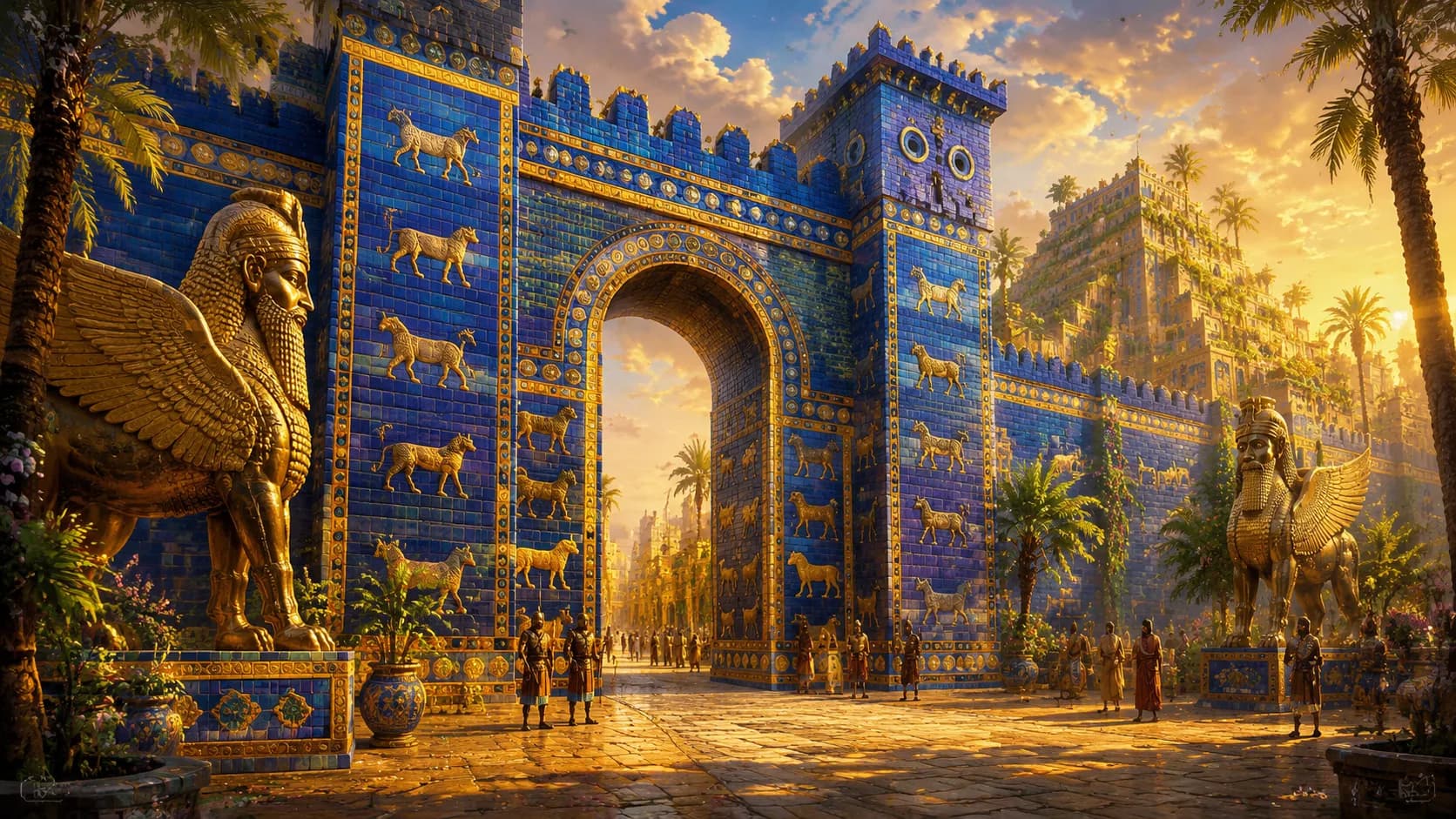
Of all Babylon's architectural triumphs, the Ishtar Gate stands as the most visually stunning and best preserved monument of Neo-Babylonian civilization. Constructed around 575 BCE by Nebuchadnezzar II, this massive double gateway served as the ceremonial entrance to the inner city and was dedicated to Ishtar, the Mesopotamian goddess of love, fertility, and divine authority. Rising approximately forty feet above the ground, the gate was entirely covered in brilliant blue glazed bricks a color achieved through a complex process involving cobalt and copper compounds that Babylonian artisans perfected over centuries.
Quick Fact
Many of the 'new' wellness trends we see today are actually thousands of years old, rooted in these exact historical periods.
The gate's surface featured alternating rows of two sacred animals: the mušḫuššu (a dragon serpent sacred to Marduk, the patron god of Babylon) and the auroch (a wild bull sacred to Adad, the storm god). These creatures were molded in relief from the brick surface and glazed in yellow and brown against the vivid blue background, creating a striking visual effect that would have been visible from great distances. Archaeologists estimate that the gate originally displayed approximately 575 animal figures across its full surface a breathtaking display of craftsmanship and devotion.
German archaeologist Robert Koldewey excavated the Ishtar Gate between 1902 and 1914, carefully removing thousands of glazed brick fragments and shipping them to Berlin. Today, a stunning reconstruction stands in the Pergamon Museum, where it remains one of the most visited ancient artifacts in the world. The reconstruction reaches only about half the original gate's height yet it still overwhelms visitors with its scale, color, and artistic sophistication, offering a glimpse into the magnificence that once welcomed travelers to the greatest city on Earth.
"The Ishtar Gate was basically ancient Babylon's version of a red carpet entrance except it was blue, forty feet tall, and covered in dragons. Hollywood has nothing on Nebuchadnezzar."
575 animal reliefs decorated the Ishtar Gate's surface each individually molded, glazed, and fitted into the blue brick facade. The manufacturing process required temperatures exceeding 1,000°C in specialized kilns.

Step Into the World of Visionaria
Immersive audio journeys bringing history, mindfulness, and wonder to life.
Why did the historian break up with the archaeologist? Because her career was literally in ruins.
The Hanging Gardens: Wonder of the Ancient World
Perhaps no ancient structure has inspired more wonder and debate than the Hanging Gardens of Babylon one of the original Seven Wonders of the Ancient World. According to ancient writers, the gardens consisted of tiered stone terraces rising high above the city, each level planted with trees, flowers, and exotic vegetation that cascaded down like a living waterfall of green. The effect was described as a lush mountain oasis rising from the flat Mesopotamian plain an engineering marvel that seemed to defy both gravity and nature itself.
Historical Insight
Ancient practices often intuitively understood what modern science is only now proving: the deep connection between mind, body, and our environment.
Ancient sources attribute the gardens' construction to Nebuchadnezzar II, who reportedly built them to comfort his wife, Queen Amytis of Media, who was homesick for the green hills of her homeland. The Babylonian priest Berossus (writing around 290 BCE) described elevated walkways supported by stone columns, with soil deep enough to sustain full grown trees. An ingenious irrigation system possibly using chain pumps or Archimedean screws lifted water from the Euphrates to the garden's highest levels, keeping the terraces verdant even during Mesopotamia's scorching summers.
The great mystery of the Hanging Gardens is that no definitive archaeological evidence has been found at the Babylon site. This has led scholars to propose several intriguing theories. Oxford scholar Stephanie Dalley suggests the gardens may actually have been located in Nineveh, built by the Assyrian king Sennacherib. Others argue that the gardens existed but were made primarily of perishable materials that left no archaeological trace. Regardless of their exact location, the Hanging Gardens remain one of humanity's most powerful symbols of beauty, love, and engineering ambition a testament to what ancient civilizations could achieve when vision met determination.
Read more: What Is an Imagination Training Practice?

A philosopher walked into a wall. His students asked if it hurt. He replied, 'The wall is an illusion, but my headache is quite real.'
The Tower of Babel: Reaching for the Heavens
The biblical story of the Tower of Babel is one of the most recognized narratives in human history and it was almost certainly inspired by a real structure: the Etemenanki ziggurat in Babylon. This massive stepped tower, dedicated to Marduk, rose approximately 300 feet (91 meters) above the city making it one of the tallest structures in the ancient world. Its name translates to "House of the Foundation of Heaven and Earth," perfectly capturing the Babylonian ambition to create a physical connection between the human and divine realms.
The Etemenanki consisted of seven progressively smaller platforms stacked atop one another, with a small temple at the summit where priests performed sacred rituals. Each level was painted a different color corresponding to the seven known celestial bodies, creating a rainbow like effect visible from miles away. The base measured approximately 300 feet on each side roughly the area of a modern football field and the entire structure was constructed primarily of sun dried mudbrick with an exterior facing of baked brick set in bitumen mortar, giving it remarkable durability.
Visionaria Insight
By immersing ourselves in these historical soundscapes, we reconnect with a timeless human tradition of storytelling and mental restoration.
Alexander the Great, upon conquering Babylon in 331 BCE, was so impressed by the Etemenanki that he ordered its restoration. Unfortunately, the project was never completed, and the structure gradually fell into ruin. Today, only the foundation remains a vast square depression in the Iraqi landscape that hints at the enormous scale of what once stood there. The ziggurat's influence, however, lives on in religious texts, art, and architecture across cultures, making it one of the most culturally significant structures ever built.
"The Tower of Babel was essentially the world's first skyscraper project. And just like modern construction, it probably went over budget and behind schedule."
Why did the historian break up with the archaeologist? Because her career was literally in ruins.
The Processional Way: Sacred Boulevard of Marduk
Stretching over half a mile from the Ishtar Gate to the Temple of Marduk (Esagila), the Processional Way was ancient Babylon's most sacred boulevard and one of the most spectacular streets ever constructed. Known in Akkadian as Aibur šābu ("the enemy shall never pass"), this ceremonial avenue served as the primary route for the annual Akitu festival Babylon's most important religious celebration, held during the spring equinox to honor Marduk and ensure cosmic order for the coming year.
The Processional Way was paved with enormous limestone and red breccia slabs, each carefully fitted and inscribed on the underside with dedications from Nebuchadnezzar II. The walls flanking the avenue rose approximately forty feet and were decorated with sixty glazed brick lions symbols of Ishtar striding purposefully toward the gate. These life sized lion reliefs, crafted in golden yellow, white, and brown glazes against the signature blue background, created an overwhelming visual corridor that would have awed anyone approaching the sacred precinct.
Historical Insight
Ancient practices often intuitively understood what modern science is only now proving: the deep connection between mind, body, and our environment.
During the Akitu festival, the processional route came alive with extraordinary pageantry. Statues of Marduk and other gods were carried along the avenue by priests in elaborate vestments, accompanied by musicians, dancers, and the entire Babylonian court. The king himself played a central role in the ceremonies, which included ritual humiliation and reinstatement symbolizing the annual renewal of his divine mandate to rule. This twelve day festival drew pilgrims from across the Neo-Babylonian Empire, transforming the Processional Way into one of the ancient world's most awe-inspiring spectacles.
Visionaria's Babylon audio journey recreates the sights and sounds of the Processional Way using spatial 3D audio you'll hear lion roars echoing off glazed walls, priests chanting, and ceremonial drums as you walk the sacred route in your imagination.
A time traveler went back to antiquity to teach them about 'holistic health.' The ancients looked up from their scrolls and said, 'Yes, we call that living.'
Architectural Wonders of Mesopotamian Engineering
The engineering achievements of ancient Babylon were nothing short of revolutionary. Babylonian builders developed sophisticated techniques for brick manufacturing, glazing, waterproofing, and large scale urban planning that remained unsurpassed for centuries. The city's infrastructure included an elaborate canal network that brought water from the Euphrates to every quarter, drainage systems that prevented flooding, and standardized brick sizes that allowed for rapid, precise construction of massive structures.
One of Babylon's most remarkable engineering feats was the development of glazed brick technology. Artisans created brilliant colors by mixing metalite compounds cobalt for blue, antimony for yellow, copper for green into a silica-based glaze that was then applied to formed bricks and fired at temperatures exceeding 1,000°C. This technology allowed Babylonians to create vast decorative surfaces that were both beautiful and weather-resistant, a combination that fascinated ancient visitors and continues to amaze modern scholars who study the chemical composition of these 2,600 year old materials.
Did You Know?
The relentless drive to understand the world was seen not just as an academic pursuit, but as a spiritual and healing practice by the ancients.
Babylon's defensive fortifications represented another engineering triumph. The city was surrounded by a double wall system with a combined thickness of nearly eighty feet, interspersed with watchtowers and reinforced gates. The outer wall (Nimit Enlil) was made of mudbrick, while the inner wall (Imgur Enlil) used baked brick for additional strength. Between them ran a passage wide enough for military chariots, creating a defensive corridor that made Babylon virtually impregnable to contemporary siege technology.
"Babylonian engineers were basically the ancient world's Silicon Valley except instead of disrupting industries, they were disrupting enemy siege plans. 'Move fast and build walls' was their motto."
Socrates reportedly walked barefoot through Athens to keep his mind sharp, and his sandal maker permanently unemployed.
Religion and Spirituality in Babylonian Life
Religion permeated every aspect of Babylonian existence from architecture and governance to daily routines and seasonal celebrations. The Babylonian pantheon included over 2,000 named deities, each governing specific aspects of nature, human activity, and cosmic order. At the apex stood Marduk, the patron god of Babylon, whose rise to supremacy was celebrated in the Enūma Eliš (the Babylonian creation epic) and whose temple, Esagila, formed the spiritual heart of the city. Every major architectural project in Babylon from the Ishtar Gate to the Etemenanki was conceived as an act of devotion to the gods and an expression of the king's role as their earthly representative.
Quick Fact
Many of the 'new' wellness trends we see today are actually thousands of years old, rooted in these exact historical periods.
The Akitu (New Year) festival was the most important religious event in the Babylonian calendar a twelve day celebration that combined theological drama, political theater, and public spectacle. During the festival, the epic of Marduk's triumph over the chaos dragon Tiamat was recited, temple rituals renewed the cosmic order, and the king underwent a remarkable ritual of humiliation and reinstatement before the statue of Marduk. This ceremony, in which the high priest would remove the king's regalia and symbolically restore his authority, represented the annual renewal of the bond between heaven and earth ensuring prosperity, fertility, and divine protection for the coming year.
Babylonian priests were among the most educated people in the ancient world, serving as astronomers, mathematicians, healers, and scribes alongside their religious duties. They developed sophisticated astronomical observation systems that tracked planetary movements with remarkable accuracy, laying the groundwork for modern astronomy and the zodiac. The priestly class maintained vast libraries of cuneiform tablets containing medical texts, mathematical treatises, astronomical tables, and literary works including the famous Epic of Gilgamesh, one of humanity's oldest surviving works of literature.
"Babylonian priests were essentially the world's first multi tasking professionals doctor, astronomer, librarian, and spiritual advisor all in one. They'd love LinkedIn's 'skills' section."
A time traveler went back to antiquity to teach them about 'holistic health.' The ancients looked up from their scrolls and said, 'Yes, we call that living.'
The Legacy of King Nebuchadnezzar II
No discussion of Babylon's wonders is complete without understanding the extraordinary ruler who built most of them. Nebuchadnezzar II (reigned 605-562 BCE) was not only Babylon's greatest builder but also one of the most capable military commanders and administrators in ancient Near Eastern history. He expanded the Neo-Babylonian Empire to its greatest extent, overseeing territories from Egypt's borders to the Persian Gulf, and used the wealth generated by this vast domain to fund an unprecedented building program that transformed Babylon into a city of legendary beauty.
Nebuchadnezzar's building projects were remarkable for their scale, ambition, and attention to detail. He personally supervised the construction or restoration of virtually every major structure in Babylon, including the Ishtar Gate, the Processional Way, the Etemenanki ziggurat, the Southern Palace, and the fortification walls. His construction inscriptions stamped into millions of individual bricks reveal a ruler obsessed with both magnificence and permanence, frequently expressing his desire to create works that would endure forever and glorify the gods of Babylon.
Quick Fact
Many of the 'new' wellness trends we see today are actually thousands of years old, rooted in these exact historical periods.
Beyond his architectural achievements, Nebuchadnezzar was a shrewd diplomat and a patron of learning. He maintained peaceful relations with Media (his wife Amytis's homeland), developed trade networks spanning the known world, and supported Babylon's scholarly institutions. His reign represented the pinnacle of Babylonian civilization a golden age when art, science, religion, and political power converged to create something truly extraordinary. The king's legacy extends far beyond the ruins of his city: he established architectural and urban planning principles that influenced subsequent empires, including the Persians, Greeks, and Romans.
Nebuchadnezzar II personally stamped his name on millions of bricks used in Babylon's construction. These stamped bricks found across archaeological sites in modern Iraq remain among the most abundant ancient artifacts in existence and serve as testament to the scale of his building ambitions.
What's an ancient intellectual's favorite exercise? Jumping to conclusions.
Trade and Culture Along the Euphrates
Babylon's position along the Euphrates River made it one of the ancient world's most important commercial centers. Trade caravans arrived from every direction bringing cedarwood from Lebanon, copper from Cyprus, lapis lazuli from Afghanistan, gold from Egypt, and spices from Arabia. The city's markets bustled with merchants speaking dozens of languages, creating a cosmopolitan atmosphere that rivaled any modern international trading center. Babylonian merchants developed sophisticated commercial practices, including written contracts, interest bearing loans, partnership agreements, and even early forms of insurance financial innovations that profoundly influenced the development of Western commerce.
Did You Know?
The relentless drive to understand the world was seen not just as an academic pursuit, but as a spiritual and healing practice by the ancients.
Culturally, Babylon served as the intellectual capital of the ancient Near East. The city's scribal schools produced scholars who made groundbreaking contributions to mathematics, astronomy, medicine, and literature. Babylonian mathematicians developed the sexagesimal (base 60) number system that we still use today for measuring time (60 seconds, 60 minutes) and angles (360 degrees). Their astronomical observations, recorded on clay tablets with extraordinary precision, tracked planetary cycles that modern instruments confirm to within fractions of a degree a remarkable achievement that formed the foundation of both scientific astronomy and astrological tradition.
The literary tradition of Babylon was equally impressive. The scribal academies preserved and transmitted works of extraordinary cultural importance, including the Epic of Gilgamesh, the Enūma Eliš (Creation Epic), the Atrahasis (the Babylonian flood narrative that predates the biblical account), and vast collections of medical, mathematical, and astronomical texts. These libraries predecessors to the famous Library of Alexandria represented humanity's first systematic effort to collect, organize, and preserve knowledge for future generations.
"Babylonians invented the 60 minute hour. Which means every time you're counting down the minutes until Friday, you have ancient Mesopotamia to thank. Or blame."
Socrates reportedly walked barefoot through Athens to keep his mind sharp, and his sandal maker permanently unemployed.
Babylon's Influence on Modern Architecture and Design
The architectural legacy of Babylon extends far beyond the ruins of ancient Mesopotamia. The city's innovative use of glazed tiles, monumental gateways, processional avenues, and terraced gardens has directly influenced architectural movements spanning thousands of years. From the grand entrances of Persian Persepolis to the triumphal arches of Rome, the concept of creating awe-inspiring ceremonial approaches originated with Babylon's Processional Way and Ishtar Gate a design philosophy that continues to shape how we build civic and religious spaces today.
Did You Know?
The relentless drive to understand the world was seen not just as an academic pursuit, but as a spiritual and healing practice by the ancients.
In the modern era, Babylon's influence is visible in institutions like the Pergamon Museum in Berlin (which houses the reconstructed Ishtar Gate), Art Deco skyscrapers that incorporate zigzag and stepped patterns inspired by ziggurats, and contemporary landscape architecture that echoes the concept of elevated gardens. The Hanging Gardens' concept integrating lush vegetation into multi-story structures has experienced a renaissance in modern "green architecture" and vertical farming projects, demonstrating how ancient Babylonian ingenuity continues to inspire solutions to contemporary urban challenges.
Read more: What Is Exploration Meditation? Complete Guide (2026)

Beyond physical architecture, Babylon's cultural symbols permeate modern storytelling, art, and media. The Tower of Babel appears in paintings by Pieter Bruegel, literary works from Borges to Rushdie, and contemporary films exploring themes of human ambition and linguistic diversity. The Ishtar Gate's blue and gold aesthetic has influenced everything from museum design to luxury branding. And the very concept of Babylon as both a place of wonder and a symbol of human aspiration continues to resonate in popular culture, making it one of the most enduring and evocative names in human history.
Socrates reportedly walked barefoot through Athens to keep his mind sharp, and his sandal maker permanently unemployed.
Experiencing Ancient Babylon Through Audio Journeys
While visiting Babylon's archaeological site in Iraq remains challenging for most travelers, interactive audio journeys offer an extraordinary alternative. Through Visionaria's immersive 3D audio technology, you can walk the Processional Way, stand before the Ishtar Gate, and explore the terraces of the Hanging Gardens all from the comfort of your home. Spatial audio technology places sounds around you in three-dimensional space, creating a sense of presence that transforms historical knowledge into felt experience.
Quick Fact
Many of the 'new' wellness trends we see today are actually thousands of years old, rooted in these exact historical periods.
Visionaria's Babylon journeys are meticulously researched, drawing from archaeological evidence, historical texts, and scholarly reconstructions to create authentic sonic environments. You'll hear the rumble of chariot wheels on limestone paving stones, the gentle splash of water cascading through irrigation channels, the chanting of priests in the temple precinct, and the calls of merchants in the bustling market districts. Each sound is precisely positioned using cinematic meditation techniques to create a complete sensory environment that educates while it relaxes.
The beauty of experiencing Babylon through audio journeys is that your imagination fills in what archaeology cannot. While physical ruins show only fragments of the original city, guided visualization allows you to see the complete Ishtar Gate in all its blue tiled glory, watch the Hanging Gardens in full bloom, and witness the Akitu festival procession moving along the avenue of lions. This combination of historical accuracy and imaginative engagement creates profound mental wellness benefits reducing stress while expanding your understanding of human achievement across the ages.
"I put on my headphones expecting a history lesson and ended up on a vacation. The Babylon journey is basically a time machine no DeLorean required."
A philosopher walked into a wall. His students asked if it hurt. He replied, 'The wall is an illusion, but my headache is quite real.'
How to Begin Your Babylonian Journey
Starting your exploration of ancient Babylon through Visionaria is simple and accessible. The app offers multiple Babylon-themed journeys ranging from 10 to 25 minutes, allowing you to choose experiences that fit your schedule and interests. Begin with the introductory "Ishtar Gate" journey, which provides an overview of the city's most iconic landmark, then progress to deeper explorations of the Processional Way, the Hanging Gardens, and the Temple of Marduk. Each journey builds upon the previous one, creating a comprehensive understanding of Babylonian civilization.
For the best experience, use quality headphones in a quiet space. The spatial audio technology works with any stereo headphones, but higher quality options enhance the three-dimensional effect. Find a comfortable position sitting or lying down close your eyes, and allow the guided narrative to transport you. The first few minutes of a journey are usually for settling in; by the middle, it becomes easier to feel present in the ancient environment. Regular sessions develop your visualization skills, making each subsequent journey more vivid and immersive.
Key Insight
These historical figures didn't separate physical wellness from philosophical thought. To them, it was all one continuous practice of living well.
Visionaria's Babylon collection connects to a broader network of journeys spanning ancient civilizations, mythology, and legendary tales. After exploring Babylon, you might continue to ancient Athens, discover the ruins of Troy, or venture into mythological realms inspired by the very legends that originated in Mesopotamia. The journey through the ancient world is limitless and it begins with a single download.
"Starting a Babylon journey is easier than ordering coffee. No waiting in line, no mispronounced names on cups just ancient Mesopotamian splendor delivered directly to your ears."

The Story Behind Beauty and the Beast: Origins, Symbolism & Timeless Magic
Discover the enchanting origins of Beauty and the Beast, from ancient Cupid and Psyche legends to Madame de Beaumont's 18th-century fairy tale.
Why did the historian break up with the archaeologist? Because her career was literally in ruins.
The Bottom Line
You've explored the wonders of Babylon from the brilliant blue tiles of the Ishtar Gate to the legendary Hanging Gardens, the towering Etemenanki ziggurat, and the sacred Processional Way. These aren't just historical curiosities they represent humanity's enduring capacity for beauty, innovation, and ambition on a monumental scale.
Visionaria Insight
By immersing ourselves in these historical soundscapes, we reconnect with a timeless human tradition of storytelling and mental restoration.
This article covered the city's grandeur during the Neo-Babylonian period, the architectural genius behind the Ishtar Gate's glazed brick technology, the ongoing scholarly debate about the Hanging Gardens, the religious significance of the Etemenanki ziggurat, the cultural richness of Babylonian trade and scholarship, and how modern technology can bring these ancient wonders back to life.
"After 2,600 years, Babylon is still giving us homework. At least now you can do it with headphones on and your eyes closed."
Experience More with Visionaria
Download the app to explore guided historical and wellness journeys.
Why did the inventor of the wheel win an award? Because his idea really got things rolling.
This article is for educational and informational purposes only. Historical details are based on available research and may evolve as new evidence emerges.
Visionaria journeys are designed for relaxation, guided imagination, and personal enrichment. They are not a substitute for medical, mental health, legal, or professional advice.