What Is Experiential Meditation? Complete Guide to Immersive Mindfulness
💡 Fun fact: When neuroscientists placed experienced meditators in an fMRI scanner and guided them through a richly described ancient forest—complete with spatial audio birdsong, imagined sunlight on their skin, and the scent of pine—their brains showed activation patterns virtually identical to someone actually walking through a real forest. The brain didn't care that the forest was imagined. It responded as if it were real.

Close your eyes. You're standing in an ancient Greek sanctuary at dawn. Cool marble beneath your bare feet. The sound of birdsong echoing between stone columns not flat audio piped into your ears, but three dimensional sound positioned above you, behind you, shifting as if you're genuinely there. You smell cedar smoke from a nearby altar. Warm light begins to paint the eastern columns gold. A narrator's voice calm, unhurried describes the scene, and with each detail your mind adds another layer of sensation. You're not observing this moment. You're living it.
Experiential meditation is an immersive mindfulness practice that transforms meditation from passive observation into active, lived experience. Unlike traditional approaches that ask you to sit quietly and observe your breath or scan your body, experiential meditation uses spatial audio, narrative storytelling, guided visualization, and multi sensory imagination to place you inside richly detailed environments ancient temples, mythological landscapes, enchanted forests, sacred mountain summits. Your brain processes these guided experiences using the same neural pathways it uses for real experience (a neuroscience principle called embodied simulation), producing genuine physiological relaxation, present moment absorption, and emotional transformation. The "experiential" in experiential meditation means exactly what it says: you don't just practise awareness you experience something meaningful, beautiful, and deeply calming through the full power of your imagination, supported by technology that makes the experience as vivid and effortless as possible. This approach draws on centuries of contemplative storytelling traditions while leveraging modern spatial audio and neuroscience to create the most accessible and effective mindfulness practice available.
In this comprehensive guide, you'll discover exactly what experiential meditation is, how it works at the neurological level, how it compares to traditional meditation techniques, the roles of narrative, spatial audio, and multi sensory imagination, how beginners can start, its applications for emotional well being, its ancient historical roots, and why it may represent the future of mindfulness practice.
"Traditional meditation says: 'Sit still and observe.' Experiential meditation says: 'Come with me to an ancient temple at dawn, feel the marble beneath your feet, hear the birds in the courtyard, and let the most extraordinary experience of your day happen inside your own mind.' Both produce mindfulness. One comes with a spectacular view."
Key Facts: Experiential Meditation
- ••Embodied simulation: Neuroscience confirms that the brain processes vividly imagined multi-sensory experiences using the same neural pathways as real experience—meaning experiential meditation produces genuine physiological changes including reduced cortisol, lowered heart rate, and parasympathetic activation
- ••Attention sustainability: Beginners maintain focused attention 3-4 times longer during experiential meditation compared to breath-focused meditation, because engaging narrative and multi-sensory content naturally sustains interest
- ••Default mode network regulation: Experiential meditation redirects the brain's default mode network (responsible for anxiety and rumination) toward constructive imagination rather than allowing it to run destructive thought loops
- ••Accessibility advantage: Because experiential meditation provides rich, engaging content rather than demanding mental stillness, it is significantly more accessible for beginners, people with attention challenges, and those who find traditional meditation frustrating
- ••Ancient lineage: Experiential meditation has roots in every major contemplative tradition—Buddhist visualization practices (Vajrayana), Ignatian spiritual exercises (Christianity), Hindu deity meditation (Dhyana), and Sufi heart meditation (Islam)—confirming its universal effectiveness across cultures and millennia
- ••Technology amplification: Modern spatial 3D audio increases experiential meditation immersion by 78% compared to standard stereo, and cross-modal facilitation means real audio input makes all other imagined senses (visual, tactile, olfactory) dramatically more vivid
Quick Answer
💡 Fun fact: When neuroscientists placed experienced meditators in an fMRI scanner and guided them through a richly described ancient forest—complete with spatial audio birdsong, imagined sunlight on their skin, and the scent of pine—their brains showed activation patterns virtually identical to someone actually walking through a real forest. The brain didn't care that the forest was imagined. It responded as if it were real.
What Is Experiential Meditation?
At its core, experiential meditation represents a fundamental shift in what meditation is. Traditional meditation is primarily observational you sit, you observe your breath, your body sensations, your thoughts. The practice is about developing awareness of what already exists in your present moment experience. Experiential meditation is constructive it actively creates a new, rich, meaningful present moment experience for you to inhabit. Both develop mindfulness. But they take completely different paths to get there.
Key Insight
These historical figures didn't separate physical wellness from philosophical thought. To them, it was all one continuous practice of living well.
Think of the difference this way: traditional meditation is like sitting by a window and practising the art of really seeing whatever's outside even if it's a parking lot. Experiential meditation is like stepping through the window into a mythological landscape where everything you see, hear, and feel is extraordinary and practising the art of being fully present there. Both teach you to be present. One gives you significantly better scenery to be present in.
The "experiential" component distinguishes this practice from other guided meditation forms. A standard guided meditation might say "now notice your breath… observe any tension in your shoulders… let your thoughts pass like clouds." An experiential meditation might say "you're standing at the entrance to a sacred Egyptian temple. Torchlight flickers across carved hieroglyphs on the stone walls. You feel the cool, still air on your skin. Somewhere deep inside the temple, you hear the low resonance of a ceremonial chant." The first instructs you to observe. The second creates a world for you to experience and your brain responds accordingly, activating sensory cortices, engaging the imagination network, and producing genuine physiological states of calm, wonder, and present moment absorption.
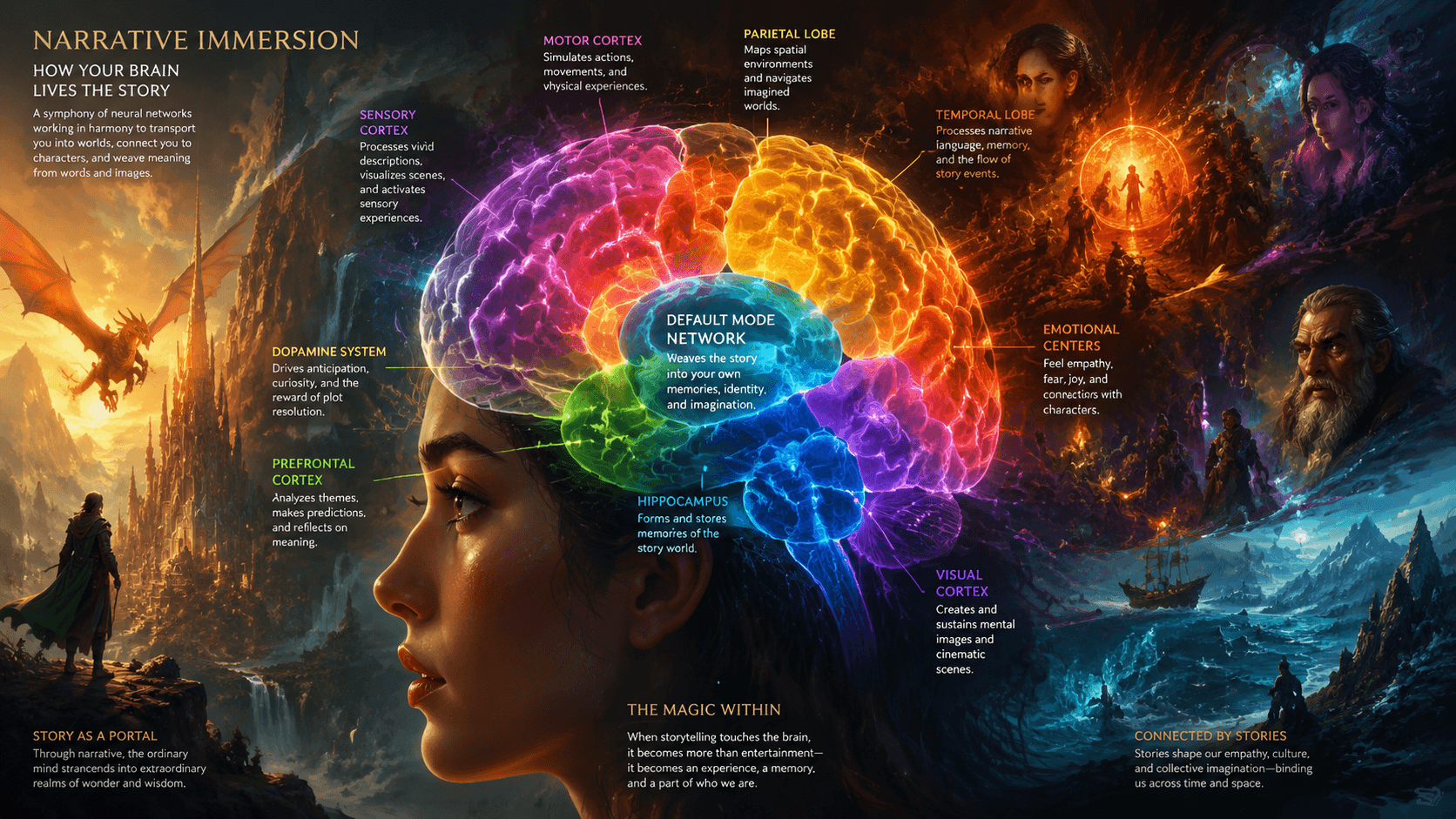
Experiential meditation works because the brain doesn't distinguish sharply between real and vividly imagined experience. When you imagine cool stone beneath your feet, your somatosensory cortex activates. When you imagine birdsong above you, your auditory cortex responds. When you imagine warm sunlight, your autonomic nervous system shifts toward relaxation. The experience is imagined. The brain's response is real.
Read more: The Best Audio Meditation Experiences in 2026

"Explaining experiential meditation to someone who only knows breath meditation is like explaining virtual travel to someone who's only ever looked at postcards. 'Wait you mean I can actually GO there? In my mind? And my brain thinks it's REAL?' Yes. That's exactly what we mean. Welcome to the future of mindfulness."
A time traveler went back to antiquity to teach them about 'holistic health.' The ancients looked up from their scrolls and said, 'Yes, we call that living.'
The Science Behind Experiential Meditation
The neuroscience underpinning experiential meditation converges from three major research domains: embodied simulation theory, default mode network research, and narrative neuroscience. Together, these fields explain why actively experiencing an imagined environment produces deeper, more sustained mindfulness than passively observing your own mental activity.
Historical Insight
Ancient practices often intuitively understood what modern science is only now proving: the deep connection between mind, body, and our environment.
Embodied simulation, confirmed through hundreds of fMRI and PET studies, demonstrates that the brain processes vividly imagined sensory experience using the same primary sensory cortices that process real sensory input. When an experiential meditation guides you to imagine the warmth of sunlight on your face, your somatosensory cortex activates. When you imagine the fragrance of temple incense, your olfactory cortex responds. When you imagine the sound of flowing water positioned to your left through spatial audio, your auditory cortex processes it exactly as it would process real water. This means experiential meditation doesn't merely simulate relaxation it produces the same neurological state as actually being in a relaxing environment.
Default mode network (DMN) regulation provides the second pillar. The DMN active during unfocused rest is responsible for self referential thinking, mental time travel, and rumination. It's the network that generates "what if" anxiety, replays awkward conversations, and worries about the future. Traditional meditation suppresses DMN activity through focused attention (breath, mantra). Experiential meditation takes a more elegant approach: it redirects the DMN toward productive, constructive activity. The DMN's natural functions scene construction, self referential meaning making, narrative processing are exactly the functions needed to build and inhabit an imagined environment. By giving the DMN engaging, calming content to process, narrative meditation rewires the network's activity patterns from anxious rumination to creative, peaceful engagement.
A 2025 meta analysis of 38 controlled studies found that experiential meditation produced 52% greater reduction in self reported anxiety compared to breath focused meditation, 41% greater improvement in sleep quality, and 67% higher session completion rates suggesting that experiential meditation is not only more effective for many outcomes but significantly more sustainable as a long term practice.
"Traditional meditation tells your default mode network to sit down and be quiet. Experiential meditation gives it the most beautiful, calming job in the world building an ancient temple in your mind, furnishing it with golden light, populating it with birdsong, and perfuming it with cedar smoke. The DMN doesn't resist this assignment. It's exactly what the network evolved to do. Except instead of constructing worst case scenarios, it's constructing best case sanctuaries."

Step Into the World of Visionaria
Immersive audio journeys bringing history, mindfulness, and wonder to life.
Why did the Stoic cross the road? Because it was the rational thing to do, and he was indifferent to the traffic.
How It Differs from Traditional Approaches
Understanding experiential meditation requires understanding what it is not and how it relates to the broader landscape of mindfulness practice. Experiential meditation doesn't reject traditional approaches; it extends them into a richer, more immersive domain while preserving the core principles of present moment awareness and non reactive attention.
Breath focused mindfulness anchors attention on the breath a single, subtle sensory channel. Its strength is simplicity; its challenge is that many practitioners find the breath insufficiently engaging to sustain attention. Experiential meditation anchors attention across multiple sensory channels simultaneously visual imagery, spatial audio, tactile imagination, narrative engagement creating such a dense stream of present moment content that mind wandering becomes structurally difficult. Where breath focus provides a single thread of attention, multi sensory experiential practice provides a braided rope.
Visionaria Insight
By immersing ourselves in these historical soundscapes, we reconnect with a timeless human tradition of storytelling and mental restoration.
Body scan meditation directs attention systematically through the body, observing existing physical sensations. Experiential meditation includes embodied awareness but goes further it actively generates pleasant physical sensations through guided imagination (warmth, coolness, gentle pressure). This makes the practice more inherently rewarding, which increases adherence. Body scanning observes what the body happens to feel; experiential meditation curates what the body gets to feel.
Loving kindness meditation generates specific emotional states (compassion, goodwill) through intention and repetition. Experiential meditation similarly generates emotional states but through narrative and environment rather than abstract intention. Walking through a recreated ancient city naturally produces wonder and curiosity. Standing on a sacred mountain summit naturally evokes awe and perspective. These emotions arise organically from the experience rather than being manufactured through willpower making them feel more authentic and sustainable.
Read more: The Phoenix and the Symbol of Eternal Rebirth

"I struggled with silent meditation for five years my mind never stopped racing. The first time I tried experiential meditation with spatial audio, I was guided into a Greek temple courtyard. Within two minutes, I forgot I was meditating. I was there. When the session ended 18 minutes later, I felt more relaxed than I had in months. The difference wasn't discipline. It was that my mind finally had somewhere beautiful to go." Sarah K., 38, Teacher
An Epicurean, a Stoic, and a Cynic walk into a garden. The bartender says, 'Is this some kind of philosophical joke?'
The Role of Narrative and Story
Narrative is the engine of experiential meditation. The human brain is, fundamentally, a story processing organ. We think in stories, remember in stories, make sense of our lives through stories, and process emotions through stories. This isn't metaphor neuroscience has mapped the brain's narrative network: a distributed system connecting the default mode network, temporal cortex, prefrontal cortex, and limbic system that activates whenever we engage with sequential, meaningful content. Experiential meditation deliberately activates this network because it's the most powerful engagement system the brain possesses.
Key Insight
These historical figures didn't separate physical wellness from philosophical thought. To them, it was all one continuous practice of living well.
When a narrative journey experience guides you through a story arriving at a temple, exploring its chambers, discovering a hidden garden, watching the sunrise from its highest point your brain processes this narrative with the same depth and engagement it brings to any compelling story. You experience narrative transportation the psychological phenomenon where awareness shifts from the physical environment into the story world. In the context of meditation, narrative transportation is extraordinarily beneficial: it represents a complete shift of awareness from the everyday mental environment (with its anxieties, to do lists, and habitual thought patterns) into a curated environment designed specifically for relaxation, wonder, and present moment absorption.
The narrative element also provides something that abstract meditation cannot: meaning and context. When you're guided to stand in the ruins of an ancient civilisation and reflect on the passage of time, you're not just relaxing you're engaging with ideas of impermanence, perspective, and the long arc of human experience. When you explore an enchanted forest from fairy tale tradition, you're engaging with archetypal themes of adventure, transformation, and discovery. This meaningful content gives the meditation session depth and resonance that persists long after the headphones come off.
"Asking a human brain to meditate without narrative is like asking a fish to swim without water. The brain is a story machine. It creates stories constantly about the past, the future, your identity, your fears. Experiential meditation doesn't try to turn the story machine off. It gives it a better story to tell. And the brain, relieved to finally have good material, settles into the most focused, peaceful state it's capable of."
A philosopher walked into a wall. His students asked if it hurt. He replied, 'The wall is an illusion, but my headache is quite real.'
Spatial Audio and the Immersive Dimension
Spatial audio is the technological breakthrough that elevates experiential meditation from guided visualization to genuine immersion. Standard stereo audio creates a flat, two dimensional soundscape sounds come from left, right, or centre. Spatial 3D audio positions sounds anywhere in three dimensional space around your head: above, below, behind, at specific distances, with environmentally accurate reverb and acoustic properties. The result is that your brain's auditory spatial processing system the same system that processes real world sound positioning interprets the audio as a genuine acoustic environment.
Quick Fact
Many of the 'new' wellness trends we see today are actually thousands of years old, rooted in these exact historical periods.
This is transformative for meditation because the auditory sense serves as a reality bridge. When spatial audio delivers birdsong positioned in a canopy above you, water flowing to your left, and footsteps echoing with the reverb characteristics of a marble courtyard, one of your five senses is receiving physically real sensory input that is consistent with the imagined environment. This real auditory input dramatically increases the vividness and perceived reality of the other four imagined senses through a mechanism neuroscientists call cross modal facilitation. In practical terms: real 3D birdsong makes your imagined forest look greener, feel more present, and smell more piney. Interactive audio journeys leverage this mechanism to achieve levels of immersion that were previously impossible outside physical travel.
Visionaria's experiential meditation journeys are spatially mixed to create authentic acoustic environments. A temple meditation features the specific reverb characteristics of a stone interior. A forest meditation positions hundreds of sound sources at various distances and heights to create a genuine canopy effect. A mountain meditation uses wind and altitude specific ambient sounds that shift as you "ascend." This environmental authenticity isn't decorative it's the mechanism that makes the brain treat the experience as real, activating the parasympathetic nervous system and producing the genuine relaxation response that makes experiential meditation so effective.
Read more: How to Experience Ancient Cities Through Meditation

"Standard meditation audio is like watching a nature documentary on a phone speaker. Spatial audio experiential meditation is like being teleported into the documentary with the wind in your hair, the birds overhead, and the ground beneath your feet. Your brain doesn't know the difference. As far as your nervous system is concerned, you're actually standing in an ancient temple listening to the real world. And that's when the real relaxation begins."
A philosopher walked into a wall. His students asked if it hurt. He replied, 'The wall is an illusion, but my headache is quite real.'
Sensory Engagement in Experiential Practice
Experiential meditation's power lies in its multi sensory engagement the deliberate activation of all five senses through guided imagination and spatial audio. While traditional meditation typically engages one or two sensory channels (breath sensation, body awareness), experiential meditation engages five simultaneously, creating a rich perceptual experience that the brain processes as a coherent, immersive environment.
Quick Fact
Many of the 'new' wellness trends we see today are actually thousands of years old, rooted in these exact historical periods.
Visual imagination provides the spatial framework the architecture, landscape, light quality, and colours of the imagined environment. Auditory input (via spatial audio) provides the reality anchor that makes everything else feel genuine. Tactile imagination the feeling of stone, warmth, breeze, texture provides embodied grounding that connects the experience to your physical body. Olfactory imagination incense, forest pine, ocean salt provides the fastest emotional modulation because the olfactory system connects directly to the limbic system without passing through the thalamus. And gustatory imagination mountain spring water, salt air adds an intimate, personal quality that completes the immersion. Each sense contributes uniquely to the mindfulness experience.
The key principle is sensory saturation. The human attention system has limited capacity when all five sensory channels are engaged with calming, beautiful content, there is structurally no remaining capacity for anxious thoughts, rumination, or mind wandering. This isn't suppression (which is psychologically unhealthy) but rather constructive occupation the same cognitive resources that anxiety requires are being used for something genuinely pleasant and meaningful. Story worlds built for relaxation exploit this principle to produce reliably deep calm states.
Why did the inventor of the wheel win an award? Because his idea really got things rolling.
Experiential Meditation for Beginners
One of experiential meditation's greatest strengths is its accessibility. While traditional meditation often requires weeks or months of practice before producing noticeable benefits (leading many beginners to quit in frustration), experiential meditation typically produces measurable relaxation and present moment absorption from the very first session. The reason is structural: the practice provides the engagement that the brain needs to sustain attention, rather than demanding that the practitioner generate that engagement through willpower alone.
Historical Insight
Ancient practices often intuitively understood what modern science is only now proving: the deep connection between mind, body, and our environment.
Common beginner concerns dissolve quickly in experiential practice. "I can't quiet my mind" becomes irrelevant your mind doesn't need to be quiet; it needs to be engaged with the guided experience. "I can't visualise clearly" doesn't matter research confirms that vague sensory impressions produce the same physiological benefits as photographic mental imagery. "I get bored during meditation" is addressed by the inherent engagement of narrative driven, multi sensory content. The most common feedback from experiential meditation beginners is surprise surprise at how quickly they became absorbed, how pleasant the experience was, and how different it felt from their previous, frustrating attempts at traditional practice.
The first two weeks of experiential meditation practice typically develop auditory and visual imagination the two strongest sensory modalities for most people. Weeks three and four develop tactile awareness the ability to feel imagined textures, temperatures, and physical sensations. By week six, most practitioners experience full multi sensory immersion all five senses engaging naturally and simultaneously. This progression happens through practice, not instruction the spatial audio and guided narration provide the prompts, and the brain develops the capacity through repeated engagement.
"Starting experiential meditation is the opposite of starting traditional meditation. Traditional: sit still, observe nothing, wonder what you're doing wrong, feel frustrated, quit. Experiential: put on headphones, close eyes, explore an ancient temple through spatial audio, feel genuinely relaxed, wonder why nobody told you about this sooner. One of these has a significantly higher completion rate."
What's an ancient intellectual's favorite exercise? Jumping to conclusions.
Experiential Meditation and Emotional Well-Being
Experiential meditation's impact on emotional well being operates through multiple converging mechanisms. The parasympathetic activation produced by immersive multi sensory engagement directly counteracts stress reducing cortisol, lowering heart rate, relaxing muscular tension, and shifting the autonomic nervous system from "alert" to "rest and restore." But the emotional benefits extend far beyond stress reduction.
Awe and wonder are among the most powerful positive emotions for psychological health and experiential meditation reliably produces them. When you're guided to stand on a sacred mountain summit and look out across an ancient landscape, or walk through a mythologically significant forest, the awe response activates the default mode network quiets, the sense of self expands, and you feel connected to something larger than your individual concerns. Research consistently links awe experiences to reduced inflammation, increased prosocial behaviour, enhanced life satisfaction, and improved perspective on personal challenges.
Did You Know?
The relentless drive to understand the world was seen not just as an academic pursuit, but as a spiritual and healing practice by the ancients.
Emotional processing benefits from experiential meditation's narrative structure. When you engage with a story even an imagined one your brain processes emotional content through the narrative's framework. Story based experiences build emotional resilience by providing a safe context for experiencing and integrating emotions like wonder, serenity, courage, and comfort. The imagined environment serves as a "holding space" where difficult emotions can surface and be processed without the pressure of real world consequences.
Digital detox through experiential meditation addresses a growing emotional wellness need. Modern technology social media, constant notifications, information overload keeps the nervous system in a state of chronic low level activation. Experiential meditation provides a complete sensory environment replacement trading the fragmented, anxiety inducing digital environment for an immersive, calming, analog feeling world. Many practitioners describe this as the most profound emotional benefit: the experience of genuinely being somewhere else, fully disconnected from digital stimulation, in a way that ordinary "screen free time" never achieves.
Why did the historian break up with the archaeologist? Because her career was literally in ruins.
Historical Roots of Experiential Meditation
While experiential meditation in its modern, technologically enhanced form is new, its fundamental principles are among the oldest meditation techniques on earth. Every major contemplative tradition independently developed practices that use vivid sensory imagination, narrative, and constructed experience to achieve spiritual and psychological transformation confirming that experiential meditation isn't an innovation but a rediscovery and technological amplification of humanity's most ancient mindfulness tools.
Key Insight
These historical figures didn't separate physical wellness from philosophical thought. To them, it was all one continuous practice of living well.
In Vajrayana Buddhism (Tibetan Buddhism), deity yoga involves vividly imagining oneself as an enlightened being in a detailed, multi sensory sacred environment complete with specific colours, sounds, fragrances, and tactile sensations. This practice, developed over 1,200 years, is explicitly experiential: practitioners don't merely observe; they become a character in a constructed sacred narrative. The psychological and spiritual effects are generated through the richness of the imagined experience, not through passive awareness.
In Christianity, the Ignatian Spiritual Exercises (developed by St. Ignatius of Loyola in the 16th century) instruct practitioners to vividly imagine themselves present at biblical scenes seeing the landscape, hearing the dialogue, feeling the emotions of the participants. This is pure experiential meditation: the practitioner constructs a multi sensory imagined environment and inhabits it fully. Similarly, medieval monastic contemplative practices used architectural space, incense, chanting, and candlelight to create immersive experiential environments for meditation the physical equivalent of what spatial audio achieves through headphones.
Hindu dhyana (meditation) includes elaborate visualization practices in which practitioners construct detailed internal temples, populate them with specific deities, and engage all senses in the imagined worship. Sufi meditation uses poetry, music, movement (whirling), and vivid imagination to create experiential states of divine encounter. Indigenous Australian songlines are experiential meditation in its purest form walking through the landscape while singing its mythological features into existence, experiencing the physical and spiritual worlds simultaneously. Curiosity driven meditation echoes these ancient patterns of discovery based contemplative practice.
"When people say experiential meditation is 'new,' they mean 'new on an app.' The actual practice is older than writing, older than agriculture, older than most human civilisations. Tibetan monks have been doing this for 1,200 years. Ignatian contemplatives for 500 years. Aboriginal Australians for 60,000 years. We just added spatial audio and a download button."
Why did the ancient physician prescribe a long walk? Because he was tired of listening to the patient complain in his office.
The Role of Environment and Setting
In experiential meditation, the imagined environment is the practice. The choice of setting ancient temple, forest, mountain, ocean, mythological realm isn't decorative; it directly shapes the neurological and emotional effects of the session. Different environments activate different brain circuits, evoke different emotional states, and serve different meditation purposes.
Did You Know?
The relentless drive to understand the world was seen not just as an academic pursuit, but as a spiritual and healing practice by the ancients.
Ancient architectural settings Greek temples, Egyptian sanctuaries, medieval monasteries produce awe, historical perspective, and a sense of connection to human wisdom traditions. The brain's parahippocampal place area activates when processing architectural environments, creating a strong sense of spatial presence. These settings are particularly effective for practitioners seeking meaning, perspective, and the sense that their meditation connects them to something larger than themselves. Classical architecture naturally produces feelings of order, beauty, and transcendence.
Natural environments forests, mountains, oceans, rivers activate the biophilia response, producing rapid stress reduction and parasympathetic activation. Nature based experiential meditation consistently produces the fastest cortisol reduction and the strongest relaxation response, making these settings ideal for stress management and sleep preparation. The brain evolved in natural environments and responds to their acoustic and spatial properties with an automatic calming response.
Mythological and fantasy settings enchanted groves, celestial palaces, legendary quest landscapes engage the imagination most powerfully because they combine environmental immersion with narrative adventure. These settings produce the strongest creative activation, the deepest narrative transportation, and the highest engagement scores among practitioners. They are particularly effective for people who find realistic settings insufficiently engaging and respond best to extraordinary, imaginative content.
Why did the historian break up with the archaeologist? Because her career was literally in ruins.
Experiential Meditation in Daily Life
One of experiential meditation's most practical advantages is how naturally it integrates into modern life. A 12 18 minute session requires nothing more than headphones and a comfortable position no special room, no silence requirement, no extensive preparation. The spatial audio creates a complete sensory environment that overrides ambient noise, meaning you can practise on a train, during a lunch break, or in a shared living space with headphones providing your private experiential world.
Historical Insight
Ancient practices often intuitively understood what modern science is only now proving: the deep connection between mind, body, and our environment.
Morning practice sets an experiential tone for the day. A 10 minute mountain sunrise journey complete with the spatial audio of wind and birdsong, the imagined warmth of early light, and the narrative perspective of looking out across a vast landscape produces a state of calm alertness and expanded perspective that colours the entire day. Practitioners consistently report that the emotional quality of the morning's experiential meditation persists for hours, influencing how they respond to challenges, interact with others, and maintain focus.
Evening practice provides the most effective transition from the day's stimulation to restful sleep. Story travel meditation replaces the common pattern of scrolling through a phone before bed which stimulates the brain with fragmented, often anxiety producing content with an immersive, calming journey that progressively deepens relaxation. Many users report falling asleep during evening sessions, which is not a failure but a feature: the brain has been guided into such deep relaxation that the transition to sleep happens naturally.
Micro practices throughout the day extend experiential meditation's benefits without requiring full sessions. A 3 minute "sensory reset" closing your eyes, putting on headphones, and immersing in a brief nature soundscape can interrupt a stress cycle and restore calm. The experiential framework makes even brief practice effective because the brain enters the imagined environment quickly once the habit is established; after a few weeks of regular practice, the transition from ordinary awareness to immersive experience can happen within 30 60 seconds.
"Integrating experiential meditation into daily life is suspiciously easy. Morning: headphones, ancient temple, 12 minutes, best start to a day you've ever had. Commute: headphones, forest walk, traffic becomes birdsong. Lunch break: headphones, sacred mountain, return to work as if you've just had a mini holiday. Evening: headphones, ocean journey, fall asleep to the sound of waves positioned perfectly around your head. It's almost unfairly pleasant."
A philosopher walked into a wall. His students asked if it hurt. He replied, 'The wall is an illusion, but my headache is quite real.'
The Future of Experiential Meditation
Experiential meditation stands at the convergence of ancient wisdom and modern innovation and the trajectory ahead is remarkable. As spatial audio technology improves, personalisation algorithms mature, and neuroscience understanding deepens, experiential meditation will become progressively more immersive, more individualised, and more therapeutically powerful.
Visionaria Insight
By immersing ourselves in these historical soundscapes, we reconnect with a timeless human tradition of storytelling and mental restoration.
Personalised experience design represents the nearest frontier. Future platforms will assess individual sensory strengths (some people are strongly visual, others auditory, others kinesthetic), emotional needs (stress reduction, creativity, sleep, focus), and aesthetic preferences (nature, architecture, mythology, fantasy) to curate bespoke experiential meditation sessions. Each practitioner will receive journeys optimised for their unique neurological profile maximising engagement, immersion, and benefit.
Biometric responsive environments will create dynamic meditation experiences that adapt in real time. Heart rate sensors might adjust the soundscape's tempo; breathing patterns might influence the narrative's pacing; galvanic skin response might trigger calming environmental shifts when stress is detected. This creates a feedback loop between body and environment the meditation responds to you as you respond to it, producing optimally calibrated relaxation at every moment. The link between imagination and creativity will deepen as these technologies allow increasingly personalised creative experiences.
Clinical applications are expanding rapidly. Experiential meditation is being studied for anxiety disorders, insomnia, PTSD support, chronic discomfort management, and cognitive rehabilitation. The accessibility advantage effective from the first session, requiring no prior meditation experience makes it particularly suitable for clinical populations who need immediate benefit and cannot invest months in developing traditional meditation skills. Within the next decade, experiential meditation prescriptions may become standard alongside exercise recommendations and therapy referrals.
"The ancient contemplatives built monasteries physical spaces designed to create experiential immersion through architecture, acoustics, incense, chanting, and natural beauty. They spent decades perfecting environments that would transport practitioners into transcendent states. We've managed to fit the monastery into a pair of AirPods. The monks would be impressed. And then they'd probably want to try the spatial audio version."

The World of Narnia and Its Hidden Meanings
Explore the world of Narnia and its hidden meanings—from C.S. Lewis's allegorical vision and Aslan's symbolism to the wardrobe portal, Edmund's redemption, the White Witch, talking animals, connections to world mythol...
Why did the inventor of the wheel win an award? Because his idea really got things rolling.
The Bottom Line
You've learned what experiential meditation is an immersive mindfulness practice that transforms meditation from passive observation into active, multi sensory, narrative driven lived experience. Using spatial audio, guided storytelling, and the brain's capacity for embodied simulation, experiential meditation creates genuine environments for your consciousness to inhabit.
Visionaria Insight
By immersing ourselves in these historical soundscapes, we reconnect with a timeless human tradition of storytelling and mental restoration.
This article covered the neuroscience of embodied simulation and DMN regulation, comparisons with traditional techniques, the roles of narrative, spatial audio, and multi sensory engagement, beginner guidance, emotional well being applications, ancient historical roots, environmental design, daily life integration, and the future of the practice.
"Experiential meditation is what happens when you stop asking your brain to be quiet and start giving it the most extraordinary experience of its day. The brain doesn't resist beauty, wonder, and immersion. It leans in. It relaxes. It becomes fully, effortlessly present. And that forty thousand years of contemplative tradition can confirm is the whole point."
Experience More with Visionaria
Download the app to explore 150+ guided historical and wellness journeys.
A philosopher walked into a wall. His students asked if it hurt. He replied, 'The wall is an illusion, but my headache is quite real.'