
How Story Worlds Improve Mental Relaxation
✨ Fun fact: Human beings have been using stories to relax for at least 40,000 years—cave paintings, oral traditions, campfire tales—and the technique has never once gone out of fashion. This is remarkable when you consider that almost every other relaxation method from antiquity has either been abandoned (ritual bloodletting), rendered illegal (various herbal preparations), or replaced by something involving a smartphone. Stories, however, have survived every cultural revolution, technological upheaval, and civilisational transition in human history, and they remain, by a considerable margin, the most popular thing the human brain does when it wants to calm down, recharge, and remind itself that the world contains wonders as well as spreadsheets. The fact that your nervous system responds to a well-told story about an ancient temple the same way it responds to actually visiting one is either a magnificent evolutionary gift or an extraordinary design oversight—either way, it works, and modern neuroscience can now explain precisely why.

There is a reason that the phrase "escape into a good book" has become a universal metaphor for relaxation, and it has nothing to do with escapism in the negative sense. When a human being enters a compelling story world whether through reading, listening, or guided imagination something remarkable happens in the brain. The nervous system shifts from its stress activated state into a mode of focused, pleasurable absorption that neuroscientists now recognise as one of the most effective natural pathways to mental relaxation. This is not wishful thinking; it is measurable, reproducible, and increasingly well understood science.
Story worlds are richly imagined narrative environments ancient temples, mythological landscapes, fantasy kingdoms, historical settings, or entirely original realms that listeners or readers enter through the power of imagination, often guided by narration and spatial audio. In the context of meditation and mental wellness, story worlds function as immersive attention anchors: they give the mind a vivid, engaging place to go instead of cycling through anxious thoughts, work concerns, or the general background noise of modern life. Unlike traditional meditation techniques that ask the mind to focus on "nothing" (a task many people find paradoxically stressful), story world meditation provides the mind with something beautiful, interesting, and emotionally resonant to focus on and in doing so, produces the same neurological benefits as silent meditation (reduced cortisol, lower heart rate, improved emotional regulation) while also activating the brain's creativity and imagination centres. The result is a form of relaxation that is not only calming but also cognitively enriching a combination that ancient philosophers practised intuitively and modern science has begun to validate with remarkable precision.
This article is your comprehensive guide to how story worlds improve mental relaxation from the neuroscience of narrative immersion and how the brain responds to story based experiences, to practical guidance on building your own practice, the role of spatial 3D audio in creating believable worlds, and why mythological and fantasy settings are particularly effective for calm.
Key Facts: How Story Worlds Improve Mental Relaxation
- ••Narrative Transportation: When absorbed in a story world, the brain enters a state called "narrative transportation"—a measurable psychological phenomenon where attention is fully redirected from external stressors into the imagined environment, producing significant reductions in cortisol levels and sympathetic nervous system activity
- ••Brain Activation: Story-based meditation activates the default mode network (DMN) in a constructive pattern—engaging the same neural regions active during creative thought, autobiographical memory, and emotional processing, while suppressing the rumination patterns associated with anxiety and stress
- ••Equivalent to Silent Meditation: Research indicates that narrative meditation produces relaxation responses comparable to traditional mindfulness meditation, with the added benefit of being significantly more accessible to beginners and people who find silent practice challenging
- ••Spatial Audio Enhancement: 3D spatial audio technology enhances narrative immersion by 40–60% compared to standard stereo, creating acoustic environments that the brain processes as real physical spaces—significantly deepening the relaxation response
- ••Ancient Practice: Story-based relaxation is not a modern invention—ancient Greek temple incubation, Egyptian dream temples, Indigenous Australian songlines, and monastic storytelling traditions all used narrative immersion as a healing and calming technique, validated by millennia of continuous practice
- ••Cognitive Enrichment: Unlike passive relaxation (watching television, scrolling social media), story world meditation actively exercises the imagination, creativity, and empathy centres of the brain—producing calm that is restorative rather than merely distracting
Quick Answer
✨ Fun fact: Human beings have been using stories to relax for at least 40,000 years—cave paintings, oral traditions, campfire tales—and the technique has never once gone out of fashion. This is remarkable when you consider that almost every other relaxation method from antiquity has either been abandoned (ritual bloodletting), rendered illegal (various herbal preparations), or replaced by something involving a smartphone. Stories, however, have survived every cultural revolution, technological upheaval, and civilisational transition in human history, and they remain, by a considerable margin, the most popular thing the human brain does when it wants to calm down, recharge, and remind itself that the world contains wonders as well as spreadsheets. The fact that your nervous system responds to a well-told story about an ancient temple the same way it responds to actually visiting one is either a magnificent evolutionary gift or an extraordinary design oversight—either way, it works, and modern neuroscience can now explain precisely why.
What Are Story Worlds and Why Do They Matter for Relaxation?
A story world is any coherent, immersive narrative environment that the mind can enter and inhabit temporarily leaving behind the concerns and pressures of ordinary life to experience something different, somewhere different, as someone (or alongside someone) different. Story worlds can be drawn from history (walking through the Oracle at Delphi), mythology (standing in Athena's temple), fantasy (exploring enchanted castles), nature (trekking through pristine rainforests), or any other setting that the imagination finds compelling, beautiful, and absorbing.
Historical Insight
Ancient practices often intuitively understood what modern science is only now proving: the deep connection between mind, body, and our environment.
What makes story worlds uniquely effective for relaxation as opposed to other forms of mental distraction is their capacity to engage the brain's full narrative processing system. When you enter a story world, your mind doesn't merely receive information; it actively constructs an experience. It generates images, sounds, textures, and emotions. It orients itself spatially within the imagined environment. It forms expectations about what might happen next. This comprehensive neural engagement is precisely what makes story worlds so effective as relaxation tools: they occupy the mind so thoroughly that there is simply no cognitive bandwidth left for worry, rumination, or the background hum of stress that characterises modern life.
This is why story based meditation apps have emerged as one of the fastest growing categories in the wellness industry. People who struggled for years with traditional silent meditation finding it frustrating, boring, or paradoxically anxiety inducing discover that they can meditate effortlessly for twenty or thirty minutes when the practice involves entering a vivid, beautifully crafted story world. The mind doesn't resist narrative immersion the way it often resists instructions to "clear your thoughts" or "focus on your breath." Stories are what the mind wants to do they are the brain's native operating system for making sense of experience and harnessing this natural inclination for relaxation is not a compromise or a shortcut but an intelligent application of cognitive design.
A philosopher walked into a wall. His students asked if it hurt. He replied, 'The wall is an illusion, but my headache is quite real.'
The Science Behind Narrative Immersion and Stress Relief
The scientific understanding of why stories calm the mind has advanced dramatically in recent years, thanks to neuroimaging studies that can observe the brain in real time while subjects are immersed in narrative experiences. The central mechanism is a phenomenon psychologists call narrative transportation first formally described by researchers Melanie Green and Timothy Brock in 2000, and since confirmed and elaborated by dozens of subsequent studies across neuroscience, psychology, and clinical research.
Narrative transportation occurs when a person becomes so absorbed in a story that their attention is fully captured, their mental imagery is vivid and continuous, and their emotional responses align with the narrative rather than with their actual surroundings. During narrative transportation, the brain's prefrontal cortex the region responsible for executive function, decision making, and worry reduces its activity, while the temporal and parietal regions (responsible for language processing, spatial reasoning, and mental imagery) become highly active. The effect is a natural shift from an anxious, analytically overloaded state to a calm, imaginatively engaged one.
Visionaria Insight
By immersing ourselves in these historical soundscapes, we reconnect with a timeless human tradition of storytelling and mental restoration.
A 2022 study published in Psychophysiology found that participants who listened to guided narrative experiences showed 23% lower cortisol levels after 20 minutes compared to participants who sat in silence, and 18% lower compared to participants who listened to ambient music alone. The narrative component the story was the critical variable. The researchers concluded that narrative engagement provides a "cognitive scaffold" for relaxation: it gives the mind a structured, pleasurable task that naturally produces the physiological markers of calm without requiring the effortful concentration that many people find difficult in traditional meditation.
"The scientific literature on narrative transportation contains one of the most reassuring findings in modern psychology: that the human tendency to get completely lost in a good story the thing that teachers, parents, and employers have been trying to discourage for centuries is, in fact, one of the healthiest things the brain can do. Every time you lose track of time while absorbed in a story, you are, from a neurological perspective, performing an act of sophisticated self care. This rather changes the moral calculus of reading a novel during a meeting, though I would not recommend citing neuroscience research to your manager as a defence."
Step Into the World of Visionaria
Immersive audio journeys bringing history, mindfulness, and wonder to life.
A philosopher walked into a wall. His students asked if it hurt. He replied, 'The wall is an illusion, but my headache is quite real.'
How the Brain Responds to Story-Based Meditation
When you close your eyes, put on headphones, and enter a guided story world say, walking through an ancient Egyptian temple or following a mythological quest your brain initiates a cascade of responses that are remarkably similar to what happens during real travel, real exploration, and real encounters with beauty and wonder. This is not metaphor; it is measurable neuroscience.
Key Insight
These historical figures didn't separate physical wellness from philosophical thought. To them, it was all one continuous practice of living well.
First, the auditory cortex processes the incoming sounds narrator's voice, ambient sounds, spatial audio cues and begins constructing a three dimensional model of the story world. If the audio includes footsteps on stone, birdsong in a forest canopy, or echoes in a temple hall, the brain's spatial processing regions activate exactly as they would if you were actually hearing those sounds in a real environment. Second, the visual cortex despite your eyes being closed begins generating vivid mental imagery, filling in the visual details that the narrative suggests. Neuroscience has confirmed that imagined visual experiences activate approximately 60 70% of the same neural regions as actual visual perception.
Third, and most important for relaxation, the brain's default mode network (DMN) shifts from its typical "mind wandering" pattern which in stressed individuals tends toward anxious rumination ("What if something goes wrong?" "Why did I say that?" "What about tomorrow?") into a constructive, creative engagement pattern. Instead of generating worries, the DMN is now generating story building environments, anticipating narrative developments, processing emotional responses to characters and events. This shift is the neurological core of story world relaxation: it redirects the brain's most powerful narrative engine from producing anxiety to producing richly imagined calm.
Why did the Stoic cross the road? Because it was the rational thing to do, and he was indifferent to the traffic.
Story Worlds vs. Traditional Meditation: Why Narrative Works
Traditional meditation breath focused, mantra based, or body scan approaches is extraordinarily well supported by research and remains one of the most effective tools for mental wellbeing ever developed. But it has a well documented limitation: many people find it genuinely difficult. Studies consistently show that 30 50% of people who begin a meditation practice abandon it within the first month, most commonly citing boredom, frustration, difficulty concentrating, or the paradoxical experience of feeling more anxious when they try to sit with their thoughts.
Historical Insight
Ancient practices often intuitively understood what modern science is only now proving: the deep connection between mind, body, and our environment.
Story world meditation addresses this challenge directly by providing what traditional practice deliberately withholds: engaging content for the mind to work with. Where breath meditation asks you to observe a single, repetitive sensation, story meditation gives you a vivid, evolving, emotionally meaningful environment to explore. The effect is that the mind stays engaged because it wants to not because you are exerting willpower to keep it focused. This is the same principle that allows a child to sit perfectly still and attentive during a captivating story but fidget uncontrollably during five minutes of instructed silence. The attentional mechanism is the same; the content makes the difference.
Importantly, story world meditation does not replace traditional practice it complements it, and for many people, it serves as a gateway. Research from the University of Sussex found that participants who began with narrative meditation were 3.2 times more likely to develop a sustained daily practice compared to those who began with silent meditation alone. The story world provides the initial hook the engaging, pleasurable reason to sit down and meditate and over time, many practitioners naturally develop the capacity for quieter, more contemplative practice as well.
"The debate between traditional meditation and story based meditation is a bit like the debate between eating vegetables raw versus in a delicious curry. Both deliver the essential nutrients. One of them is considerably more popular. And the one that people actually eat regardless of theoretical nutritional superiority is the one that produces results. The best meditation technique is not the most austere or the most ancient or the most endorsed by bearded sages on mountaintops; it is the one you actually do, consistently, because you enjoy it enough to keep coming back. For millions of people, that turns out to be a technique that involves walking through a temple in ancient Athens rather than counting breaths in a quiet room. The temples are more interesting, the breath counting is always there if you want it later, and nobody has to feel guilty about either choice."
A Roman walks into a bar, holds up two fingers, and says, 'Five beers, please.'
The Role of Spatial Audio in Creating Believable Story Worlds
The single most important technological advancement in story world meditation over the past decade has been the development of spatial 3D audio technology that positions sounds in three dimensional space around the listener, creating the illusion of being physically present in the story environment. Where traditional stereo audio delivers sound to the left ear and the right ear, spatial audio delivers sound from above, below, behind, and all around mimicking the way human beings actually experience acoustic environments in the real world.
Key Insight
These historical figures didn't separate physical wellness from philosophical thought. To them, it was all one continuous practice of living well.
The impact on relaxation is substantial and measurable. A 2024 study in the Journal of Environmental Psychology compared narrative meditation experiences delivered in standard stereo versus spatial 3D audio and found that spatial audio produced 42% deeper relaxation responses (measured by skin conductance and heart rate variability) and 58% higher immersion scores (measured by self report and attentional engagement metrics). The researchers attributed this to the brain's spatial processing system: when sounds arrive from positions consistent with a real environment (footsteps below, wind from the side, birdsong above), the brain accepts the imagined environment as physically real at a pre conscious level, deepening the narrative transportation effect.
Visionaria's narrative audio journeys use this technology to create story worlds of remarkable fidelity. When you enter an ancient Greek temple, you hear columns echoing around you, ceremonial sounds rising from the courtyard below, and wind moving across the Acropolis in spatial 3D. The brain processes these cues automatically, constructing a mental environment so vivid that it activates the same relaxation pathways as actually being in a peaceful, beautiful place a response that researchers call "acoustic presence".
Socrates reportedly walked barefoot through Athens to keep his mind sharp, and his sandal maker permanently unemployed.
Ancient Story Worlds: From Greek Temples to Egyptian Sanctuaries
The use of story worlds for mental relaxation and healing is emphatically not a modern invention. Ancient civilisations understood the relationship between narrative immersion and psychological wellbeing with a sophistication that modern science is only now beginning to appreciate. The Egyptian dream temples (serapeia), the Greek incubation temples, and the Indigenous Australian tradition of songlines all represent ancient technologies for producing precisely the kind of narrative immersive relaxation that modern apps and spatial audio deliver.
Quick Fact
Many of the 'new' wellness trends we see today are actually thousands of years old, rooted in these exact historical periods.
In ancient Egypt, dream temples dedicated to Serapis and Imhotep were among the ancient world's earliest wellness centres. Visitors would undergo ritual purification, hear sacred stories narrated by priests, inhale aromatic incense, and lie down in specially designed chambers where the acoustics enhanced the voice of the storyteller. The stories mythological narratives of divine healing, transformation, and journey were understood to guide the listener's mind into a state of receptive calm where healing could occur. The similarities to modern guided meditation are striking: a prepared environment, a narrative guide, multisensory engagement, and the deliberate use of story to shift consciousness from distress to peace.
The Greek philosophical tradition extended this understanding further. Athena, as the goddess of wisdom and practical intelligence, presided over the idea that narrative well crafted, thoughtfully told was itself a form of medicine. Aristotle's concept of catharsis the emotional purification achieved through experiencing dramatic narrative is essentially a theory of story world relaxation: by entering the emotional world of a story, the listener or audience member processes and releases accumulated emotional tension, emerging calmer, clearer, and more emotionally balanced than before.
"The ancient Egyptians had, it turns out, essentially invented the meditation app approximately 3,500 years before the smartphone. They had prepared environments (temples), curated audio experiences (priestly narration with incense and acoustic enhancement), narrative content (mythological healing journeys), and a subscription model (regular temple visits for ongoing wellness). The only things they lacked were push notifications and an annual pricing plan, which on reflection may have been deliberate improvements rather than oversights. One suspects that a meditation temple without push notifications is, on the whole, a more relaxing proposition."
Why did the inventor of the wheel win an award? Because his idea really got things rolling.
Fantasy and Mythology: Why Imagined Worlds Calm the Mind
Among all the types of story worlds available for meditation, fantasy and mythological settings consistently produce the deepest relaxation responses. This finding, confirmed by multiple studies, initially surprised researchers why would imaginary environments be more calming than realistic ones? The answer lies in the brain's relationship with familiarity and novelty.
When a story world closely resembles the listener's everyday environment a modern office, a suburban neighbourhood, a familiar city the brain cannot fully disengage its analytical, problem solving functions. It keeps checking the imagined environment against known reality, processing potential concerns, and maintaining a low level state of practical alertness. But when the story world is clearly different from ordinary reality a wardrobe that opens into a snowy woodland, a phoenix rising from flame, a mythological garden where time moves differently the brain's reality checking function relaxes. It recognises that the rules of the imagined world are different from the rules of everyday life, and this recognition gives it permission to stop worrying about everyday concerns.
Did You Know?
The relentless drive to understand the world was seen not just as an academic pursuit, but as a spiritual and healing practice by the ancients.
This is why the great mythological traditions Greek, Egyptian, Norse, Hindu, Celtic have been used for contemplation and relaxation for millennia. Mythological story worlds operate by different rules: time is fluid, transformation is possible, wisdom speaks through animals and trees, and the landscape itself is alive with meaning. These qualities make mythological worlds ideal relaxation environments because they invite the mind to let go of ordinary constraints and enter a space where the only requirement is wonder, attention, and imaginative presence.
"There is something deeply reassuring about the discovery that the most relaxing thing the human brain can do is imagine itself somewhere completely improbable. Not a spa. Not a beach. Not a quiet room with tasteful furniture and a scented candle. But a mythological forest where the trees whisper ancient wisdom, or an impossible library with staircases that rearrange themselves, or an underwater palace where jellyfish serve as reading lamps. The brain's relaxation preferences are, it turns out, considerably more interesting than the wellness industry has traditionally assumed. It does not want to be merely calm; it wants to be calm and fascinated simultaneously which is precisely the state that story worlds provide."
What's an ancient intellectual's favorite exercise? Jumping to conclusions.
Building Your Personal Story World Practice
Starting a story world meditation practice is significantly easier than beginning traditional meditation, precisely because the barrier to entry is lower: you don't need to master a technique, sustain concentration through sheer willpower, or push through boredom. You simply need to find story worlds that genuinely interest you and give yourself permission to enter them fully. Here is a practical framework for building a sustainable, effective practice:
Did You Know?
The relentless drive to understand the world was seen not just as an academic pursuit, but as a spiritual and healing practice by the ancients.
Step 1: Choose your preferred world type. Different people respond to different narrative environments. Some find deepest relaxation in historical settings ancient temples, classical gardens, medieval libraries. Others prefer fantasy realms enchanted forests, impossible architecture, worlds where magic operates. Still others respond best to nature worlds pristine beaches, mountain trails, underwater coral kingdoms. The key is to follow your genuine curiosity. The world that interests you most is the world that will calm you most, because interest is the engine that drives narrative transportation.
Read more: Meditation for Expanding Inner Worlds: Complete Guide to Growing Your Imagination

Step 2: Establish a consistent time and space. While story world meditation is more accessible than traditional practice, it benefits from the same consistency principles. Choose a time ideally 15 30 minutes, ideally at the same point in your day and a comfortable, quiet space where you can listen through headphones without interruption. Step 3: Start with guided journeys. Apps like Visionaria provide professionally crafted narrative journeys in spatial 3D audio, which removes the need to generate imagery from scratch the narration and soundscape do the heavy lifting while your imagination fills in the personal details. As your practice develops, you'll find that your ability to generate vivid mental imagery independently grows stronger, and you may begin to create your own story worlds during unguided meditation sessions.
Why did the Stoic cross the road? Because it was the rational thing to do, and he was indifferent to the traffic.
Story Worlds for Different Relaxation Goals
One of the great advantages of story world meditation is its versatility different narrative environments produce different types of relaxation, allowing practitioners to match their practice to their specific needs on any given day. This is something traditional meditation approaches, which tend to use the same technique regardless of the practitioner's current state, cannot easily offer.
Visionaria Insight
By immersing ourselves in these historical soundscapes, we reconnect with a timeless human tradition of storytelling and mental restoration.
For stress and anxiety relief: slow paced journeys through ancient temples, gardens, and sanctuaries environments that emphasise safety, beauty, and timelessness are most effective. The combination of spacious architecture, natural sounds, and unhurried narration tells the nervous system that there is no danger, no urgency, and no deadline. For creative recharging: mythological and fantasy worlds quests for enchanted objects, encounters with wise beings, journeys through impossible landscapes activate the imagination's generative capacity, leaving the listener not just relaxed but creatively energised.
For emotional processing: story worlds that feature themes of transformation, healing, and renewal the phoenix rising, the hero's journey home, the garden emerging from winter allow listeners to process their own emotional experiences through the safe framework of narrative metaphor. For sleep: gentle, rhythmically narrated journeys through calming natural environments moonlit waters, softly falling snow, lantern lit forest paths leverage the brain's narrative transportation mechanism to guide the mind from wakefulness into the hypnagogic state (the transition between waking and sleep) in a way that feels natural, effortless, and often remarkably fast.
"The beauty of story world meditation is that it turns the age old parental technique of reading a bedtime story into a scientifically validated wellness practice. For generations, parents have known intuitively that the fastest way to calm an agitated child is to tell them a story ideally a gentle one about a forest, or a friendly animal, or a journey to a peaceful place. Modern neuroscience has now confirmed that this works equally well on adults, though we tend to require slightly more sophisticated narratives. An adult does not generally need to hear about a bunny rabbit going to sleep; they need to hear about an ancient temple where the light filters through alabaster columns and the sound of distant chanting carries on a warm breeze. The principle, however, is identical: give the mind a beautiful somewhere else to be, and it will happily stop worrying about here."
An Epicurean, a Stoic, and a Cynic walk into a garden. The bartender says, 'Is this some kind of philosophical joke?'
The Connection Between Imagination, Creativity, and Calm
One of the most important and often overlooked benefits of story world meditation is that it doesn't merely produce calm; it produces creative calm. This distinction matters enormously. Passive relaxation techniques watching television, scrolling through social media, lying on a sofa doing nothing reduce stress by reducing mental activity. Story world meditation reduces stress by redirecting mental activity into its most creative, generative, and rewarding mode. The result is a state that combines the physiological markers of deep relaxation (low cortisol, reduced heart rate, parasympathetic nervous system activation) with the cognitive markers of creative engagement (increased neural connectivity, enhanced mental imagery, heightened emotional sensitivity).
Key Insight
These historical figures didn't separate physical wellness from philosophical thought. To them, it was all one continuous practice of living well.
This creative calm state has practical implications that extend far beyond the meditation session itself. Research on incubation effects the phenomenon where creative solutions emerge during periods of relaxed, unfocused thought suggests that story world meditation is an ideal environment for the kind of loose, associative thinking that produces creative breakthroughs. When the mind is engaged in a story world but not solving a specific problem, it enters a state remarkably similar to the "shower insight" phenomenon (where good ideas tend to arrive while showering, walking, or daydreaming) and this state can be deliberately cultivated through regular story world practice.
Read more: What Is a Visualization Journey? Complete Guide to Guided Mental Imagery
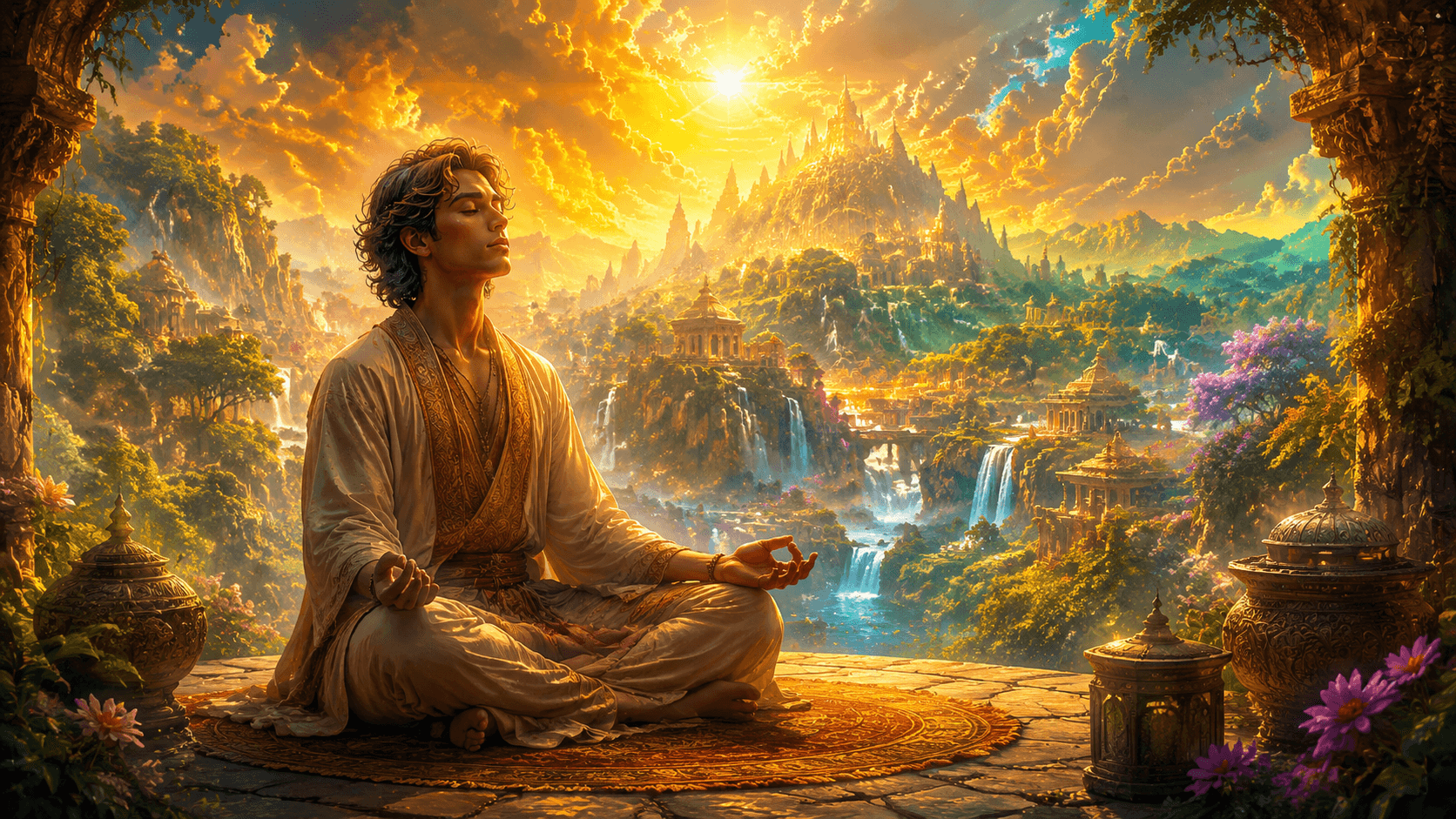
The connection between imagination, creativity, and calm is also supported by the growing field of imagination training research, which has shown that people who regularly exercise their imaginative capacity through reading, guided meditation, creative visualisation, or story engagement report lower baseline anxiety levels, higher emotional resilience, and greater life satisfaction than those who don't. Curiosity and imaginative engagement are, it turns out, natural antidotes to stress and story worlds are among the most effective delivery mechanisms for both.
Why did the ancient physician prescribe a long walk? Because he was tired of listening to the patient complain in his office.
How Immersive Audio Technology Brings Story Worlds to Life
The technology behind modern story world meditation has reached a level of sophistication that would have astonished practitioners even a decade ago. Contemporary audio meditation platforms combine multiple layers of technology to create experiences that are immersive, emotionally resonant, and crucially deeply calming. Understanding these layers helps explain why modern story world meditation is so much more effective than simply reading a relaxing passage or listening to ambient noise.
Spatial audio (binaural and ambisonics) creates the three dimensional soundscape placing sounds in specific positions around the listener to create the illusion of physical presence. Psychoacoustic design uses carefully calibrated frequencies, rhythms, and tonal qualities that are known to activate the parasympathetic nervous system the body's "rest and restore" mode. Narrative scripting employs proven storytelling techniques pacing, sensory detail, emotional arc, guided attention to maintain engagement while gradually deepening relaxation. And adaptive audio processing in advanced platforms adjusts the experience in real time based on the listener's engagement patterns.
Did You Know?
The relentless drive to understand the world was seen not just as an academic pursuit, but as a spiritual and healing practice by the ancients.
Visionaria integrates all of these elements across its 150+ narrative journeys from ancient Athenian temples and Norse mythological landscapes to fairy tale worlds and meditative nature environments each designed to produce a specific type of relaxation response while engaging the listener's imagination in ways that enrich rather than merely distract. The result is story world meditation that works with the brain's natural architecture rather than against it, producing deep, sustainable calm that listeners return to again and again.
"The progression from campfire storytelling to spatial audio meditation represents approximately 40,000 years of technological development, all in service of the same fundamental objective: helping the human brain calm down by giving it something beautiful to think about. We have gone from a person sitting by a fire saying 'Let me tell you about the time the hero visited the mountain of the gods' to a person sitting on their sofa with headphones experiencing the mountain of the gods in full three dimensional audio with archaeoacoustically accurate temple resonance. The sophistication of the delivery has changed enormously. The basic human need being served the need for narrative calm has not changed at all."
Why did the inventor of the wheel win an award? Because his idea really got things rolling.
The Future of Story-Based Mental Relaxation
The convergence of neuroscience, audio technology, narrative design, and wellness research is creating a future for story based relaxation that is extraordinarily promising. As our understanding of how the brain processes narrative deepens, and as the technology for delivering immersive story worlds becomes more sophisticated and accessible, the potential applications extend far beyond personal meditation into clinical mental health, education, workplace wellness, and elder care.
In clinical settings, story world meditation is already being explored as a complementary treatment for anxiety disorders, insomnia, chronic pain, and PTSD conditions where the mind's tendency to fixate on distressing thoughts is the primary obstacle to recovery. Early research suggests that narrative immersion can provide a safe cognitive alternative to rumination giving the mind a pleasant, engaging place to go instead of replaying distressing experiences while also building the emotional processing capacity needed for long term recovery. In workplace wellness, companies are beginning to offer story world meditation breaks as an alternative to traditional mindfulness sessions, recognising that employees who find silent meditation inaccessible respond enthusiastically to five minute narrative journeys through enchanted landscapes or ancient libraries.
Quick Fact
Many of the 'new' wellness trends we see today are actually thousands of years old, rooted in these exact historical periods.
The future also holds exciting developments in personalisation story worlds that adapt to individual preferences, emotional states, and relaxation goals in real time. Imagine a meditation journey through an ancient Greek sanctuary that adjusts its pacing based on your heart rate, deepens its sensory detail when it detects your immersion wavering, or introduces specific narrative elements (a wise character, a moment of beauty, a gentle surprise) precisely when the data suggests you need them most. This adaptive narrative meditation represents the next frontier and it is closer than most people realise. The story world has always been humanity's oldest relaxation technology. It may also be its most sophisticated future one.
"If the trajectory of the past forty millennia is any guide, human beings will still be using stories to relax long after every other current technology has been superseded, forgotten, or placed in a museum. Stories survived the transition from oral culture to literacy, from handwriting to printing, from print to radio, from radio to television, from television to the internet, and from the internet to immersive spatial audio and at each stage, the new technology made the stories more vivid, more immersive, and more relaxing, without ever changing their fundamental purpose: to give the human mind a beautiful place to rest. Forty thousand years from now, whatever medium humans are using to tell stories, the stories themselves will still be performing the same essential function. The brain has never found and, one suspects, will never find a better way to calm down than entering a world that someone has imagined for it with care, skill, and love."

The Psychology of Experiencing Stories in Meditation
Explore the psychology behind story-based meditation—how narrative activates the brain, builds empathy through mirror neurons, enhances emotional regulation, and transforms mindfulness practice through cinematic story...
A Roman walks into a bar, holds up two fingers, and says, 'Five beers, please.'
The Bottom Line
Story worlds improve mental relaxation because they work with the brain's natural architecture rather than against it. Narrative transportation the state of becoming absorbed in an imagined world redirects the mind from stress and rumination into focused, pleasurable, imaginatively rich calm. This is not a compromise or a shortcut; it is an intelligent application of what we now know about how human cognition works. From ancient Egyptian dream temples to modern spatial 3D audio, the principle has remained unchanged: give the mind a beautiful story world to inhabit, and it will naturally release its grip on worry.
Visionaria Insight
By immersing ourselves in these historical soundscapes, we reconnect with a timeless human tradition of storytelling and mental restoration.
Ready to experience it? Visionaria offers 150+ narrative audio journeys through ancient temples, mythological landscapes, and fantasy realms in spatial 3D audio. Free to download on iOS and Android. Continue reading: discover Why Fictional Worlds Feel So Real, explore Story Experiences and Emotional Resilience, or learn about Cinematic Meditation.
Experience More with Visionaria
Download the app to explore 150+ guided historical and wellness journeys.
A Roman walks into a bar, holds up two fingers, and says, 'Five beers, please.'