Why Fairy Tales Still Shape Imagination Today
✨ Fun fact: The Brothers Grimm published their first collection of fairy tales in 1812, but they didn't actually write most of them: they collected stories that had been passed down orally for centuries, sometimes millennia. They also kept editing the tales to make them "more suitable" for children, which is the 19th-century equivalent of applying content filters to ancient wisdom. Imagine explaining to a 5,000-year-old story that it needs to be more family-friendly. The story would have opinions.
- The Ancient Origins of Fairy Tales: Older Than Written Language
- The Psychology of Fairy Tales: Why Our Minds Crave These Stories
- Archetypes and Symbols: The Hidden Language of Fairy Tales
- How Fairy Tales Teach Emotional Resilience and Problem-Solving
- The Evolution of Fairy Tales Across Cultures and Centuries
- Fairy Tales and the Science of Imagination
- How Classic Fairy Tales Influence Modern Storytelling
- The Therapeutic Power of Fairy Tales
- Why Adults Need Fairy Tales as Much as Children
- How Immersive Audio Brings Fairy Tales to Life
- Experience Fairy Tales Through Visionaria
- The Bottom Line
- Frequently Asked Questions
Once upon a time four words that have opened doorways to enchanted worlds for thousands of years, spoken in every language, on every continent, by storytellers who understood that the human imagination needs fairy tales the way the body needs nourishment. From the fireside recitations of ancient oral cultures to the bedtime stories whispered in modern homes, fairy tales have served as humanity's most enduring technology for transmitting wisdom, building empathy, and expanding the boundaries of what the mind can envision. They are not merely children's entertainment they are psychological blueprints for navigating the full spectrum of human experience, encoded in a language of enchantment that speaks directly to the deepest layers of consciousness.
Fairy tales are narrative structures typically featuring enchantment, transformation, moral challenges, and resolution that have been transmitted across cultures for millennia and continue to shape how humans develop imagination, emotional intelligence, and creative thinking. Unlike myths (which explain cosmic origins) or legends (which recount the deeds of historical figures), fairy tales operate in a timeless symbolic space where ordinary people encounter extraordinary circumstances and discover capacities they didn't know they possessed. This definition matters because modern research in narrative transportation science and developmental psychology reveals that fairy tales are not quaint relics of pre literate culture they are precision instruments for cognitive and emotional development whose structures align with how the human brain naturally processes experience, forms memories, and constructs meaning. Through immersive spatial 3D audio, these ancient stories now reach listeners with unprecedented sensory richness, activating the same imaginative faculties that fairy tales have cultivated in human minds since before the invention of writing.
This article explores why fairy tales have endured for thousands of years examining their ancient origins, the psychology behind their extraordinary staying power, the archetypal symbols that give them universal resonance, their role in building emotional resilience, how they've evolved across cultures, and why modern science is confirming what storytellers have always known: that fairy tales are among the most powerful tools ever created for developing the human imagination. Whether you're drawn to classic tales of transformation, the intersection of storytelling and inner growth, or the science of why enchanted narratives feel so profoundly real, this journey through the world of fairy tales will transform how you understand the stories that shaped you.
"Fairy tales have survived for 6,000 years, outlasting empires, technologies, and entire civilizations. They've been told by firelight, printed on paper, animated for the big screen, and now delivered through spatial audio. The tales themselves would probably find this journey amusing: 'We started as campfire stories and ended up as 3D audio experiences. And humans still argue about whether the wolf was really that bad.' The wolf, for the record, has declined to comment."
Key Facts About Fairy Tales and Imagination
- ••Ancient Origins: Phylogenetic analysis by researchers at Durham University suggests that some fairy tale plots are 4,000-6,000 years old, predating written language, major world religions, and the earliest known civilizations, making fairy tales among humanity's oldest surviving cultural artifacts
- ••Universal Patterns: Over 500 distinct fairy tale types have been catalogued in the Aarne-Thompson-Uther (ATU) index, with variants of the same core stories appearing independently across cultures that had no historical contact, suggesting these narratives emerge from shared patterns of human cognition
- ••Brain Activation: Neuroimaging studies show that listening to fairy tales activates brain regions associated with empathy (mirror neuron system), mental simulation (default mode network), and emotional processing (amygdala and prefrontal cortex), engaging more cognitive systems simultaneously than almost any other narrative form
- ••Developmental Impact: Children who are regularly exposed to fairy tales demonstrate stronger empathy, more sophisticated moral reasoning, greater creative flexibility, and better emotional vocabulary compared to peers who primarily consume plot-driven entertainment without symbolic depth
- ••Therapeutic Applications: Fairy tale therapy (bibliotherapy and narrative therapy using fairy tale structures) is now used in clinical psychology, trauma recovery, and educational settings, with research showing measurable improvements in emotional regulation, self-concept, and resilience
- ••Modern Influence: The structural patterns of fairy tales (identified by Vladimir Propp's morphology) underpin the narrative frameworks of modern cinema, literature, video games, and immersive audio, from a famous space saga and modern wizard-school stories to Visionaria's spatial audio journeys
Quick Answer
✨ Fun fact: The Brothers Grimm published their first collection of fairy tales in 1812, but they didn't actually write most of them: they collected stories that had been passed down orally for centuries, sometimes millennia. They also kept editing the tales to make them "more suitable" for children, which is the 19th-century equivalent of applying content filters to ancient wisdom. Imagine explaining to a 5,000-year-old story that it needs to be more family-friendly. The story would have opinions.
The Ancient Origins of Fairy Tales: Older Than Written Language
The fairy tales we tell today are far older than most people realize and their antiquity reveals something profound about why they continue to shape imagination across generations. In 2016, researchers at Durham University and the University of Lisbon applied phylogenetic analysis (a technique borrowed from evolutionary biology) to trace the genealogy of fairy tales across Indo-European language groups. Their findings were extraordinary: some tale types, including "The Smith and the Devil" and variants of "Jack and the Beanstalk," appear to be 4,000 to 6,000 years old placing their origins in the Bronze Age, long before the earliest written texts, before the founding of Rome, before the construction of Stonehenge, and before the emergence of the world's major religions.
Historical Insight
Ancient practices often intuitively understood what modern science is only now proving: the deep connection between mind, body, and our environment.
This means that fairy tales are among humanity's oldest surviving cultural artifacts older than any building still standing, older than any written document, older than virtually every institution we take for granted. They survived not because anyone deliberately preserved them (there were no libraries, no publishers, no copyright law) but because they were so perfectly adapted to the human mind that each generation spontaneously chose to remember and retell them. The evolutionary success of fairy tales mirrors the evolutionary success of language itself: both emerged because they gave their users a significant cognitive advantage. Just as hidden monk temples preserved sacred knowledge through millennia, fairy tales preserved psychological wisdom through the far more fragile medium of human memory.
The oral transmission of fairy tales also explains their remarkable structural efficiency. Unlike literary stories, which can afford complexity and digression because they exist in written form, oral fairy tales had to be memorable enough to survive being told and retold across hundreds of generations without a single written word. This selective pressure produced narratives that are stripped to their psychological essentials every character, every event, every transformation serves a purpose. The princess locked in a tower, the youngest sibling who proves wiser than their elders, the magical helper who appears at the moment of greatest need these are not arbitrary plot devices but concentrated symbols of universal human experiences refined by millennia of retelling, much as the legendary quests of mythology distill the essence of the human journey into archetypal narrative.
Why did the inventor of the wheel win an award? Because his idea really got things rolling.
The Psychology of Fairy Tales: Why Our Minds Crave These Stories
The enduring power of fairy tales is not merely cultural it is neurological. When a listener encounters a fairy tale, their brain engages in a sophisticated process that neuroscientists call "narrative transportation": the conscious mind temporarily releases its grip on external reality, and the listener's sense of identity merges with the story's characters and world. Research published in the journal NeuroImage shows that during narrative transportation, the brain's default mode network (associated with self-reflection and imagination), mirror neuron system (associated with empathy), and emotional processing centers all activate simultaneously creating a whole brain experience that is more cognitively complex than most forms of real world engagement.
Fairy tales are particularly effective at triggering this state because of their symbolic simplicity. Unlike realistic fiction, which requires the brain to process complex social situations, ambiguous motivations, and nuanced character psychology, fairy tales present experience in its most distilled symbolic form: good and challenging, wise and foolish, enchanted and ordinary. This simplification is not a limitation it is what makes fairy tales so psychologically powerful. By reducing experience to its archetypal patterns, fairy tales allow the brain to process emotional material that might be overwhelming in realistic form. A child who cannot yet articulate their feelings about a new sibling can process those emotions through the story of Cinderella; an adult navigating a life transition can find their experience mirrored in the tale of a character who enters an enchanted forest and emerges transformed.
Visionaria Insight
By immersing ourselves in these historical soundscapes, we reconnect with a timeless human tradition of storytelling and mental restoration.
Bruno Bettelheim, in his landmark work The Uses of Enchantment, argued that fairy tales provide children with "existential messages" answers to the fundamental questions that every developing mind must grapple with: Am I capable of facing challenges? Can difficult situations improve? Is there meaning in struggle? Fairy tales consistently answer yes to all three questions, not through reassurance but through narrative demonstration: the protagonist faces genuine difficulty, uses their wits and courage, and achieves a positive outcome. This structure provides what psychologists call a "mastery narrative" a template for believing in one's own capacity to navigate adversity which research links to better stress management, stronger emotional resilience, and more optimistic life outlooks.
"Psychologists have spent decades studying why fairy tales are so effective at shaping the human mind, and they've concluded that these stories are basically ancient brain training programs. Goldilocks taught risk assessment. Jack and the Beanstalk taught entrepreneurship (dubious) and climbing skills (excellent). The Three Little Pigs taught materials engineering. And Red Riding Hood taught the importance of verifying identity before sharing personal information a lesson that is now called 'cybersecurity awareness.' The fairy tales saw it coming."
Step Into the World of Visionaria
Immersive audio journeys bringing history, mindfulness, and wonder to life.
A Roman walks into a bar, holds up two fingers, and says, 'Five beers, please.'
Archetypes and Symbols: The Hidden Language of Fairy Tales
One of the most remarkable features of fairy tales is their use of a symbolic language that transcends cultural boundaries. The enchanted forest, the wise old woman, the magical transformation, the glass slipper, the spinning wheel, the golden key these images appear in fairy tales from cultures that had no contact with each other, suggesting that they emerge from shared patterns of human cognition rather than from any single cultural tradition. Carl Jung identified these recurring symbols as archetypes universal patterns embedded in what he called the "collective unconscious" and argued that fairy tales are the purest expression of archetypal psychology available in human culture.
Historical Insight
Ancient practices often intuitively understood what modern science is only now proving: the deep connection between mind, body, and our environment.
The enchanted forest, perhaps the most universal fairy tale setting, serves as a symbol of the unconscious mind itself the unknown interior landscape where the familiar rules of everyday life no longer apply and where genuine transformation becomes possible. When a fairy tale character enters the forest, they are symbolically entering a journey inward leaving behind the known world to encounter aspects of themselves that have been hidden, neglected, or undeveloped. The challenges they face in the forest (the tricky riddle, the helpful animal, the dangerous enchantment) represent the psychological tasks of self-discovery: learning to trust intuition, recognizing hidden allies, and finding courage in unfamiliar territory.
Transformation is the central archetype of fairy tales, and it takes countless forms: frogs become princes, pumpkins become carriages, ragged clothes become ball gowns, and ordinary youngest children reveal themselves as the wisest of all. These transformations speak to the deep human intuition that identity is not fixed that circumstances can change, that hidden potential can be revealed, and that the gap between who we are and who we might become is bridgeable. This is the same principle that underlies modern visualization and meditation practices: the understanding that imagining a different state of being is the first step toward achieving it. Fairy tales have been teaching this principle for six thousand years modern psychology is simply catching up.
A time traveler went back to antiquity to teach them about 'holistic health.' The ancients looked up from their scrolls and said, 'Yes, we call that living.'
How Fairy Tales Teach Emotional Resilience and Problem-Solving
Fairy tales are, at their core, stories about overcoming obstacles and this makes them uniquely powerful tools for developing emotional resilience. In a typical fairy tale, the protagonist faces a sequence of increasingly difficult challenges: an impossible task set by a ruler, a riddle posed by a guardian, an enchantment that must be broken through cleverness rather than force. The protagonist succeeds not through superior physical strength but through qualities that every listener can develop: kindness, perseverance, creative thinking, willingness to accept help, and the courage to act despite uncertainty.
Research in developmental psychology confirms that exposure to fairy tales strengthens children's capacity for emotional regulation. The researchers concluded that fairy tales function as "emotional simulations" safe environments where children can vicariously experience fear, disappointment, injustice, and uncertainty, and then observe how these challenging emotions can be navigated successfully. This is the same principle that makes story-based meditation effective for adults.
Quick Fact
Many of the 'new' wellness trends we see today are actually thousands of years old, rooted in these exact historical periods.
The fairy tale's characteristic "happy ending" plays a crucial but often misunderstood role in this process. Critics sometimes dismiss fairy tale endings as unrealistic or overly optimistic, but developmental psychologists argue that the resolution serves a specific psychological function: it provides the listener with a template of hope not the naive belief that everything always works out, but the deeper conviction that effort, ingenuity, and moral courage can lead to positive outcomes even in seemingly impossible circumstances. This is not wishful thinking; it is the psychological foundation of agency the belief in one's capacity to influence outcomes which research consistently identifies as one of the strongest predictors of mental health, academic achievement, and life satisfaction across all age groups.
"Fairy tales have been teaching resilience for thousands of years with a remarkably consistent methodology: throw the protagonist into an impossible situation, take away every obvious advantage, and then watch as they figure it out using nothing but cleverness, kindness, and occasionally a talking animal. Modern resilience training programs have more PowerPoint slides but fundamentally the same message. The fairy tales, however, have better characters. Nobody tells bedtime stories about PowerPoint."
A Roman walks into a bar, holds up two fingers, and says, 'Five beers, please.'
The Evolution of Fairy Tales Across Cultures and Centuries
One of the most fascinating aspects of fairy tales is how the same core stories appear across radically different cultures often in versions so similar that they seem to share a common ancestor, yet with local variations that reveal the unique values and concerns of each society. The Cinderella story alone has been documented in over 700 variants worldwide: from the Chinese "Ye Xian" (recorded around 850 CE, making it the earliest known written version) to the Egyptian tale of Rhodopis, the German version collected by the Brothers Grimm, the French retelling by Charles Perrault, and indigenous versions from cultures across Africa, Southeast Asia, and the Americas. Each version preserves the core structure a worthy person in humble circumstances achieves recognition and transformation through a combination of inner virtue and magical assistance while adapting the details to local context.
Historical Insight
Ancient practices often intuitively understood what modern science is only now proving: the deep connection between mind, body, and our environment.
This cross-cultural proliferation suggests that fairy tales don't just reflect culture they help create it. Anthropologist Jack Zipes argues that fairy tales have functioned throughout history as a "civilizing discourse" a way for communities to encode and transmit their values, model desired behaviors, and process collective experiences through symbolic narrative. When a culture tells and retells a fairy tale, it is simultaneously preserving ancient wisdom and adapting it to contemporary circumstances a process that mirrors how ancient sacred traditions preserved their core teachings while evolving across centuries.
Read more: The Secrets of the Processional Way in Babylon: Sacred Route, Ishtar Gate & Ancient Wonders
The written literary fairy tale, which emerged in 17th century France with authors like Charles Perrault and Madame d'Aulnoy, added new dimensions to this ancient oral tradition. These salon fairy tales (contes de fées, which gave the genre its name) were sophisticated literary works aimed at adult audiences, using the fairy tale form to explore questions of gender, class, and power in the reign of Louis XIV. The Brothers Grimm in 19th century Germany brought a different approach collecting and publishing oral tales as expressions of folk wisdom and national identity. Each era has reimagined fairy tales for its own purposes while preserving their essential psychological architecture, demonstrating a remarkable adaptability that continues in modern immersive storytelling formats.
Why did the historian break up with the archaeologist? Because her career was literally in ruins.
Fairy Tales and the Science of Imagination
Modern neuroscience is revealing that fairy tales don't merely entertain the imagination they actively develop it. When a child hears "Once upon a time, in a land far away, there lived a princess in a tower surrounded by thorns," their brain must construct an entire world from scratch: the tower's shape and color, the landscape surrounding it, the quality of light, the texture of the thorns, and the emotional state of the princess within. This process of mental world building engages the same neural networks used for planning, empathy, creative problem solving, and future-oriented thinking making fairy tales one of the most comprehensive cognitive exercises available to the developing brain.
Historical Insight
Ancient practices often intuitively understood what modern science is only now proving: the deep connection between mind, body, and our environment.
Historical Insight: Cognitive psychologist Keith Oatley at the University of Toronto has argued that narrative fiction works as a kind of "flight simulator for social life," letting readers practise understanding other people. When listeners enter a fairy tale, their brains simulate the emotions, decisions, and social interactions of the characters using the same neural systems they would employ in real situations. This simulation provides low risk practice for emotional and social skills that would be costly to develop through real world trial and error alone. The implications for imagination and creativity are profound: fairy tales literally expand the range of scenarios the brain has "experienced," making listeners more cognitively flexible and more prepared for novel situations.
Particularly fascinating is the role fairy tales play in developing "counterfactual thinking" the ability to imagine how things could be different from how they are. When fairy tales present worlds where animals talk, pumpkins become carriages, and invisible cloaks grant concealment, they are training the brain's capacity to entertain possibilities beyond immediate reality. This capacity is the cognitive foundation of all innovation, scientific hypothesizing, and creative endeavor. Einstein himself attributed his greatest insights to "thought experiments" essentially, fairy tales for physics. As explored in Einstein's approach to curiosity, the imaginative capacity he relied upon was precisely the capacity that fairy tales cultivate from early childhood.
"Scientists have confirmed that listening to fairy tales is basically a full body workout for the brain. Your default mode network handles imagination, your mirror neurons handle empathy, your prefrontal cortex handles moral reasoning, and your amygdala handles the emotional stakes of whether Hansel and Gretel will find their way home. All this from a story about a house made of candy. The human brain is remarkable. The candy architecture, however, remains structurally questionable."
A Roman walks into a bar, holds up two fingers, and says, 'Five beers, please.'
How Classic Fairy Tales Influence Modern Storytelling
The structural DNA of fairy tales is embedded in virtually every form of modern storytelling from blockbuster films and bestselling novels to video games and immersive audio experiences. In 1928, Russian folklorist Vladimir Propp analyzed a corpus of Russian fairy tales and identified 31 "narrative functions" that appeared in consistent sequence across stories that seemed superficially different. These functions the hero's departure, the encounter with a donor, the receipt of a magical agent, the confrontation with an adversary, the hero's transformation form a universal narrative grammar that modern storytellers continue to employ, often unconsciously.
Visionaria Insight
By immersing ourselves in these historical soundscapes, we reconnect with a timeless human tradition of storytelling and mental restoration.
Joseph Campbell's concept of the "monomyth" or Hero's Journey which he developed partly from Propp's fairy tale analysis became the most influential storytelling framework in modern entertainment. Filmmakers have openly credited Campbell's work as the structural foundation of a famous space saga; leading animation studios build their story development process around fairy tale structures; and a famous wizard-school series follows fairy tale patterns so closely that scholars have identified it as a modern fairy tale in novel form. The orphan who discovers extraordinary abilities, the magical school hidden from the ordinary world, the wise mentor, the shape shifting trickster, the transformative quest these are all fairy tale elements operating in contemporary clothing.
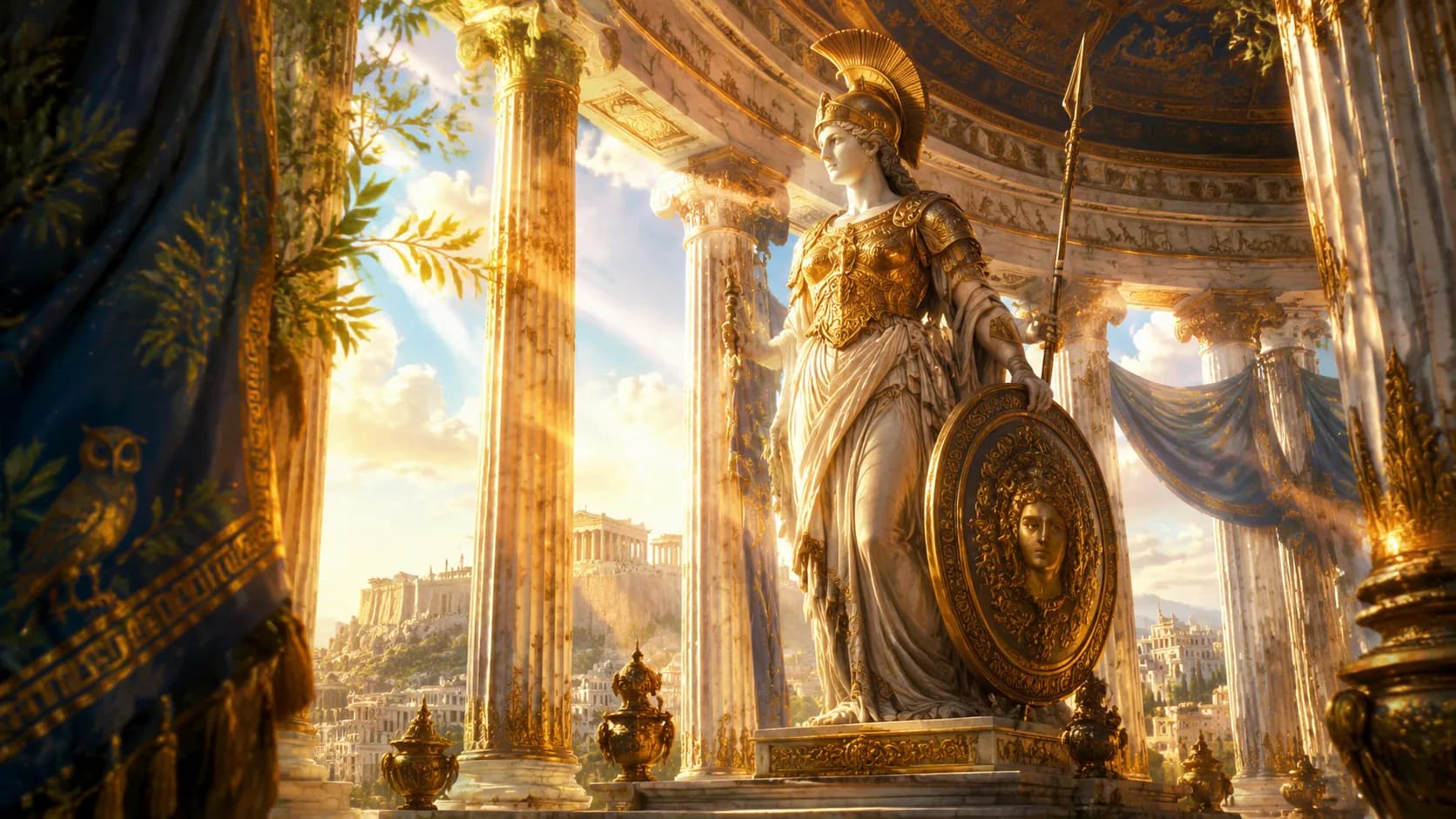
Read more: Athena and the Wisdom of the Ancient World
What's particularly significant is how fairy tale structures work in immersive and interactive media. Video games like fantasy adventure games and Dark Souls use fairy tale patterns to create meaningful player experiences: the enchanted world, the escalating challenges, the magical tools, the transformative journey. Similarly, story-based meditation and immersive audio experiences draw on fairy tale structures to create narratives that listeners don't just observe but inhabit stepping into the role of the protagonist and experiencing the tale's transformation from within. The fairy tale's ancient genius for engaging the imagination has found its most powerful modern expression in formats that dissolve the boundary between storyteller and listener.
Why did the inventor of the wheel win an award? Because his idea really got things rolling.
The Therapeutic Power of Fairy Tales
The use of fairy tales in therapeutic contexts sometimes called fairy tale therapy or narrative bibliotherapy has grown significantly as research confirms what intuitive healers have known for millennia: stories can help people process difficult experiences, develop new perspectives on their challenges, and access emotional resources they didn't know they possessed. In clinical settings, therapists use fairy tales to help clients externalize internal struggles mapping personal difficulties onto symbolic characters and events, which creates psychological distance and makes challenging emotions more manageable.
Did You Know?
The relentless drive to understand the world was seen not just as an academic pursuit, but as a spiritual and healing practice by the ancients.
Research published in The Arts in Psychotherapy found that fairy tale-based therapeutic interventions produced measurable improvements in emotional regulation, self-concept, and anxiety levels among participants ranging from young children to elderly adults. The effectiveness crosses age groups because fairy tales operate at a level of psychological depth that transcends developmental stage the symbols speak to universal human experiences regardless of the listener's age, education, or cultural background. A 70 year old facing retirement and a 7 year old facing a new school can both find their experience mirrored in the tale of a character who must leave their familiar home and venture into unknown territory.
Particularly notable is the growing use of fairy tales in trauma recovery. Trauma disrupts the brain's capacity to create coherent narratives about experience leaving memories fragmented, emotions disconnected from context, and the sense of personal agency diminished. Fairy tales provide ready-made narrative structures that can help trauma survivors reorganize their experience: the concept of enchantment (feeling trapped or transformed against one's will), the journey through darkness (processing difficult experiences), and the breaking of the spell (recovery and renewed agency) all map meaningfully onto the trauma recovery process. This narrative approach to healing connects to the broader field of story-based emotional resilience, where structured narratives provide frameworks for psychological growth and recovery.
"Therapists are now formally prescribing fairy tales as treatment, which means that 'Read Cinderella and call me in the morning' is an actual therapeutic approach. The fairy tales are reportedly delighted by this professional recognition. After 6,000 years of working in the field without credentials, they've finally been validated by peer-reviewed research. 'We always knew we were therapeutic,' said Cinderella, metaphorically. 'We just didn't have the paperwork.'"
A Roman walks into a bar, holds up two fingers, and says, 'Five beers, please.'
Why Adults Need Fairy Tales as Much as Children
There is a persistent cultural assumption that fairy tales are "for children" but this assumption is historically recent and psychologically unfounded. For most of their 6,000 year history, fairy tales were told by adults, for adults, as part of communal storytelling traditions that served the entire community. The idea that fairy tales belong exclusively to childhood emerged primarily in the 19th century, when the Grimm brothers and other collectors began marketing their compilations as children's literature. The original audiences for these stories the peasants and villagers who told them around fires, the salon aristocrats who refined them into literary art would have been astonished by the suggestion that fairy tales were only for the young.
Did You Know?
The relentless drive to understand the world was seen not just as an academic pursuit, but as a spiritual and healing practice by the ancients.
Modern psychology supports what ancient storytellers knew: adults benefit from fairy tales in ways that are distinct from but equally important as children's benefits. For adults, fairy tales serve as what psychoanalyst Marie-Louise von Franz called "mirrors of the soul" symbolic narratives that reflect the listener's own psychological situation back to them in a form that bypasses the ego's defenses and speaks directly to the unconscious. An adult who feels stuck in a joyless career may find profound resonance in the tale of a character trapped under an enchantment; an adult navigating a difficult relationship may recognize their situation in a story about breaking a curse through patience and understanding. The fairy tale doesn't tell the adult what to do it activates their own inner wisdom by presenting their situation in symbolic form, engaging the same psychological processes that guided imagination journeys use to facilitate personal insight.
The adult relationship with fairy tales also offers something that purely rational approaches to self-understanding cannot: access to the poetic and numinous dimensions of experience. In a culture that increasingly values data, metrics, and evidence-based reasoning, fairy tales preserve a way of knowing that operates through symbol, metaphor, and emotional truth. They remind adults that the world is more mysterious, more beautiful, and more full of possibility than any spreadsheet can capture a message that, far from being childish, is one of the most psychologically sophisticated insights available. As G.K. Chesterton wrote, "Fairy tales do not tell children the dragons exist. Children already know that dragons exist. Fairy tales tell children the dragons can be overcome." The same is true for adults perhaps even more so.
A philosopher walked into a wall. His students asked if it hurt. He replied, 'The wall is an illusion, but my headache is quite real.'
How Immersive Audio Brings Fairy Tales to Life
Fairy tales were born as spoken stories and the transition from oral tradition to printed text, while preserving their content, inevitably diminished their most powerful dimension: the immersive, multisensory experience of hearing a tale performed in a living voice, surrounded by the sounds of a communal space. When a medieval storyteller performed a fairy tale by firelight, the audience didn't just process words they heard the crackle of flames, felt the warmth, saw the shadows dance on walls, and experienced the collective energy of other listeners. The story existed not as text but as living experience and it was this experiential quality that gave fairy tales their transformative power.
Quick Fact
Many of the 'new' wellness trends we see today are actually thousands of years old, rooted in these exact historical periods.
Immersive spatial 3D audio technology restores this experiential dimension and extends it far beyond what any fireside performance could achieve. Through binaural recording and spatial audio processing, a fairy tale journey can place the listener inside the enchanted forest: hearing branches snap behind them, a stream murmuring to their left, birdsong overhead, and the distant sound of a mysterious tower's bell ahead. The narrator's voice can move around the listener, shift in perspective, and blend with environmental sounds that create a three-dimensional story worldthat the brain experiences as genuinely present. Spatial audio can add a strong sense of presence compared with conventional stereo, closing some of the gap between hearing a story and living inside one. Fairy tale narratives and spatial audio work well together because both draw the listener into the scene.
Fairy tales engage the imagination through symbolic storytelling; spatial audio engages the imagination through environmental immersion. Together, they create experiences that are more psychologically engaging than either could achieve alone activating not just the language processing and narrative comprehension systems that reading engages, but also the spatial awareness, emotional resonance, and embodied presence systems that characterize direct experience. This is why Visionaria's fairy tale journeys can produce the sense of genuinely stepping into an enchanted world because the brain's systems for distinguishing story from reality are being engaged in ways that printed text cannot match, creating the same immersive states that ancient sacred spaces were designed to produce.
"For 6,000 years, the most immersive fairy tale technology available was a skilled storyteller, a fire, and a dark night. Now we have spatial 3D audio, binaural processing, and noise-cancelling headphones. The storyteller has been upgraded. The fire has been replaced by ambient sound design. The dark night has been replaced by a comfortable couch. Only one thing hasn't changed: the moment the story begins, the listener disappears into the tale. The technology changes. The magic stays the same."
An Epicurean, a Stoic, and a Cynic walk into a garden. The bartender says, 'Is this some kind of philosophical joke?'
Experience Fairy Tales Through Visionaria
Everything this article has explored the ancient origins, the psychology, the archetypes, the emotional resilience, the cultural evolution, and the science of imagination converges in Visionaria's immersive audio journeys. Each journey draws on the narrative structures that fairy tales have refined over millennia, presented through spatial 3D audio that transforms listening into living. You don't passively receive the story you step into it, surrounded by its soundscape, immersed in its world, and engaged with its challenges and revelations in a way that activates the full spectrum of cognitive and emotional systems that fairy tales were designed to engage.
Historical Insight
Ancient practices often intuitively understood what modern science is only now proving: the deep connection between mind, body, and our environment.
With immersive journeys spanning enchanted realms, legendary quests, ancient sacred sites, encounters with history's most fascinating minds, and explorations of mythological worlds, Visionaria continues the tradition that fairy tales began six thousand years ago: using the power of narrative to expand the imagination, develop emotional wisdom, and connect listeners to the deepest patterns of human experience. The fairy tale tradition has always been about doorways and Visionaria opens them wider than ever before.
The storytellers who first told fairy tales around ancient fires understood something that modern neuroscience is only now confirming: the right story, told in the right way, can change how you see the world and your place in it. For millennia, that required a storyteller and a fire. Today, it requires Visionaria and a pair of headphones and the enchantment that has shaped human imagination since the Bronze Age is as close as your next listen.
"After 6,000 years of continuous service, fairy tales remain the undisputed champions of imagination development outlasting every competitor, every technology, and every cultural shift. They've survived the printing press, radio, television, the internet, social media, and streaming services. At this point, the fairy tales are basically immortal. And they're still accepting new listeners. No subscription required. No algorithm. Just 'once upon a time' and an open mind. The oldest technology for the imagination still works. It always has."

The Trojan War Stories That Shaped Greek Mythology
Discover the Trojan War stories that shaped Greek mythology, from the Judgment of Paris and Helen of Troy to Achilles, Odysseus, the Trojan Horse, the role of the gods, Homer's epic legacy, archaeological discoveries a...
Why did the inventor of the wheel win an award? Because his idea really got things rolling.
The Bottom Line
Fairy tales still shape imagination today because they are perfectly designed for the human brain encoding universal patterns of challenge, transformation, and hope in symbolic language that activates deep neurological pathways associated with empathy, creativity, emotional resilience, and meaning making. From their origins 4,000-6,000 years ago to their modern expression in immersive audio, fairy tales have persisted not through tradition alone but because they serve a fundamental cognitive and emotional need that no other narrative form addresses as effectively.
Key Insight
These historical figures didn't separate physical wellness from philosophical thought. To them, it was all one continuous practice of living well.
For those seeking to reconnect with the transformative power of enchanted storytelling, Visionaria offers immersive spatial 3D audio journeys that bring fairy tale worlds to life. Continue exploring: discover The Story Behind Beauty and the Beast, explore The Most Legendary Quests in Mythology, or learn about Why Fictional Worlds Feel So Real to Readers.
Experience More with Visionaria
Download the app to explore guided historical and wellness journeys.
An Epicurean, a Stoic, and a Cynic walk into a garden. The bartender says, 'Is this some kind of philosophical joke?'
This article is for educational and informational purposes only. Historical details are based on available research and may evolve as new evidence emerges.
Visionaria journeys are designed for relaxation, guided imagination, and personal enrichment. They are not a substitute for medical, mental health, legal, or professional advice.