The Secrets of the Processional Way in Babylon: Sacred Route, Ishtar Gate & Ancient Wonders
Fun fact: Discover the secrets of Babylon's legendary Processional Way, from the magnificent Ishtar Gate to sacred festivals. Explore the glazed brick marvels, architectural wonders, and cultural legacy of ancient Mesopotamia's most spectacular ceremonial route.
- 1 What Was the Processional Way of Babylon?
- 2 The Historical Context: Nebuchadnezzar's Vision
- 3 The Ishtar Gate: Gateway to Wonder
- 4 Sacred Architecture and Engineering Wonders
- 5 The Glazed Brick Masterpieces
- 6 The Akitu Festival: A Journey of Renewal
- 7 Religious Significance and Divine Processions
- 8 Archaeological Discovery and Excavation
- 9 Modern Reconstructions: Berlin and Beyond
- 10 Cultural Legacy and Lasting Influence
- 11 Experiencing the Processional Way Today
- Frequently Asked Questions
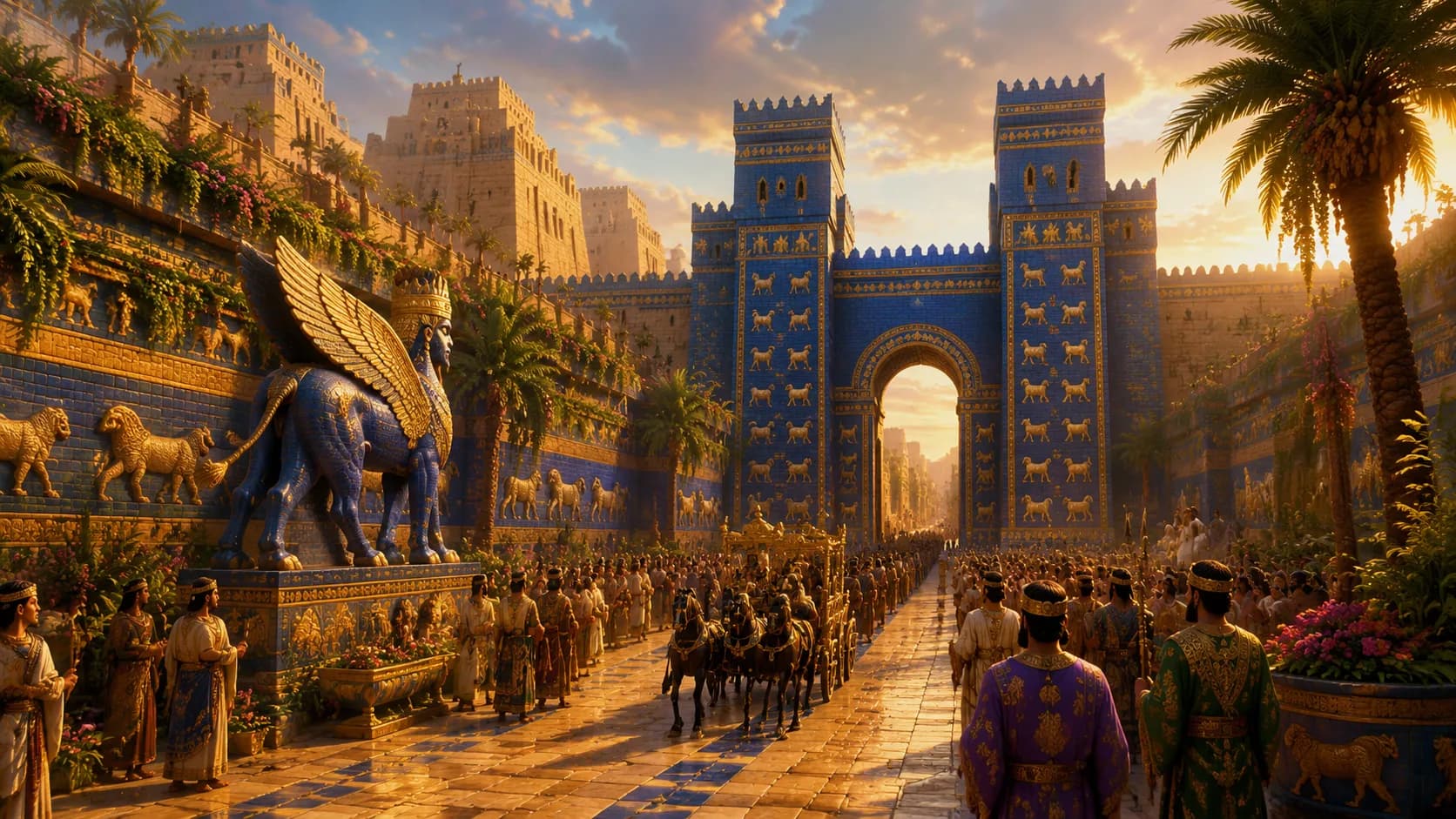
The Processional Way of Babylon stands as one of ancient Mesopotamia's most magnificent architectural achievements a sacred ceremonial boulevard stretching over 800 meters from the stunning Ishtar Gate through the heart of Babylon to its holiest temples. Built during the reign of King Nebuchadnezzar II (605-562 BCE), this extraordinary street was adorned with over 120 striding lions rendered in brilliant glazed bricks of blue, yellow, and white, creating a corridor of divine artistry that has captivated historians, archaeologists, and dreamers for millennia. Today, this legendary route serves as the immersive setting for Visionaria's Babylon audio journey, where spatial audio technology transports you back to experience the grandeur of this ancient wonder.
Key Facts About the Processional Way
- •Length & Scale: The Processional Way stretched approximately 800-1000 meters (half a mile) with walls reaching up to 12 meters high, creating an awe-inspiring ceremonial corridor.
- •Construction Era: Built primarily during King Nebuchadnezzar II's reign (605-562 BCE) as part of his massive building program that transformed Babylon into the ancient world's greatest city.
- •Artistic Masterpiece: Over 120 striding lions in glazed brick relief lined the walls, along with dragons and bulls on the Ishtar Gate, all rendered in brilliant blues, yellows, and whites using advanced glazing techniques.
- •Sacred Purpose: The route served as the ceremonial pathway for the twelve-day Akitu (New Year) Festival, when the statue of Marduk was carried from the Esagila temple to the Akitu house outside the city.
- •Modern Discovery: German archaeologist Robert Koldewey excavated the Processional Way from 1899-1917, with reconstructions now featured at Berlin's Pergamon Museum and in Iraq.
- •Engineering Wonder: The street featured sophisticated drainage systems, limestone paving, and walls built with fired clay bricks, showcasing Babylon's advanced engineering capabilities.
- •Cultural Legacy: The Processional Way influenced urban design and ceremonial architecture across the ancient Near East and continues to inspire modern architects, artists, and storytellers worldwide.
Quick Answer
Discover the secrets of Babylon's legendary Processional Way, from the magnificent Ishtar Gate to sacred festivals. Explore the glazed brick marvels, architectural wonders, and cultural legacy of ancient Mesopotamia's most spectacular ceremonial route.
1 What Was the Processional Way of Babylon?
Imagine standing at the threshold of ancient Babylon during the height of its power in the 6th century BCE. Before you stretches the Processional Way a breathtaking ceremonial boulevard that represents the pinnacle of Mesopotamian architectural achievement. This wasn't merely a street; it was a sacred pathway connecting the earthly and divine realms, a stunning display of royal power, and an artistic masterpiece that would influence urban design for millennia to come.
The Processional Way began at the magnificent Ishtar Gate a towering entrance adorned with brilliant blue glazed bricks depicting dragons and bulls in golden hues. From this monumental gateway, the route stretched southward through Babylon's inner city for approximately 800 to 1,000 meters (roughly half a mile), terminating at the Esagila temple complex, the earthly residence of Marduk, Babylon's patron deity, and the nearby ziggurat Etemenanki, believed by many scholars to be the inspiration for the Biblical Tower of Babel.
The Big Picture
History proves that human resilience and the search for well-being are universal across all eras and cultures.
What made this route truly extraordinary was its decoration. The walls flanking the Processional Way rose up to 12 meters high (approximately 40 feet), creating an enclosed corridor that amplified the sense of awe and sacred purpose. These towering walls were faced with over 120 striding lions rendered in molded glazed brick relief each lion measuring about 2 meters in length and shown in profile, walking toward the temple district. The lions, sacred to the goddess Ishtar, were rendered in vivid yellow and white against backgrounds of brilliant blue, creating a mesmerizing visual rhythm that guided processional participants toward their sacred destination.
The street itself was paved with limestone and breccia slabs, polished smooth by countless footsteps over the centuries. Beneath this surface ran sophisticated drainage systems designed to channel away the seasonal flooding from the nearby Euphrates River an engineering feat that showcased Babylon's advanced urban planning. The entire construction demonstrated King Nebuchadnezzar II's ambition to create not just a functional thoroughfare, but a transformative experience that would inspire awe in every visitor, diplomat, and worshipper who walked its length.
Today, you can experience the wonder of walking this legendary route through Visionaria's immersive Babylon journey, where spatial audio technology and vivid storytelling transport you back to the height of Babylon's glory. Feel the presence of those ancient lions, hear the sounds of sacred processions, and witness the grandeur that made Babylon one of the Seven Wonders of the Ancient World.

"Though you could technically drive a chariot down it, we recommend walking better for appreciating the lions and also for your meditative state."
Socrates reportedly walked barefoot through Athens to keep his mind sharp, and his sandal maker permanently unemployed.
2 The Historical Context: Nebuchadnezzar's Vision
The Processional Way reached its magnificent final form during the reign of Nebuchadnezzar II (605-562 BCE), one of ancient Mesopotamia's most ambitious and accomplished rulers. When Nebuchadnezzar ascended to the throne of the Neo-Babylonian Empire, he inherited a city that was already ancient and venerable, but he dreamed of transforming it into something unprecedented the greatest metropolis the world had ever seen.
Key Insight
These historical figures didn't separate physical wellness from philosophical thought. To them, it was all one continuous practice of living well.
Nebuchadnezzar's building program was staggering in its scope and ambition. He constructed or renovated the famous Hanging Gardens of Babylon (one of the Seven Wonders of the Ancient World), rebuilt the ziggurat Etemenanki to reach skyward heights, fortified the city with massive defensive walls, and commissioned the Processional Way and Ishtar Gate as the crown jewels of his urban redesign. Contemporary inscriptions found on bricks throughout the route credit him directly: "Nebuchadnezzar, King of Babylon, the pious prince, who has paved the street with precious stones for the procession of the great lord Marduk."
This building frenzy wasn't mere vanity it served multiple strategic purposes. First, it demonstrated Babylon's wealth and power to visiting dignitaries and potential rivals, creating a psychological deterrent against aggression. Second, it honored the gods (particularly Marduk) and reinforced the king's role as their earthly representative, legitimizing his divine mandate to rule. Third, it provided employment for thousands of craftsmen, laborers, and artists, creating economic prosperity and social stability. The Processional Way embodied all these purposes in a single stunning architectural statement.
The choice of the Processional Way's route was deeply symbolic. It connected the outer world (represented by the Ishtar Gate at the northern city wall) with the inner sanctum (the Esagila temple and Etemenanki ziggurat), creating a physical manifestation of the journey from the mundane to the sacred. Every element was carefully planned: the rising elevation as you approached the temple district symbolized ascending toward the divine, while the narrowing of the passage created an increasingly focused spiritual experience.
Archaeological evidence suggests that earlier versions of processional routes existed in Babylon before Nebuchadnezzar's time, but he expanded and glorified them beyond recognition. His inscriptions make clear his intention to create something eternal: "I built high gates of cedar wood adorned with bronze, and I laid down thresholds and door sills of bronze. Mighty wild bulls and fearsome serpents I fashioned." The result was a street that would remain functional and awe-inspiring for centuries, even after Babylon's political power waned following the Persian conquest in 539 BCE.
Understanding this historical context enriches your experience of Visionaria's Babylon journey, where you'll walk in the footsteps of Nebuchadnezzar himself during the city's golden age. You'll witness the realization of his grand vision and understand how this single street embodied an entire civilization's highest aspirations.
"Nebuchadnezzar's building budget was so massive, his accountants probably needed their own ziggurat to store the paperwork."

Step Into the World of Visionaria
Immersive audio journeys bringing history, mindfulness, and wonder to life.
Why did the inventor of the wheel win an award? Because his idea really got things rolling.
3 The Ishtar Gate: Gateway to Wonder
The Ishtar Gate served as the magnificent entrance to the Processional Way, and it remains one of the most recognizable symbols of ancient Mesopotamian civilization. Rising approximately 12 meters high (some estimates suggest the original may have been even taller), this monumental gateway was dedicated to Ishtar, the powerful goddess of love, fertility, and divine strength one of the most important deities in the Babylonian pantheon.
What made the Ishtar Gate breathtaking was its use of glazed brick technology at an unprecedented scale. The entire surface was covered in brilliant lapis lazuli blue glazed bricks, creating a shimmering facade that would have been visible from great distances. Against this deep blue background, approximately 575 animal figures were arranged in alternating rows: dragons (known as mushussu, associated with the god Marduk) and aurochs or bulls (associated with the weather god Adad). These creatures were rendered in raised relief and glazed in contrasting colors yellow, white, and brown creating a stunning visual effect that seemed almost three-dimensional.
The gate wasn't a single structure but rather a double gate system with an outer gateway and an inner gateway, connected by a passage approximately 48 meters long. This created a threshold experience: as visitors passed through the outer gate, they entered a liminal space no longer in the outside world, but not yet in the sacred city. The passage walls were also decorated with the same brilliant glazed bricks, intensifying the sense of entering a divine realm. The entire experience was carefully choreographed to inspire awe and reinforce the sacred nature of what lay beyond.
Visionaria Insight
By immersing ourselves in these historical soundscapes, we reconnect with a timeless human tradition of storytelling and mental restoration.
Inscriptions on the Ishtar Gate credit Nebuchadnezzar II directly with its construction and explain his motivations: "I placed wild bulls and ferocious dragons in the gateways and thus adorned them with luxurious splendor so that people might gaze on them in wonder." This explicit intention to create wonder reveals the psychological and spiritual purposes behind the gate's extraordinary artistry. It wasn't decoration for decoration's sake it was architectural theater designed to transform the consciousness of everyone who passed through.
The gate also served practical defensive purposes. Its massive cedar wood doors (no longer extant) could be closed and barred, while the double gate design created a defensive trap where invaders could be contained and attacked from above. The combination of beauty and functionality exemplified Babylonian architectural philosophy, where sacred, aesthetic, and practical concerns were seamlessly integrated.
Today, the most complete reconstruction of the Ishtar Gate stands in Berlin's Pergamon Museum, assembled from original bricks excavated by Robert Koldewey and transported to Germany in the early 20th century. While controversial, this reconstruction has allowed millions of visitors to experience the gate's overwhelming beauty. A smaller replica also stands at the archaeological site in Iraq. Through Visionaria's Ishtar Gate journey, you can experience passing through this legendary gateway in its original context, complete with spatial audio that recreates the sounds of ancient Babylon during its golden age.
"The Ishtar Gate was essentially ancient Babylon's way of saying 'Welcome!' with 575 blue tiled animals because a simple doormat would have been insufficient."
Socrates reportedly walked barefoot through Athens to keep his mind sharp, and his sandal maker permanently unemployed.
4 Sacred Architecture and Engineering Wonders
The Processional Way represented the zenith of Babylonian engineering and architectural innovation. Every aspect of its construction from the foundation to the decorative elements demonstrated sophisticated technical knowledge that would not be surpassed in the region for many centuries. Understanding these engineering marvels helps us appreciate not just the aesthetic beauty of the route, but the extraordinary technical achievement it represented.
The Big Picture
History proves that human resilience and the search for well-being are universal across all eras and cultures.
The foundation of the Processional Way was carefully engineered to handle both the weight of the massive walls and the challenges posed by Babylon's geography. The city sat in a flood plain near the Euphrates River, meaning that seasonal flooding and high groundwater presented constant challenges. Babylonian engineers addressed this by creating deep foundations using layers of baked bricks set in bitumen (natural tar), creating a waterproof barrier. Above this, they built up the street level using compacted earth and gravel, ensuring proper drainage and stability.
The street surface itself was paved with limestone and breccia slabs a relatively rare and expensive choice that demonstrated the route's importance. These stones were carefully cut and fitted together, creating a smooth, durable surface that could withstand heavy processional traffic. Inscriptions on some of these paving stones include more of Nebuchadnezzar's declarations: "The Processional Way of Babylon I filled with a high filling for the procession of Marduk, my lord, and with Turumanabanda stones and Shadu stones I made the Processional Way from the Ishtar Gate to the south."
Beneath the visible street ran an intricate drainage system channels and conduits designed to collect rainwater and groundwater seepage and direct it away from the foundations. This system connected to larger canals that channeled excess water back to the Euphrates, preventing the undermining of the street and walls. The sophistication of this hidden infrastructure reveals that Babylonian engineers understood principles of hydrology and urban water management that would be lost and rediscovered multiple times in subsequent millennia.
The walls flanking the Processional Way rose to heights of up to 12 meters and were built using millions of fired clay bricks. These weren't simple mud bricks dried in the sun (which would erode quickly in Babylon's climate), but rather bricks that had been fired in kilns at high temperatures, making them extremely durable. The walls were built in multiple layers with different brick types: common bricks for the core structure, and special molded glazed bricks for the decorative facing. This layered construction provided both structural integrity and aesthetic beauty.
The alignment and proportions of the Processional Way also reveal sophisticated understanding of architectural psychology. The street was designed to narrow slightly as it approached the temple district, creating a forced perspective that made the temples appear even larger and more imposing. The height of the walls relative to the width of the street created an aspect ratio that enhanced the sense of enclosure and sacred purpose you were meant to feel embraced and guided by the architecture, not merely surrounded by it.
Modern archaeologists and engineers continue to study the construction techniques employed in the Processional Way, finding new appreciation for Babylonian technical capabilities. The combination of artistic vision and engineering prowess remains inspiring a reminder that truly great architecture seamlessly integrates beauty, function, and meaning. Experience this architectural wonder come to life through Visionaria's immersive Babylon journey, where you'll appreciate both the visible splendor and the hidden engineering genius that made it possible.
"The Babylonian drainage system was so well engineered, it probably worked better than some modern city infrastructure no comment on which cities."
A time traveler went back to antiquity to teach them about 'holistic health.' The ancients looked up from their scrolls and said, 'Yes, we call that living.'
5 The Glazed Brick Masterpieces
The glazed brick decorations of the Processional Way and Ishtar Gate represent one of the ancient world's most spectacular achievements in ceramic art and architectural ornament. These weren't simple painted images that would fade with time they were permanent, vibrantly colored ceramic sculptures integrated directly into the architecture, designed to last for millennia. The technical and artistic mastery required to create them reveals Babylonian civilization at its creative peak.
The creation of glazed bricks was a complex, multi-stage process requiring specialized knowledge and extraordinary precision. First, craftsmen would mold wet clay into brick shapes, often creating raised relief patterns of animals or decorative elements directly in the mold. After initial shaping, the bricks were allowed to dry partially, then fired once at relatively low temperatures to create a bisque (unglazed) ceramic. This first firing hardened the brick but left it porous enough to accept the glaze in the next stage.
Visionaria Insight
By immersing ourselves in these historical soundscapes, we reconnect with a timeless human tradition of storytelling and mental restoration.
The glazes themselves were sophisticated chemical mixtures that required precise formulation. The dominant blue color that brilliant lapis lazuli hue that defines the Ishtar Gate's appearance was created using copper compounds combined with silica (sand), flux (to lower the melting point), and other minerals. The yellows and whites were achieved using different metal oxides: lead antimonate for yellow, tin oxide for white. Browns came from iron oxides. Each color required a different chemical formula and firing temperature, making multi colored pieces extremely challenging to produce successfully.
After the glaze was applied to the bisque fired bricks, they underwent a second firing at high temperatures (around 900-1000°C). This melted the glaze into a glass like coating that fused permanently to the brick surface, creating that distinctive glossy, waterproof finish that has survived for over 2,500 years. The precision required was extraordinary too cool and the glaze wouldn't fuse properly; too hot and the colors would burn away or the brick itself could crack or deform. Success required deep understanding of materials and firing techniques passed down through generations of master craftsmen.
Perhaps most impressive was the creation of large scale figurative compositions using individual bricks. Each striding lion on the Processional Way was composed of approximately 46 individual molded bricks that had to fit together perfectly to create the complete image. This meant that brickmakers needed to work from master designs, ensuring that each individual piece would align correctly with its neighbors when assembled on the wall. It's akin to creating a massive jigsaw puzzle where each piece must also function as a structural building block an integration of art and architecture that few other ancient civilizations achieved at this scale.
The symbolic choices in the decorative program were equally sophisticated. The 120+ striding lions on the Processional Way walls weren't randomly placed they were shown walking toward the temple district, symbolically escorting worshippers on their sacred journey. The lions, sacred to Ishtar, represented divine protection and royal power. On the Ishtar Gate itself, the alternating rows of mushussu dragons (Marduk's sacred animal) and aurochs bulls (sacred to Adad) created a theological statement: visitors entering Babylon were passing through a gateway guarded by the city's most powerful gods.
The durability of these glazed bricks is remarkable. While unglazed mud brick structures from the same period have largely eroded away, glazed bricks from the Processional Way retain their vivid colors and glossy surfaces after more than two millennia. This longevity was intentional Nebuchadnezzar II wanted to create monuments that would proclaim Babylon's greatness for all time. In this, he succeeded beyond imagination. Today, you can see original glazed bricks from the Processional Way in museums worldwide, including the stunning reconstruction at Berlin's Pergamon Museum, and experience their full glory through Visionaria's Ishtar Gate journey, where spatial audio and narrative transport you to the moment of their creation.
"Ancient Babylonian artisans: proving that if you're going to build a wall, you might as well cover it with 120 magnificent lions. Go big or go home."
A philosopher walked into a wall. His students asked if it hurt. He replied, 'The wall is an illusion, but my headache is quite real.'
6 The Akitu Festival: A Journey of Renewal
The Processional Way reached its highest purpose during the Akitu Festival a twelve day New Year celebration held each spring that was the most important religious event in the Babylonian calendar. This wasn't merely a celebration; it was a cosmic ritual that renewed the world order, reaffirmed the king's divine mandate, and reenacted the creation myths that explained Babylon's place in the universe. The Processional Way served as the sacred stage for the festival's central dramatic moment.
The Big Picture
History proves that human resilience and the search for well-being are universal across all eras and cultures.
The Akitu Festival began inside the Esagila temple, Marduk's primary sanctuary in Babylon. For the first several days, priests performed purification rituals, recited the Enuma Elish (Babylon's creation epic that told how Marduk became king of the gods), and prepared the divine statue for its journey. The king himself participated in these rituals, symbolically surrendering his crown and royal insignia to the high priest, receiving them back only after affirming his worthiness to rule a powerful reminder that his authority derived from divine favor, not personal power.
On the festival's climactic day, the statue of Marduk was carried from the Esagila through the city along the Processional Way, passing through the magnificent Ishtar Gate, and proceeding to the Akitu house (Bit Akitu) a temple located outside the city walls. This journey wasn't a simple walk; it was a sacred procession involving priests, musicians, the king, nobility, and thousands of citizens who lined the route. The procession moved slowly, allowing participants and observers to experience the full transformative power of the ceremonial architecture. The striding lions on the walls seemed to accompany the divine presence, while the brilliant blue glazed bricks created an otherworldly atmosphere that reinforced the sense of entering sacred time and space.
The symbolism of this procession was profound. Marduk's journey from the temple out of the city and then back again reenacted mythological narratives of divine absence and return, symbolizing themes of renewal, regeneration, and the cyclical nature of time. Agricultural imagery pervaded the festival it celebrated the spring planting season and invoked divine blessing for the coming harvest. The god's departure and return symbolized the agricultural cycle itself: the apparent disappearance of life in winter and its triumphant return in spring.
At the Akitu house, additional rituals took place, including a sacred marriage ceremony (hieros gamos) that symbolically united divine and earthly realms. Historical sources suggest this may have involved the king representing the god and a priestess representing Ishtar, though the exact nature of these rites remains debated among scholars. What is certain is that these rituals were understood to ensure fertility, prosperity, and cosmic order for the coming year.
After several days at the Akitu house, the procession reversed course, carrying Marduk's statue back through the Ishtar Gate and along the Processional Way to the Esagila temple. This return journey completed the cycle of renewal and marked the beginning of the new year. The king's royal authority was reaffirmed, the social order was renewed, and the covenant between gods and people was restored. The Processional Way, throughout all of this, served as the axis mundi the cosmic axis connecting heaven and earth, divine and mortal realms.
Understanding the Akitu Festival helps us appreciate why the Processional Way was built with such extraordinary care and expense. It wasn't decoration; it was sacred infrastructure necessary for maintaining cosmic order. Through Visionaria's Babylon journey, you can experience the Akitu procession as an ancient participant might have walking the sacred route, surrounded by the crowds, witnessing the glory of Marduk's passage through a city transformed by sacred purpose.
"The Akitu Festival was basically Babylon's way of throwing a twelve day cosmic renewal party and the Processional Way was the VIP entrance."
Why did the ancient physician prescribe a long walk? Because he was tired of listening to the patient complain in his office.
7 Religious Significance and Divine Processions
Beyond the Akitu Festival, the Processional Way served as the sacred route for numerous religious processions throughout the Babylonian year. Ancient Mesopotamian religion was deeply ritualistic, with many festivals, holy days, and ceremonial occasions that required processions of divine statues, priests, and worshippers. The Processional Way was designed to facilitate these sacred movements while providing an architectural environment that enhanced their spiritual impact.
In Babylonian cosmology, the Processional Way wasn't just a physical street it was a liminal space where the boundaries between the earthly and divine realms became permeable. The street's alignment, decoration, and ritual use all reinforced this sacred function. When you walked the Processional Way during a religious ceremony, you were understood to be walking between worlds, temporarily inhabiting a space that was simultaneously earthly (you could touch the walls, feel the stone beneath your feet) and divine (you were in the presence of the gods, surrounded by sacred imagery).
The theological program embedded in the street's decoration was sophisticated and multilayered. The striding lions that lined the walls weren't merely decorative they were apotropaic guardians that protected the sacred route from evil influences while also representing the divine power of Ishtar. Ancient Mesopotamians believed that images could channel actual divine presence, so these lions weren't just representations; they were, in a sense, real embodiments of Ishtar's protective power made manifest in glazed brick.
Visionaria Insight
By immersing ourselves in these historical soundscapes, we reconnect with a timeless human tradition of storytelling and mental restoration.
The route's connection to multiple deities created a theological network. It passed through the Ishtar Gate (sacred to Ishtar), proceeded along walls guarded by lions (also Ishtar's symbols), and terminated at the Esagila temple (sacred to Marduk) and the ziggurat Etemenanki (which connected earth to heaven, serving as a dwelling place for Marduk). This integration of different divine presences reflected Babylon's sophisticated theological understanding the gods weren't isolated entities but formed an interconnected divine family whose domains overlapped and interrelated.
The Processional Way also played a role in royal ideology and divine kingship. When the king walked this route during ceremonies, he was explicitly connecting his earthly authority to divine sanction. The street's magnificence reflected not just on the gods but on the king who built it Nebuchadnezzar II's inscriptions throughout the route constantly remind viewers that he, as Marduk's chosen representative, created this wonder. The architecture thus served a political as well as religious function, naturalizing and legitimizing royal power by integrating it seamlessly into sacred ritual.
For ordinary Babylonians, walking the Processional Way during festivals was likely a transformative experience. Most people lived in relatively modest mud brick houses on narrow streets. Entering the Processional Way meant entering an environment of unprecedented splendor soaring walls covered in brilliant colors, massive ceremonial architecture, and the presence of the divine made visible and tangible. This contrast was intentional: it reminded citizens of the gods' power, the king's magnificence, and Babylon's superiority over all other cities. It was experiential theology religious truth communicated through architecture and ritual experience rather than just words.
Today, you can experience this sacred journey through Visionaria's immersive audio journeys, which use spatial audio and narrative to recreate the sensory and spiritual dimensions of walking the Processional Way during ancient Babylon's most sacred moments. You'll gain not just historical knowledge but experiential understanding of how architecture, ritual, and belief intertwined in one of history's most remarkable sacred spaces.
Read more: What Is an Imagination Training Practice?

"The Processional Way was essentially Babylon's way of creating an immersive spiritual experience ancient VR powered by glazed bricks and theological genius."
Why did the inventor of the wheel win an award? Because his idea really got things rolling.
8 Archaeological Discovery and Excavation
For over two thousand years, the Processional Way lay buried beneath accumulated debris, forgotten except in ancient texts and legends. Then, in 1899, German archaeologist Robert Koldewey began excavations at the mound of Babil near modern Hillah, Iraq a site long suspected to be ancient Babylon. What he uncovered over the following eighteen years would revolutionize our understanding of ancient Mesopotamian civilization and restore the Processional Way to the world's consciousness.
Koldewey's approach to archaeology was remarkably systematic and scientific for its time. Unlike many earlier excavators who had essentially treasure hunted ancient sites, Koldewey carefully documented everything he found, created detailed plans and drawings, and preserved artifacts with meticulous care. His background in architecture proved invaluable he could interpret fragmentary wall remains and understand the original structures in ways that historians without architectural training might have missed.
Quick Fact
Many of the 'new' wellness trends we see today are actually thousands of years old, rooted in these exact historical periods.
The excavation of the Processional Way and Ishtar Gate was a massive undertaking requiring hundreds of workers over many years. The site was buried under meters of accumulated debris collapsed mud brick structures, wind blown sand, and the detritus of millennia. Workers carefully removed this overburden layer by layer, revealing first the outline of the street, then the foundations of the flanking walls, and finally thrillingly the first glazed bricks still in place or collapsed nearby.
What made the discovery truly extraordinary was the state of preservation of the glazed bricks. While unglazed mud brick structures had largely melted away, the glazed bricks retained their vivid colors and glossy surfaces even after 2,500 years underground. Koldewey's team uncovered thousands of these bricks some still in their original positions on the walls, others fallen and buried nearby. The brilliant blues, yellows, and whites emerged from the earth looking almost as vibrant as the day they were fired, creating a sensation in the archaeological world.
Koldewey faced a critical decision: what to do with these extraordinary finds? Leaving them in situ would eventually lead to their deterioration from weathering and potential looting. With permission from Ottoman authorities (who controlled Iraq at that time), he carefully excavated thousands of glazed bricks and shipped them to Berlin, where they could be preserved, studied, and eventually reconstructed. This decision remains controversial some view it as cultural preservation during a period when on site conservation was not feasible, others as colonial era appropriation of cultural heritage.
Koldewey's meticulous documentation proved essential for the reconstruction efforts that followed. He created detailed drawings showing the position of each brick, the decorative patterns, and the overall architectural layout. This allowed later scholars and museum specialists to recreate portions of the Processional Way and Ishtar Gate with considerable accuracy. The main reconstruction in Berlin's Pergamon Museum, assembled over decades, stands as one of the world's most impressive displays of ancient architecture.
The excavations also uncovered inscriptions and cuneiform texts that provided historical context for the structures. Nebuchadnezzar's proud proclamations on bricks throughout the site confirmed the biblical and classical accounts of Babylon's magnificence. Cylinder seals, pottery, and other artifacts found along the Processional Way helped archaeologists date the construction and understand how the route was used over the centuries.
Today, archaeological work continues at the Babylon site, though under very different circumstances than Koldewey faced. Modern archaeologists use advanced techniques ground penetrating radar, photogrammetry, digital 3D modeling to study the site non invasively. Iraqi and international scholars work to preserve what remains, balance tourism with conservation, and ensure that Babylon's heritage remains accessible to future generations. Meanwhile, the glazed bricks in museums worldwide and immersive experiences like Visionaria's Babylon journey ensure that the wonder of the Processional Way continues to inspire and educate people across the globe.
"Robert Koldewey spent eighteen years excavating Babylon proving that some jigsaw puzzles are worth the extremely long game."
A philosopher walked into a wall. His students asked if it hurt. He replied, 'The wall is an illusion, but my headache is quite real.'
9 Modern Reconstructions: Berlin and Beyond
The most famous reconstruction of the Processional Way and Ishtar Gate stands in Berlin's Pergamon Museum, where it has been one of the institution's star attractions since the museum's opening in 1930. This reconstruction, assembled from original bricks excavated by Robert Koldewey, represents one of the most ambitious museum projects ever undertaken an attempt to recreate not just an artifact but an entire architectural experience.
The Berlin reconstruction includes a full scale Ishtar Gate standing approximately 14 meters tall, along with a section of the Processional Way flanked by walls decorated with striding lions. Walking through this reconstruction gives visitors a powerful sense of the original's overwhelming impact. The brilliant blue glazed bricks, the golden dragons and bulls, the sheer scale of the architecture all combine to create an experience that, while not identical to the ancient original, captures much of its essential character.
Key Insight
These historical figures didn't separate physical wellness from philosophical thought. To them, it was all one continuous practice of living well.
However, it's important to understand the limitations and interpretations involved in this reconstruction. First, it's not complete only a portion of the Processional Way is recreated, and the Ishtar Gate reconstruction represents primarily the inner gateway rather than the entire double gate complex. Second, the reconstruction uses both original ancient bricks and modern replicas where originals were damaged or missing. Third, the museum context inevitably changes the experience you're in a climate controlled modern building rather than under Babylon's open sky, surrounded by a living ancient city.
The Pergamon Museum's reconstruction has been controversial from multiple perspectives. From a cultural heritage standpoint, many argue that the bricks should be returned to Iraq, where they originated. The counter argument points out that when Koldewey excavated them, Iraq was part of the Ottoman Empire, and the excavation was legally sanctioned; furthermore, the political instability in Iraq during much of the 20th and early 21st centuries raised concerns about whether the artifacts would be safer in Berlin or in their country of origin. This debate continues, with valid points on multiple sides.
In Iraq itself, there are also reconstructions of portions of the Processional Way and Ishtar Gate. During the 1980s, Saddam Hussein commissioned extensive reconstruction work at the Babylon archaeological site, including a partial recreation of the Ishtar Gate using modern materials. While this work was archaeologically problematic (it covered original remains and used anachronistic construction methods), it did make the site more accessible to visitors and demonstrated Iraq's pride in its ancient heritage. Since then, Iraqi authorities and international organizations have worked to preserve the site while making it accessible to tourists and researchers.
Beyond physical reconstructions, digital technology is creating new ways to experience the Processional Way. Virtual reality reconstructions allow users to walk the entire length of the original route, seeing the architecture as it appeared in Nebuchadnezzar's time. Scholarly 3D models help researchers understand construction techniques and test hypotheses about the original appearance. Educational apps and websites bring the site to classrooms worldwide, democratizing access to Babylon's wonders.
Perhaps most immersively, Visionaria's Babylon audio journey uses spatial audio technology and narrative storytelling to transport listeners to the Processional Way during its glory days. Unlike museum visits or archaeological sites, this approach lets you experience the route as the ancients did during the Akitu Festival, surrounded by crowds, witnessing the sacred procession of Marduk's statue, hearing the sounds and feeling the atmosphere of this legendary place at the height of its power. It's a complement to physical reconstructions, offering an experiential dimension that static displays cannot provide.
The variety of reconstructions physical, digital, and narrative reflects our enduring fascination with the Processional Way. Each approach has strengths and limitations, but together they ensure that this ancient wonder remains alive in contemporary consciousness, inspiring new generations to appreciate the artistic and architectural genius of ancient Babylon.
Read more: How Story-Based Meditation Improves Focus

"The Pergamon Museum reconstruction: where ancient Babylonian artisans and modern German museum specialists collaborated across 2,500 years to create something magnificent."
A philosopher walked into a wall. His students asked if it hurt. He replied, 'The wall is an illusion, but my headache is quite real.'
10 Cultural Legacy and Lasting Influence
The Processional Way's influence extends far beyond ancient Mesopotamia, shaping architectural traditions, artistic movements, and cultural imagination across millennia. Its innovative integration of monumental architecture with ceramic art, its sophisticated use of color and symbolism, and its conceptualization of ceremonial space as a transformative experience have inspired countless architects, artists, and urban planners throughout history.
Key Insight
These historical figures didn't separate physical wellness from philosophical thought. To them, it was all one continuous practice of living well.
In the ancient world, Babylon's architectural innovations including the Processional Way influenced neighboring civilizations. Persian architects adopted and adapted glazed brick technology for their own monumental buildings, as seen in the palace complex at Susa. The concept of ceremonial routes connecting gateways to sacred precincts appears in later ancient cities from Athens (the Panathenaic Way) to Rome (the Via Sacra), suggesting that Babylon's model of sacred urban design had wide ranging impact.
During the Islamic Golden Age, when Baghdad became a major cultural center not far from ancient Babylon, scholars and artists studied the ruins of the ancient city. The use of glazed tiles in Islamic architecture from the magnificent mosques of Persia to the Dome of the Rock in Jerusalem draws on techniques and aesthetic sensibilities that trace back to Babylonian ceramic traditions. The love of brilliant blues, geometric patterns, and integration of calligraphy and decoration reflects a continuity of artistic vision across millennia.
The rediscovery of the Processional Way in the early 20th century had immediate impact on European art and design movements. The brilliant colors and bold decorative schemes influenced Art Deco designers, who incorporated Mesopotamian motifs, stepped forms, and vibrant glazed ceramics into their work. Buildings from the 1920s 1930s often feature Babylonian inspired decorative programs, particularly in theaters, hotels, and other public buildings where architectural drama was desired.
In contemporary architecture, the Processional Way's lessons about experiential design remain relevant. Modern architects interested in creating meaningful, transformative spaces study how Babylonian architects used scale, proportion, color, and sequential revelation to shape visitors' emotional and psychological responses. The concept of architecture as a choreographed experience where movement through space is carefully orchestrated to create specific effects owes much to precedents like the Processional Way.
The Processional Way also lives on in popular culture and imagination. It appears in historical novels, films, and games set in ancient Mesopotamia. Artists continue to create works inspired by its imagery the striding lions, the brilliant blue gate, the grand ceremonial processions. The aesthetic has become shorthand for ancient splendor and lost civilizations, appearing in everything from fantasy literature to science fiction to contemporary political symbolism.
Perhaps most importantly, the Processional Way serves as a reminder of human creative potential. It demonstrates that people living 2,600 years ago possessed sophisticated aesthetic sensibilities, advanced technical capabilities, and profound understanding of how to create meaningful spaces. It challenges simplistic narratives about progress and reminds us that ancient peoples were our intellectual and creative equals they simply had different technologies and different cultural priorities.
Today, experiencing the Processional Way through Visionaria's immersive audio journeys connects you to this vast cultural legacy. You're not just learning about an ancient street you're engaging with an architectural and artistic tradition that has shaped human civilization for millennia and continues to inspire creativity and wonder in the present day.
"From ancient Babylon to Art Deco skyscrapers: proof that good design never goes out of style, even if it takes 2,500 years to come back into fashion."

How to Train Your Imagination With Meditation
Learn how to train your imagination with meditation, from visualization techniques and guided imagery to sensory expansion, spatial audio, narrative meditation, creative thinking, emotional resilience, daily routines,...
Why did the ancient physician prescribe a long walk? Because he was tired of listening to the patient complain in his office.
11 Experiencing the Processional Way Today
While the original Processional Way lies partially in ruins at the archaeological site near modern Hillah, Iraq, there are numerous ways to experience its grandeur today each offering different perspectives on this ancient wonder. Whether you're interested in seeing physical reconstructions, exploring digital recreations, or experiencing immersive storytelling, the Processional Way remains accessible and inspiring for contemporary audiences.
Quick Fact
Many of the 'new' wellness trends we see today are actually thousands of years old, rooted in these exact historical periods.
The most impressive physical encounter with the Processional Way is at Berlin's Pergamon Museum, home to the reconstructed Ishtar Gate and a significant section of the ceremonial route. Walking through this reconstruction is a powerful experience the scale alone is overwhelming, and the vivid colors of the glazed bricks retain their intensity after 2,500 years. The museum context allows you to examine individual bricks closely, appreciate the technical artistry, and understand the construction methods through accompanying displays and documentation.
For those able to visit Iraq, the archaeological site of Babylon offers a different kind of experience. Here you walk on the actual ground where Nebuchadnezzar walked, see the original alignment of the street, and sense the relationship between the Processional Way and the broader urban context. While much of the original structure has weathered away, and later reconstructions have altered the site, there's an authenticity and historical resonance that museum reconstructions cannot replicate. Iraqi authorities have been working to improve visitor facilities and conservation efforts, making the site increasingly accessible.
Virtual reality and digital reconstructions offer yet another approach. Several scholarly projects have created detailed 3D models of the Processional Way as it appeared in antiquity. These digital environments allow you to explore the entire route, examine architectural details from impossible angles, and see how the street connected to other parts of ancient Babylon. Some VR experiences even simulate the Akitu Festival procession, letting you witness the ceremonial use of the space. These technologies are particularly valuable for education, allowing students worldwide to explore Babylon without leaving their classrooms.
Books, documentaries, and scholarly articles provide deep intellectual engagement with the Processional Way. Understanding its historical context, construction techniques, religious significance, and archaeological discovery enriches any physical or virtual visit. Resources range from accessible popular histories to detailed academic studies there's something appropriate for every level of interest and expertise. Many museums with Mesopotamian collections offer lectures, workshops, and educational programs focused on Babylon and its monuments.
Perhaps the most innovative and accessible way to experience the Processional Way is through Visionaria's immersive audio journey. Using spatial audio technology and narrative storytelling, this experience transports you to Babylon during the Akitu Festival at the height of Nebuchadnezzar's reign. You don't just learn about the Processional Way you walk it, hearing the crowds, the sacred music, the priests' chants, and the overwhelming presence of divine power made manifest in architecture and ritual.
What makes the Visionaria approach unique is its integration of historical accuracy with meditative experience. The journey is meticulously researched, drawing on archaeological evidence, historical texts, and scholarly interpretation to create an authentic representation of ancient Babylon. But it's also designed as a meditation a way to quiet modern anxieties, engage your imagination, and find peace and wonder in the exploration of human cultural achievement. You emerge from the experience not just more knowledgeable about Babylon, but more relaxed, centered, and connected to the vast sweep of human history.
"Whether you experience the Processional Way in Berlin, Iraq, VR, or through Visionaria's audio journey the important thing is you experience it. Nebuchadnezzar would approve."
Experience More with Visionaria
Download the app to explore guided historical and wellness journeys.
Why did the historian break up with the archaeologist? Because her career was literally in ruins.
This article is for educational and informational purposes only. Historical details are based on available research and may evolve as new evidence emerges.
Visionaria journeys are designed for relaxation, guided imagination, and personal enrichment. They are not a substitute for medical, mental health, legal, or professional advice.