The Story Behind Beauty and the Beast: Origins, Symbolism & Timeless Magic
💡 Fun fact: The earliest known version of Beauty and the Beast was published in 1740, meaning this fairy tale is older than the United States, the French Revolution, and the electric lightbulb. Yet somehow, the enchanted rose still gets more social media attention than all three combined.
- What Is the Story Behind Beauty and the Beast?
- The Original French Tale: Madame de Beaumont's Vision
- Ancient Roots: Cupid and Psyche and Earlier Legends
- The Power of Transformation in Fairy Tales
- Belle: The Heroine Who Chose Compassion
- The Enchanted Castle: Symbolism and Inner Worlds
- Music, Art, and Adaptation Through the Centuries
- The Psychology of Beauty and the Beast
- How Spatial Audio Brings Fairy Tales to Life
- Cultural Variations Around the World
- Lessons That Resonate Across Generations
- Experiencing Beauty and the Beast Through Meditation
- The Bottom Line
- Frequently Asked Questions
A single enchanted rose, a castle shrouded in mist, and a young woman whose courage transforms everything Beauty and the Beast has captivated hearts for nearly three centuries in its literary form, and for millennia in its deeper mythological roots. It is a story about looking beyond surfaces, about the alchemy of compassion, and about the extraordinary things that happen when someone dares to see the hidden beauty in what the world has deemed frightening or unlovable.
Beauty and the Beast is a fairy tale of mythological significance in which a kind-hearted young woman named Belle agrees to live with a fearsome yet gentle Beast in his enchanted castle. Through patience, empathy, and genuine affection, Belle discovers the prince hidden beneath the enchantment teaching audiences across centuries that true beauty radiates from within. The tale's origins weave through ancient mythology, 18th century French literature, and countless cultural retellings that span the globe.
In this guide, you'll journey through the story's ancient origins in Greek and Roman mythology, explore Madame de Beaumont's transformative 1756 tale, discover the rich psychological symbolism woven throughout, and learn how interactive audio journeys and spatial audio can transport you inside this beloved fairy tale's enchanted world. Whether you're a folklore enthusiast, a meditation practitioner, or simply someone who loves a good story, this exploration reveals why Beauty and the Beast continues to enchant generation after generation.
"Beauty and the Beast has been retold in every medium imaginable books, films, operas, ballets, and now immersive audio. The only medium it hasn't conquered yet is interpretive mime, and frankly, the enchanted furniture scenes would be spectacular."
Key Facts About Beauty and the Beast
- ••First Literary Version: Published by Gabrielle-Suzanne Barbot de Villeneuve in 1740 as a 362-page novel
- ••Best-Known Version: Madame Jeanne-Marie Leprince de Beaumont's condensed 1756 retelling became the definitive fairy tale
- ••Ancient Roots: The story pattern echoes Cupid and Psyche from Apuleius's The Golden Ass (2nd century CE)
- ••Global Reach: Over 400 cultural variants of the "animal bridegroom" tale type exist across every inhabited continent
- ••Core Theme: Transformation through compassion (true beauty is found in character, not appearance)
- ••Fairy Tale Classification: Aarne-Thompson-Uther type 425C, part of the "Search for the Lost Husband" cycle
Quick Answer
💡 Fun fact: The earliest known version of Beauty and the Beast was published in 1740, meaning this fairy tale is older than the United States, the French Revolution, and the electric lightbulb. Yet somehow, the enchanted rose still gets more social media attention than all three combined.
What Is the Story Behind Beauty and the Beast?
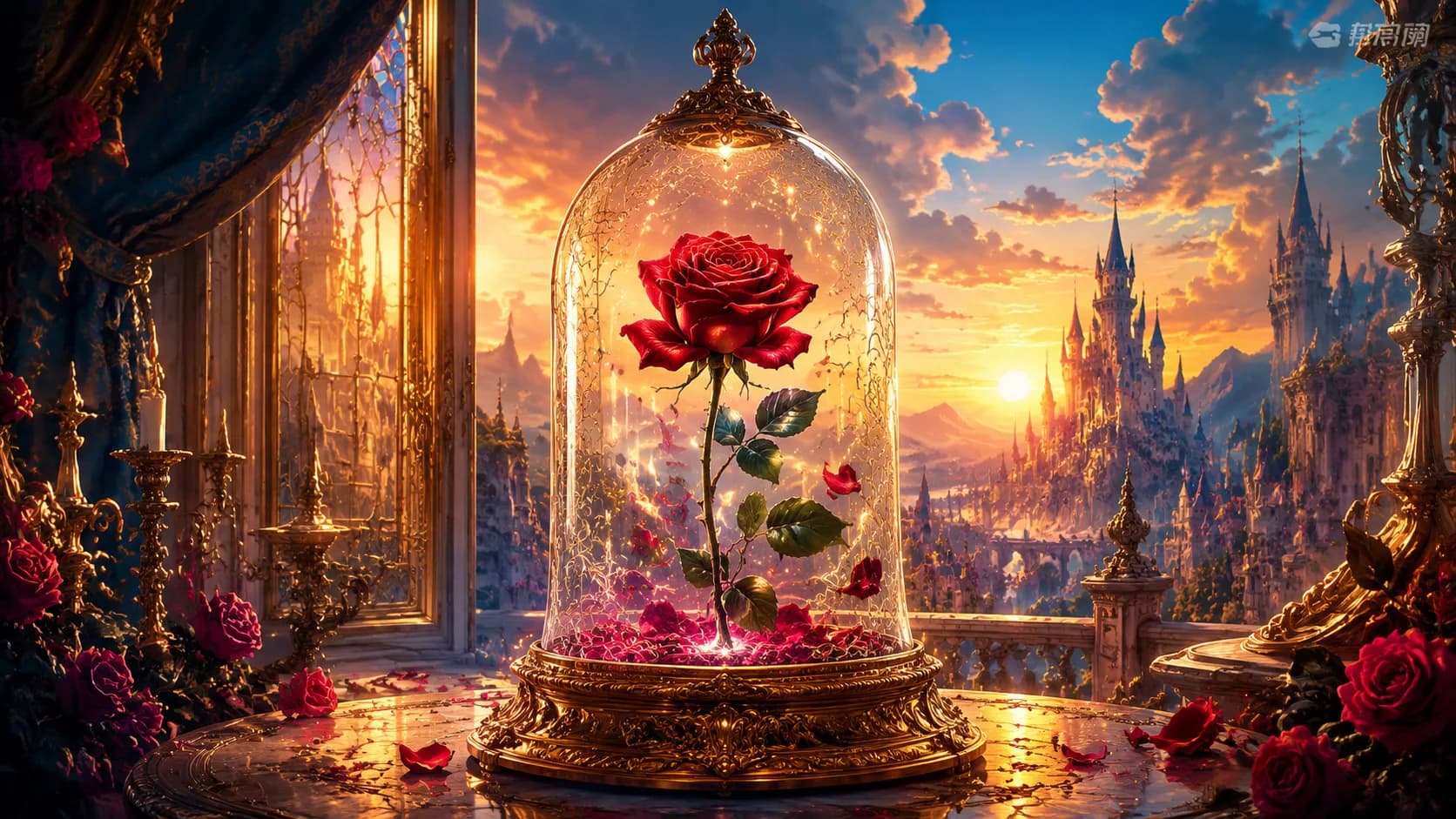
At its heart, Beauty and the Beast tells the story of a wealthy merchant who loses his fortune and must relocate his family to a modest country cottage. When the merchant stumbles upon a magnificent but seemingly deserted castle during a journey, he plucks a rose from the garden as a gift for his youngest daughter, Belle the only thing she requested while her older sisters demanded jewels and gowns. This small act of love triggers a cascade of events: the castle's master, a fearsome Beast, appears and demands the merchant's life in payment for the stolen rose, unless one of his daughters comes to live in the castle willingly.
Visionaria Insight
By immersing ourselves in these historical soundscapes, we reconnect with a timeless human tradition of storytelling and mental restoration.
Belle, true to her compassionate nature, volunteers to take her father's place. What she discovers within the Beast's enchanted domain surprises her profoundly. The castle is filled with invisible servants, enchanted objects, magnificent gardens, and every luxury imaginable. The Beast himself, despite his fearsome exterior, is unfailingly gentle, courteous, and generous. Each evening he dines with Belle, and each evening he asks the same question: "Will you marry me?" Each evening, Belle gently declines though she grows to care for him deeply as a friend and companion.
The turning point arrives when Belle asks to visit her family and the Beast grants her leave, giving her a magic mirror and ring. When she overstays her visit delayed by her jealous sisters she sees through the mirror that the Beast is close to passing away from heartbreak. Racing back to the castle, Belle finds him near the enchanted rose, fading. In a moment of profound emotional truth, she declares her love for him and the enchantment shatters. The Beast transforms into a handsome prince, the castle bursts into celebration, and Belle discovers that her capacity for compassion and inner vision has been the true magic all along.
"The Beast gave Belle an entire enchanted castle with an infinite library, self-playing musical instruments, and food that appeared from thin air. Meanwhile, modern dating involves splitting the bill at a coffee shop. Progress is complicated."
A time traveler went back to antiquity to teach them about 'holistic health.' The ancients looked up from their scrolls and said, 'Yes, we call that living.'
The Original French Tale: Madame de Beaumont's Vision
The story as most people know it was shaped by Madame Jeanne-Marie Leprince de Beaumont, a French author and governess who published her streamlined version in 1756 as part of Le Magasin des enfants (The Young Misses' Magazine). De Beaumont took the much longer 1740 novel by Gabrielle-Suzanne Barbot de Villeneuve which ran to over 360 pages and included elaborate backstories involving fairy courts, genealogies, and political intrigues and distilled it into a concise, emotionally powerful fairy tale of roughly 15 pages that captured the essential magic of the story.
Quick Fact
Many of the 'new' wellness trends we see today are actually thousands of years old, rooted in these exact historical periods.
De Beaumont's genius lay in her understanding that the story's power resided not in its supernatural mechanics but in its emotional core. She stripped away Villeneuve's extensive fairy mythology and focused relentlessly on the relationship between Belle and the Beast the gradual evolution from fear to curiosity, from curiosity to friendship, from friendship to love. She understood that the enchanted castle, the invisible servants, and the magic mirror were not merely decorative elements but symbolic landscapes reflecting Belle's inner emotional journey from judgment to compassion.
What makes de Beaumont's version particularly remarkable is its educational intention. Writing explicitly for young women of the French bourgeoisie, she embedded within the fairy tale a sophisticated moral philosophy: that virtue, kindness, and inner character matter more than wealth, beauty, or social status. Belle's refusal of superficiality her request for a simple rose when her sisters demand expensive gifts establishes from the opening scenes that this is a heroine who values meaning over materialism. This thematic emphasis ensured the tale's longevity, as each generation finds in Belle's journey a mirror for its own struggles with appearance, authenticity, and the courage to love unconventionally.

Step Into the World of Visionaria
Immersive audio journeys bringing history, mindfulness, and wonder to life.
An Epicurean, a Stoic, and a Cynic walk into a garden. The bartender says, 'Is this some kind of philosophical joke?'
Ancient Roots: Cupid and Psyche and Earlier Legends
Long before Madame de Beaumont put pen to paper, the essential pattern of Beauty and the Beast was already ancient. The most influential precursor is Cupid and Psyche, a tale embedded within Apuleius's 2nd century Roman novel The Golden Ass. In this myth, the beautiful mortal Psyche is whisked away to a magnificent palace by Cupid, the god of love, who visits her only in darkness and forbids her from seeing his face. Like Belle, Psyche lives in supernatural luxury with an unseen companion; like Belle, her journey involves overcoming fear and societal pressure to discover that love transcends appearance.
The parallels between Cupid and Psyche and Beauty and the Beast are striking: a young woman separated from her family, an enchanted dwelling of impossible beauty, a mysterious companion whose true nature is hidden, jealous sisters who undermine the relationship, and a climactic moment of revelation and transformation. Folklorists classify both tales under the Aarne-Thompson-Uther type 425 "The Search for the Lost Husband" a story pattern found in mythological traditions worldwide, from Scandinavia's "East of the Sun, West of the Moon" to India's "The Girl Who Married a Snake."
Did You Know?
The relentless drive to understand the world was seen not just as an academic pursuit, but as a spiritual and healing practice by the ancients.
Recent folkloristic research by Dr. Jamie Tehrani at Durham University used phylogenetic analysis a technique borrowed from evolutionary biology to trace the "animal bridegroom" tale type back an estimated 4,000 years, to the Bronze Age. This means the essential narrative pattern predates not only written literature but even the Golden Age of Athens and the building of the Ishtar Gate in Babylon. The story's extraordinary persistence across millennia and continents suggests it touches something fundamental in the human psyche a universal longing to believe that compassion can transform even the most seemingly impossible situations into grace.
"Cupid and Psyche is basically Beauty and the Beast with more Greek drama togas, jealous goddesses, and a divine mother in law situation that makes modern family dinners look relaxing."
Why did the historian break up with the archaeologist? Because her career was literally in ruins.
The Power of Transformation in Fairy Tales
Transformation lies at the very heart of Beauty and the Beast and at the heart of the fairy tale tradition itself. The Beast's metamorphosis from animal to prince is the story's most visible transformation, but it is far from the only one. Belle transforms too from a sheltered young woman into a person of courage, emotional depth, and radical empathy. The castle transforms from a prison into a home. Even the enchanted servants frozen in forms not their own are restored to their true selves. The entire narrative is structured as a cascade of transformations, each triggered by acts of genuine compassion.
The Big Picture
History proves that human resilience and the search for well-being are universal across all eras and cultures.
Fairy tale scholars like Jack Zipes and Marina Warner argue that transformation stories serve a vital psychological function. They teach us that change is possible that seemingly fixed conditions, whether external or internal, can be altered through courage, patience, and love. For the Beast, transformation means shedding the exterior that has defined and limited him. For Belle, transformation means expanding her capacity for empathy beyond conventional boundaries. In both cases, the message is revolutionary: you are not defined by how the world sees you, but by how you choose to see the world.
This transformative power is precisely what makes fairy tales such effective vehicles for meditation and inner world expansion. When you engage deeply with a transformation narrative especially through immersive audio journeys that place you inside the story your brain processes the transformation as though it were happening to you. This is why fairy tale-based meditation can produce genuine shifts in perspective and emotional state: the neural pathways activated by imagined transformation are remarkably similar to those engaged by real experience.
A philosopher walked into a wall. His students asked if it hurt. He replied, 'The wall is an illusion, but my headache is quite real.'
Belle: The Heroine Who Chose Compassion
Belle stands as one of fairy tale literature's most enduring heroines, and her significance extends far beyond her role as a love interest. From the story's opening, she is defined by intellectual curiosity, moral courage, and a willingness to see beyond surfaces. While her sisters obsess over material wealth and social status, Belle asks only for a rose a living, growing thing of natural beauty. This seemingly simple choice reveals a character who values meaning over materialism, substance over spectacle.
Belle's decision to take her father's place at the castle is often misread as passive self-sacrifice. In the original tales, however, it is presented as an active choice-driven by love and courage. Belle walks into the unknown, faces her deepest fears, and discovers something extraordinary: the capacity to connect with someone whom the entire world has rejected. Her superpower isn't beauty despite her name but emotional intelligence. She perceives the Beast's loneliness, recognizes his kindness beneath his fearsome form, and responds with genuine warmth rather than fear or pity.
Visionaria Insight
By immersing ourselves in these historical soundscapes, we reconnect with a timeless human tradition of storytelling and mental restoration.
This emotional intelligence makes Belle a uniquely modern heroine despite her 18th century origins. She doesn't need to be rescued; she is the rescue her compassion literally breaks the enchantment. Contemporary psychology research on story-based meditation confirms that engaging with characters like Belle imaginatively inhabiting their perspectives and emotional experiences develops the practitioner's own empathy circuits. Belle's journey of expanding her capacity for compassion mirrors the inner world expansion that meditation itself facilitates.
"Belle was basically the world's first bookworm heroine centuries before audiobooks, e-readers, or the concept of 'cozy reading.' She would have absolutely dominated BookTok."
Why did the ancient physician prescribe a long walk? Because he was tired of listening to the patient complain in his office.
The Enchanted Castle: Symbolism and Inner Worlds
The Beast's enchanted castle is far more than a setting it functions as a symbolic representation of the inner self. From the outside, it appears dark, forbidding, and impenetrable much like the Beast himself. But within, Belle discovers rooms of extraordinary beauty: libraries filled with countless books, galleries adorned with art, gardens blooming with impossible flowers, dining halls where music plays from unseen instruments. The castle's exterior interior contrast is the story's central metaphor made architectural: what appears frightening on the surface contains extraordinary richness within.
Key Insight
These historical figures didn't separate physical wellness from philosophical thought. To them, it was all one continuous practice of living well.
The enchanted objects furniture that moves, dishes that serve themselves, candelabras that bow and curtsy represent the hidden life within seemingly inert things. The Beast's servants, transformed into household objects by the enchantment, are literally invisible people: human beings whose essential personhood has been concealed beneath a surface that others cannot see past. Belle's growing ability to interact naturally with these enchanted beings seeing them as people rather than objects parallels her developing ability to see the Beast as a person rather than a monster.
For practitioners of inner world meditation, the enchanted castle offers a powerful architectural metaphor for the mind itself. Your inner world, like the castle, may appear ordinary or even forbidding from the outside. But with exploration room by room, corridor by corridor you discover spaces of unexpected beauty, hidden treasures of memory and emotion, and entire wings you never knew existed. The practice of cinematic meditation is essentially the art of exploring your own enchanted castle discovering that the interior of your consciousness is far vaster, more beautiful, and more magical than the exterior suggests.
Read more: Thor and the Thunder Gods of Norse Mythology

Visionaria's interactive audio journeys bring enchanted environments to life through spatial audio letting you explore fairy tale castles, ancient cities, and mythical realms as richly detailed inner worlds.
Why did the historian break up with the archaeologist? Because her career was literally in ruins.
Music, Art, and Adaptation Through the Centuries
Few fairy tales have inspired as prolific and diverse a legacy of artistic adaptation as Beauty and the Beast. From Jean Cocteau's groundbreaking 1946 film a masterpiece of surreal cinema where arms holding candelabras emerge from castle walls and stone faces breathe above doorways to modern animated and live action interpretations that have earned billions at the global box office, the story has proven infinitely adaptable while retaining its emotional core. Each generation reimagines the tale through its own artistic sensibilities, yet the central magic remains: compassion's power to reveal hidden beauty.
Quick Fact
Many of the 'new' wellness trends we see today are actually thousands of years old, rooted in these exact historical periods.
The story has flourished across every artistic medium. In opera, Philip Glass composed a chamber opera that emphasizes the tale's dreamlike qualities. In ballet, choreographers from the Paris Opera to the Royal Ballet have translated Belle's emotional journey into movement. In literature, Angela Carter's "The Tiger's Bride" reimagined the tale through a feminist lens, while Robin McKinley's novels explored the psychology of the relationship with unprecedented depth. Each adaptation adds new dimensions to the original while demonstrating the story's remarkable ability to speak across artistic forms, cultural contexts, and historical periods.
The most recent frontier of Beauty and the Beast adaptation is immersive audio a medium uniquely suited to the story's themes. Interactive audio journeys leverage spatial audio technology to place listeners inside the enchanted castle itself, hearing the whisper of silk curtains to their left, the distant echo of the Beast's footsteps approaching from behind, the tinkle of enchanted china to their right. This three-dimensional auditory immersion creates an experience closer to inhabiting the fairy tale than any previous medium except, perhaps, the original experience of hearing the story told aloud by firelight in an 18th century French salon.
Read more: Why Fictional Worlds Feel So Real to Readers

"If you count every film, TV show, musical, ballet, opera, manga, and webcomic adaptation, Beauty and the Beast has been reimagined more times than your grandmother's lasagna recipe. And like that recipe, every version claims to be the definitive one."
Why did the ancient physician prescribe a long walk? Because he was tired of listening to the patient complain in his office.
The Psychology of Beauty and the Beast
Psychologists have long recognized Beauty and the Beast as one of the most psychologically rich fairy tales in the Western canon. Bruno Bettelheim, in his landmark work The Uses of Enchantment, interpreted the Beast as representing the initially frightening aspects of intimate relationships the fear of vulnerability, of the unknown other, of what lies beneath the social masks we all wear. Belle's journey, in Bettelheim's reading, symbolizes the psychological maturation required to move from fear-based perception to love-based understanding.
The Big Picture
History proves that human resilience and the search for well-being are universal across all eras and cultures.
Jungian analysts offer a complementary reading that focuses on the shadow self. In Jungian psychology, the Beast represents aspects of the self that have been repressed, rejected, or hidden from conscious awareness qualities that appear monstrous precisely because they have been denied expression. Belle's journey toward the Beast mirrors the process of shadow integration: encountering the rejected parts of oneself with compassion rather than fear, and discovering that these "beastly" qualities often contain tremendous energy, creativity, and emotional depth when acknowledged and embraced rather than suppressed.
This psychological dimension is what makes Beauty and the Beast particularly powerful as a meditation narrative. When experienced through story-based meditation, the tale activates what psychologists call "narrative transportation" a state where you emotionally merge with a character's perspective. Research shows that narrative transportation produces real changes in empathy, self-understanding, and emotional processing. Meditating with the Beauty and the Beast narrative particularly through cinematic meditation can facilitate genuine encounters with your own inner "beasts" in a safe, symbolically contained environment where transformation is not only possible but inevitable.
Why did the ancient physician prescribe a long walk? Because he was tired of listening to the patient complain in his office.
How Spatial Audio Brings Fairy Tales to Life
Spatial audio technology creates an unprecedented opportunity to experience fairy tales not as stories told to you but as worlds that surround and envelop you. When Beauty and the Beast is rendered through three-dimensional sound, the enchanted castle becomes an auditory environment you physically inhabit. The Beast's voice rumbles from a specific location in the room. Enchanted candelabras flicker and whisper to your left. A distant harpsichord plays from somewhere deep within the castle. Rain taps against stained glass windows above and behind you. The cumulative effect is a sense of genuine spatial presence that transforms passive listening into active inhabitation.
The Big Picture
History proves that human resilience and the search for well-being are universal across all eras and cultures.
The neuroscience explains why this matters. Spatial audio activates the brain's place cells and grid cells the same neural structures that create your sense of physical location in real environments. When these cells fire during a fairy tale meditation, your brain generates a genuine navigational model of the enchanted castle. You're not merely imagining the castle your brain is building it as a spatial environment you can explore, with rooms, corridors, and gardens positioned in consistent three-dimensional space. This neurological process means that fairy tale meditation with spatial audio creates significantly more vivid and memorable inner world experiences.
For Beauty and the Beast specifically, spatial audio unlocks dimensions of the story that flat narration cannot reach. The acoustic contrast between the cold, echoing exterior of the castle and the warm, intimate interior of the library mirrors the story's thematic contrast between appearance and reality. The gradual acoustic transformation of the Beast's chambers from harsh and reverberant to warm and welcoming parallels Belle's changing perception of her companion. Sound design becomes emotional storytelling, and every reverb, echo, and whispered detail contributes to a meditation experience that engages the imagination at its deepest levels.

"Regular audiobooks tell you about an enchanted castle. Spatial audio puts you inside one and lets the enchanted furniture gossip about you from across the room. It's a completely different experience."
Why did the inventor of the wheel win an award? Because his idea really got things rolling.
Cultural Variations Around the World
The "animal bridegroom" story pattern of which Beauty and the Beast is the most famous example appears in over 400 documented variants across every inhabited continent. This extraordinary global distribution suggests the tale addresses universal human concerns that transcend any single culture's boundaries. Each variation reflects its originating culture's values, fears, and aspirations while preserving the fundamental narrative arc: a compassionate person encounters a being whose true nature is hidden beneath a frightening exterior, and through love and courage, catalyzes transformation.
In Scandinavia, "East of the Sun, West of the Moon" tells of a girl who marries a great white bear who transforms into a prince each night. In India, tales of women who marry serpents that reveal their divine nature appear across multiple regional traditions. In China, the "Snake Husband" cycle features a bride who discovers her serpent spouse is actually a dragon prince a being of immense power and beauty. The Scottish "The Black Bull of Norroway" and the Russian "The Scarlet Flower" both follow the essential pattern while incorporating culturally specific magical elements and moral frameworks.
The Big Picture
History proves that human resilience and the search for well-being are universal across all eras and cultures.
What unites these global variations is a shared conviction that appearances are unreliable guides to inner reality. Whether the hidden bridegroom is a bear, a snake, a bull, or a beast, the narrative insists that compassionate attention reveals truths invisible to fearful eyes. This universality is precisely what makes the story so powerful as a meditation theme across cultures it speaks to a fundamental human capacity for seeing beyond surfaces that every tradition recognizes and celebrates. Modern interactive audio journeys drawing from this multicultural tradition can explore the tale through diverse cultural lenses, enriching the listener's understanding of both the story and themselves.
Visionaria's journey library draws from global fairy tale, mythological, and historical traditions exploring tales from ancient Greece, Norse mythology, and Mesopotamian civilizations.
Why did the ancient physician prescribe a long walk? Because he was tired of listening to the patient complain in his office.
Lessons That Resonate Across Generations
Beauty and the Beast endures because its lessons operate on multiple levels simultaneously accessible to children hearing it for the first time yet profound enough to reward adult reflection. At its most immediate level, the story teaches that appearances can be deceiving a lesson every child needs to learn. But beneath this surface moral lies a deeper teaching about the nature of love itself: that genuine love is not a response to beauty but a creative act of seeing that reveals beauty where others see only fear.
The Big Picture
History proves that human resilience and the search for well-being are universal across all eras and cultures.
"The moral of Beauty and the Beast is simple: never judge a book by its cover. Unless it's a library book that's been returned with mysterious stains. Then maybe judge a little."
What's an ancient intellectual's favorite exercise? Jumping to conclusions.
Experiencing Beauty and the Beast Through Meditation
Fairy tales were originally experienced not as texts read in silence but as stories told aloud immersive verbal performances that engaged the listener's imagination through voice, rhythm, and atmosphere. Modern interactive audio journeys return to this ancient mode of engagement while enhancing it with spatial audio technology that the original fireside storytellers could never have imagined. The result is a meditation experience that honors the fairy tale tradition while unlocking new dimensions of immersion and personal transformation.
Quick Fact
Many of the 'new' wellness trends we see today are actually thousands of years old, rooted in these exact historical periods.
When you experience Beauty and the Beast through cinematic meditation, you don't simply hear the story you enter it. You feel the chill of the castle's stone corridors. You hear the Beast's footsteps approaching from the darkness. You sense the warmth of the enchanted library as you explore its infinite shelves. You experience Belle's emotional journey from fear to curiosity to love not as an outside observer but as a participant whose own emotional responses become part of the meditation. This first person perspective transforms the fairy tale from entertainment into a genuine tool for emotional growth and self-discovery.
"Experiencing a fairy tale through spatial audio meditation is like the difference between reading a restaurant menu and actually tasting the food. Both involve the same words, but only one engages your senses."
How Story Worlds Improve Mental Relaxation
Discover how story worlds improve mental relaxation, from the neuroscience of narrative immersion and stress relief to spatial audio meditation, fantasy worlds, ancient temples, imagination training, and how immersive...
Why did the inventor of the wheel win an award? Because his idea really got things rolling.
The Bottom Line
Beauty and the Beast is far more than a children's fairy tale it is one of humanity's oldest and most profound stories about the transformative power of compassion. From its ancient roots in Cupid and Psyche to Madame de Beaumont's 18th century masterpiece, from over 400 global cultural variations to modern immersive audio experiences, this tale has endured because it speaks to something fundamental in the human heart: the belief that love can reveal beauty where others see only fear.
Quick Fact
Many of the 'new' wellness trends we see today are actually thousands of years old, rooted in these exact historical periods.
This guide explored the story's origins in ancient mythology, its literary evolution, the rich psychological symbolism of Belle's journey and the enchanted castle, its extraordinary global presence, and how interactive audio journeys with spatial audio can transport you inside this beloved fairy tale's world.
"After 4,000 years, Beauty and the Beast is still going strong. That's more staying power than any streaming service, social media platform, or dietary trend. If only our attention spans were as durable as this fairy tale."
Experience More with Visionaria
Download the app to explore guided historical and wellness journeys.
A Roman walks into a bar, holds up two fingers, and says, 'Five beers, please.'
This article is for educational and informational purposes only. Historical details are based on available research and may evolve as new evidence emerges.
Visionaria journeys are designed for relaxation, guided imagination, and personal enrichment. They are not a substitute for medical, mental health, legal, or professional advice.