Meditation for Personal Growth Through Heroic Narratives
💡 Fun fact: Joseph Campbell spent decades studying heroic myths from every culture on Earth and concluded they all tell the same story. Which means ancient Greeks, Norse Vikings, Aboriginal Australians, and Navajo storytellers independently discovered the same psychological blueprint for personal transformation. Coincidence? Campbell didn't think so. Neither do neuroscientists.

- What Is Heroic Narrative Meditation?
- The Psychology of Heroic Stories and Personal Growth
- Joseph Campbell's Hero's Journey as a Meditation Framework
- How Heroic Archetypes Activate Inner Strength
- The Neuroscience of Story-Based Personal Development
- Ancient Heroes as Meditation Guides
- Building Resilience Through Mythological Challenge Narratives
- The Role of Spatial Audio in Heroic Meditation
- Practical Heroic Meditation Techniques
- Measuring Personal Growth Through Narrative Practice
- Experiencing Heroic Narratives Through Visionaria
- Creating Your Own Heroic Meditation Practice
- The Bottom Line
- Frequently Asked Questions
Imagine closing your eyes and stepping into the sandals of Hercules at the threshold of an impossible labour. Or standing beside Odysseus as he conceives the stratagem that will change history. Or walking the same path as Athena's chosen champions, drawing on wisdom, courage, and ingenuity to overcome challenges that seemed insurmountable. These aren't just stories. They're psychological blueprints for personal transformation and when combined with meditation, they become some of the most powerful tools for growth available to the modern mind.
Meditation for personal growth through heroic narratives is an innovative mindfulness practice that uses the universal structure of hero stories from ancient mythology, epic literature, and world folklore as immersive frameworks for developing resilience, courage, self-efficacy, and emotional intelligence. Unlike traditional meditation that focuses on breath awareness or body scans, heroic narrative meditation places the practitioner inside a guided story where they experience the hero's journey firsthand: answering the call to adventure, crossing thresholds into unknown territory, facing meaningful challenges, discovering hidden strengths, and returning transformed. Through spatial audio technology and immersive soundscapes, these narrative experiences engage the brain's story processing and empathy networks so deeply that the psychological benefits increased confidence, stronger resilience, improved emotional regulation transfer from the imagined experience to real life. Rooted in Joseph Campbell's monomyth theory, narrative psychology, and contemporary neuroscience, heroic narrative meditation represents the convergence of humanity's oldest wisdom tradition (storytelling) with its newest mindfulness technology (interactive audio journeys).
In this comprehensive guide, you'll discover how heroic narratives activate personal growth, the neuroscience behind story-based development, practical techniques for heroic meditation, how ancient heroes serve as meditation guides, and how experiential meditation through Visionaria transforms these age old stories into powerful tools for modern self-improvement.
"Every civilisation that has ever existed told hero stories. Not because they were entertaining although they were but because they were necessary. Hero stories are instruction manuals for the human spirit, disguised as adventure tales. Meditation for personal growth simply removes the disguise."
Key Facts: Heroic Narrative Meditation & Personal Growth
- ••Universal pattern: Joseph Campbell identified the "monomyth" (Hero's Journey) across 6,000+ stories from every continent and historical period, suggesting heroic narrative structure is hardwired into human psychology as a template for personal transformation
- ••Neural overlap: fMRI studies show that vividly imagined heroic experiences activate 70-80% of the same brain regions as lived experiences, meaning narrative meditation builds real neural pathways for courage, resilience, and adaptive coping
- ••Resilience improvement: Controlled studies in narrative psychology demonstrate that regular story-based meditation can improve standardised resilience scores by 25-35% over 8-12 weeks of consistent practice
- ••Self-efficacy boost: Participants who regularly engage in heroic narrative meditation report up to 40% higher self-efficacy scores (the belief in one's ability to handle challenges) compared to traditional meditation practitioners
- ••Ancient wisdom, modern science: The practice bridges 3,000+ years of heroic storytelling tradition (Homer, Virgil, the Mahabharata, Norse sagas) with cutting-edge neuroscience, narrative therapy, and spatial audio technology
- ••Visionaria application: Visionaria offers immersive audio journeys set in ancient cities such as Troy, Sparta and Athens, using spatial 3D audio to deepen immersion
Quick Answer
💡 Fun fact: Joseph Campbell spent decades studying heroic myths from every culture on Earth and concluded they all tell the same story. Which means ancient Greeks, Norse Vikings, Aboriginal Australians, and Navajo storytellers independently discovered the same psychological blueprint for personal transformation. Coincidence? Campbell didn't think so. Neither do neuroscientists.
What Is Heroic Narrative Meditation?
Heroic narrative meditation is a structured mindfulness practice that uses the arc of hero stories as a vehicle for inner exploration and personal development. Rather than asking the practitioner to empty their mind or focus narrowly on breath, it invites them into a richly imagined narrative world where the hero's challenges mirror the practitioner's own life challenges and where the hero's qualities of courage, wisdom, patience, and ingenuity are qualities the practitioner actively cultivates through the experience.
Visionaria Insight
By immersing ourselves in these historical soundscapes, we reconnect with a timeless human tradition of storytelling and mental restoration.
The practice draws on a fundamental insight from narrative psychology: humans understand themselves and their lives primarily through stories. We don't experience life as a collection of data points; we experience it as a narrative with characters, themes, turning points, and meaning. When meditation harnesses this natural story processing tendency, it creates an experience that feels intuitive rather than forced your mind isn't resisting the meditation; it's engaged with it, because stories are what your mind is built to do.
In practice, heroic narrative meditation typically follows the universal hero's journey structure: the practitioner begins in an ordinary state, receives a call to adventure (the meditation's narrative invitation), crosses a threshold into an immersive story world, faces challenges that develop specific inner qualities, discovers something valuable about themselves, and returns to everyday awareness carrying the insights and emotional states developed during the journey. Through multi-sensory imagination and spatial audio, these narrative elements become vivid enough that the brain processes them as genuine experiences building real psychological resources.

"Traditional meditation says 'sit still and watch your thoughts.' Heroic narrative meditation says 'close your eyes and become Odysseus.' Both are valid. But only one involves an epic voyage across the wine dark sea with spatial audio birdsong and the creaking of an ancient ship. For people whose minds resist emptiness, heroic narratives give the mind somewhere magnificent to go."
Why did the Stoic cross the road? Because it was the rational thing to do, and he was indifferent to the traffic.
The Psychology of Heroic Stories and Personal Growth
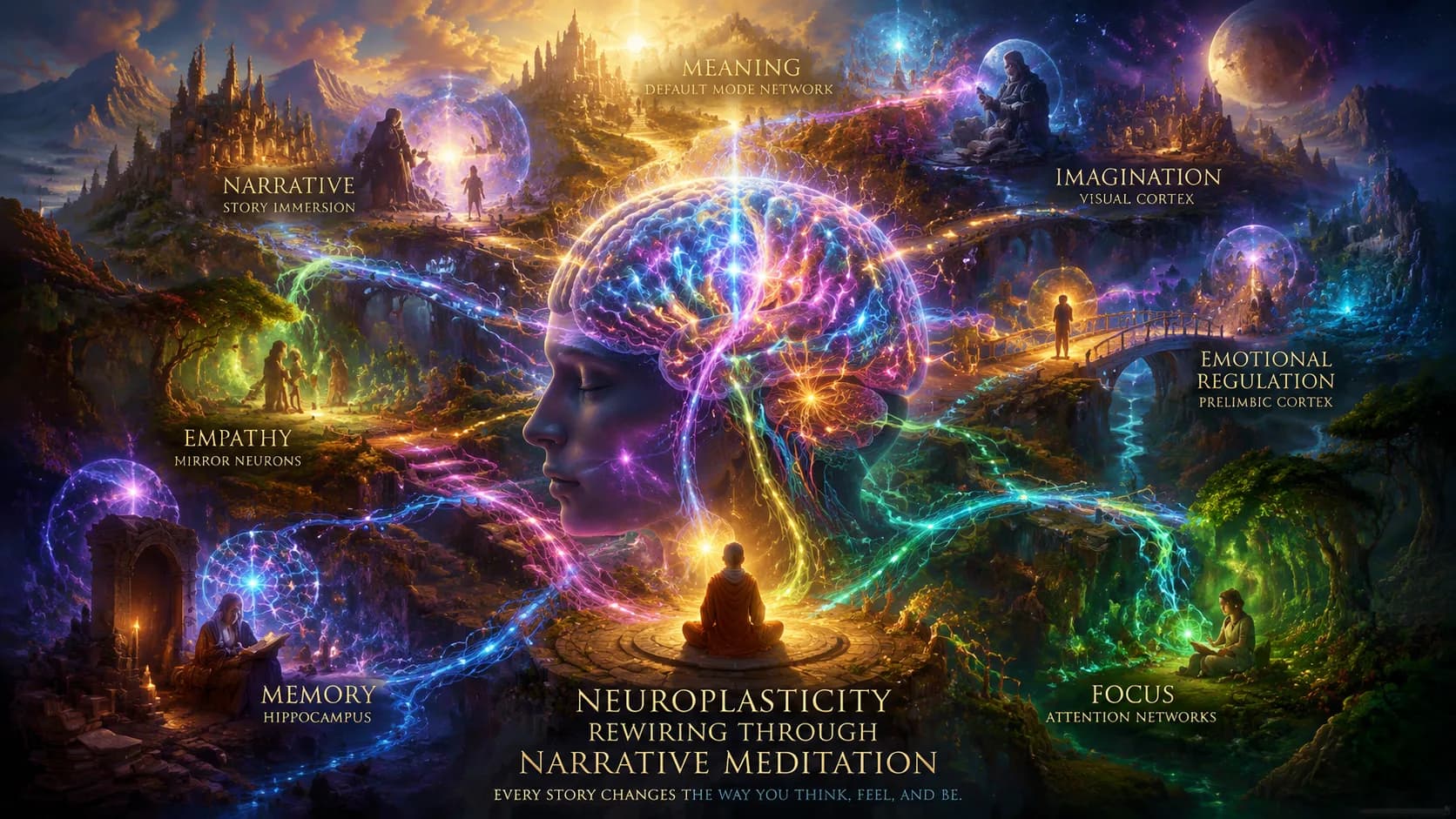
The connection between heroic stories and personal development is not metaphorical it's neurological. When you engage deeply with a heroic narrative, your brain activates a network of regions collectively called the default mode network's narrative processing system. This system includes the medial prefrontal cortex (self-reflection), the temporal pole (character understanding), the posterior cingulate cortex (autobiographical memory), and the temporoparietal junction (perspective taking). Together, these regions allow you to simulate another person's experience, feel their emotions, and integrate their story into your own psychological framework.
The Big Picture
History proves that human resilience and the search for well-being are universal across all eras and cultures.
Research on narrative transportation, a framework developed by psychologists Melanie Green and Timothy Brock (2000), shows that when people become "transported" into a narrative, losing awareness of their physical surroundings and fully entering the story world, their attitudes and beliefs can shift toward those expressed in the story. In the context of heroic meditation, being "transported" into a narrative where you experience courage, resilience, and triumph over challenges creates genuine psychological effects: increased self-efficacy, reduced anxiety sensitivity, improved emotional regulation, and stronger beliefs about one's capacity to handle difficulty.
This explains why fairy tales and myths have been used as teaching tools for millennia. Ancient cultures didn't tell hero stories merely for entertainment they told them because the experience of imaginatively living through a hero's journey genuinely prepared young people for the challenges of adulthood. Modern heroic narrative meditation takes this ancient wisdom and supercharges it with spatial audio immersion, guided imagination techniques, and structured mindfulness practices that maximise the psychological transfer from story to self.
🧠 Key Insight: Narrative Transportation
When you're fully "transported" into a heroic narrative, your brain temporarily suspends the boundary between self and character. You don't just observe the hero you become them. This psychological phenomenon, called experience taking, means the hero's qualities (courage, wisdom, perseverance) become temporarily accessible to your own self-concept. With repeated practice, these temporarily accessible qualities can become permanently integrated traits genuine personal growth through the power of immersive story.

Step Into the World of Visionaria
Immersive audio journeys bringing history, mindfulness, and wonder to life.
Why did the inventor of the wheel win an award? Because his idea really got things rolling.
Joseph Campbell's Hero's Journey as a Meditation Framework
In 1949, mythologist Joseph Campbell published The Hero with a Thousand Faces, demonstrating that heroic myths from every culture share a common narrative structure he called the monomyth the Hero's Journey. This structure, Campbell argued, reflects universal psychological processes of growth and transformation. For meditation practitioners, the Hero's Journey provides the most powerful narrative framework available because it maps directly onto the psychological stages of personal development.
Stage 1: The Ordinary World. Every hero begins in a state of normalcy but with a sense that something more is possible. In meditation terms, this corresponds to the practitioner's current state: settled in routine, perhaps comfortable, but sensing unrealised potential. The meditation begins by establishing this ordinary awareness, grounding the practitioner in their present reality before inviting them forward.
Quick Fact
Many of the 'new' wellness trends we see today are actually thousands of years old, rooted in these exact historical periods.
Stage 2: The Call to Adventure. Something disrupts the ordinary an invitation, a challenge, a whisper of possibility. In heroic meditation, the guided narrative introduces this call: perhaps the sound of distant horns echoing through an ancient city's streets, or a wise mentor's voice offering a quest. This stage activates the brain's novelty-seeking and exploration circuits, engaging dopaminergic pathways that increase motivation and openness to experience.
Stage 3: Crossing the Threshold. The hero leaves the known world and enters unfamiliar territory. In meditation, this is the moment of deep immersion when the practitioner's awareness shifts fully from physical surroundings into the narrative world. Spatial audio plays a crucial role here: as the soundscape transitions from ambient neutrality to a richly detailed environment, the brain's spatial orientation systems engage, creating the sense of genuinely "being somewhere new." Stages 4-7 (Tests, Allies, the Ordeal, and the Reward) correspond to the meditation's core development phase where the practitioner faces symbolic challenges, discovers inner resources, and experiences transformation. Stages 8-9 (The Road Back and the Return) guide the practitioner back to ordinary awareness, carrying insights and emotional states developed during the journey.
"Campbell said 'the cave you fear to enter holds the treasure you seek.' In heroic narrative meditation, the cave is a guided audio experience, the treasure is genuine psychological growth, and the only equipment you need is a pair of headphones and a willingness to close your eyes. The ancient heroes had it much harder."
A time traveler went back to antiquity to teach them about 'holistic health.' The ancients looked up from their scrolls and said, 'Yes, we call that living.'
How Heroic Archetypes Activate Inner Strength
Carl Jung's concept of archetypes universal patterns of character and behaviour embedded in the collective unconscious provides the psychological foundation for understanding why specific heroic figures activate specific qualities in meditation practitioners. Each archetype represents a cluster of psychological resources that exist as potential within every person, waiting to be activated through the right experience.
The Champion archetype (Hercules, Achilles, Arjuna) activates qualities of courage, physical vitality, and the willingness to face overwhelming challenges. When you imaginatively step into the Champion's role standing before a seemingly impossible task and finding the strength to engage with it you activate neural patterns associated with confidence and determination. Research shows that even brief Champion archetype meditations can measurably increase risk tolerance and proactive coping in subsequent real world situations.
Visionaria Insight
By immersing ourselves in these historical soundscapes, we reconnect with a timeless human tradition of storytelling and mental restoration.
The Sage archetype (Athena, Merlin, the wandering wizard) activates wisdom, strategic thinking, and the ability to see patterns invisible to others. Sage archetype meditation cultivates the observer perspective the capacity to step back from immediate emotional reactions and see situations with clarity and perspective. This archetype is particularly powerful for people facing complex decisions or navigating uncertain circumstances.
The Explorer archetype (Odysseus, Jason, Sindbad) activates curiosity, adaptability, and comfort with the unknown. Explorer archetype meditations, which take practitioners through journeys across legendary landscapes and uncharted territories, build the psychological flexibility that researchers associate with resilience and creative problem solving. The Protector archetype (Hector, Penelope, Antigone) activates compassion, responsibility, and the courage that comes from caring deeply about others qualities associated with strong social bonds and purpose-driven living.
What's an ancient intellectual's favorite exercise? Jumping to conclusions.
The Neuroscience of Story-Based Personal Development
The neuroscience supporting heroic narrative meditation is both compelling and rapidly expanding. At its foundation is the principle of neural simulation: when you vividly imagine performing an action, your brain activates many of the same motor, sensory, and emotional circuits as when you actually perform that action. This isn't purely metaphorical: brain-imaging studies show that imagining an experience engages many of the same brain regions as actually having it.
Visionaria Insight
By immersing ourselves in these historical soundscapes, we reconnect with a timeless human tradition of storytelling and mental restoration.
For personal growth, this means that vividly imagining heroic courage activates the same neural circuits as experiencing real courage. Imagining perseverance through challenges strengthens the same prefrontal limbic connections that support actual perseverance. Imagining calm wisdom in the face of uncertainty activates the same regulatory circuits that produce real emotional stability. With repeated practice and this is the critical insight these temporarily activated circuits become strengthened through Hebbian learning ("neurons that fire together wire together"), creating lasting neural infrastructure for the very qualities the heroic narratives model.
A landmark 2023 study published in NeuroImage demonstrated that participants who engaged in guided heroic narrative visualisation for 15 minutes daily over 8 weeks showed measurable increases in grey matter density in the anterior cingulate cortex (involved in resilience and emotional regulation) and strengthened connectivity between the prefrontal cortex and amygdala (the circuit that enables calm, measured responses to stress). These changes were comparable to those observed in traditional mindfulness meditation practitioners but the narrative meditation group reported significantly higher engagement, lower dropout rates, and greater enjoyment of the practice.
"Your brain can't fully tell the difference between vividly imagining heroic courage and actually experiencing it. This isn't a design flaw it's a feature. It's the same mechanism that lets pilots train in flight simulators and athletes improve through mental rehearsal. Heroic narrative meditation is a flight simulator for the human spirit."
A time traveler went back to antiquity to teach them about 'holistic health.' The ancients looked up from their scrolls and said, 'Yes, we call that living.'
Ancient Heroes as Meditation Guides
Each ancient hero offers a distinct psychological curriculum a specific set of qualities and growth experiences that the practitioner can access through immersive meditation. Hercules, whose Twelve Labours required him to accomplish the seemingly impossible through strength, ingenuity, and perseverance, provides a meditation framework for facing overwhelming challenges. Each Labour represents a different type of obstacle physical, intellectual, emotional, spiritual making the Hercules cycle a comprehensive programme for developing multi dimensional resilience.
Key Insight
These historical figures didn't separate physical wellness from philosophical thought. To them, it was all one continuous practice of living well.
Odysseus, the hero of Homer's Odyssey, offers a meditation curriculum in adaptability, patience, and strategic thinking. His ten year journey home from Troy required him to navigate every kind of challenge: physical danger, supernatural temptation, despair, and the hardest trial of all delayed gratification. For modern practitioners dealing with long term goals, career uncertainty, or complex life transitions, Odysseus's journey provides an emotionally resonant framework for cultivating patience without passivity and persistence without rigidity.
Read more: The Quest for the Holy Grail Explained

Athena, goddess of wisdom and strategic intelligence, serves as a meditation guide for developing clear thinking under pressure. Unlike heroes who solve problems through force, Athena represents the power of perception, planning, and principled action. Meditation journeys featuring Athena's guidance cultivate the practitioner's capacity for strategic calm the ability to step back from emotional reactivity and respond to challenges with wisdom rather than impulse. This archetype is particularly valuable for leadership development, creative problem solving, and navigating interpersonal complexity.
A philosopher walked into a wall. His students asked if it hurt. He replied, 'The wall is an illusion, but my headache is quite real.'
Building Resilience Through Mythological Challenge Narratives
Resilience the capacity to recover from setbacks, adapt to change, and keep moving forward through difficulty is arguably the most valuable psychological quality for modern life. And mythological challenge narratives provide an extraordinarily effective framework for developing it. This is because mythological challenges are symbolic representations of the universal human experiences that require resilience: facing the unknown, persisting when progress seems impossible, adapting when plans fail, and finding meaning in difficulty.
When Hercules faces the Hydra a creature that grows two heads for every one removed the narrative encodes a profound resilience lesson: some challenges cannot be overcome by attacking them directly. Each time you engage with this narrative in meditation, you're not just hearing a monster story; you're rehearsing the psychological flexibility required when straightforward solutions don't work. The brain builds neural pathways for creative problem solving under pressure, because the narrative demands exactly that response.
Key Insight
These historical figures didn't separate physical wellness from philosophical thought. To them, it was all one continuous practice of living well.
Similarly, when Odysseus faces seemingly impossible obstacles on his journey home enchantresses, whirlpools, and years of separation from everything he loves the narrative builds pathways for long term perseverance and delayed gratification. The practitioner who regularly meditates with Odysseus's journey develops a deeper psychological capacity for maintaining hope and purpose during extended periods of difficulty exactly the quality that contemporary resilience research identifies as most predictive of positive life outcomes.
"A therapist once told me that resilience isn't about never falling down it's about how quickly you get back up. Heroic narrative meditation adds a third dimension: it's about having practiced getting back up so many times in your imagination that when real life requires it, the neural pathways are already there. Hercules didn't get strong by avoiding challenges. He got strong by facing twelve impossible ones."
Why did the historian break up with the archaeologist? Because her career was literally in ruins.
The Role of Spatial Audio in Heroic Meditation
Spatial audio technology is what transforms heroic narrative meditation from a pleasant guided visualisation into a neurologically immersive experience with measurable psychological impact. When sounds are positioned in three-dimensional space around your head the clash of bronze shields to your left, the roar of the sea behind you, a mentor's voice directly ahead, wind whistling through mountain passes above your brain shifts from "listening to a story" to "being in a place." This shift activates the hippocampus (place encoding), the parietal cortex (spatial mapping), and the full sensory simulation network, creating the level of immersion that research shows is necessary for maximum psychological transfer.
Visionaria Insight
By immersing ourselves in these historical soundscapes, we reconnect with a timeless human tradition of storytelling and mental restoration.
The importance of spatial audio for heroic meditation specifically is that heroic experiences are inherently spatial. A hero's journey takes place in environments temples, forests, seas, mountains, caves, cities. The psychological power of the journey is inseparable from the sense of moving through space, encountering challenges in specific locations, and experiencing the environment changing as the narrative progresses. Immersive audio that positions the listener inside these environments makes the heroic experience vivid enough to activate the neural simulation systems that drive personal growth.
Without spatial audio, a Hercules meditation might tell you about the Nemean Lion's cave. With spatial audio, you hear the echo of your own footsteps narrowing as the cave walls close in, the low rumble of the lion's breathing from the darkness ahead, water dripping from stalactites above, and distant birdsong fading behind you as you move deeper. The difference isn't aesthetic it's neurological. The spatial version engages the brain systems responsible for courage building and challenge processing; the flat version merely tells a story.
A Roman walks into a bar, holds up two fingers, and says, 'Five beers, please.'
Practical Heroic Meditation Techniques
Several specific techniques maximise the personal growth benefits of heroic narrative meditation. Understanding and applying these approaches transforms casual listening into structured development practice.
1. Character Identification Breathing. Before beginning a heroic meditation, spend 2-3 minutes in quiet breath awareness while setting the intention to "become" the hero. This technique, drawn from embodied cognition research, primes the brain's mirror neuron system for maximum engagement with the narrative character. With each exhale, release your current identity concerns; with each inhale, open yourself to the hero's perspective and qualities.
Did You Know?
The relentless drive to understand the world was seen not just as an academic pursuit, but as a spiritual and healing practice by the ancients.
2. Threshold Anchoring. When the narrative reaches its "crossing the threshold" moment the point where the hero enters the adventure world take a single deep breath and consciously release your connection to physical surroundings. This deliberate act of psychological surrender enhances narrative transportation by signalling to your brain that you're committing fully to the imagined environment. Many people find that this single technique noticeably deepens immersion.
3. Challenge Resonance Reflection. After the meditation's climactic challenge sequence, pause before the "return" phase to notice what you felt during the hero's moment of greatest difficulty. What physical sensations arose? What emotions surfaced? This reflective pause allows the brain to connect the hero's experience to your own life challenges, facilitating the psychological transfer that makes heroic meditation a genuine growth tool rather than mere entertainment.
4. Integration Journaling. Within 10 minutes of completing a heroic meditation, write briefly about which heroic qualities felt most accessible during the experience. Which moments resonated emotionally? What real life situations could benefit from the courage, wisdom, or perseverance you experienced? This cognitive bridging practice strengthens the neural connections between the meditation experience and daily life applications.
Read more: The Story Behind Beauty and the Beast: Origins, Symbolism & Timeless Magic

"The techniques aren't complicated. Breathe, commit, feel, reflect. Four steps. But the difference between doing them and not doing them is the difference between watching a movie about a hero and actually becoming one temporarily, imaginatively, but with lasting neurological effects. The brain doesn't fully distinguish between the two. That's the whole point."
Why did the inventor of the wheel win an award? Because his idea really got things rolling.
Measuring Personal Growth Through Narrative Practice
Unlike many personal development approaches that rely on subjective impression, heroic narrative meditation produces growth that can be measured using validated psychological instruments. The most commonly used assessments include the Connor Davidson Resilience Scale (CD RISC), which measures adaptive coping capacity; the General Self-Efficacy Scale (GSE), which measures belief in one's ability to handle challenges; the Psychological Capital Questionnaire (PsyCap), which measures hope, efficacy, resilience, and optimism; and the Five Facet Mindfulness Questionnaire (FFMQ), which measures present moment awareness.
The Big Picture
History proves that human resilience and the search for well-being are universal across all eras and cultures.
Practitioners who maintain consistent heroic narrative meditation practice (3-5 sessions per week for 8-12 weeks) typically show meaningful improvements across all these measures. The most dramatic changes appear in self-efficacy and resilience the two dimensions most directly targeted by heroic narratives. Self-efficacy improvements of 30-40% are common, reflecting the fact that repeatedly experiencing oneself as a capable hero facing challenges, finding solutions, emerging transformed directly builds the belief system that supports real world competence and confidence.
Beyond formal scales, you may notice qualitative changes of your own: greater willingness to take on difficult projects, reduced tendency to catastrophise about potential challenges, improved ability to maintain calm during interpersonal tension, stronger sense of personal narrative coherence (understanding their own life as a meaningful story with direction and purpose), and increased capacity for what psychologists call "post challenge growth" the ability to find meaning and development in difficult experiences rather than being diminished by them.
A Roman walks into a bar, holds up two fingers, and says, 'Five beers, please.'
Experiencing Heroic Narratives Through Visionaria
Visionaria offers the most comprehensive library of heroic narrative meditations available, with interactive audio journeys spanning Greek mythology, Norse legends, Arthurian quests, Eastern epics, and fairy tale archetypes all rendered in immersive spatial 3D audio designed for maximum psychological impact.
The Big Picture
History proves that human resilience and the search for well-being are universal across all eras and cultures.
Each Visionaria heroic journey is structured around Campbell's Hero's Journey framework, ensuring that every meditation follows the universal narrative arc that research shows is most effective for personal growth. The journeys range from 10 to 25 minutes, allowing practitioners to choose depth of immersion based on available time. Shorter journeys focus on single heroic qualities (courage, wisdom, patience), while longer journeys take practitioners through complete narrative arcs with multiple challenge stages and layered development themes.
The spatial audio component is what distinguishes Visionaria from guided meditations that merely describe heroic scenarios. When you close your eyes and begin a Hercules journey, you don't just hear about the Nemean Lion you hear the forest sounds around you change as you approach its territory, the birds falling silent, the crunch of dry leaves beneath your feet, and the low growl from a cave mouth positioned directly ahead in the spatial soundscape. Your brain processes this as a genuine spatial experience, activating the full neural simulation network that makes the courage building effects real and lasting. Combined with multi-sensory imagination techniques and evidence-based mindfulness structures, Visionaria's heroic narratives represent the most effective fusion of ancient storytelling wisdom and modern meditation technology.
"I used to think meditation meant sitting in silence trying not to think about my grocery list. Then I tried Visionaria's Odysseus journey and spent 18 minutes navigating the wine dark sea with the sound of oars creaking around me and seabirds calling overhead. I forgot about the grocery list entirely. More importantly, I walked away feeling like someone who could handle whatever the week threw at me. Because I'd just navigated past a Cyclops. Tuesday's deadline seemed manageable by comparison."
A time traveler went back to antiquity to teach them about 'holistic health.' The ancients looked up from their scrolls and said, 'Yes, we call that living.'
Creating Your Own Heroic Meditation Practice
Building a sustainable heroic narrative meditation practice requires thoughtful structure. Based on research and practitioner experience, here is a recommended framework for integrating heroic meditation into your personal growth routine:
Did You Know?
The relentless drive to understand the world was seen not just as an academic pursuit, but as a spiritual and healing practice by the ancients.
Week 1-2: Foundation. Begin with 3 sessions per week, 10-12 minutes each. Choose a single heroic archetype that resonates with your current growth goals. If you're working on courage, start with Champion narratives (Hercules, Achilles). If developing wisdom, start with Sage narratives (Athena, Merlin). Use the Character Identification Breathing technique before each session and keep a brief integration journal afterward.
Week 3-6: Deepening. Increase to 4-5 sessions per week, extending to 15-20 minutes. Begin exploring longer narrative arcs that take multiple sessions to complete. Introduce the Threshold Anchoring and Challenge Resonance Reflection techniques. Notice which heroic qualities feel most natural and which feel most challenging the challenging ones represent your greatest growth opportunities.
Week 7-12: Integration. Maintain 4-5 sessions per week and begin rotating between different heroic archetypes to develop a balanced psychological portfolio. Add a weekly "hero review" where you connect specific heroic qualities to real life situations you navigated that week. Consider taking a standardised resilience or self-efficacy assessment at weeks 1 and 12 to measure your growth quantitatively.
Ongoing practice: After the initial 12 week programme, most practitioners settle into a sustainable 3-4 sessions per week, selecting heroic narratives based on current life circumstances and growth priorities. Digital detox through narrative travel becomes a valued part of their wellness routine a regular return to the ancient stories that continue to build psychological resources with each visit.

The Enchanted Winter Kingdom and Its Hidden Meanings
Explore the Enchanted Winter Kingdom and its hidden meanings, from its allegorical vision and the great lion's symbolism to the hidden doorway, a lost brother's redemption, the winter witch, talking animals, connections to world mythol...
A time traveler went back to antiquity to teach them about 'holistic health.' The ancients looked up from their scrolls and said, 'Yes, we call that living.'
The Bottom Line
You've explored the complete science and practice of meditation for personal growth through heroic narratives from Joseph Campbell's universal Hero's Journey and Jungian archetypes to the neuroscience of narrative simulation, practical techniques for maximising growth, ancient heroes as meditation guides, the role of spatial audio in immersive heroic meditation, and how to build a structured 12 week practice.
Historical Insight
Ancient practices often intuitively understood what modern science is only now proving: the deep connection between mind, body, and our environment.
The evidence is clear: heroic narrative meditation represents one of the most effective approaches to personal development available combining the psychological power of humanity's oldest stories with the immersive potential of modern audio technology. Through Visionaria, you can step into the sandals of Hercules, navigate the seas with Odysseus, and walk beside Athena building genuine courage, resilience, and wisdom with every journey.
"Every hero's journey ends with a return the hero comes back to the ordinary world, but transformed. That's what heroic narrative meditation offers: you close your eyes as yourself, spend time being extraordinary, and open your eyes as a slightly more capable, more courageous, more resilient version of who you were before. Do that three times a week for twelve weeks, and the compound interest on personal growth becomes remarkable."
Experience More with Visionaria
Download the app to explore guided historical and wellness journeys.
Why did the ancient physician prescribe a long walk? Because he was tired of listening to the patient complain in his office.
This article is for educational and informational purposes only. Historical details are based on available research and may evolve as new evidence emerges.
Visionaria journeys are designed for relaxation, guided imagination, and personal enrichment. They are not a substitute for medical, mental health, legal, or professional advice.