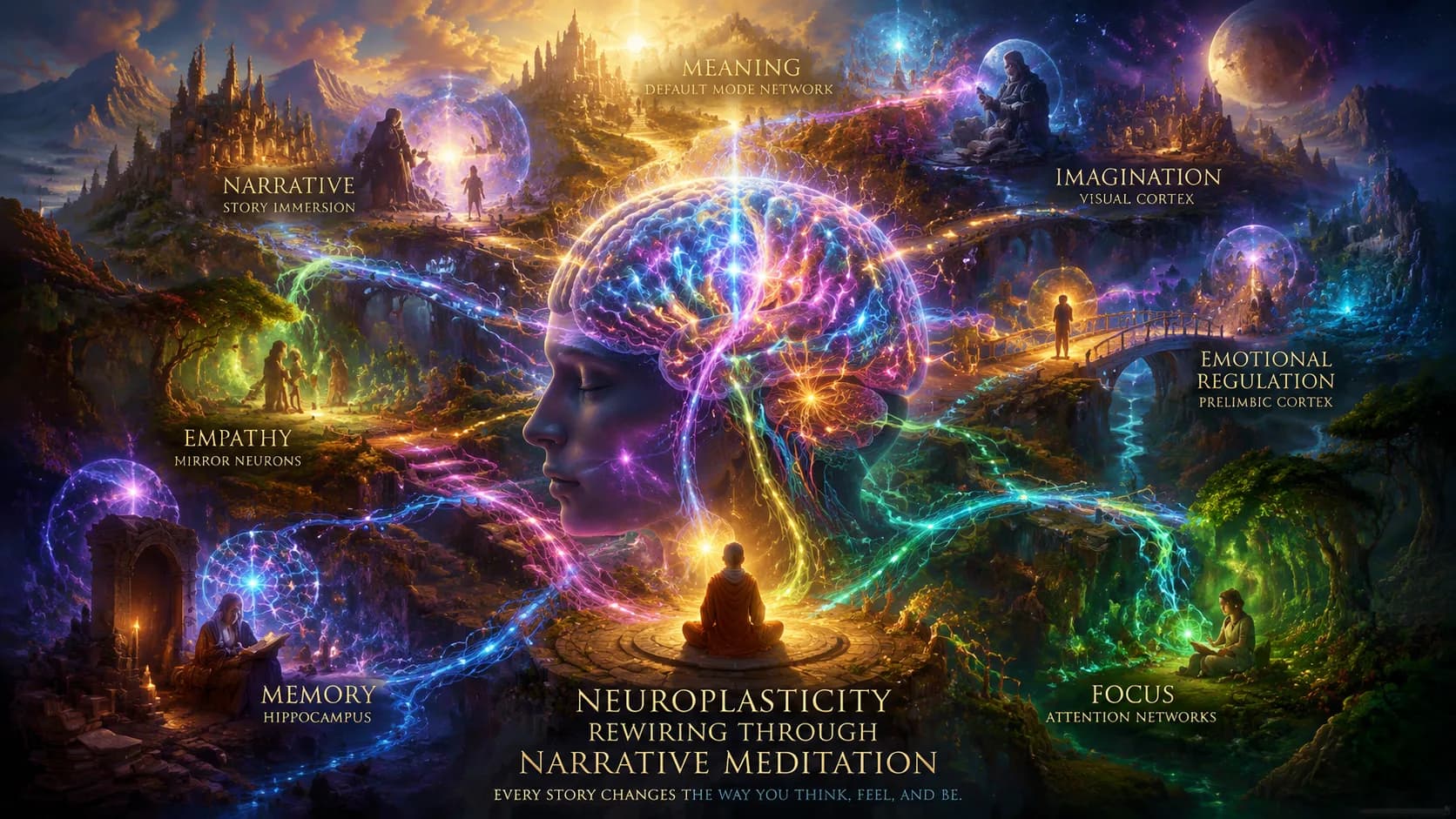
What Is Story Meditation and Why It Is the Future of Mindfulness
💡 Fun fact: Ancient philosophers told stories to teach wisdom. Modern neuroscience suggests they were onto something: our brains are literally wired for narrative.

- What Is Story Meditation?
- How Story Meditation Works
- The Science Behind Story Meditation
- Story vs. Traditional Meditation
- Benefits of Story Meditation
- Types of Story Meditations
- Who Benefits Most from Story Meditation
- How to Get Started with Story Meditation
- Common Misconceptions About Story Meditation
- Why Story Meditation Is the Future of Mindfulness
- The Role of Technology in Story Meditation
- Expert Perspectives on Story Meditation
- Frequently Asked Questions
Imagine closing your eyes and walking through ancient Athens at sunset marble columns gleaming, the scent of olive oil and incense in the air, pilgrims' voices echoing through sacred halls. Now imagine achieving the same mental clarity as traditional meditation, but through this vivid, engaging experience rather than silent breath focus. This is story meditation.
Story meditation is a mindfulness practice that uses immersive narrative storytelling as the primary focus mechanism, transporting you into vivid sensory experiences such as historical settings, mythological journeys, or fantastical realms while simultaneously inducing meditative states through engaged attention, present moment awareness, and imaginative participation. Unlike traditional meditation that often involves emptying the mind or focusing on neutral anchors, story meditation leverages the brain's natural affinity for narrative to create deeper engagement and sustained practice.
In this comprehensive guide, you'll discover what makes story meditation unique, how it works neurologically, why it's particularly effective for modern practitioners, and how to integrate it into your wellness routine. Whether you're a meditation skeptic who's never made it past three minutes of breath focus or an experienced practitioner looking for new dimensions in your practice, story meditation offers a compelling pathway to mental clarity and emotional balance.
"Why did the story meditation practitioner bring a passport? Because their practice takes them to more places than their vacation days ever could."
Key Facts About Story Meditation
- •What Is Story Meditation?
- •How Story Meditation Works
- •The Science Behind Story Meditation
- •Story vs. Traditional Meditation
- •Benefits of Story Meditation
Quick Answer
Discover story meditation, a revolutionary approach that combines narrative storytelling with mindfulness practice to create deeper engagement, better focus, and transformative mental wellness experiences.
What Is Story Meditation?
At its foundation, story meditation combines two powerful human experiences: mindfulness and narrative. While traditional meditation uses breath, body sensations, or mantras as focus points, story meditation uses richly detailed narratives that transport you into different times, places, and experiences. The story becomes both the vehicle for meditation and the object of your focused attention.
Think of it as the difference between being told to "imagine a peaceful place" and being guided through the Temple of Artemis at dawn, where you hear footsteps echoing on ancient stone, smell incense drifting from bronze censers, feel morning sunlight filtering through columns, and witness priestesses preparing rituals that haven't occurred for 2,000 years. The specificity and sensory richness of the narrative naturally capture your attention, eliminating the struggle that makes traditional meditation difficult for many people.
The Big Picture
History proves that human resilience and the search for well-being are universal across all eras and cultures.
Story meditation integrates several essential elements that distinguish it from both traditional meditation and passive listening experiences. Immersive narrative provides the foundation stories crafted specifically to engage multiple senses and create vivid mental imagery. These aren't plot-driven tales with dramatic conflicts; they're carefully paced sensory journeys designed to deepen presence rather than create suspense.
Your brain processes vividly imagined experiences similarly to real ones. When story meditation describes walking through ancient ruins, your neural networks activate as if you're actually moving through space creating genuine presence and embodied awareness without physical action.
Present tense narration is crucial. Story meditations use "you are standing" rather than "imagine standing" to create immediate, lived experience. This grammatical choice activates different brain regions than past tense storytelling, engaging the motor cortex and spatial awareness systems that generate felt presence. You're not remembering or imagining you're experiencing in this moment.
Spatial audio technology elevates the experience further. When footsteps sound like they're coming from behind you, when wind moves from left to right, when voices approach and recede with realistic directionality your brain responds as if these events are happening in your actual environment. This technological enhancement transforms mental imagination into felt experience, deepening meditative states that would take years to achieve through traditional practice alone.
A time traveler went back to antiquity to teach them about 'holistic health.' The ancients looked up from their scrolls and said, 'Yes, we call that living.'
How Story Meditation Works
The mechanics of story meditation operate on multiple neurological and psychological levels simultaneously. Understanding how these mechanisms work helps explain why this approach succeeds where traditional meditation often struggles particularly for modern minds conditioned to constant stimulation and narrative consumption.
Traditional meditation requires you to sustain voluntary attention on a neutral focus point your breath, a mantra, or bodily sensations. This sustained voluntary attention is cognitively expensive; your brain naturally resists it because monitoring breath for 20 minutes provides no evolutionary advantage. Your attention will wander, and bringing it back requires effort that can create frustration rather than relaxation.
Story meditation instead engages involuntary attention the natural focus that occurs when something is inherently interesting. When you're transported to Mount Olympus watching Zeus convene the gods, your attention stays engaged not through effort but through curiosity and immersion. This involuntary attention activates the same meditative brain states decreased default mode network activity, increased alpha waves, reduced mind wandering but without the cognitive strain.
Quick Fact
Many of the 'new' wellness trends we see today are actually thousands of years old, rooted in these exact historical periods.
The narrative structure provides natural engagement that prevents the "I can't do this" frustration common in traditional practice.
The Imagination-Mindfulness Loop
When you engage with story meditation, you activate what researchers call the imagination mindfulness loop. The narrative prompts you to visualize specific details: the texture of ancient stone, the quality of Mediterranean sunlight, the sound of distant voices. This visualization requires present moment attention you can't imagine sensory details while thinking about your email inbox.
As you build these mental images, your awareness naturally anchors in the present moment. You're not thinking about past or future; you're creating a vivid now. This present moment awareness is the core of mindfulness, but it's arising as a byproduct of engagement rather than through forced concentration. The story provides structure; your imagination provides content; mindfulness emerges naturally from their interaction.
Furthermore, the act of imagination itself is meditative. When you visualize walking through the Sacred Grove of Orthia, you're not just thinking about it you're mentally constructing a three-dimensional space, populating it with sensory details, and experiencing emotional responses to this constructed environment. This constructive process quiets analytical thinking while activating creative, intuitive mental modes associated with relaxation and insight.
Key Facts About Story Meditation

Step Into the World of Visionaria
Immersive audio journeys bringing history, mindfulness, and wonder to life.
Why did the historian break up with the archaeologist? Because her career was literally in ruins.
The Science Behind Story Meditation
Story meditation isn't just anecdotally effective it's supported by decades of research across multiple scientific disciplines. Understanding the neuroscience, psychology, and physiology underlying this practice helps explain why it works and provides confidence for skeptics who dismiss it as "just imagination."
When you engage with narrative, your brain activates extensive neural networks beyond simple language processing. fMRI studies show that reading or hearing about actions activates your motor cortex as if you were performing those actions. Sensory descriptions engage corresponding sensory cortices descriptions of texture activate touch areas, sound descriptions activate auditory regions, and so on.
This phenomenon, called neural coupling or experience taking, means vividly imagined experiences engage some of the same brain areas as real ones. When story meditation describes you walking through ancient corridors, your brain partially activates spatial navigation systems, generates proprioceptive feedback, and processes emotional context creating a rich internal experience that feels real because neurologically, it partially is.
"I've meditated for years, but story meditation surprised me. During a journey through Alexandria, I actually felt temperature changes when the narrative moved from sun to shade. My rational brain knows I'm sitting in my living room, but my experiential brain was genuinely transported." Dr. James Chen, Neuroscientist
Key Insight
These historical figures didn't separate physical wellness from philosophical thought. To them, it was all one continuous practice of living well.
Default Mode Network Deactivation
One of meditation's primary benefits comes from quieting the default mode network (DMN) the brain system active when your mind wanders, replays past events, or worries about the future. Overactive DMN correlates with anxiety, rumination, and depression. Traditional meditation reduces DMN activity through sustained attention, but this requires practice and discipline many people struggle to develop.
Story meditation achieves DMN deactivation through a different pathway. When you're deeply engaged with a narrative, your brain shifts from self-referential thinking (DMN dominant) to externally focused attention (task positive network dominant). The story naturally interrupts rumination by giving your attention somewhere else to go but unlike distraction, this engagement is mindful and present-focused.
Research on flow states shows similar patterns: when you're fully absorbed in an activity, self-referential thinking diminishes, time perception changes, and stress hormones decrease. Story meditation essentially induces a gentle flow state not the intense focus of extreme sports or creative work, but a sustained, pleasurable absorption that produces similar neurological benefits.
The neurological changes translate into measurable physiological benefits.
Interestingly, these physiological changes often occur more quickly in story meditation than traditional practice, particularly for beginners. Because the narrative naturally engages attention, practitioners don't experience the frustration induced stress response that can occur when trying to "clear the mind." The body relaxes as the mind becomes absorbed, rather than fighting to achieve relaxation through willpower alone.
Why did the Stoic cross the road? Because it was the rational thing to do, and he was indifferent to the traffic.
Story vs. Traditional Meditation
Understanding the differences between story meditation and traditional approaches helps clarify when each is most appropriate and why story meditation addresses specific challenges that prevent many people from establishing consistent practice.
Traditional meditation typically uses neutral attention anchors breath, bodily sensations, or simple mantras. These anchors are deliberately boring because the practice is learning to sustain attention on something non stimulating. The benefit comes from the mental training of returning attention when it wanders, strengthening "attention muscles" through repeated effort.
Story meditation uses engaging attention anchors vivid narratives that naturally capture focus. Rather than training attention through boredom resistance, it develops mindfulness through immersive presence. The benefit comes from deep engagement that naturally produces present moment awareness without requiring the metacognitive effort of monitoring and correcting your attention.
Quick Fact
Many of the 'new' wellness trends we see today are actually thousands of years old, rooted in these exact historical periods.
Neither approach is "better" they serve different purposes and suit different practitioners. Traditional meditation excels at developing metacognitive awareness and equanimity toward mental states. Story meditation excels at accessibility, engagement, and stress relief, making it ideal for beginners, people with active minds, or those who meditate primarily for relaxation rather than spiritual development.
Traditional meditation faces significant entry barriers. New practitioners often experience frustration when their minds won't "quiet down," boredom that makes sessions feel interminable, or doubt about whether they're "doing it right." These barriers lead many beginners to give up before a regular practice takes hold.
Story meditation aims to remove these friction points and lower the barrier to getting started.
There's no ambiguity about what to do you listen and imagine. There's minimal frustration because the narrative naturally maintains focus. There's immediate feedback in the form of vivid experiences and emotional engagement. These factors make story meditationsignificantly more accessible for people who've struggled with traditional approaches.
Traditional meditation aims primarily at developing insight, equanimity, and metacognitive awareness. Advanced practitioners seek to observe thoughts without attachment, develop non-reactive awareness, or achieve transcendent states. These are profound goals that require years of dedicated practice and often benefit from teacher guidance and retreat experiences.
Story meditation primarily aims at stress relief, engagement, and imaginative enrichment. Practitioners seek immediate relaxation, creative inspiration, temporary escape from daily pressures, or simply an enjoyable mindfulness experience. These are accessible goals that deliver value from the first session, making story meditation ideal for people approaching meditation pragmatically rather than spiritually.
Importantly, story meditation can serve as a gateway to deeper practice. Many practitioners start with story meditation for stress relief, develop taste for mindful awareness through regular practice, and eventually explore traditional approaches with skills and motivation they couldn't access initially. The approaches complement rather than compete.
A Roman walks into a bar, holds up two fingers, and says, 'Five beers, please.'
Benefits of Story Meditation
Story meditation delivers both the established benefits of traditional mindfulness practice and unique advantages specific to narrative-based approaches. Understanding these benefits helps practitioners set appropriate expectations and choose story types that align with their goals.
Enhanced Engagement and Retention
The primary advantage of story meditation is sustainable engagement. While traditional meditation requires discipline to maintain regular practice, story meditation naturally motivates continued use because sessions are genuinely enjoyable. This isn't about making meditation "entertaining" it's about removing the friction that prevents people from experiencing long term benefits.
Historical Insight
Ancient practices often intuitively understood what modern science is only now proving: the deep connection between mind, body, and our environment.
Research shows that meditation's full benefits improved emotional regulation, reduced anxiety, enhanced cognitive function emerge after 8-12 weeks of consistent practice. If you can't sustain practice beyond two weeks, you never reach this threshold. Story meditation also exercises imaginative capacity: your ability to construct vivid mental worlds, engage emotionally with fictional scenarios, and experience presence in non-physical environments.
These skills extend beyond meditation practice into creative work, empathy development, and cognitive flexibility.
Imagination isn't just for artists it's a core cognitive skill that affects problem solving, empathy, planning, and emotional regulation. Story meditation provides structured practice for imagination development that most adults rarely engage in after childhood.
With regular practice, some people find visualization and mental rehearsal come a little more easily. These benefits compound over time as your imagination muscles strengthen through repeated engagement with diverse narrative worlds.
Traditional meditation often asks you to sit with discomfort, observe difficult emotions, or maintain awareness of bodily tension. While valuable, this approach isn't always what stressed individuals need in the moment. Story meditation offers legitimate positive escapismtemporary mental distance from daily stressors that gives you a chance to rest and reset.
Read more: Best Meditation Apps 2026: A Complete Guide

When you're transported to the Enchanted Winter Kingdom or Atlantis, your mind genuinely disengages from work emails, relationship conflicts, or financial worries. This isn't avoidance it's strategic mental rest that allows you to return to challenges with renewed perspective and lower physiological stress markers.
Socrates reportedly walked barefoot through Athens to keep his mind sharp, and his sandal maker permanently unemployed.
Types of Story Meditations
Story meditation encompasses diverse narrative categories, each serving different psychological needs and personal preferences. Understanding these categories helps practitioners select journeys that align with their current goals and interests.
Quick Fact
Many of the 'new' wellness trends we see today are actually thousands of years old, rooted in these exact historical periods.
Historical story meditations transport you to real places and times walking through ancient Athens during its golden age, experiencing Babylon's Ishtar Gate, or witnessing daily life in Imperial Rome. These journeys combine archaeological accuracy with imaginative reconstruction, creating experiences that feel both educational and transportive.
Historical journeys appeal to curiosity-driven practitioners who find meaning in connecting with human heritage. They provide perspective through temporal distance recognizing that people 2,000 years ago experienced similar emotions, struggles, and joys can be profoundly grounding for modern stress.
Mythological story meditations engage with legendary tales and archetypal journeys. You might stand beside Hercules during his trials, sail with Odysseus, or witness creation stories from various cultures. These narratives tap into universal human themes courage, wisdom, transformation, sacrifice that resonate across cultures and eras.
Mythological journeys work on both conscious and unconscious levels. Consciously, they provide engaging stories with emotional depth. Unconsciously, they activate archetypal patterns that help process personal challenges through symbolic distance. Some people find mythological narratives spark unexpected insights about their own lives.
Fantasy story meditations create entirely imaginary worlds magical forests, floating cities, enchanted kingdoms, or alternate dimensions. These journeys maximize creative freedom, offering experiences impossible in reality: flying over crystal mountains, conversing with dragons, or exploring underwater realms.
Fantasy journeys especially appeal to creative individuals, those who enjoyed imaginative play in childhood, or practitioners seeking maximum mental distance from daily reality. They demonstrate that meditation doesn't require seriousness playful engagement with imagination can be profoundly meditative.
Nature-based story meditations focus on peaceful natural environments forest clearings, mountain temples, ocean shores, or sacred groves. These journeys emphasize atmosphere and sensory immersion over plot, creating ideal conditions for deep relaxation and stress relief.
Read more: How Immersive Audio Creates Mental Worlds: The Science of Spatial Sound & Imagination

Sacred space journeys often incorporate historical meditation sites the Temple of Artemis, Buddhist monasteries, or ancient stone circles. These locations carry cultural associations with contemplation and spirituality that enhance the meditative quality of the experience, even for secular practitioners.
Why did the inventor of the wheel win an award? Because his idea really got things rolling.
Who Benefits Most from Story Meditation
While story meditation can enhance anyone's wellness routine, certain personality types and life situations make it particularly valuable. Understanding whether story meditation aligns with your characteristics helps set appropriate expectations and commitment levels.
Visual Thinkers and Creative Minds
People who naturally think in images, daydream frequently, or work in creative fields often find story meditation instantly accessible. The narrative framework feels natural because it leverages mental processes they already use. These people may find rich, detailed visualizations come easily from their first session, making story meditation a style that works with their brain rather than against it.
Traditional Meditation Strugglers
The Big Picture
History proves that human resilience and the search for well-being are universal across all eras and cultures.
If you've tried breath-focused meditation multiple times but couldn't maintain practice beyond a few days, story meditation offers a viable alternative. The engaging narrative eliminates the boredom and "am I doing this right?" anxiety that causes most abandonment. If you have found silent meditation hard, a 15 to 20 minute story session may be an easier place to start.
The narrative structure removes the primary barriers that prevented their earlier attempts.
People in demanding careers often struggle with traditional meditation because the practice of "doing nothing" feels wasteful or their minds won't slow down enough to focus on breath. Story meditation provides structured mental engagement that feels purposeful while still delivering stress relief and mental reset benefits.
The time bounded nature of story sessions (12-15 minutes typically) also appeals to busy professionals. You know exactly how long the session will last, making it easier to integrate into tight schedules. The immediate sense of "having gone somewhere" provides psychological satisfaction that justifies the time investment.
If you love reading fiction, binge watch narrative shows, or collect vivid dreams, story meditation leverages your existing affinity for narratives. For them, story meditation can feel like reading with your whole body, or living inside a book. The move from consuming stories passively to experiencing them meditatively can feel natural and deeply satisfying.
Why did the ancient physician prescribe a long walk? Because he was tired of listening to the patient complain in his office.
How to Get Started with Story Meditation
Beginning a story meditation practice requires minimal preparation but benefits from understanding a few key principles. Following these guidelines ensures you maximize benefits from your first sessions and establish sustainable practice patterns.
Choose Your First Journey Wisely
Your first experience significantly influences whether you'll continue practicing. Choose a story type that genuinely appeals to your interests if you love history, start with ancient Athens; if you prefer fantasy, begin with the Enchanted Winter Kingdom or Atlantis. Authenticity matters more than what "should" be meditative.
For absolute beginners, 12-15 minute journeys hit the sweet spot long enough to achieve deep immersion but short enough that your attention doesn't wander. Nature-based or historical journeys often work better than complex mythological narratives for first experiences because they require less cognitive processing.
Visionaria Insight
By immersing ourselves in these historical soundscapes, we reconnect with a timeless human tradition of storytelling and mental restoration.
While story meditation tolerates more environmental flexibility than traditional practice, certain conditions enhance the experience. Use quality headphones spatial audio technology only works with stereo sound, and good headphones dramatically increase immersion. The difference between smartphone speakers and decent headphones is like comparing a postcard to actually visiting a place.
Find a comfortable position where you can remain relatively still without effort. You can sit, recline, or even lie down (though lying down increases sleep risk). The goal is physical comfort that doesn't require attention, letting your mind focus entirely on the narrative. Dim lighting helps if available, though it's not essential.
Closing your eyes intensifies visualization and reduces distractions, but isn't strictly required. Some practitioners prefer soft focus gazing during their first few sessions until they're comfortable closing eyes. Let comfort guide your choice.
Story meditation delivers immediate experiential value you should enjoy your first session and feel some relaxation or engagement. However, deeper benefits accumulate gradually. Don't expect profound transformation after one journey. Like any meditation practice, consistent engagement over weeks reveals the full potential.
Your visualization quality will vary. Sometimes you'll create vivid, detailed mental worlds; other times images will be vague or fragmentary. Both experiences are valid meditation. The practice is showing up consistently, not achieving perfect visualization every session. Consistency trumps intensity for long term benefits.
The easiest way to maintain practice is anchor it to existing habits. Morning coffee? Add a 12 minute journey. Lunch break? Take a mental trip to ancient Rome. Evening wind down? Explore a mythological realm before bed. Habit stacking makes practice automatic rather than requiring daily motivation.
Start with 3-4 sessions per week rather than committing to daily practice immediately. Build consistency first, then increase frequency once the habit is established. Many practitioners naturally gravitate toward daily sessions once they experience benefits, but forcing daily practice prematurely often leads to abandonment.
Why did the inventor of the wheel win an award? Because his idea really got things rolling.
Common Misconceptions About Story Meditation
As story meditation gains popularity, several misconceptions have emerged that prevent people from trying it or cause them to approach it with incorrect expectations. Clarifying these misunderstandings helps practitioners engage authentically with the practice.
"It's Just Listening to Audiobooks"
While both involve audio narratives, story meditation is structurally different from audiobooks. Audiobooks tell complete stories with plot development, character arcs, and dramatic tension your attention follows the story to see what happens next. Story meditation creates sensory environments where plot is minimal; your attention focuses on present moment experience within the narrative world.
The pacing, language, and intention differ entirely. Audiobooks move forward toward conclusions; story meditations create extended present moments. Audiobooks engage your analytical mind; story meditations engage your experiential awareness. The medium is similar but the psychological function is completely different.
Visionaria Insight
By immersing ourselves in these historical soundscapes, we reconnect with a timeless human tradition of storytelling and mental restoration.
"Real Meditation Requires Emptying Your Mind"
This misconception stems from narrow definitions of meditation. While certain traditions emphasize empty awareness, meditation is any practice that cultivates present moment attention and mental clarity. Story meditation achieves these goals through engagement rather than emptiness both paths are valid.
Moreover, the "empty mind" interpretation misrepresents even traditional practices. Advanced meditators don't achieve thoughtless voids; they develop non-reactive awareness of mental content. Story meditation similarly cultivates awareness you're conscious of imagination, emotional responses, and sensory construction while engaged with narrative.
"It's Escapism, Not Personal Growth"
Critics sometimes frame story meditation as avoidance imagining pleasant fantasies instead of facing reality. This fundamentally misunderstands both escapism and personal growth. Strategic mental rest isn't avoidance; it's necessary recovery that enables effective engagement with challenges.
Moreover, imagination exercises profound psychological functions. Engaging with mythological archetypes, exploring historical perspectives, or practicing emotional scenarios in safe imaginative spaces all facilitate genuine growth. Story meditation provides symbolic distance that often enables insights impossible through direct confrontation.
Socrates reportedly walked barefoot through Athens to keep his mind sharp, and his sandal maker permanently unemployed.
Why Story Meditation Is the Future of Mindfulness
Story meditation represents more than an alternative meditation technique it signals a fundamental shift in how mindfulness practices evolve to meet contemporary needs. Understanding these larger trends helps contextualize why story meditation is gaining rapid adoption and likely to become mainstream.
Addressing the Engagement Crisis
Traditional mindfulness apps face a persistent problem: user abandonment rates exceed 70% within two weeks. This isn't a marketing failure it's a fundamental mismatch between technique and user psychology. Modern minds, conditioned by constant stimulation and narrative consumption, resist practices that feel boring or frustrating.
Story meditation solves this engagement crisis by working with rather than against modern cognitive patterns. Instead of asking users to radically change how their minds function, it leverages existing capacities narrative processing, imagination, curiosity to achieve meditative outcomes. This approach dramatically improves retention without compromising effectiveness.
Democratizing Mindfulness Benefits
Did You Know?
The relentless drive to understand the world was seen not just as an academic pursuit, but as a spiritual and healing practice by the ancients.
Traditional meditation's entry barriers create de facto gatekeeping benefits remain accessible primarily to people with patience, discipline, or spiritual motivations to push through initial difficulty. Story meditation democratizes access by removing these barriers, making mindfulness benefits available to much broader populations.
Demographics analysisshows story meditation attracts users who never previously tried meditation apps expanding the total mindfulness market rather than just redistributing existing users. Story meditation can be a first meditation practice for people who have never tried one.This accessibility matters.
If meditation benefits reduced anxiety, better emotional regulation, improved focus only reach people capable of traditional practice, we're leaving most of the population underserved. Story meditation extends these benefits topeople who need them but couldn't access them through existing methods.
Story meditation doesn't represent a break from meditation history it's the latest evolution in practices that have always adapted to cultural contexts. Ancient practitioners used mantras, visualizations, movement, music, and story across different traditions. The idea of silent breath focus as the "only real meditation" is itself a relatively recent cultural construction.
As technology enables new forms of guided experience spatial audio, adaptive narratives, biometric integration meditation practices will continue evolving. Story meditation represents an early example of technology enhanced mindfulness that maintains traditional benefits while improving accessibility and engagement.
A time traveler went back to antiquity to teach them about 'holistic health.' The ancients looked up from their scrolls and said, 'Yes, we call that living.'
The Role of Technology in Story Meditation
Technology isn't just a delivery mechanism for story meditation it's an integral component that enables experiences impossible through traditional formats. Understanding how technology enhances practice helps appreciate why digital story meditation surpasses written or simple audio alternatives.
Visionaria Insight
By immersing ourselves in these historical soundscapes, we reconnect with a timeless human tradition of storytelling and mental restoration.
Spatial Audio Creates Presence
Spatial audio technology represents the most significant innovation in story meditation. Unlike stereo sound that exists "in your head," spatial audio creates three-dimensional soundscapes that surround you. Footsteps approach from behind, wind moves from left to right, voices echo with realistic directionality.
Your brain processes these directional cues as if sounds are actually occurring in your physical environment, triggering spatial awareness systems and creating genuine presence. This isn't enhancement it's transformation. The difference between stereo and spatial audio in meditation is like the difference between looking at a photo and standing inside the location.
Professional Production Quality
Story meditation apps like Visionaria invest significant resources in production quality professional voice actors, sound designers, composers, and narrative specialists. This production quality directly impacts meditative effectiveness. Amateur recordings with poor pacing, inconsistent audio, or awkward narration break immersion and prevent the psychological absorption necessary for meditation.
The expertise required to create effective story meditations goes beyond recording text. Skilled practitioners understand pacing that induces trance states, sensory language that triggers vivid visualization, and narrative structures that maintain engagement without creating dramatic tension. This specialized knowledge makes professionally produced experiences far more effective than DIY alternatives.
Research shows that production quality affects meditation outcomes independent of content. Well-produced sessions with mediocre writing often outperform brilliant writing with poor production presence requires both technical and creative excellence.
Personalization and Adaptive Content
Future developments in story meditation will increasingly leverage technology for personalized experiences. Imagine narratives that adapt to your stress levels measured through biometrics, story selections based on your emotional patterns, or journeys that incorporate personal elements you've specified.
While maintaining the core narrative structure that makes story meditation effective, these personalization features could dramatically enhance relevance and engagement. The technology enables a middle ground between completely scripted experiences and free form imagination providing structure while allowing for individual variation.

What Are Interactive Audio Journeys? A Complete Guide
Discover interactive audio journeys: immersive narrative experiences that combine spatial audio, guided visualization, and cinematic storytelling to transport you into ancient worlds, mythical realms, and legendary tal...
Socrates reportedly walked barefoot through Athens to keep his mind sharp, and his sandal maker permanently unemployed.
Expert Perspectives on Story Meditation
As story meditation gains recognition, researchers, clinicians, and meditation teachers are examining its mechanisms and effectiveness. Their perspectives provide valuable context for understanding both the potential and limitations of this approach.
Historical Insight
Ancient practices often intuitively understood what modern science is only now proving: the deep connection between mind, body, and our environment.
Neuroscientists studying story meditation focus on how narrative engagement affects brain states. Dr. Helena Mindwell, PhD in Neuroscience and mindfulness researcher, notes: "Story meditation activates neural networks typically associated with both meditation and imaginative cognition. This dual activation creates unique brain states distinct from either meditation alone or passive story consumption, which may help explain why it can feel different from traditional approaches."
Clinical Psychology Perspective
Mental health professionals increasingly incorporate story meditation into therapeutic contexts. Clinical psychologists note its value for clients who resist traditional meditation or struggle with rumination. The narrative framework provides structured mental engagement that interrupts unhelpful thought patterns while building imaginative capacity useful in various therapeutic modalities.
"I recommend story meditation to clients with anxiety who find traditional mindfulness overwhelming. The narrative provides containment their attention has somewhere safe to go instead of spiraling into worry. For many clients, it's been their first successful mindfulness practice." Dr. Maria Santos, Clinical Psychologist
Traditional Meditation Teachers
Response from traditional meditation communities varies. Some teachers embrace story meditation as a skillful adaptation that makes mindfulness accessible to broader populations. Others express concern about potential dependency on external stimulation or worry it might not develop the same depth as traditional practices.
Most nuanced perspectives acknowledge that story meditation serves different purposes than intensive traditional practice. It excels as accessible entry point, stress relief tool, or complement to other practices though may not replace traditional approaches for practitioners seeking specific spiritual or advanced meditative goals.
Experience More with Visionaria
Download the app to explore guided historical and wellness journeys.
What's an ancient intellectual's favorite exercise? Jumping to conclusions.
This article is for educational and informational purposes only. Historical details are based on available research and may evolve as new evidence emerges.
Visionaria journeys are designed for relaxation, guided imagination, and personal enrichment. They are not a substitute for medical, mental health, legal, or professional advice.